
It’s 11:47 p.m. You’ve just submitted your ERAS. You applied to 120 programs. Your email is empty. Your friends are posting their first interview invites in the group chat, and you’re staring at your application list wondering which of these places will actually read what you wrote.
Here’s the reality most people will not say out loud: a huge number of programs will never truly “review” your application.
Not because you’re an IMG in some vague, abstract way. Because you tripped a hidden filter. An unspoken cutoff. A quiet rule they do not put on their website, don’t state on their FREIDA profile, and often will lie about when asked directly on Zoom open houses.
I’ve watched this from the inside. PD meetings. Selection committee huddles. Coordinators running filters in ERAS while attendings go back to clinic and “trust the process.”
Let me walk you through what actually happens.
How Programs Really Screen IMGs (Not the Story They Tell You)
Publicly, programs talk about “holistic review.” They say they “consider all aspects” of your application.
Behind the scenes, it usually starts like this: the PD or APD walks into the coordinator’s office and says something like, “We have 4,000 applications. I need that list down to 400 by next week. Do the usual filters.”
“The usual filters” is where most IMGs die.
The coordinator opens ERAS. Clicks a few boxes. Sets a few numeric cutoffs. And in 30 seconds, half to two-thirds of the list disappears.
No one reads those deleted files. No one looks at your PS, your LORs, your research, your awards. You’re gone because the system never generated your name on a review spreadsheet.
For IMGs, the “usual filters” are much harsher than for US MDs. Programs don’t like to say this out loud, but when they’re pressed in closed meetings, they admit it.
Do all programs use aggressive filters? No. But enough do that if you ignore them, you’ll waste your money and time and end up with 0–2 interviews wondering what went wrong.
Let’s break down the real filters.
Filter #1: Degree Type and Country – the First, Quiet Wall
Before scores, before anything else, many programs hit you with a simple, brutal sort: who you are and where you trained.
The unspoken hierarchy most PDs use looks roughly like this (even if they won’t admit it in public):
| Tier | Category |
|---|---|
| 1 | US MD |
| 2 | US DO (varies by specialty) |
| 3 | US citizen/GC IMG (top countries) |
| 4 | Non-US citizen IMG (same schools) |
| 5 | Other IMGs |
Within the IMG group, they create mental “tiers” of schools and countries. Nobody writes this down. But they use it.
I’ve heard variations of all of these:
- “We’ll consider IMGs from Ireland, UK, Australia, or top Caribbean. Nothing else unless they’re exceptional.”
- “Filter to US grads, then US IMGs, then only IMGs from X, Y, Z schools we know.”
- “We’ll look at IMGs only if they’re US citizens or green card holders.”
Do they ever state this in FREIDA? Almost never.
What this means for you:
If you trained in a less-known country or newer school, you’re playing on hard mode from the first click. You cannot play the same game as a UK grad or an Irish grad. You need to be surgical with where you apply and assume you’re being filtered unless proven otherwise.
Programs that commonly run a country/school filter before anything else:
- Small community programs drowning in apps with 1–2 people doing all screening
- Mid-tier university programs in competitive locations
- Programs that have been “burned” (their word) by weak prior IMG residents
They justify it by saying, “We don’t know the clinical training quality from those schools.” Translation: they don’t want to invest the time to find out.
Filter #2: USMLE/Step Scores – The Real IMG Cutoffs
You’ve heard “we don’t have a hard cutoff.” That’s technically true in the sense that nobody prints it on a brochure. But on ERAS, they absolutely use numeric thresholds.
And for IMGs, the bar is usually higher.
Here’s roughly how it plays out in common specialties like internal medicine, family medicine, pediatrics, neurology, and psych.
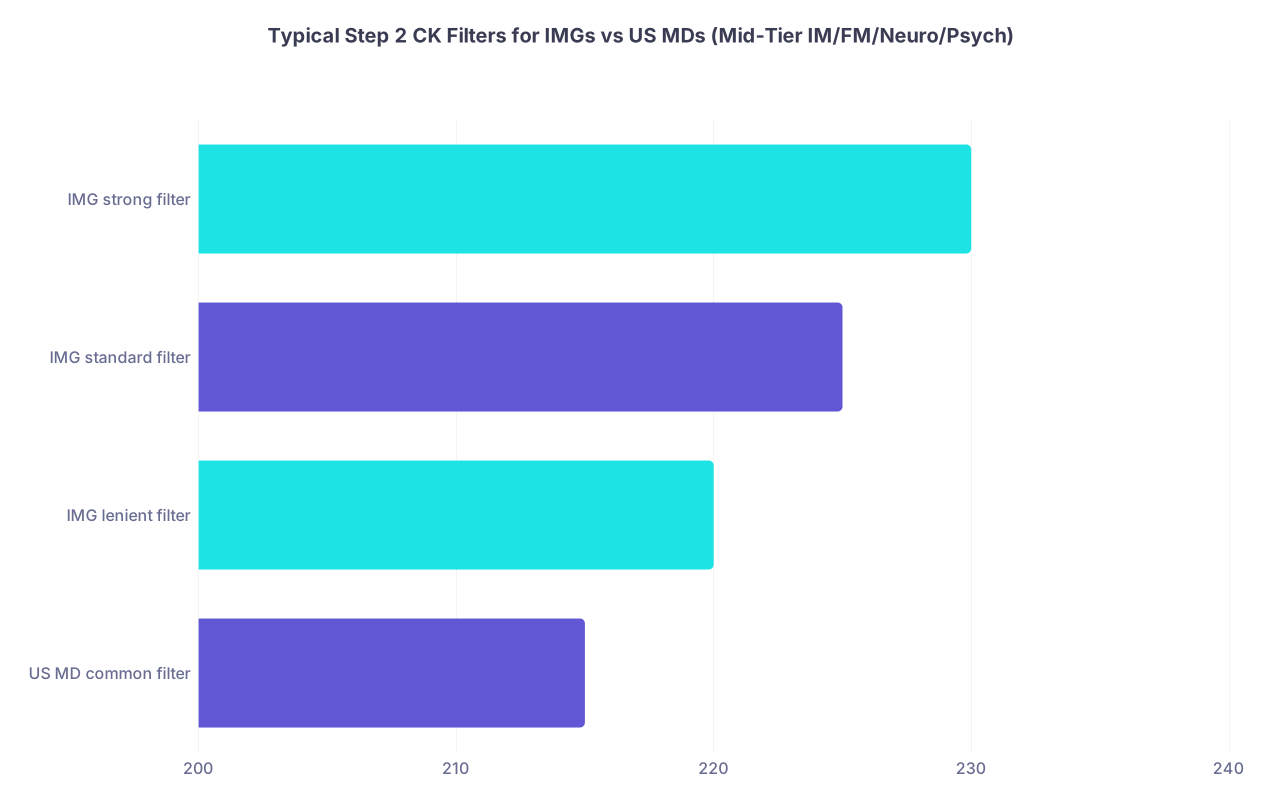
| Category | Value |
|---|---|
| US MD common filter | 215 |
| IMG lenient filter | 220 |
| IMG standard filter | 225 |
| IMG strong filter | 230 |
What I’ve seen repeatedly:
- US MDs get through with 210–215, sometimes less in non-competitive places.
- IMGs often need 225+ to avoid an auto-reject at many mid-tier university and solid community programs.
- Some programs use 230+ for IMGs if they’re overwhelmed with strong applicants.
And this is post-Step 1 pass/fail era. Step 2 CK is now the main numeric weapon.
Do some FM and lower-resourced IM programs go lower? Yes. I’ve seen:
- IMG filters around 215–220 in less desirable locations (rural, small town, non-coastal).
- Programs that say “no cutoff,” but when pressed admit, “We rarely interview IMGs under 220 unless they’re local or we know them.”
Where it gets truly vicious for IMGs:
- Any score < 210
- Any attempt failure (even with a later high score)
- Big gap between attempts
“I’ll just explain it in my personal statement” does not fix this for most places. Filters are blind to explanations.
PDs think in tiers here, even if they don’t say the numbers out loud:
- 235+ (IMG): “Strong applicant, can compete almost anywhere non-elite.”
- 225–234: “Workable, especially if other boxes are checked.”
- 215–224: “Borderline, needs something extra – USCE, connections, niche location.”
- <215: “Only programs with very mild screening or extreme need will look.”
You might find a program that screens lower. But as a strategy, banking on exceptions is how people end up unmatched.
Filter #3: YOG and Time Since Graduation – The Silent Age Bias
Programs rarely say this plainly, but I’ve heard it behind closed doors many, many times:
“We don’t want people more than 5 years out from graduation.” “Filter out IMGs older than 3 years unless they’ve done US training.”
Here’s the mental model they’re using: the longer you’ve been out, the “rustier” you are. Whether that’s fair or not is irrelevant. It’s how they think.
Typical unspoken YOG filters for IMGs:
- Many university IM programs: YOG within 3–5 years
- Competitive specialties (radiology, derm, anesthesia, etc.): 0–3 years
- Community FM/IM/psych: 5–10 years sometimes, especially if you’ve been clinically active
I’ve literally watched a coordinator apply: “Year of graduation ≥ 2017” for the current cycle and hide everyone else from the list. Gone. No human eyes.
There’s also a hidden interaction here: older grad + low score = near-certain auto-reject at most places.
If you’re 8–10+ years out:
- You must target programs with a history of taking older grads.
- You need clear recent clinical experience, ideally in the US.
- You cannot just apply “broadly” and hope the volume will save you. Volume does not beat filters.
Filter #4: Citizenship and Visa Status – The Tab They Don’t Show You
This one is brutally simple. There’s a checkbox in ERAS: “Requires visa” or some variation of that.
A lot of programs tick “US citizens & permanent residents only” before they even get to Step scores.
They often deny this publicly. On their website they say, “We sponsor J-1 visas” because GME as an institution does. But the program itself may quietly avoid FMGs requiring visa because they:
- Don’t want the paperwork
- Had a past visa delay mess up their schedule
- Believe non-visa candidates are a lower risk
Behind closed doors I’ve heard:
“Filter out everyone needing visa; we don’t have the bandwidth this year.” “Only show me J-1 candidates, no H-1Bs – we can’t afford the cost.”
If you need a visa, your realistic program pool shrinks dramatically. And it shrinks again if you’re looking for H-1B specifically.
Rough reality:
- J-1 only: a decent number of programs, but they still often raise other filters (scores, YOG) for visa candidates.
- H-1B: small fraction of programs, highly competitive, often require very strong Step 2 CK.
Do some IMGs on visas match anyway? Of course. But they weren’t playing blind. They targeted programs that explicitly and consistently sponsor visas and often had an inside edge (US clinical experience at that exact site, faculty connection, or very strong scores).
Filter #5: US Clinical Experience – The “Not Required” Requirement
You’ve seen this line on websites:
“US clinical experience preferred but not required.”
For IMGs, this often means: if you don’t have USCE, you’ll probably be filtered out once we’re overwhelmed with applications from people who do.
I’ve seen selection spreadsheets with a column: “USCE Y/N, Duration.”
In some places, the PD explicitly tells the coordinator: “Sort by USCE months, then scores.” That single choice changes who gets seen.
Common hidden rules for IMGs:
- No USCE at all: many mid-tier and above programs quietly deprioritize or auto-drop.
- Only observerships: borderline. Some PDs don’t count these as real clinical work.
- Hands-on USCE (sub-I, elective, externship, US residency, or hospital-based experience): strong plus, sometimes used as a semi-filter.
And here’s the ugly truth: many programs don’t trust LORs from abroad. A strong US LOR from a known academic or respected clinician often works as your entry pass.
I’ve heard this said almost verbatim in a resident selection meeting:
“We have plenty of people with US letters. Why take a chance on someone whose only references are from overseas?”
Is it fair? No. Is it happening? Yes.
Filter #6: Gaps, Failures, and “Weird” Paths
Programs love a “clean story.” Graduated recently, passed everything the first time, no unexplained gaps.
For IMGs, any deviation gets magnified.
Here’s how these get used:
- Step 1 or 2 failure: many programs use blanket filters – “No failed attempts.” The coordinator literally clicks a box.
- Long gaps between graduation and application with no clinical work: auto-suspicion and often auto-reject.
- Long US research fellowships with no clinical exposure: some PDs interpret this as “they couldn’t get clinical work” unless the research is obviously strong and supervised by big names.
You might have perfectly good reasons for your gap: family illness, financial issues, military service. Some programs will listen. But many will not see your explanation because the filter got you first.
If you’ve failed an exam or have a gap, your best route is not to pretend it doesn’t exist. It’s to overwhelm the risk with:
- Higher subsequent scores
- Clear, continuous clinical work
- Strong, specific LORs from US attendings who explicitly address your reliability and performance
The Hidden Combined Filters: Where IMGs Quietly Disappear
Here’s what most applicants don’t realize: programs don’t usually apply just one filter. They stack them.
A common real-world example at a mid-tier academic IM program might look like this behind the scenes:
- Exclude DO-Not-Sponsor-Visa candidates if they don’t want visa hassle this year.
- Filter out YOG > 5 years for IMGs.
- Filter IMGs with Step 2 CK < 225.
- Sort remaining by USCE months and preference “known” schools or countries.
If you’re:
- 7 years out
- 221 Step 2 CK
- Need a J-1
- No USCE
You’re dead before anyone clicks your PDF.
That’s how IMGs end up applying to 150 programs and getting 1–2 interviews total. Not because “the match is random” but because 80% of their list was fundamentally misaligned with these combined filters.
How to Read Between the Lines and Find Your Real Program Pool
This is the part most people never learn: your effective application list is not the number you type into ERAS. It’s the number of programs where you actually survive the filters.
You find those by doing what 90% of IMGs are too exhausted to do: pattern hunting.
Here’s what insiders and savvy IMGs actually do:
Go to individual program websites and resident lists.
- How many IMGs?
- What schools and countries?
- What graduation years?
- Any older grads or are they all 0–3 years out?
Look at visa history, not just what the site claims.
- Filter residency rosters for obviously non-US names and check their citizenship/visa where possible (LinkedIn, institutional profiles).
- If you see multiple H-1Bs or many J-1s across years, they’re truly visa-friendly.
- If they say “we sponsor” but their last 5 years’ residents are 100% US MD/DO, you have your answer.
Use resident biographies to reverse-engineer score expectations.
Residents sometimes post “interests: medical education, Step 1 tutoring” or brag about AOA, high scores, etc. The overall profile gives you a sense of how competitive their typical resident is.Email smart, specific questions (or ask on open houses) and listen to what they dodge.
- If they refuse to answer questions about typical Step scores but say “we’re very competitive,” assume higher filters.
- If they keep repeating “we don’t have a cutoff” and then add “but we receive 4,000 applications,” that’s code for “yes, we filter aggressively but won’t say it.”
You’re not looking for official policies. You’re mapping their actual behavior.
Strategic Application: Matching to the Filters You Can’t See
You can’t control what filters programs use. You can control whether you’re applying to the right types of programs for your profile.
Let’s take a concrete scenario.
Say you’re an IMG with:
- Step 2 CK: 224
- YOG: 2019
- Needs J-1
- 3 months hands-on USCE
- No failures
Here’s how most applicants like you blow up their season: they apply to 200 programs, including tons of mid- to high-tier university IMs in big cities and coastal states. Maybe 30–40 of those will realistically look at them. The rest will kill them at YOG, score, or visa filters.
A smarter play:
- Focus on community IM/FM/psych in Midwest, South, non-coastal Northeast that historically take IMGs and visas.
- Prioritize programs with current residents from your grad year range (2018–2020) and visa holders.
- Include some lower-profile university-affiliated community programs rather than flagship academic centers.
You don’t need 200 programs if 150 of them will instantly filter you out. You need 60–80 where your file actually opens and gets seen.
That’s the game.
Two Things Programs Rarely Filter On (But IMGs Worry About)
A quick twist: there are areas IMGs obsess over that, in the first filter pass, often barely register.
Research:
Outside of competitive specialties and top-tier academic programs, most places do not filter on research. They may use it as a plus once you’re in the final pile, but I’ve never seen a small IM program tell the coordinator, “Filter out anyone with fewer than X publications.”
Personal statement quality:
No one runs a filter on this. Is it read? Sometimes. Often quickly. But it’s not part of the automation. The PS won’t save you from bad filters, but it can hurt you later if it’s a mess. Still, it’s a second-stage problem.
How This Actually Looks Inside a Program
Let me give you a rough snapshot of what a real cycle looked like in one IM program I know:
- ~4,200 total applications
- ~2,600 IMGs
They applied initial filters:
- Only J-1 or no visa needed (H-1B off the table that year): ~2,000 left
- YOG ≤ 5 years for IMGs: down to ~1,400
- Step 2 CK ≥ 225 for IMGs: ~800
- At least 1 month USCE: ~600
- Manual removal of some schools they “haven’t had good experiences with” (their phrasing): ~500
From 2,600 IMGs to 500 before anyone really read an application.
Then the faculty reviewers each got spreadsheets of 80–100 names post-filter.
If you weren’t in that 500, you never existed to them. That’s what you’re up against.
The Only Rational Way to Approach This as an IMG
You can’t wish away the filters. You can’t argue them away. You can’t send an email to the PD hoping they’ll override the system for you. Ninety-five percent of the time, they won’t.
Your leverage points are different:
- You build a profile that survives the most common filters: recent enough YOG, as strong a Step 2 CK as you can possibly achieve, at least some meaningful USCE, and no unnecessary gaps.
- You pick targets that historically take people like you, not people completely unlike you.
- You stop pretending all programs are equally realistic and start thinking like a cold strategist, not a hopeful applicant.
If you’re already “off-norm” (older grad, lower score, visa need, no USCE), your response has to be equally aggressive on the other side: more focused research on programs, more networking, more willingness to go where others don’t want to go geographically.
You’re not trying to convince every PD to love you. You’re trying to find the 20–30 who will actually let your file through their wall.
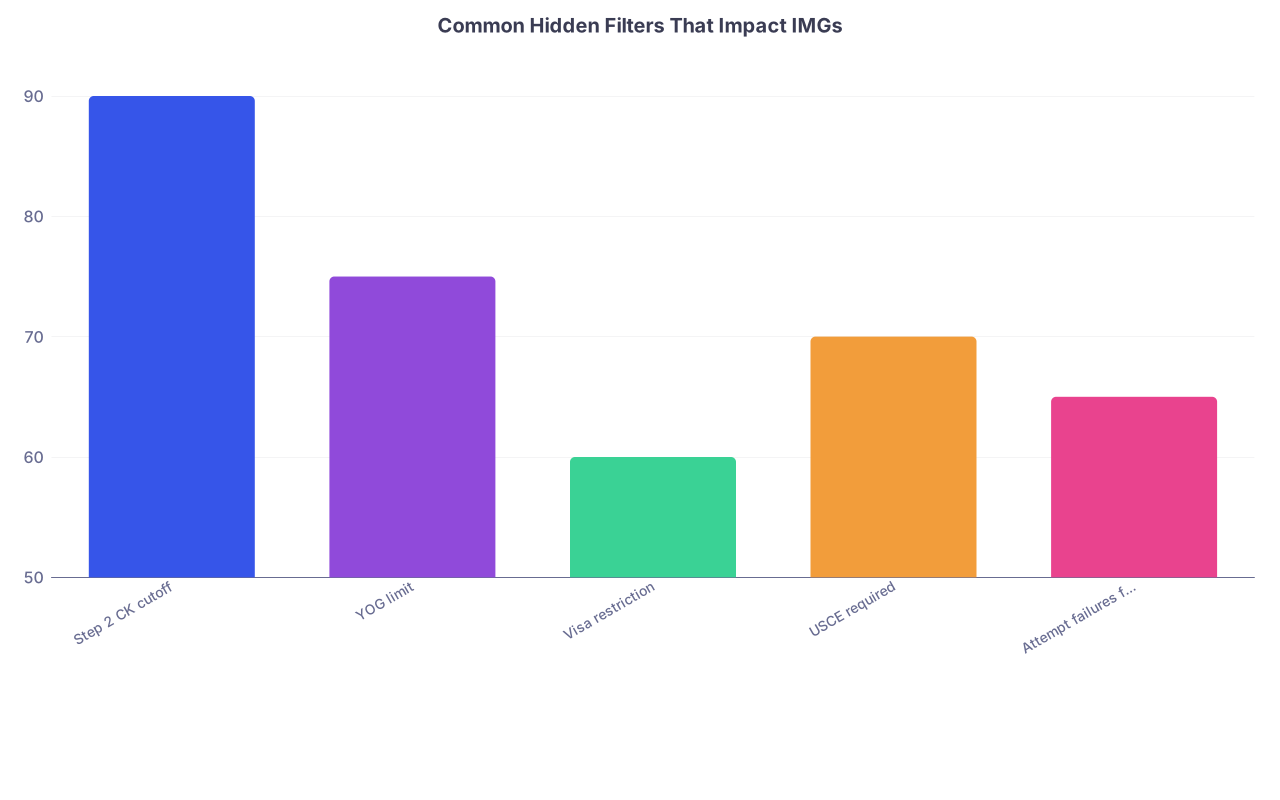
| Category | Value |
|---|---|
| Step 2 CK cutoff | 90 |
| YOG limit | 75 |
| Visa restriction | 60 |
| USCE required | 70 |
| Attempt failures filtered | 65 |
Final Takeaways
First: most programs use hidden filters for IMGs that they will never publish. Scores, YOG, visa status, and USCE get weaponized long before anyone reads your story.
Second: your match success as an IMG depends less on raw application volume and more on whether you’re applying to places where you can realistically survive the filters.
Third: stop playing blind. Study resident rosters, track real visa and IMG patterns, and build a list where you’re not an exception; you’re their usual type of IMG. That’s how you get from being auto-deleted in silence to actually getting a seat at the table.