
The biggest factor IMGs underestimate in the Match is not Step scores. It is their visa status.
I’ve sat in rooms where program directors skimmed ERAS filters, and your entire future got reduced to: “US citizen? Green card? H-1B? J-1? Non-sponsored? Next.” You worked a decade for this, and they’re making decisions in seconds based on a drop-down field you filled out half-asleep in August.
Let me walk you through what really happens behind closed doors and how your visa status quietly, systematically shapes your interview chances—often more than your 10 extra publications or your Step 2 score bump.
What PDs Actually See When They Filter IMGs
Most applicants imagine some holistic, careful review. That’s not how busy programs operate in October.
On ERAS, programs can mass-filter applications by:
- US vs non-US MD/DO vs IMG
- Citizenship/visa status
- Step scores and attempts
- Graduation year
And many of them do. Aggressively.
Here’s the part no one tells you: a large chunk of programs never actually see your application if your visa situation doesn’t match their internal rules. You’re filtered out before any human opens your file.
Programs use rough tiers in their heads (sometimes unofficial, sometimes very, very explicit in a spreadsheet):
| Tier | Status Type | How Programs Commonly View It |
|---|---|---|
| 1 | US citizen / Green card | Easiest, zero immigration hassle |
| 2 | No visa needed but IMG | Slightly more scrutiny, still easy |
| 3 | J-1 (ECFMG sponsored) | Acceptable for many IMG-friendly |
| 4 | H-1B eligible (Step 3 done) | Attractive, but more admin burden |
| 5 | Needs H-1B, no Step 3 yet | Often auto-rejected or filtered |
Is this formally written anywhere? Rarely. But sit in on a selection committee and you’ll hear it:
- “We’re not dealing with H-1Bs this year.”
- “Filter out anything not J-1 eligible.”
- “We can’t sponsor anything; we’re fully funded by state money.”
So before we even talk about strategy, you need to accept this unromantic reality: your stated visa preference and your practical visa eligibility can either open doors—or quietly close half the country to you.
The Real Differences Between J-1 and H-1B (From PD Eyes, Not Blogs)
Public forums explain J-1 vs H-1B like a law school exam. That’s not how PDs think.
They think in three questions:
- How much paperwork and risk is this?
- Will GME and legal fight me on this?
- Can this resident actually start on July 1 without a disaster?
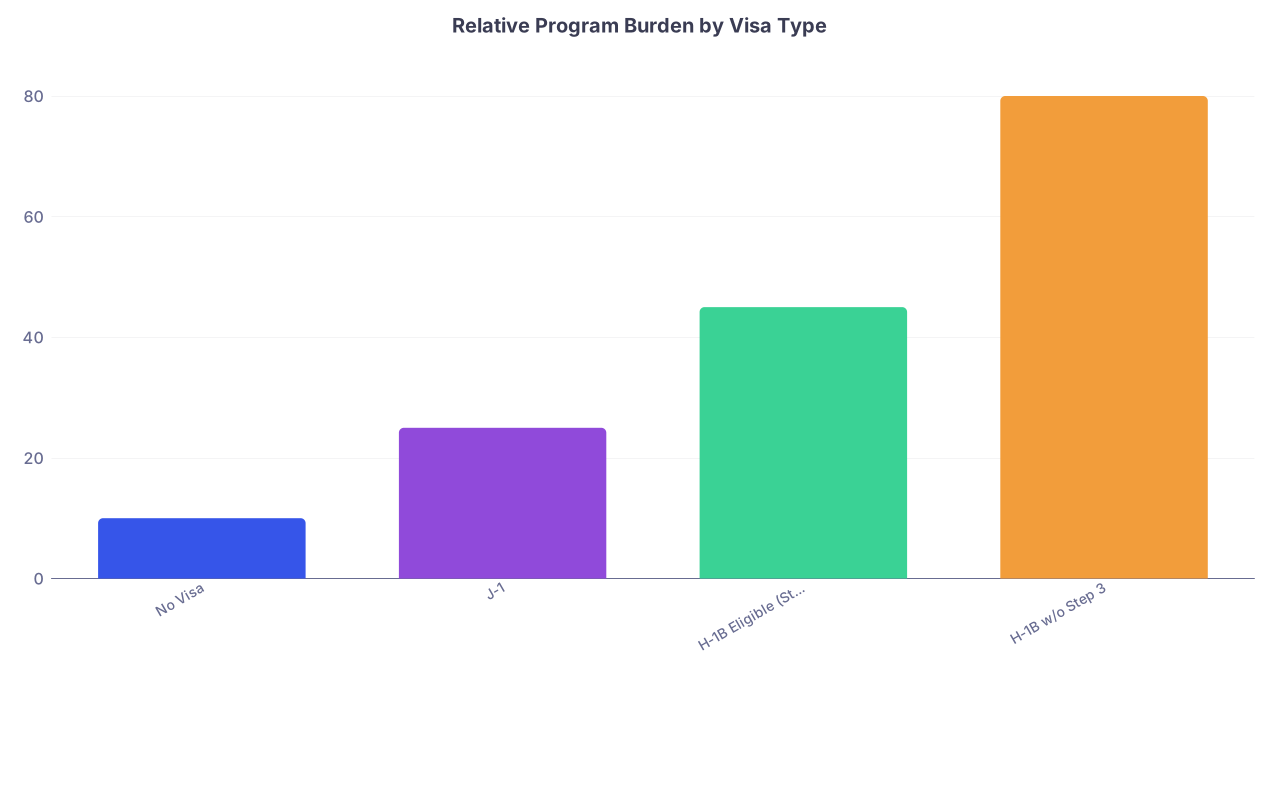
Let me translate how these look from inside the program.
| Category | Value |
|---|---|
| No Visa | 10 |
| J-1 | 25 |
| H-1B Eligible (Step 3) | 45 |
| H-1B w/o Step 3 | 80 |
The “burden” here is exactly what it sounds like: time, legal review, cost, and uncertainty. Lower is better—for you.
How J-1 is actually viewed
J-1 is like the “standard IMG package” for many academic and community hospitals:
- ECFMG does most of the legwork
- HR has done this a hundred times
- Legal knows the playbook
- GME budget impact is modest
So what do they say in meetings?
- “If they’re fine with J-1, we’re fine.”
- “Yeah, J-1 is easy. Our GME office knows that system.”
The catch is not residency. The catch is after residency: the two-year home-country requirement and waiver jobs. PDs know this but see it as your problem, not theirs. They care about July 1 and ACGME requirements. The rest is your future headache.
So if you’re J-1 eligible and you signal willingness to take a J-1, you’re in the “manageable” category for most IMG-friendly programs.
How H-1B is actually viewed
H-1B makes PDs and coordinators sigh.
They know:
- It costs the hospital more money
- Legal gets heavily involved and slows things down
- There’s more room for denials and delays
- Any delay past orientation is their nightmare
What you hear in closed-door conversations:
- “We only do H-1Bs for truly exceptional candidates.”
- “If they don’t have Step 3 yet, don’t even bother shortlisting.”
- “We have a soft cap on H-1Bs. We used our slot already this year.”
Some programs happily do H-1Bs and are very good at it, but they’re the minority. Even in those programs, H-1B is not neutral; it’s a limited resource. That means you’re competing not just with other applicants but also with the internal “H-1B quota” mentality.
So if your whole strategy is “I’ll only accept H-1B,” you’ve quietly knocked yourself out of dozens of interview pools before your personal statement is even opened.
How Your Stated Visa Preference Filters You Out (Without You Realizing)
One of the most harmful, under-discussed mistakes I see: IMGs ticking “H-1B only” when they would actually accept J-1.
Here’s what happens in practice.
A mid-tier internal medicine program in the Midwest. PD says to coordinator in September:
“Set the filter to:
– US grads all
– IMGs: must accept J-1.
No H-1B this year. GME chewed me out about the last one.”
Coordinator goes into ERAS, toggles the filters, and you—with your solid 238 Step 2, 3 pubs, strong LORs—simply vanish from the list because your visa preference says you’re unwilling to take a J-1.
No email. No notification. Just gone.
Many of you do that because a senior told you, “Never accept J-1, you’ll be stuck.” Here’s the insider truth: that advice has cost more IMGs their only realistic chance at US residency than anything else.
If you truly need H-1B for legal/family reasons, fine. But if it’s just “I heard it’s better,” you’re choosing potential future advantage over present reality: getting in the system at all.
The Silent Filters: What Programs Never Put on Their Websites
You read program websites that say:
“We sponsor J-1 and H-1B visas.”
You believe that means: “We will consider H-1B for any qualified IMG.”
Not how it works.
There are at least four layers between “we sponsor H-1B” and “you have a shot.”

Layer 1: GME and legal mood this year
Sometimes GME had a rough year—one delayed H-1B, one candidate stuck overseas, one USCIS headache. Next cycle, they quietly tell PDs:
“We’d prefer you limit H-1B sponsorship next year.”
Does this get written on the website? No. It gets enforced through side comments, budget meetings, and “strong recommendations.”
Layer 2: Internal quota thinking
I’ve seen programs that say:
- “Max 2 H-1Bs per year across all departments.”
- “Our department decided: 1 H-1B max, rest J-1 or no visa.”
So yes, technically they sponsor H-1B. But no, they’re not opening 6 H-1B spots to IMGs in medicine that year.
Layer 3: Faculty bias and inertia
Older faculty—especially those who’ve never dealt with the immigration mess themselves—often push for the path of least resistance:
- “Why are we taking someone on a complicated visa when we have other options?”
- “We’ve had great J-1s; do we really need H-1B?”
No malice. Just convenience and risk aversion. But that shapes who even gets on the rank list.
Layer 4: Coordinator capacity
Coordinators are the unsung gods of this process. They fill the forms, chase HR, coordinate with ECFMG, and babysit timelines.
If a coordinator is already juggling multiple J-1s and one H-1B, they’re not thrilled to add three more H-1Bs. PDs know this and act accordingly. “Easy visa cases” get subconscious preference.
None of this is on the program website. You find out when you don’t get interviews and never understand why.
How Visa Status Interacts With Your Scores and Profile
Visa is rarely the only reason you get or lose an interview. But it shifts the bar.
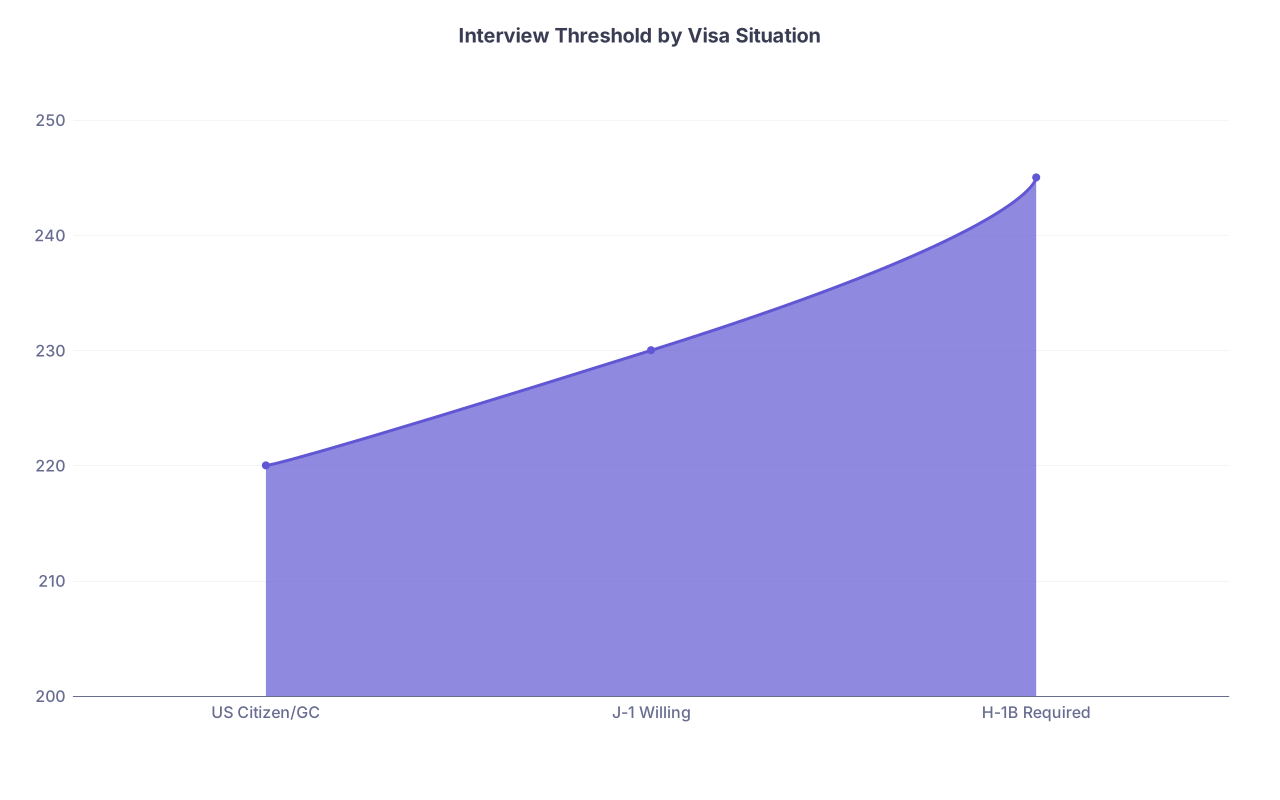
Picture three applicants to a medicine program that can sponsor visas.
- Applicant A: US citizen, 225 Step 2, average LORs
- Applicant B: IMG, J-1 eligible, 240 Step 2, strong LORs
- Applicant C: IMG, wants H-1B only, 250 Step 2, strong LORs
On pure numbers, C looks best. In an ideal world, they’d be the top pick.
In the actual selection meeting, the discussion goes like this:
“A is safe, no visa, looks fine.
B is strong, J-1 is easy, let’s definitely interview them.
C wants H-1B only—do we want to spend one of our H-1B slots on them? Let’s keep them as a maybe and see how many strong US grads we get.”
What actually happens: C’s invitation is delayed, or never sent, while A and B lock in their interviews early.
You are not being judged only against other IMGs. You’re being judged against the cost/complexity of your immigration case.
| Category | Value |
|---|---|
| US Citizen/GC | 220 |
| J-1 Willing | 230 |
| H-1B Required | 245 |
Those score numbers are illustrative, but the pattern is real: needing H-1B raises the “minimum” they want to see. Being flexible with J-1 lowers it. No visa issues at all lowers it further.
The ERAS Box That Can Save—or Kill—Your Season
There’s a piece of your application most IMGs fill in casually that, from a program’s side, functions like a gate.
Your declared visa status and preferences.
I’ve watched students sabotage themselves with a single choice. Let’s be blunt about your options and their consequences.
If you’re a foreign national with no US status
You typically can:
- Be J-1 eligible
- Potentially be H-1B eligible (if Step 3 passed and state allows)
The smart move—for most IMGs—if you want maximum interview chances:
- Indicate that you’re willing to accept either J-1 or H-1B
- Do not mark “H-1B only” unless you’re absolutely sure you’ll decline J-1
What PDs see then:
“Okay, we can just put them on J-1 if we take them.”
That takes you out of the “complicated ask” category.
If you already have US status (GC, citizen, EAD)
You’re in the lowest-friction group. But some of you still shoot yourselves in the foot by mis-labeling or adding unnecessary complexity. I’ve seen people with EADs list themselves as needing sponsorship, which triggers filters they don’t actually need.
If you do not need visa sponsorship, say so. That line alone drops you below the “hassle threshold” in many PD minds.
Hidden Regional Realities: Where Visa Hurts You Less
Different regions of the US have very different appetites for visas. This is almost never discussed openly, but you see it once you’ve watched a few cycles from the inside.
| Region | Typical Visa Friendliness | Common Patterns |
|---|---|---|
| Northeast | Moderate–High | Many J-1, some H-1B academic |
| Midwest | High for J-1 | IMG-heavy, J-1 very common |
| South | Variable | Some strong IMG hubs, some hostile |
| West Coast | Lower for new IMGs | More competitive, fewer IMGs |
Midwest community internal medicine program directors? Many of them practically run on J-1s. They’re used to it. They recruit globally. They know waiver jobs exist in their states.
A West Coast university hospital with 300 US MD applicants per spot? You needing visa sponsorship there is a real disadvantage unless you’re truly exceptional or bring something very specific.
If your visa needs are non-negotiable, you don’t get to be romantic about geography in your first application cycle. You go where the doors are actually open.
Step 3, H-1B, and the “We’ll See Later” Lie
A favorite line some PDs give on interview day:
“Yes, we can do H-1B. Just get Step 3 done before we start paperwork.”
Let me decode that.
Inside discussion usually sounds like:
“If they somehow crush everything and we love them, we’ll consider burning an H-1B on them. If not, J-1 or no rank.”
So what should you do with Step 3?
If you are serious about H-1B:
- Having Step 3 passed before interviews moves you from “theoretically could do H-1B one day” to “immediately H-1B eligible.”
- That matters more than you think because PDs don’t like contingencies. They prefer: “We can file now” over “We must wait for scores and pray.”
I’ve seen committees say:
“Two strong candidates, both want H-1B. This one has Step 3 done, this one doesn’t. Rank the one with Step 3 higher so we’re not stuck.”
If you cannot get Step 3 done, then do not pin your entire strategy on H-1B. You’re walking into a high bar without a key credential they quietly expect.
Strategic Moves IMGs Rarely Make (But Should)
Now we get to the part you actually control.
Here are the levers IMGs almost never use well around visa, but that change outcomes.
1. Emailing programs about willingness to take J-1
If you previously indicated H-1B only but would accept J-1, you can correct that. I’ve seen PDs flip from “no interview” to “okay, invite them” after a precise message.
Not a desperate essay. A short, professional note:
- Clarify that you’re fully willing to accept J-1
- Mention ECFMG certification or timeline if pending
- Attach updated CV if anything improved
You’re lowering their perceived risk and effort. That matters.
2. Targeting programs with documented history of taking your visa type
Here’s another thing insiders do: they look at residents’ profiles on program websites. If a program has:
- Multiple J-1s from diverse countries year after year
- Or multiple H-1Bs already in their resident roster
That’s more valuable than any one-line statement on their website. It shows legal and GME have workable pathways. It means your case won’t be their first rodeo.

| Step | Description |
|---|---|
| Step 1 | Find Program |
| Step 2 | Check Current Residents |
| Step 3 | Research Past 3 Years Classes |
| Step 4 | Lower Priority |
| Step 5 | High Visa-Friendly Priority |
| Step 6 | Consider but Apply Cautiously |
| Step 7 | Any J-1/H-1B? |
3. Adjusting your story to make visa risk feel lower
Programs don’t say this out loud, but they’re more comfortable sponsoring visas for people who feel “stable” and “commitment-probable”:
- Strong US clinical experience at reputable sites
- Clear explanation of long-term career plans in the US
- No sense you’re using them as a brief stopover before going elsewhere
Your visa need is a risk. Your narrative needs to signal that risk is worth it.
Common IMG Myths About Visa and Interviews—And Why They’re Wrong
Let me burn through the bad advice you’ve probably heard from seniors.
“Never accept J-1, you’ll be trapped.”
Wrong for most people. For many IMGs, J-1 is the only practical doorway into the system. And once you’re in, you have tools: waivers, underserved jobs, later transitions. No residency = nothing to waive.
“Scores will overcome any visa issue.”
Not reliably. I’ve watched 260+ H-1B-hopeful IMGs get fewer interviews than 230 J-1-willing IMGs. Scores help, but they don’t erase institutional risk.
“If a program says they sponsor H-1B, you’re good.”
You’re “theoretically” good. But you’re still competing against their internal cap, GME politics, and easier options.
“My friend matched with H-1B and lower scores, so I’ll be fine.”
Your friend may have had a green card spouse, university ties, or some back-channel support you don’t know about. Do not build a strategy on survivor stories.
What I’d Do If I Were an IMG Needing a Visa, Applying Next Cycle
Let me be direct.
If I needed any visa support and my priority was to maximize interviews, here’s the hierarchy I’d actually follow:
- I’d mark myself as willing to take J-1 unless I had a rock-solid legal reason not to.
- I’d target heavy IMG internal medicine, family medicine, peds programs in the Midwest and Northeast with a track record of J-1 residents.
- If I wanted H-1B, I’d treat it as a bonus, not a condition, and push hard to get Step 3 done before applications or at least before interviews.
- I’d double check my ERAS visa fields and have a mentor read them like a PD: “Does this make me look easy to onboard or like a problem?”
- I’d email a short, precise update to visa-sponsoring programs I care about, clarifying I’m fully J-1 willing, if that wasn’t obvious.
You do not win this game by demanding ideal conditions. You win it by getting in the door, then building from there.