
What if your ERAS application is solid on paper, but programs quietly toss it aside in 10 seconds?
That happens to IMGs all the time.
Not because of low scores. Not because of your school.
Because of subtle ERAS red flags that scream: “Risky applicant. Pass.”
I’ve watched strong IMGs—Step 1: 240s, decent research, solid letters—get 0–2 interviews while weaker peers matched comfortably. The difference wasn’t stats. It was landmines in their ERAS that they didn’t even realize were there.
Let’s walk through the 10 subtle ERAS red flags that quietly sink strong IMG applications—and how to not be that cautionary tale.
1. The “Perfect” Application That Looks… Manufactured
Programs don’t like chaos. But they also do not trust perfection that feels fake.
Common red flags here:
- Every single entry starts with the same polished verb and long sentence
- No weakness, no struggle, no learning curve—just endless “success”
- Activities sound generic and interchangeable: “I enhanced my communication skills…” on repeat
- Over-edited language that sounds like ChatGPT wrote it, not a human being
I’ve heard PDs say during file review:
“Looks like someone did this for them. I don’t trust it.” File back on the pile.
How this quietly kills you
They assume:
- You didn’t write your own stuff
- You’re hiding something
- You lack self-awareness (no humility, no growth arc)
No one’s path is frictionless. If you present yourself like some polished robot, you look dishonest.
How to avoid this
- Vary your sentence structure and tone across entries
- Include at least a few moments of struggle, adjustment, or learning
- Example: “At first, I struggled with…” followed by what you changed
- Use clear, direct language—no corporate buzzwords, no excessive adjectives
- If someone edits your writing, keep your voice. Don’t let them sanitize it into PR copy
2. Sloppy, Inconsistent Timelines That Whisper “Something’s Off”
Programs scan timeline first: grad year, exams, US experience, gaps.
If your dates and progression feel confusing or messy, they often don’t bother solving the puzzle. They just move on.
Subtle timeline red flags:
- Month/year don’t line up across CV, personal statement, and LoRs
- Activities overlapping in impossible ways (e.g., “Full-time research” + “Full-time clinical” same dates)
- Long unexplained gaps hidden between entries
- USCE all jammed into a short burst right before application season with no continuity
Here’s the quiet thought in a reviewer’s head:
“If I’m confused in 20 seconds, I don’t have time for this.”
How to avoid this
- Build a master timeline in a simple table first and sync everything to it
| Period | Activity | Location |
|---|---|---|
| 2016–2022 | Medical school | Home country |
| 03–06/2021 | Research internship | Home country |
| 01–03/2023 | US observership 1 | New York |
| 04–06/2023 | US observership 2 | Chicago |
| 07–02/2024 | Home clinical + study | Home country |
- Make sure:
- Dates are consistent in ERAS, CV, and LoR descriptions
- Any gap >3 months is either:
- Explained by an activity, or
- Addressed briefly in personal statement or an entry (“Family responsibilities”, “Exam prep”, etc.)
- Don’t fake overlaps. If two things overlapped, clarify intensity:
- “Part-time remote research (5–10 hrs/week)”
3. “US Clinical Experience” That Isn’t Really Clinical
This one sinks a lot of strong IMGs.
They think they have “strong USCE.” PDs look and think, “This is weak shadowing dressed up as clinical.”
Subtle red flags:
- Using grand titles: “Sub-internship,” “Clinical externship” for what was really shadowing
- No clear responsibilities listed—only observations
- Rotations too short and scattered: 1–2 weeks each, 6 different places
- All experiences are private clinics with no hospital-based exposure
- No continuity with one attending long enough to earn a meaningful letter
Programs care less about word labels and more about function.
They want to see: did you actually do anything in a US setting?
How to avoid this
- Be honest and precise in descriptions:
- “Observed outpatient clinic visits; participated in case discussions; presented literature reviews”
- Aim for:
- 2–3 solid, longer experiences (4–8 weeks)
- At least one hospital-based rotation in your target specialty
- Don’t stack 6 one-week “experiences” and expect that to impress anybody
- Get at least 1 letter from someone who saw you work over time, not a 1-week flyby
4. The Vague, Generic Personal Statement That Could Be Anyone’s
You know that personal statement that could belong to literally any IMG, any specialty, any country?
Programs see 100 of those a day. They skim 3 lines, realize it’s fluff, and stop.
Subtle PS red flags:
- Could be copy-pasted into another specialty with zero changes
- No specific patient stories, no concrete clinical moments
- Reads like a biography instead of an argument for why you’re a good bet for this specialty in the US system
- Mentions “lifelong dream” and “passion for helping people” without any specifics
- Has a weird mismatch with your CV:
- PS says: “I’m deeply committed to research.”
- CV: One small case report.
Programs don’t reject you just for a boring PS, but it contributes to the “meh” pile where no one fights for you.
How to avoid this
- Anchor your statement around 1–2 specific clinical experiences that:
- Show how you think, not just what you saw
- Reflect your specialty choice clearly
- Tie your IM background to US training realistically:
- What you bring
- What you know you must adapt to
- Make sure your claims match your actual record:
- If you barely have research, don’t call yourself “research-focused”
- Have each PS version specialty-specific, not one-size-fits-all
5. Letters of Recommendation That Sound “Polite but Cold”
IMGs often obsess over big-name letter writers. But a bland letter from a famous name is worse than a strong letter from a mid-tier place.
Subtle LoR red flags:
- “Observership” letters that basically say:
- “They attended clinic, were punctual, and pleasant.”
- No strong comparative language:
- “One of the best I’ve worked with,” “Top 10%,” etc.
- Letters full of vague adjectives, no specific anecdotes
- Letter writer didn’t actually supervise you closely (PDs can smell this)
- Letters not matching the rest of your story:
- PS: “I’m deeply passionate about internal medicine.”
- Letter: Generic “rotated with us in surgery.”
I’ve watched PDs skim a letter, sigh, and say, “Nice kid, but this letter says nothing.” And that’s that.
How to avoid this
- Prioritize who knows you over who’s “famous”
- Work long enough with an attending (ideally 4+ weeks) that:
- They’ve seen you with patients
- You’ve presented to them
- They’ve seen growth or resilience
- Before they write:
- Give them a short summary of your work with them
- Remind them of specific cases or tasks you handled
- Don’t use letters from meaningless micro-rotations unless there’s no alternative
6. “Red-Flag Silence” Around Attempts, Failures, or Gaps
Programs don’t like surprises.
What they hate even more: when something’s clearly off and you pretend it doesn’t exist.
Subtle concealment red flags:
- Step failure or multiple attempts mentioned nowhere in PS or experiences
- 2–3 year gap between graduation and application with zero explanation
- Massive drop in performance (e.g., from strong medical school grades → nothing on CV for years) without any narrative
- Being in another residency overseas and leaving, with no mention
Here’s the internal reaction:
“If they won’t address this, they’ll probably hide things as a resident too.”
How to avoid this
You don’t write a confession letter. You write a mature explanation.
- Briefly acknowledge the issue
- Take responsibility without self-destruction
- Show what changed and what you did since
Examples:
- Step failure:
- “After an initial failed attempt at Step 1, I restructured my study approach, sought faculty guidance, and passed on my next attempt. This experience changed how I handle setbacks; I now build in accountability and early feedback into my work.”
- Gap:
- “From 2020–2022, I returned home due to family responsibilities and simultaneously worked as a general practitioner while preparing for US exams.”
Silence is louder than a short, honest explanation.
7. Research That Looks Inflated, Confusing, or Dishonest
You want to show research productivity. Programs want to see credibility.
What kills trust fast? Inflated, unclear, or suspicious research entries.
Subtle research red flags:
- Endless “submitted” and “in preparation” papers—almost none published
- Author positions that seem improbable for an IMG with limited time in the US
- Conference poster titles that sound almost identical, duplicated across multiple entries
- No clear institution or supervisor listed
- Claiming roles that don’t match your actual background (e.g., heavy biostatistics when you’ve never done stats anywhere else)
Academic people are very good at spotting research nonsense.
When something smells off, they assume embellishment. And once they doubt one thing, they doubt everything.
How to avoid this
- List only real, verifiable work
- Use clear, modest descriptions:
- “Assisted with data collection and chart review”
- “Performed preliminary literature review and helped draft introduction”
- Be honest about status:
- “Submitted” only if actually submitted to a named journal
- Don’t list “in preparation” papers as if they’re real products
- If your name isn’t on the final paper, don’t claim authorship
8. Activities Section That Reads Like a Dumping Ground
ERAS activities are not a place to list every breath you’ve taken since high school.
But many IMGs overpack this section trying to “catch up” or “prove worth.”
Subtle activities red flags:
- 30 random short-term roles that show no coherence or depth
- Old, irrelevant items dominating the list (high school awards, non-medical hobbies blown up as main achievements)
- Repeating the same experience in multiple entries to pad volume
- Descriptions that are clearly copy-paste, with identical phrasing
Programs don’t want maximal volume. They want a readable story.
How to avoid this
- Prioritize:
- Clinical roles (especially US)
- Teaching / leadership
- Meaningful volunteering
- Research (real, not imagined)
- In each entry, answer:
- What did you actually do?
- What did you learn or change?
- How does it connect to residency potential?
- It’s better to have:
- 10–15 strong, coherent entries
- Than 30 chaotic, shallow ones
Trim the noise. You’re not paid per line.
9. Applying Like a “US Grad” When You’re Not
Harsh but real: you don’t get to behave like a US MD if you’re an IMG.
Different risk calculation. Different baseline.
Subtle but deadly strategy red flags:
- Applying to only 40–60 programs in a competitive specialty as an IMG with average scores
- Not including enough community or lower-tier academic programs
- Applying to programs that have never or almost never taken IMGs
- Poor specialty ranking strategy: applying to a single highly competitive specialty with no realistic backup
Let me be blunt:
I’ve watched excellent IMGs with 240+ scores apply like US grads and come back with 0 interviews.
How to avoid this
- Study program histories:
- Look at recent residents on program websites
- Check how many IMGs they have, and from where
- Adjust numbers based on reality:
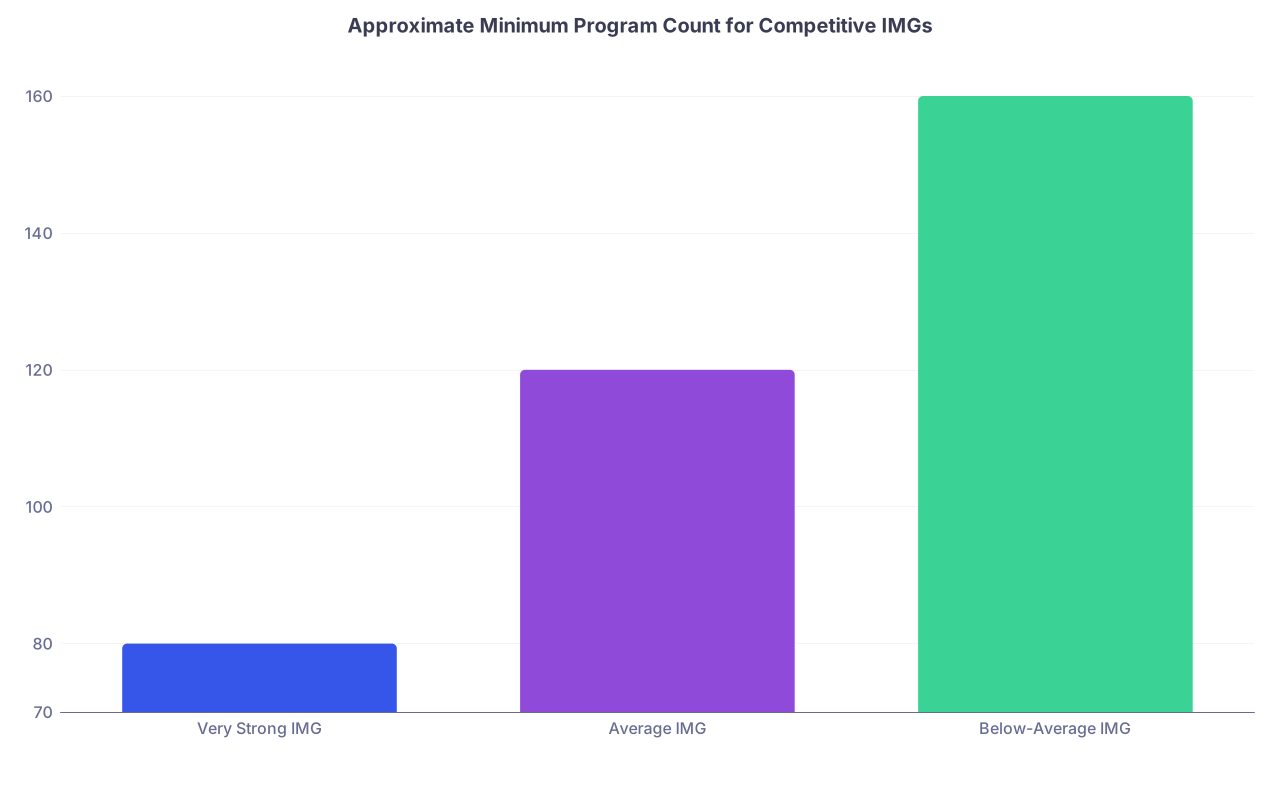
| Category | Value |
|---|---|
| Very Strong IMG | 80 |
| Average IMG | 120 |
| Below-Average IMG | 160 |
- Very strong IMG (recent grad, strong scores, USCE, solid letters): ~80–100 programs
- Average IMG: 120–150
- Below-average or older grad: 150+ if financially feasible
- Include:
- A mix of academic and community
- Programs that have at least 1–2 IMGs in recent classes
- Don’t waste 20 applications on programs that explicitly state “No IMGs accepted” or haven’t had any in a decade
You are not just applying. You’re risk-managing.
10. A Story With No Clear Direction or Specialty Commitment
Finally, the quiet killer: your ERAS doesn’t clearly answer one simple question:
Who are you as a future physician, and why this specialty?
Subtle lack-of-direction red flags:
- Personal statement for internal medicine, but:
- Experiences heavy in surgery, plastics, radiology, and almost nothing in IM
- Activities list with scattered specialties, no dominant theme
- LoRs from 3 unrelated fields and none in the specialty you’re applying to
- Long “trying out” phase that never gets explained (why the shift to this specialty now?)
Programs don’t want to train someone who’s still shopping around.
How to avoid this
- Make sure your ERAS shows:
- At least 2–3 clinical experiences in your target specialty
- At least one letter from that specialty
- Activities that can be framed as relevant to that field
- If you truly switched specialties:
- Briefly explain in your PS:
- “Initially, I pursued surgery and completed two rotations in that field. Over time, I realized that what I valued most was long-term continuity and complex medical decision-making, which I found in internal medicine. Since then, I’ve focused my training and experiences on IM.”
- Briefly explain in your PS:
- Don’t try to be “open to everything.” It reads as “I don’t know what I want.”
How These Red Flags Add Up (And Quietly Destroy You)
Individually, many of these aren’t automatic rejections.
But here’s the danger: they stack.
Picture this profile:
- Solid scores
- Good school
- 2 US rotations
- But: vague PS, generic letter, confusing timeline, inflated research, and weak specialty signaling.
On paper, you’re “strong.”
On ERAS, you’re risky, confusing, and unconvincing. And programs don’t have time to be generous.
Here’s what the reviewer’s brain does in 15–30 seconds:

| Step | Description |
|---|---|
| Step 1 | Open ERAS File |
| Step 2 | Reject |
| Step 3 | Consider for Interview |
| Step 4 | Scores OK? |
| Step 5 | Timeline Clean? |
| Step 6 | USCE Solid? |
| Step 7 | Letters Convincing? |
| Step 8 | Clear Specialty Fit? |
Your job isn’t just to avoid disaster. It’s to make saying “yes” easy.
Quick Self-Audit: Are You Quietly Red-Flagging Yourself?
Before you submit ERAS, sit with your application and ask:
- Do my dates line up cleanly with no puzzle-solving required?
- Would a stranger know why I’m going into this specialty after a 1-minute skim?
- Do my letters and PS sound like the same person described in my CV?
- Am I exaggerating anything that would collapse if someone pressed for details?
- If I were a PD, would I bet a residency spot on this person—or would I move on to the next 600 applications?
If you hesitate on any of those, you probably have subtle red flags to clean up.
Final Takeaways
- Strong stats can’t rescue an application that feels confusing, inflated, or directionless.
- Programs are not looking for perfection; they’re looking for coherent, honest, low-risk applicants.
- Your biggest hidden enemy isn’t one huge mistake—it’s the quiet accumulation of small red flags you never bothered to fix.