
Most program directors do not read your letters of recommendation for what they say. They read them for what they signal.
Let me be even clearer: for IMGs, the hidden subtext of your letters matters more than the adjectives. The PDs and selection committees know exactly which phrases are code, which are filler, and which are quiet red flags. You are not supposed to know this. But I do, because I’ve sat in those meetings where we slice apart 200 files in a night and letters become tie-breakers.
You want to know what actually moves the needle for an IMG? It is not “hard‑working” and “compassionate.” It is who writes it, how they write it, what they do not say, and how specifically they connect you to U.S. residency norms.
Let’s walk through what really happens behind closed doors.
How PDs Actually Read IMG Letters
PDs read IMG letters differently than they read US‑grad letters. They are hunting for reassurance on three specific fears:
- Can this person function on Day 1 in a U.S. hospital?
- Will they be a problem—communication, professionalism, visa headaches, culture issues?
- Is someone we trust willing to “vouch” for them with their reputation?
Most IMG applications are a blur of similar phrases: “hardworking,” “dedicated,” “great asset to your residency program.” PDs skim past that. The committee is looking for pattern recognition and soft signals.
Here’s how it goes on a real selection night:
File opens. PD scrolls to letters.
“Who wrote them?” Quick scan: titles, institutions.
Any names they recognize? Any chairs, PDs, APDs, well-known faculty?
Then: “What’s the tone? Any real commitment, or is this a template?”
The content itself is often read in 20–40 seconds per letter. That’s it. The decision is not based on a poetic paragraph; it’s based on a set of cues they’ve learned to read after thousands of letters.
The First Soft Signal: Who Wrote the Letter (and What That Really Tells Them)
The harsh truth: for IMGs, letter writer identity is often more important than the flowery content.
Here’s the mental hierarchy most PDs use, even if they deny it publicly:
| Rank | Letter Writer Type |
|---|---|
| 1 | U.S. Program Director / APD in the specialty |
| 2 | U.S. Chair or Division Chief in the specialty |
| 3 | U.S. Core Faculty, academic center |
| 4 | U.S. Community Attending with teaching role |
| 5 | Non‑U.S. faculty with U.S. connection |
| 6 | Purely foreign letter, no U.S. link |
They do not spell this out in their “requirements.” But this is how the file is interpreted.
For you as an IMG, the key soft signals here are:
1. U.S. clinical exposure is real, not “observership fluff.”
A strong U.S. letter coming from someone with direct clinical oversight (not just “observed rounds”) signals you were trusted with real patient interaction. The letter itself will mention:
- “He took primary responsibility for…”
- “She independently presented patients on rounds…”
- “I directly observed him/her performing…”
Those phrases tell the PD you weren’t standing in the back of the team room holding a badge and a pen.
2. The writer understands U.S. residency standards.
A letter from Dr. Big Name at “Famous International Hospital” without U.S. context is less persuasive than a mid-tier U.S. faculty who clearly knows how residents are evaluated.
Program directors know which overseas institutions have a history of over‑inflated letters, and they treat them accordingly.
3. The writer’s institution reputation bleeds into your profile.
If a PD has repeatedly interviewed or matched strong residents from a particular U.S. hospital’s IMG observership/externship pathway, letters from that place carry extra weight—even if it’s not a top‑10 name. They use their own track record as a bias filter: “Our last two residents from Dr. X’s letters were solid; I’ll trust this one.”
Most IMGs underestimate this local-network effect.
Tone, Temperature, and Subtext: How PDs Read Between the Lines
Program directors can tell in the first two sentences whether your letter writer actually cares about you or just did you a professional favor.
There are three main “temperature” zones they react to:
1. The Warm, Committed Letter (Green Light)
This is the gold standard signal. It usually starts with something like:
“It is with great enthusiasm that I recommend Dr. ___ for a residency position in Internal Medicine. Over the past three months working closely together on our inpatient service, I came to trust her clinical judgment and professionalism at the level of an early intern.”
Notice the components:
- “Great enthusiasm” – not just “pleasure”
- Specific time frame
- Specific clinical context
- A comparison to an intern or resident level
Then later, something like:
“I will be disappointed if she does not match in a strong U.S. program.”
Or:
“I’d be very happy to have him as a resident in our own program.”
Those are huge soft signals. They scream: “I’m staking my name on this person.” PDs perk up when they see that.
2. The Lukewarm, Polite Letter (Yellow Light)
Lots of IMG letters live here. They sound fine on the surface but signal nothing.
“It is my pleasure to recommend Dr. ___ for residency. During his time in our department, he demonstrated professionalism and strong work ethic. I believe he will be a good addition to any program.”
PDs translate this as:
- “Pleasure” instead of “enthusiasm” or “strongly recommend”
- Generic traits anyone can have
- No risk taken by the writer
- No personal ownership: “good addition” = safe, middle-of-the-road
These letters don’t hurt you much, but they definitely do not rescue a borderline application. For an IMG, too many of these and you blend into the pile.
3. The Dry or Distanced Letter (Red or Dark Yellow Light)
This is the stuff you never want:
“I worked with Dr. ___ during a four-week observership in our department. He attended rounds and observed patient care.”
Or:
“I did not have the opportunity to work extensively with Dr. ___, but during the time I saw him, he appeared dedicated and polite.”
You may think: “At least they said something nice.” PDs think: “This writer is telling me, politely, that they cannot vouch for this person in a meaningful way.”
I’ve been in the room when a PD said: “If the best they can say is ‘appeared dedicated,’ that means they barely know them. Next file.”
The Specificity Signal: Concrete Details vs. Template Filler
A seasoned PD can spot a template letter in under ten seconds. Many IMGs get burned by this without realizing it.
Soft signal number one for seriousness: specific, observed behaviors.
Strong letters include things like:
- A particular case: “On our first call night together, we admitted a complex DKA patient…”
- A specific skill: “She consistently produced concise, well-structured presentations, and her assessment and plan were aligned with resident-level thinking.”
- Comparative language: “Among the 20 students and observers I have supervised this year, he ranks in the top 2–3.”
Weak letters read like this:
“She is hard-working, punctual, and well-liked by staff and patients. She has good clinical skills and would be an asset to any program.”
In committee, the PD will say: “No examples. Probably a template.” And move on.
You want your letter writer to write things only they could write about you. That’s the signal of genuineness.
The U.S. Readiness Signal: Cultural and System Fluency
Here’s one thing IMGs consistently underestimate: PDs are not just asking, “Are you smart enough?” They’re asking, “Will you survive and not crash on U.S. wards?”
They want to see:
- Communication with nurses, consultants, and patients in a U.S. setting
- Understanding of EHRs, handoffs, paging, and call culture
- Behavior under fatigue and stress
A letter that says:
“He communicated effectively with patients and families, adapting explanations to their level of understanding and cultural background, and he handled a difficult family meeting with maturity beyond his training level.”
…carries more weight for an IMG than “excellent fund of knowledge.” Why? Because most committee members assume that a motivated IMG can memorize content. They’re less confident about your ability to function in a fast-paced, medico-legal, communication-heavy environment.
Another subtle but powerful signal: mention of EHR and workflow.
“She quickly learned our EPIC system, wrote clear, organized notes, and responded promptly to nursing pages.”
You might think this is boring. The PD thinks: “Ok, this person won’t implode on Day 1 of ward months.”
The Comparison Signal: How You Stack Against U.S. Grads
Most IMGs never see the comparison language committees watch for like hawks.
Strong comparative phrases:
- “At the level of our graduating U.S. medical students.”
- “Comparable to a strong PGY‑1 early in the year.”
- “In the top 10% of students I’ve worked with over the past five years.”
- “Outstanding among both our U.S. and international trainees.”
These phrases are the currency of trust. They allow PDs to map you onto a familiar mental scale.
Lukewarm or vague comparison:
- “One of the better students I have supervised.”
- “Above average.”
- “Performed well.”
These are technically positive, but the PD’s brain reads: “Not a standout. Safe, not special.”
Damning with faint praise:
- “Performed adequately.”
- “Met expectations.”
- “Showed improvement over time.” (without specifying that you ended up strong)
Those are soft red flags. On a high-volume review day, that may push your file from “maybe” to “no interview.”
The “Ownership” Signal: Will the Writer Stick Their Neck Out?
Inside selection committees, people will literally say: “Does anyone know this letter writer? Would they send us someone weak?”
That is the ownership question: is the writer someone who, historically, only writes strong letters for strong candidates?
Watch for phrases like:
“I recommended Dr. ___ to several colleagues without hesitation.”
“We have encouraged him to apply broadly, but I have specifically contacted a few programs on his behalf.”
“I would be thrilled to have her as a categorical resident here, and we have invited her to apply to our own program.”
These statements tell PDs: this writer is actually investing political capital in you. That’s a very loud signal. On the flip side, bland letters from powerful names can hurt more than they help—because the committee will say, “If this chair really loved them, this letter would sound different.”
How PDs Read Multiple Letters Together (Pattern Recognition)
Single letters are not interpreted in isolation. The pattern across all your letters is itself a soft signal.
Consider three common patterns I’ve seen:
Pattern 1: One Stellar, Two Generic
PD reaction: “Ok, they can shine in the right setting. Might be context-dependent. If the stellar letter is from the most recent, U.S.-based rotation, that’s a positive trajectory. If the weaker letters are older or foreign, they’re discounted somewhat. You’re still in the game.
Pattern 2: All Generic, All Polite
PD reaction: “No one is willing to say this person is exceptional.” For a U.S. grad that might still be ok. For an IMG, generic across the board is a quiet rejection unless your scores or CV are spectacular.
Pattern 3: Gradient – Early Weak, Later Strong
This pattern is especially strong for IMGs:
- Old foreign letter: “hardworking, polite”
- First U.S. letter: “performed well, worked diligently”
- Most recent U.S. letter: “strongly recommend, at intern level, top 10%”
That progression screams growth, adaptation to U.S. culture, and rising trust. Committees love this. It tells a story: “They came here, adapted, and now they can function at our level.”
The Quiet Red Flags PDs Don’t Tell You About
There are a few things that almost never get said on the record, but they absolutely change how your letters are read.
1. Over-the-top praise from a non-U.S. writer
If a foreign dean writes: “The best student in the history of our institution,” and the rest of your file is just okay, PDs roll their eyes. Many have seen this movie before. Hyperbole from certain regions or schools is heavily discounted.
2. Vague timeframe or unclear contact
If the letter says:
“I met Dr. ___ during various activities in our department.”
…that often signals minimal direct supervision. PDs want to see exact blocks: “four-week inpatient rotation,” “two-month sub-internship,” “three-week ICU rotation.”
3. No mention of clinical reasoning
A letter that only talks about your personality—“kind, dedicated, well-liked”—and nothing about your history-taking, physical exam, differential diagnosis, or management plans… makes PDs nervous. For IMGs, that can suggest you were more of an observer than a clinician.
4. Backhanded compliments
Phrases like:
- “Eager to learn despite language barriers.”
- “Improved his note-writing over time.”
- “With continued practice, she will become more efficient.”
Look innocent. They are not. These are coded concerns. On a borderline application, they can tip you into “pass.”
What You Can Actually Influence (Before and After the Rotation)
You cannot write your own letter. But you can absolutely influence the signals that end up in it.
During your U.S. rotations, you want to create material your letter writer can use:
- Take ownership of patients (within allowed scope). Present clearly. Take feedback and visibly improve.
- Ask for mid-rotation feedback and fix what they mention. That gives them a story: “She responded remarkably to feedback—by the end of the month, her presentations were concise and resident-level.”
- Show up early, stay late when it matters, but more importantly, show judgment—know when to ask for help, when to escalate, when to say “I’m not sure.”
Near the end of the rotation, you do something most IMGs skip: you have a direct, professional conversation.
You say, in person:
“Dr. Smith, I’m planning to apply to U.S. internal medicine programs as an IMG. Your evaluation and any letter you’re comfortable writing would be very important for me. If you feel you can strongly recommend me, I’d be honored to have a letter from you.”
If they hesitate, or say something like “I can write you a standard letter,” that’s a warning. A “standard letter” is code for polite but unenthusiastic. You should seriously consider whether that letter will help you.
If they say: “Yes, I can strongly recommend you,” lean in. Offer a CV, personal statement, and a brief list of cases or examples you worked on together. Not to script them—but to remind them of specifics. You want them to write the detailed, concrete stories PDs love.
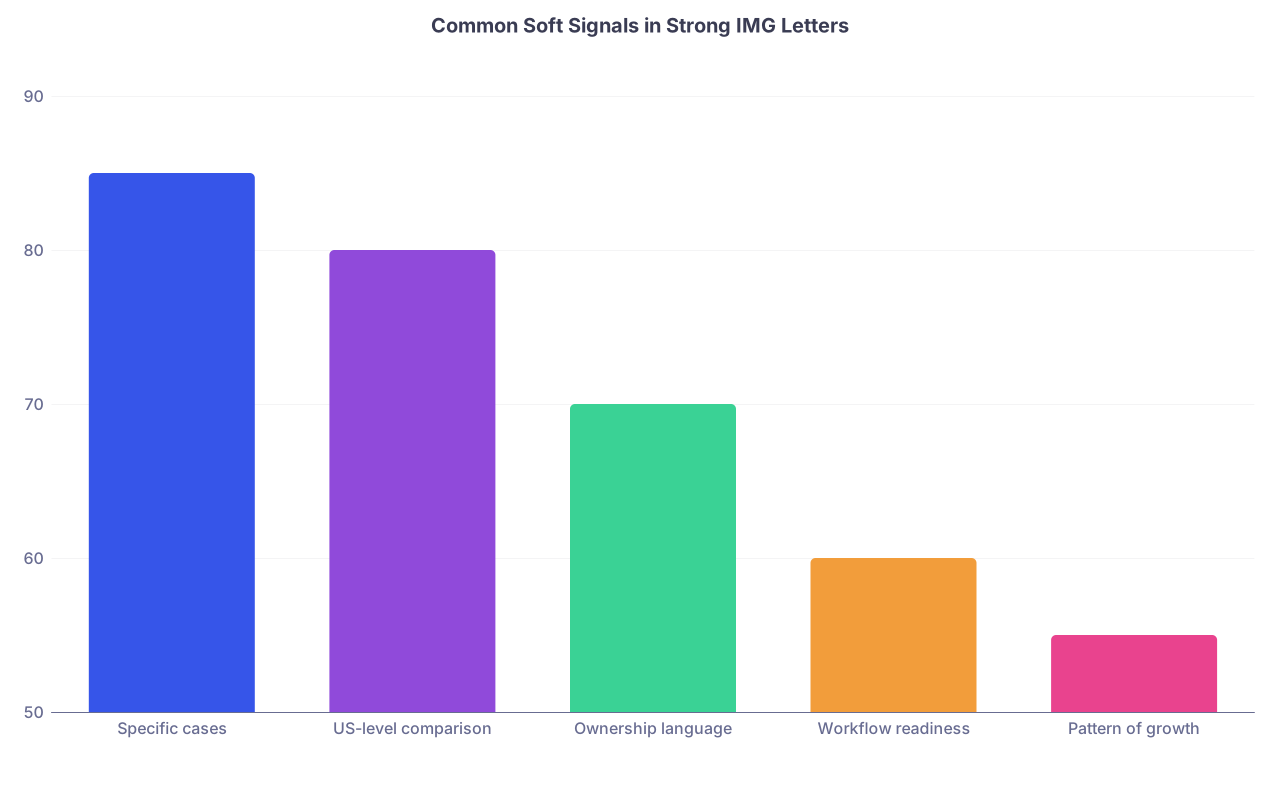
| Category | Value |
|---|---|
| Specific cases | 85 |
| US-level comparison | 80 |
| Ownership language | 70 |
| Workflow readiness | 60 |
| Pattern of growth | 55 |
How Committees Actually Use Letters as Tie-Breakers
By the time letters matter, the committee has usually filtered by Step scores, YOG, attempts, and sometimes research or visa status. Letters then separate “we can take a risk” from “too risky.”
In borderline cases, I’ve watched PDs say:
- “Her scores are a bit low, but this PD is basically begging us to interview her.”
- “He’s an IMG with older graduation, but these two U.S. letters say he’s functioning like an intern. Let’s bring him in.”
- Or the opposite: “Scores are good, but these are all fluffy letters. No one is really committing. Pass.”
The hidden rule: A genuinely strong U.S. letter can partially offset a weaker numerical profile. A stack of generic letters can sink even a decent profile.
IM Gs with great letters often have something in common: they impressed real people, in real U.S. clinical contexts, enough that those people were willing to put their own reputation on the line.
That’s the game. Not adjectives. Reputation exchange.

| Step | Description |
|---|---|
| Step 1 | Open Application |
| Step 2 | Check Letter Writers |
| Step 3 | Scan for strength & specifics |
| Step 4 | Lower impact unless famous or known |
| Step 5 | Flag as positive signal |
| Step 6 | Neutral or weak impact |
| Step 7 | Consider interview despite weaknesses |
| Step 8 | Letters not a differentiator |
| Step 9 | US-based writer? |
| Step 10 | Strong commitment language? |
FAQ: IMG Letters and Soft Signals
1. Are strong foreign letters ever enough without U.S. letters?
Rarely. For very competitive specialties, practically never. A brilliant foreign letter from a world-famous professor still does not answer the PD’s biggest fear: “Can this person function in our system?” If you cannot get U.S. clinical letters, you need something else extraordinary—top-tier research, publications with U.S. co-authors, or a niche skill set. For most IMGs, you should treat strong U.S. letters as mandatory, not optional.
2. How many U.S. letters do I actually need as an IMG?
Three is ideal, two is the minimum. One U.S. letter plus two foreign letters is technically acceptable in some places, but in real selection rooms, a file with two or three genuine U.S. clinical letters routinely wins over similar applicants with mostly foreign letters—even at mid-tier programs.
3. Does it matter if the letter writer is not in my target specialty?
Yes and no. A strong, detailed letter from a U.S. internist is still very helpful if you’re applying to neurology or psychiatry. It demonstrates clinical function, communication, and professionalism. But for competitive specialties (and even for internal medicine), at least one letter from within the specialty or a closely related field carries extra weight. PDs want someone in their own world saying, “I know what this specialty demands, and this person can do it.”
4. What if my attending seems too busy to know me well?
Then you have a choice: either change your behavior during the rotation to be more visible (present on rounds, ask for feedback, volunteer for tasks) or proactively find another faculty who interacted with you more and ask that person for the primary letter. A generic letter from a famous but distant name is less powerful than a specific, committed letter from a mid-level but engaged faculty who actually supervised you closely.
5. Should I ever waive my right to see the letter?
Yes. Always. PDs expect you to waive your right under FERPA, and many quietly assume that non-waived letters are less candid. Also, some attendings simply will not write a letter if you do not waive it. If you’re worried the writer will not support you strongly, your problem is not the waiver—it’s that you’re asking the wrong person.
Key points to walk away with:
- PDs read IMG letters for who wrote them, how they commit to you, and how specifically they describe your U.S. clinical performance.
- Generic, polite letters—especially from U.S. settings—are almost as bad as no letters; strong, detailed, comparative letters can salvage a borderline file.
- Your real job on U.S. rotations is to generate stories and trust so that busy attendings have no choice but to write the kind of letter that makes a PD stop, look twice, and say: “We should interview this one.”