
The biggest thing that kills an IMG’s chances isn’t their scores. It’s the desperation they leak into everything they do.
The Silent Killer Of Strong IMG Applications
Most IMGs think their biggest problem is being “less competitive” on paper. Wrong. I’ve seen candidates with 260+ scores and great research get quietly dropped because they radiated one thing: I’ll take anything, anywhere, from anyone.
Program directors can smell that from a mile away. Coordinators whisper it in the hallways. Residents roll their eyes and move on.
Here’s the twist: almost nobody does it on purpose. You’re not trying to seem desperate. You’re trying to seem “eager,” “grateful,” “flexible.” But the way you show it sends the exact opposite signal.
Let me walk you through the most common desperation signals IMGs send—and how to stop setting yourself on fire.
1. Email Behavior That Screams “Please Pick Me”
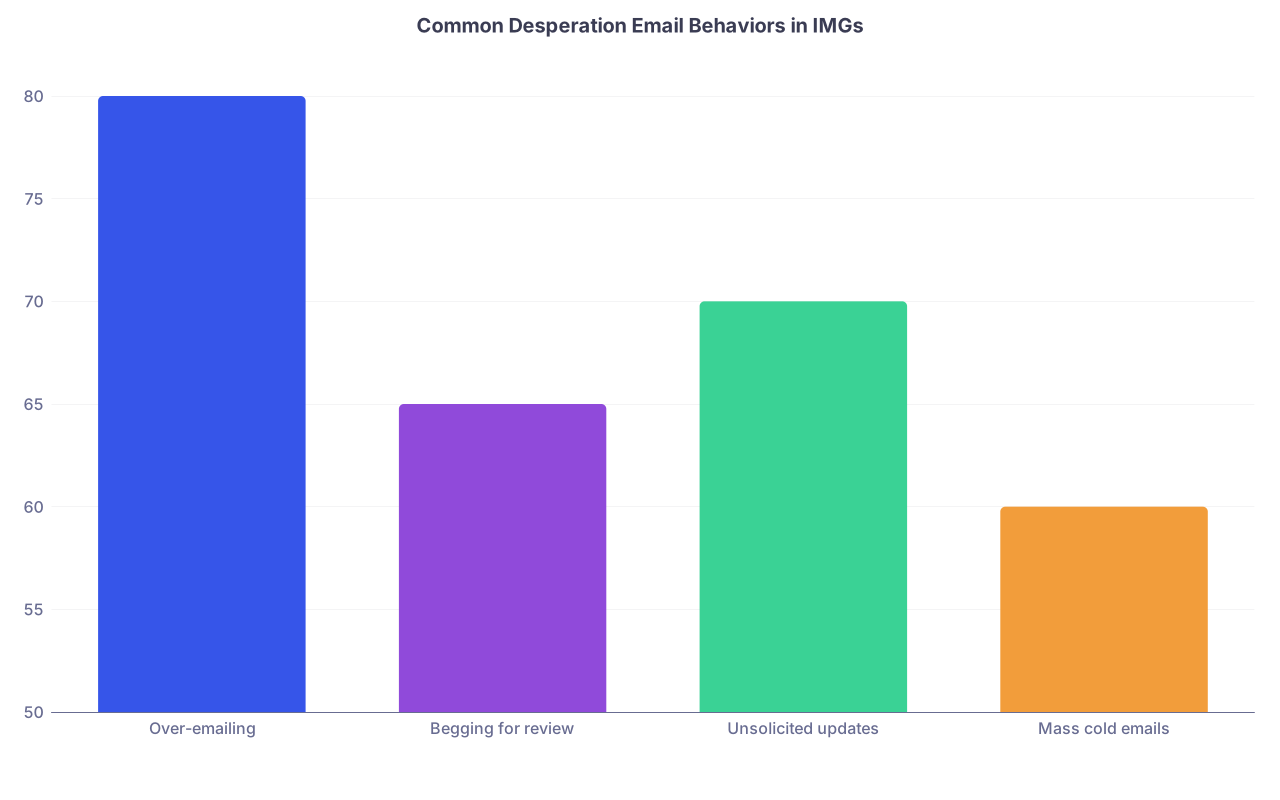
| Category | Value |
|---|---|
| Over-emailing | 80 |
| Begging for review | 65 |
| Unsolicited updates | 70 |
| Mass cold emails | 60 |
If I had to pick the number one giveaway of an anxious IMG, it’s their inbox habits. Programs talk about this. A lot.
The “Did You Review My Application?” Spam
This one is brutal.
You send:
- “Dear Program Director, I wanted to confirm my application was received.”
- Two weeks later: “Just checking if my application has been reviewed.”
- Then: “I remain extremely interested in your program.”
- Then: “This program is my dream.”
Here’s how that lands on the other side:
- They assume you don’t understand the volume they deal with.
- You look like you think the rules don’t apply to you.
- You’re adding work without adding value.
Real outcomes I’ve seen:
- Applicant flagged by the coordinator as “high maintenance”
- PD literally saying, “If they’re this needy now, imagine them as a resident.”
Do not make this mistake.
Use this instead:
- One polite introductory note only if you have a legitimate connection (home rotation, mentor, aligned research).
- No “Did you review my ERAS yet?” emails. Ever.
- Post-interview: one solid, specific thank-you. Not a weekly newsletter.
The Cold Email Blast To Every Faculty Member
Another disaster: emailing 5–10 faculty in the same department with the same generic message.
Subject line: “Passionate IMG seeking opportunity” Body: Copy-paste about being hardworking, dedicated, and “willing to do any work.”
Red flags here:
- Faculty talk. When they all get the same email, you look unserious.
- The tone screams, “I just want a visa spot, any spot.”
- The lack of specificity shows you don’t care about them, just about yourself.
How to not look desperate:
- If you must email, email one carefully chosen person.
- Mention one concrete thing they’ve done that you actually read (a paper, a talk, a project).
- Ask for advice, not a favor: “Would you have any guidance for an IMG with X background interested in Y area?”
The Oversharing, Trauma-Dump Email
You’re stressed. You’ve sacrificed. Family pressures are real. I get it.
But explaining all of that in a long emotional email to a PD or coordinator—especially before they even interview you—doesn’t make them sympathetic. It makes them nervous.
Common mistakes:
- Detailing financial hardship, family illness, visa panic.
- Explaining how “this is my only hope.”
- Apologizing in advance for scores or gaps with dramatic backstories.
Programs aren’t equipped (or willing) to become your rescue line. They want to train physicians, not manage someone’s entire life catastrophe.
You can explain context in your personal statement or ERAS if it’s relevant. You do not need to dump it into people’s inboxes.
2. Personal Statements That Beg Instead Of Impress

Personal statements are where many IMGs accidentally torch themselves. They think they’re showing gratitude and humility. Programs read it as low confidence and dependence.
The “I’ll Take Anything” Tone
Watch for lines like:
- “I am willing to work in any location and under any conditions.”
- “I will be forever grateful for any opportunity.”
- “I humbly beg your consideration.”
- “As an IMG, I know I am not as competitive, but…”
You think this shows flexibility. It doesn’t.
Programs want:
- Candidates who chose them for clear, thoughtful reasons.
- People who will stay, grow, and contribute.
- Colleagues, not charity cases.
Desperation signals in personal statements:
- Overemphasis on being an IMG as a disadvantage.
- Constant apologizing for your background.
- Talking mostly about your need instead of your value.
Replace that with:
- Specific reasons you’re suited to the specialty.
- Concrete examples: cases, projects, clinical moments.
- Quiet confidence: “I bring X, Y, Z strengths that align with this work.”
Over-Explaining Every Weakness
Another trap: turning your personal statement into a defensive essay.
Examples:
- A full paragraph about one failed attempt at Step.
- Detailed excuses about why you had a gap, with every personal drama included.
- Trying to pre-empt every possible concern in one go.
Programs do not have time—or patience—for an application that’s mostly spin control. Address major issues briefly and factually if needed. Not like a legal defense.
One or two sentences, max, for test failures or interruptions, unless it’s central to your story and you can show true growth.
3. Wild, Unfocused Program Lists
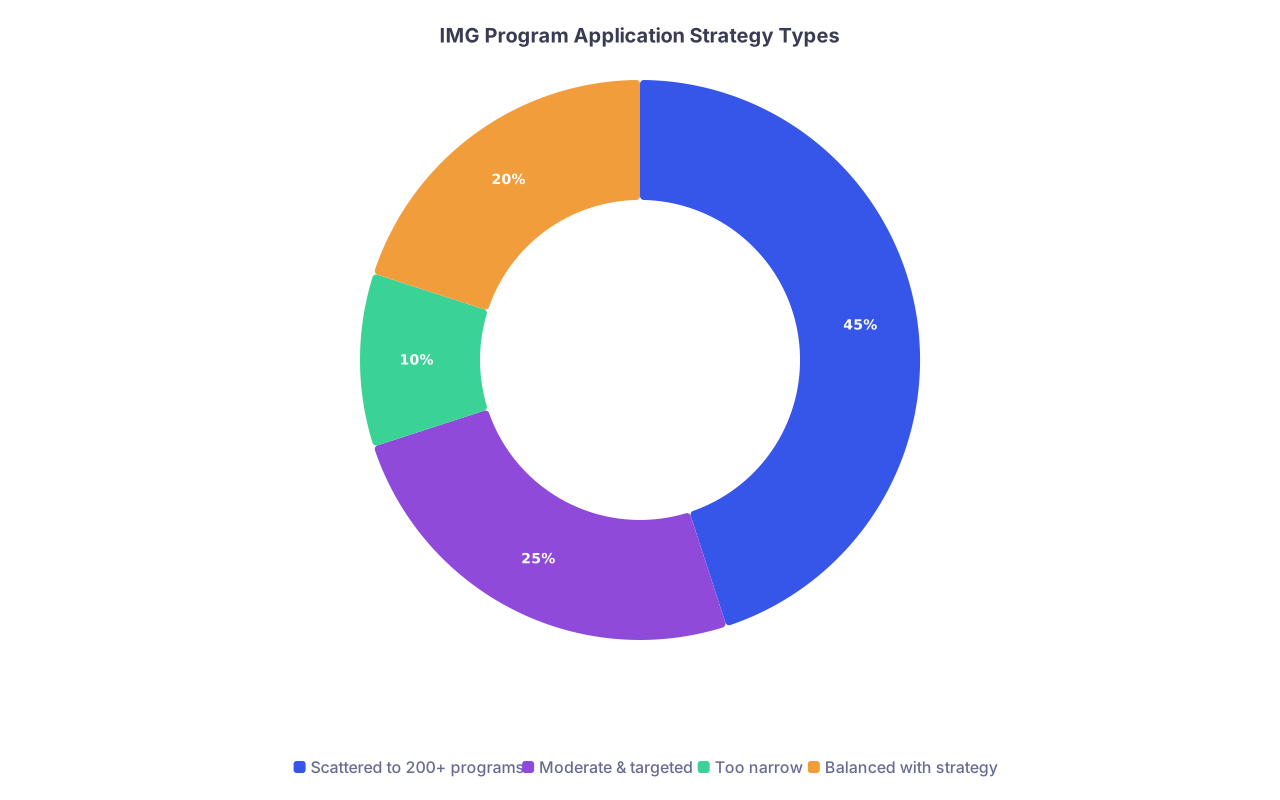
| Category | Value |
|---|---|
| Scattered to 200+ programs | 45 |
| Moderate & targeted | 25 |
| Too narrow | 10 |
| Balanced with strategy | 20 |
Your program list tells a story about you. And some of you are telling the story: “I have no idea what I’m doing. I just need someone to take me.”
The “Apply To Everything That Moves” Approach
IMGs love to brag in forums:
- “Applied to 250+ IM programs.”
- “Sent to every FM program in the country.”
- “Even applied to prelim surgery just in case.”
Here’s how that can backfire:
- You obviously haven’t researched most of those programs.
- Your signals (if you have them) get diluted to uselessness.
- If multiple programs in the same city see you applying across wildly different specialties, you look directionless.
Programs see this and think:
- “Will they actually come here?”
- “Or are we just one of 200 back-up plans?”
Better approach:
- Choose a primary specialty and stick to it unless you have a very deliberate dual-plan.
- Build tiers: realistic programs, a stretch group, and a safety group—but all with real reasons.
- Prioritize places where IMGs historically match, where your visa is supported, and where your profile actually fits.
Internal Medicine + Family Medicine + Prelim + Transitional + Random Specialty
I’ve seen ERAS lists that look like a panic attack:
- 120 IM
- 60 FM
- 30 Prelim Medicine
- 20 TY
- 15 Neurology
- 10 Psych
That’s not strategy. That’s thrashing.
Programs assume:
- You don’t really care about their specialty.
- You’re likely to leave or be unhappy.
- You will say whatever they want to hear.
If you’re applying to more than 2 specialties, it better be extremely intentional. And your personal statement, letters, and experiences need to match each path. Not some vague “I like working with people” essay recycled for everything.
4. Red-Flag Interview Behavior

| Step | Description |
|---|---|
| Step 1 | Interview Start |
| Step 2 | Excessive flattery |
| Step 3 | Over-sharing personal struggles |
| Step 4 | Asking about visa as first question |
| Step 5 | Program doubts sincerity |
| Step 6 | Program worries about stability |
| Step 7 | Program sees visa>training priority |
Once you finally get an interview, this is where a single desperate move can sink you.
Over-Flattering The Program
Saying you like the program is normal. Saying things like:
- “This is my absolute top choice” (to 10 programs)
- “I will rank you number one” (and they know IMGs say this constantly)
- “I’ve dreamed of training here my entire life” (about a community hospital you’d never heard of before ERAS)
That doesn’t build connection. It sets off alarms.
Residents are especially allergic to fake enthusiasm. They remember who came across as genuine and who was performing.
Instead:
- Pick 2–3 honest, specific reasons you like the program (curriculum style, patient population, research niche, mentorship culture).
- State strong interest without theatrics: “I could see myself fitting well here because…”
- Save “ranking” language unless you truly mean it and are using official communication thoughtfully.
Dumping Your Visa Anxiety On Them
You should absolutely care about visa sponsorship. You should not make it the opening theme of your interview.
Examples that hurt you:
- First question of the day: “Will you sponsor H-1B?” in a tense, urgent tone.
- Bringing up fears about previous visa denials or complex immigration issues in detail.
- Repeating, “I really need a visa sponsor” in multiple answers.
The message this sends:
- Your main priority is not training, it’s paperwork.
- You might come with additional administrative burden.
- You may be more likely to panic if visa things go sideways.
What to do instead:
- Check basics before applying (filter by visa type in FREIDA, program websites, or verified forums).
- Ask one clear, calm question if needed during Q&A: “Could you clarify what visa types your program currently sponsors?”
- Don’t apologize for being visa-dependent. Just don’t center your whole personality around it.
Oversharing Personal Struggles Live
I’ve watched candidates turn a standard “Tell me about a challenge you faced” into a 6-minute monologue about:
- Financial disaster.
- Family pressure.
- Mental health crises.
- Romantic breakups.
Not because they’re weak, but because they’re trying too hard to gain sympathy.
Here’s the harsh truth: programs aren’t picking the “most deserving life story.” They’re picking the safest, most reliable future coworker.
Use a challenge example that:
- Has a clear beginning, middle, and resolution.
- Shows problem-solving, not victimhood.
- Reflects professional growth or resilience tied to medicine.
Not a therapy session.
5. Hidden Desperation In Letters, WhatsApp, And Social Media

You’d be shocked how much information gets back to programs indirectly.
Letters Of Recommendation That Over-Explain
Some IMG letters accidentally sabotage you by:
- Spending half the letter describing your visa or your struggles.
- Using phrases like “deserves a chance,” “desperately wants this,” “has nowhere else to go.”
- Comparing you to “other IMGs” constantly, as if that’s your main identity.
If your letter writer keeps emphasizing how much you “need” this, it can backfire. You want letters that highlight clinical competence, reliability, and performance, not pity.
You cannot always control this, but you can:
- Choose authors who know you clinically and have supervised you directly.
- Politely share a CV and talking points focusing on your strengths and achievements.
- Avoid asking people who seem more impressed by your hardships than your work.
WhatsApp Groups And Leaky Comments
I’ve seen IMGs rant in semi-public groups:
- Complaining bitterly about specific programs.
- Admitting they lied about ranking preferences.
- Posting screenshots of emails to PDs and joking about them.
Then someone screenshots that and forwards it. Medicine is a small world. Program staff, residents, and alumni are often in those same networks quietly watching.
Act as if anything you type into the internet can eventually land in front of a PD. Because sometimes it does.
Social Media That Confesses Your Panic
No, programs are not doing deep OSINT on every candidate. They don’t have time. But residents sometimes look people up.
Posts that don’t help you:
- Publicly begging for someone to “help me get any spot.”
- Complaining about the match process unfairness with names attached.
- Contradicting things you say in interviews (“I’m fully committed to IM” on ERAS; “Maybe I’ll just try a different career” on Twitter).
You don’t need a perfect online presence. Just don’t be obviously broadcasting your desperation.
6. The Quiet, Confident Alternative: What To Do Instead
| Situation | Desperation Signal | Confident Alternative |
|---|---|---|
| Emailing programs | Repeated “Did you review me?” emails | One targeted, respectful email if justified |
| Personal statement | “I’ll take anything, anywhere” tone | Clear specialty interest and value you bring |
| Program list | 200+ scattered programs across specialties | Focused, research-based list |
| Interview conversation | Over-flattery and visa-focused | Specific interest, balanced visa questions |
Let’s be clear: you can be deeply motivated, anxious, and under pressure—without showing desperation.
Here’s what controlled, professional ambition looks like.
You respect yourself enough not to beg.
You ask, you apply, you follow up once or twice. Then you move on.You respect programs’ time.
You don’t add noise to their inboxes. When you do contact them, there’s a reason.You show value before asking for opportunity.
Your CV, rotations, letters, and personal statement emphasize what you bring, not just what you want.You accept that some doors will not open.
You stop chasing clearly dead ends and invest in the ones where there’s any realistic path.You play the long game.
If this cycle doesn’t work, you don’t burn bridges by acting unhinged in January–March. That’s when a lot of IMGs do their worst damage.
FAQs
1. Should IMGs ever send a “love letter” or program ranking email?
Yes, but sparingly and honestly. Sending a genuine “you are my clear first choice” to one program can make sense—if it’s true, and your application already fits well there. Sending versions of that to 8–10 programs is a massive integrity and credibility problem. Programs talk. Residents see patterns. Use that tool once, carefully, or not at all.
2. Is it okay to ask a program why I didn’t get an interview?
No. Do not do that. Programs are flooded, and you’ll either get a canned non-answer or silence. Worse, you risk being remembered as “that applicant who demanded an explanation.” If you want feedback, ask trusted mentors or faculty who know your profile. Programs themselves rarely give useful individualized feedback to non-interviewed applicants.
3. How many emails to a program are “too many”?
For most applicants:
- Before interview: zero, unless there’s a legitimate reason (rotated there, faculty suggested you, or a major update like a new Step 2 score).
- After interview: one solid thank-you, possibly one short update if you have a meaningful change (publication accepted, new Step score, clear ranking decision).
Anything beyond 2–3 total contacts in a season usually crosses into “clingy” territory.
4. How can I show strong interest without sounding desperate?
Be specific, not dramatic. Mention concrete aspects of the program that fit you: certain clinics, patient populations, teaching style, or research focus. Use calm, confident language: “I’d be excited to train here because…” or “This program aligns with my goals in X and Y ways.” Skip the inflated phrases like “dream program,” “begging for a chance,” or “my only hope.” Show you chose them thoughtfully, not randomly.
Key points: stop broadcasting panic, begging, and neediness in your communication; focus on demonstrating value and fit instead of pleading for mercy; and remember—professional, calm confidence will take you further than any amount of exaggerated “I’ll take anything” energy ever will.