The fastest way for an IMG to sabotage a residency application is not a bad USMLE score. It is unprofessional social media and sloppy email behavior.
I have watched perfectly competitive international applicants get quietly dropped from rank lists because of a single Twitter thread, a Facebook rant, or a bizarre email response. Programs will not explain this to you. They will just move on to the next applicant.
You are competing in a field where you are already under extra scrutiny as an IMG. You cannot afford these mistakes.
1. The Myth That “Programs Don’t Really Check Social Media”
Let me destroy this fantasy first.
Program directors, chief residents, and coordinators do look at applicants online. Not all of them, not systematically, and not for every candidate. But enough do it that you should behave as if every tweet and every Instagram post has your ERAS photo attached to it.
Here is how it typically happens:
- A name sounds familiar. Someone Googles you out of curiosity.
- A faculty member sees you followed them on X (Twitter) and clicks your profile.
- A resident you met at an open house looks you up on Instagram.
- A coordinator cross-checks your email handle and finds the same username on TikTok.
And once they are there, they cannot unsee what they see.
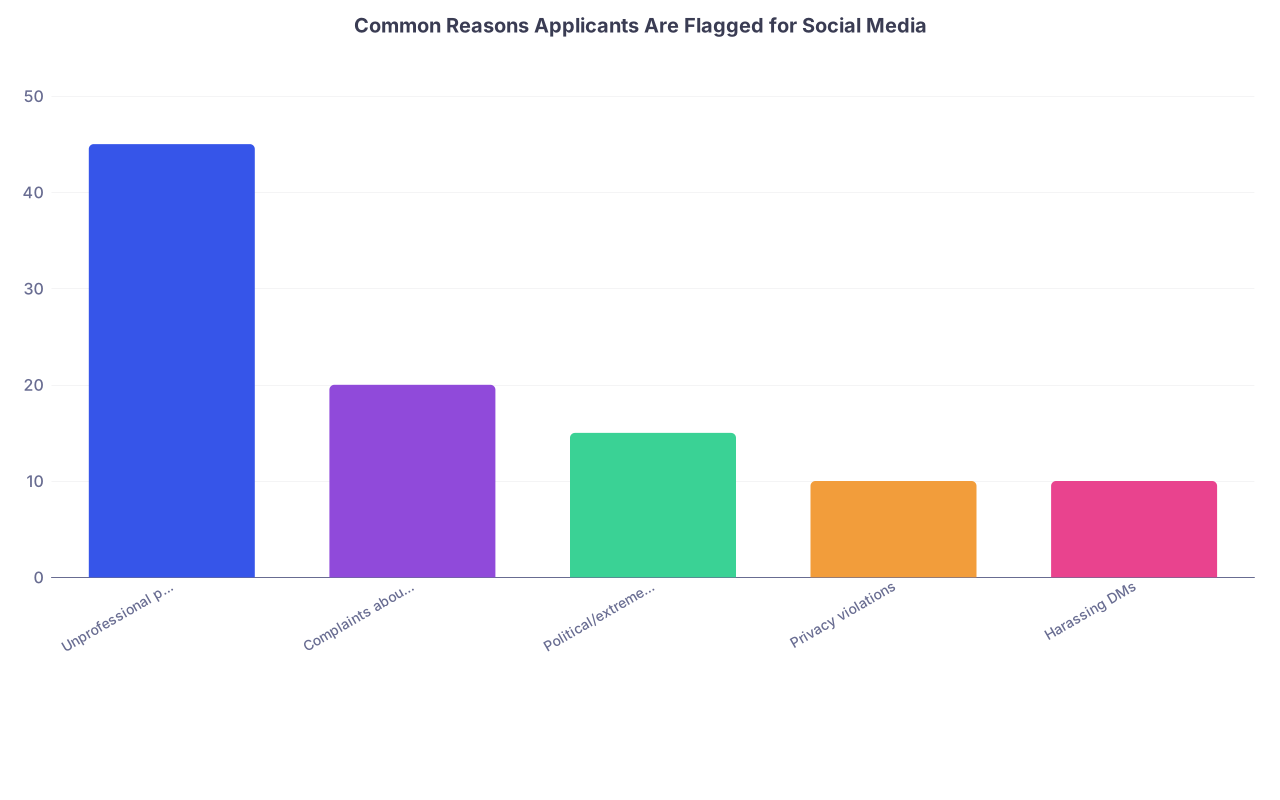
| Category | Value |
|---|---|
| Unprofessional posts | 45 |
| Complaints about prior programs | 20 |
| Political/extreme content | 15 |
| Privacy violations | 10 |
| Harassing DMs | 10 |
The dangerous mistake IMGs make is assuming, “I am overseas, they will never find this.” Wrong. Your digital footprint crosses borders much faster than your credentials.
Your mindset must be simple: if I would not show this to a program director in their office, it should not be public with my name or face on it.
2. Social Media Red Flags That Quietly Kill Your Application
There are patterns that instantly make PDs and residents uncomfortable. Not subtle. Not “maybe this is okay.” Clear red flags.
2.1 Public Complaints About Hospitals, Programs, or Colleagues
This one is fatal.
If your profile includes:
- Posts trashing your home institution or attendings
- Rants about “toxic residency culture” with names or identifiable details
- Stories mocking patients, nurses, or staff
- “Exposing” screenshots of internal messages
You have just told a program: “If we train you, you might put us on blast online the minute you are unhappy.”
Many applicants think: “But I am advocating for change.” Programs do not see advocacy. They see risk.
The worst examples I have seen:
- An IMG posting a screenshot of an attending’s email with “Look at this idiot” above it.
- TikTok videos filmed in recognizable hospital hallways complaining about “stupid patients.”
- A long Facebook post listing all the reasons one hospital was “garbage” during their observership.
Those applicants were done.
2.2 Patient Information Anywhere Near Your Content
HIPAA is not just a U.S. buzzword. It is a mindset. If you casually post patient cases, X-rays, labs, or stories—even de-identified—but with:
- Faces
- Unique stories
- Dates or locations
- Hospital logos
You look like someone who does not understand or respect confidentiality.
I have seen an IMG post a selfie in a delivery room with the newborn visible in the background. No names. But still instantly disqualifying. It screams poor judgment.
2.3 Alcohol, Drugs, and Party Culture – Misjudged
No, you do not have to pretend you never had a beer.
But if your public account is full of:
- Shots of you clearly drunk
- Posts about blacking out
- Jokes about using recreational drugs
- Captions like “Too hungover to function but still rounding haha”
This shifts you from “adult with a social life” to “possible professionalism problem.”
The line is simple: normal, tame social photos = fine. Anything that suggests impaired judgment, excess, or recklessness = not worth the risk.
2.4 Extreme, Aggressive, or Obsessive Political Content
Read this carefully: it is not about your political views. It is about tone and behavior.
What worries programs:
- Aggressive, insulting arguments in comment sections
- Posts calling groups of people idiots, trash, or worse
- Extremist or hate-adjacent content (even memes or jokes)
- Conspiracy theories, medical misinformation, anti-vaccine rants
Residency is high stress. Programs look for stability. If your public online behavior looks volatile, combative, or rigid, they will not gamble on you.
2.5 Oversexualized or “Thirst Trap” Profiles Tied to Your Real Name
Again, adults have dating lives. That is not the issue.
The problem is when:
- Your public IG/TikTok has your full name and MD/MBBS in the bio
- Your ERAS photo and your “influencer” content are obviously the same person
- You are posting highly provocative photos or suggestive videos under that name
Residency is still conservative in many places. You can fight that in principle if you want. But understand the risk: you are asking a PD to defend your online persona to a hospital board if something surfaces.
If you insist on that type of content, you need strict separation: different name, no face linkable to ERAS, fully private, no colleagues following from that account.
2.6 “Edgy” Medical Humor That Looks Like Cruelty
Dark humor is common in medicine. Most residents have heard it. Saying it privately to friends is one thing. Posting it publicly is another.
Problematic patterns:
- Jokes that dehumanize patients (“another beached whale in the ED”)
- Memes about noncompliant patients “deserving” poor outcomes
- Mocking accents, disability, mental illness, or religion
- “I hate old people” or “All psych patients are manipulative” types of posts
You think you are being edgy and relatable. A PD sees a future complaint to the hospital and a potential news story.
3. The “Professional Account” Trap for IMGs
A lot of IMGs do something that looks smart and is actually dangerous: they create a “professional” social media account to impress programs.
This goes wrong in very predictable ways.
3.1 Low-Quality Medical Content Shared with Overconfidence
You start a medical-themed IG or TikTok to show “passion for education.” Fine idea in theory. The problem:
- You oversimplify complex topics
- You share borderline inaccurate “tips” for laypeople
- You promote off-label or unproven treatments
- You speak like an authority before you are one
Now a program sees not “enthusiastic teacher” but “potential misinformation machine with our hospital name in the bio.”
3.2 Posting Cases from Rotations or Observerships
I keep seeing this:
“Interesting case from my U.S. observership today…”
Then: lab values, imaging, a disease so rare it is Googled in seconds and tied to that hospital.
Even de-identified, repeating this pattern tells programs: you do not fully grasp confidentiality culture in the U.S.
3.3 Publicly Tagging Hospitals and Preceptors
If you post:
- Photos in hospital corridors with badges visible
- “Shadowing Dr. X at Y Hospital!” with their full name
- “Love my rotation at [specific clinic]” with dates
You may think you are networking. But:
- Hospitals often have policies against this.
- If anything goes wrong, the hospital now has to answer for your account.
- You are adding a public trail that programs can cross-check against your CV.
Keep your online “professionalism” simple and boring:
- Neutral medical topics
- No case specifics
- No identifiable locations or staff
- No strong opinions on controversial medical issues
4. Email Behaviors That Make Programs Drop You Instantly
If social media is one minefield, email is another. IMGs underestimate how ruthless programs can be about email sloppiness.
| Behavior | Program Reaction |
|---|---|
| Unprofessional email address | Question judgment |
| No subject line / vague subject | Assume disorganization |
| Demanding or rude tone | Red flag professionalism |
| Mass generic emails | Ignore / delete |
| Late or incomplete replies | Doubt reliability |
4.1 Unprofessional Email Addresses
If your email is:
- partydoc89@…
- sexygirlmed@…
- killshotmedstudent@…
Or anything similar, stop. You are not a teenager applying to a summer camp.
Use a clean format:
- firstname.lastname@…
- firstinitiallastname@…
- add “md” or “mbbs” only if you must, but do not get cute with it.
And do not mix your old Gmail from high school with your ERAS application. Create a professional one and stick to it.
4.2 Sloppy, Vague, or Missing Subject Lines
Program coordinators skim hundreds of emails. If your subject line is:
- “Question”
- “Hi”
- (blank)
You look careless.
Use clear, short, specific subjects:
- “ERAS Application – [Your Name] – Question about IV dates”
- “Thank You – [Your Name], Interview 10/15, Internal Medicine”
This is not style. It is respect for their time.
4.3 Overfamiliar or Overformal Greetings
Two extremes both look bad.
Too casual:
- “Hey Sarah,”
- “Hi dear,”
- “Hello my friend,”
Too stiff or weird:
- “Respected Sir/Madam,”
- “To Whom It May Concern in the Honorable Committee,”
Aim for simple:
- “Dear Dr. [Last Name],” for faculty or PDs.
- “Dear [Ms./Mr. Last Name],” for coordinators if you know their gender, otherwise “Dear [First Name Last Name],”.
I have seen IMGs start emails with “Hi sweetie” to female coordinators because that is normal in their culture. In the U.S. context, it is inappropriate and creepy.
4.4 Long, Emotional “Story Dump” Emails
Programs do not have time to read your entire life story in an email.
Classic mistake: an IMG sends a 900-word message explaining every hardship they have faced, asking for special consideration or pre-interview feedback.
Program reaction: “This applicant may be high-maintenance and boundary-blind.”
Your emails should be:
- Brief
- Clearly structured
- Focused on a specific question or request
- Free of emotional pressure (“This is my dream,” “My life depends on this”)
4.5 Demanding or Entitled Tone
Here is what gets you flagged:
- “Why did I not receive an interview? I have strong scores.”
- “I deserve feedback on my application.”
- “I request you to reconsider my application.”
You may feel these things. You cannot email them.
Appropriate tone:
- “I understand the program is extremely competitive…”
- “If possible, I would be grateful for any general feedback regarding my application for future cycles.”
And if they do not respond? You accept it. You do not send a follow-up aiming to guilt or pressure them.
4.6 Ignoring Basic Professional Structure
Your emails should always include:
- A short greeting
- 1–3 tight paragraphs
- A polite closing line
- Your full name, credentials, and AAMC/ERAS ID in the signature
If you are writing from your phone, say so once in the signature (“Sent from my mobile, please excuse brevity”), not as an excuse for chaos.

| Step | Description |
|---|---|
| Step 1 | Need to contact program |
| Step 2 | Do not send |
| Step 3 | Draft brief message |
| Step 4 | Check tone and subject line |
| Step 5 | Add proper greeting and signature |
| Step 6 | Proofread once |
| Step 7 | Send once and wait |
| Step 8 | Is email necessary? |
5. Post-Interview Email Mistakes That Hurt Your Rank Position
After interviews, many IMGs panic. That panic shows up in email form, and programs remember.
5.1 Spamming Multiple Follow-Ups
Standard is simple:
- One thank-you email within 24–48 hours of the interview.
- Possibly one brief update / interest email later in the season if appropriate.
Anything beyond that starts to feel desperate or intrusive.
Bad patterns:
- Weekly emails asking where they will rank you.
- Re-sending slightly edited thank-you messages to the same person.
- Cc-ing extra faculty “to make sure this is seen.”
Programs compare notes. “This applicant has emailed me three times already” is not a compliment.
5.2 Overpromising and Lying About Rank Intentions
Do not tell three different programs “You are my number one choice” in writing. Residents talk. PDs talk. People move between institutions.
If you get caught, your credibility is gone.
Better wording if you genuinely intend to rank them highly:
- “Your program will be ranked very highly on my list.”
- “I feel your program is an excellent fit for my goals and I am strongly interested.”
Reserve “I will rank your program first” for exactly one place—and mean it.
5.3 Sending Generic, Copy-Paste Thank-You Emails
Coordinators and PDs can smell a template that you sent to 25 programs.
“We had a great conversation about your program’s strengths” with no specifics tells them nothing.
You do not need an essay. One or two specific details are enough:
- “I appreciated your explanation of the night float system and emphasis on resident autonomy.”
- “Our discussion about serving the local immigrant community resonated with me.”
This says: I was truly present during the interview. I am not just broadcasting.
6. Time-Zone, Delay, and Response-Style Mistakes IMGs Make
Being overseas or in another time zone is not an excuse for chaos. Programs need to know you can function smoothly in a U.S. system.
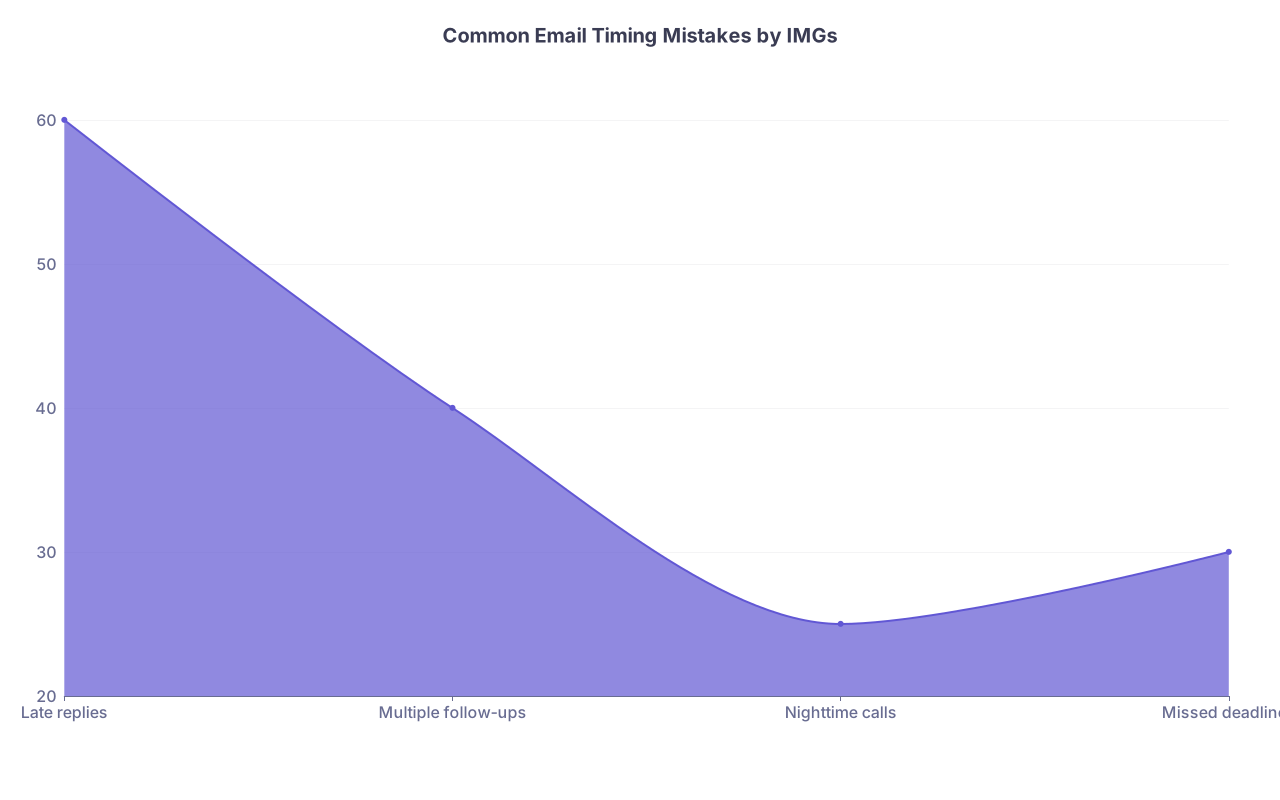
| Category | Value |
|---|---|
| Late replies | 60 |
| Multiple follow-ups | 40 |
| Nighttime calls | 25 |
| Missed deadlines | 30 |
6.1 Delayed Responses to Important Emails
Interview invitations often fill within hours. If you take 2–3 days to check your email, you will miss them. Programs will not chase you.
Critical steps:
- Use an email app with push notifications.
- Check spam/junk folders daily.
- Reply to invitations same day, ideally within a few hours.
And respond with clarity:
- Confirm time zone carefully.
- Repeat the date and time in your email to avoid confusion.
6.2 WhatsApp, DMs, and Other Informal Channels
Some IMGs do this: they find a PD’s or resident’s WhatsApp or social media and message them about their application.
This nearly always backfires.
Unsolicited messages to personal numbers or accounts feel invasive. Programs may see it as boundary issues at best, harassment at worst.
If a program gives you an official WhatsApp group for updates, fine. But do not treat it as a back door to bypass email. Do not directly message PDs unless they explicitly invite it.
6.3 Calling at Odd Hours Without Permission
Cold-calling a program at 2 AM their local time because you are in a different country is a great way to be remembered—for the wrong reason.
If you must call:
- Convert to their local time zone.
- Use business hours only.
- Keep the call very short and only for urgent, appropriate issues (e.g., technical problem with an interview link right before your scheduled time).
And even then, email first if possible.
7. How to Clean Up Your Online and Email Presence – Safely
Here is the protection plan. Do this before applications go out.
7.1 Social Media Audit Checklist
Step-by-step:
- Google your full name, common variants, and usernames. See what appears on the first 3 pages.
- Open every public account: Facebook, Instagram, TikTok, X, LinkedIn, YouTube, blogs, old forums.
- Remove or lock down any of the following:
- Posts with alcohol, partying, or suggestive content.
- Complaints about training, professors, hospitals, or health systems.
- Political fights, insults, or aggressive debates.
- Any mention of patients, cases, hospitals, or rotations with identifiable details.
Then:
- Set personal accounts to private.
- Remove MD/MBBS/Dr from bios on casual accounts.
- Use a neutral headshot or abstract image, not party photos.
If you are not sure whether something is okay, assume a grumpy 60-year-old program director is staring at it and asking: “Would I hire this person?” If the answer is anything but yes, delete it.
7.2 Email System Setup
Do this once and you reduce future mistakes drastically.
Create a professional email address.
Set a clean signature with:
- Full name
- Medical degree (e.g., MD, MBBS)
- Country of medical school
- ERAS/AAMC ID
- Professional phone number (if needed)
Use one device (phone or laptop) as your primary platform, with:
- Notifications on
- Spam folder checked regularly
- A simple folder system (Interviews, Programs, Thank You, etc.)

7.3 Drafting Safe Templates (Then Personalizing)
Have a few base templates ready:
- Interview thank-you email
- Clarification/Question email to coordinators
- Post-interview interest/update email
But never send them untouched. Always:
- Add the correct program name.
- Insert 1–2 specific references to your interaction.
- Double-check you did not leave another program’s name in the text. That mistake is common and embarrassing.
FAQs
1. Should I delete all social media during application season?
You do not have to disappear completely. But you should either: a) lock all personal accounts to private and scrub anything borderline, or b) keep only a minimal, professional LinkedIn-style presence. If you do not trust yourself to judge what is appropriate, going dark temporarily is safer than leaving risky content up.
2. Can I use social media to network with residents and programs?
Yes, cautiously. Following programs and residents, liking posts, and occasionally commenting professionally is fine. What you must avoid is DM-ing PDs or residents aggressively about your application, asking for interviews, or trying to argue that you deserve a chance. Public, respectful engagement is acceptable. Private pressure is not.
3. Is it okay to mention my political or religious views on social media?
Mild, non-combative content usually does not matter. The problem is extreme, aggressive, or insulting posts. If your comments attack groups of people, ridicule beliefs, or show volatility, you look like a future HR problem. If you want zero risk, keep political and religious discussion private or very measured during the application cycle.
4. What if a program emails me at 2 AM my time with an interview invite?
You are not expected to respond instantly in the middle of the night, but you should reply as soon as it is reasonable when you are awake—ideally within a few hours. If slots are first-come, first-served, consider checking email twice during your night until interview season calms down. The more responsive you are, the fewer opportunities you miss.
5. Can I ask programs why I was not offered an interview or did not match there?
You can, but be realistic. Most programs will not provide individual feedback. If you choose to ask, your email must be short, humble, and clearly future-focused: “If possible, I would be grateful for any general feedback that could help strengthen my application in future cycles.” Ask once. Do not follow up if they do not respond.
Key points to remember: your digital behavior is part of your application, whether you like it or not. Clean social media and disciplined email habits do not guarantee you a spot, but messy ones can absolutely cost you one. Protect yourself: audit, simplify, and treat every online action as if a program is watching. Because sometimes, they are.