
The fastest way for an IMG to kill a residency application is not weak scores. It’s over‑explaining their background until they sound like an apology, not a physician.
You’re not being rejected because you’re an IMG. You’re being rejected because you talk about being an IMG like it’s a problem that needs defending.
Let me walk you through how IMGs accidentally talk themselves down—and how to stop doing it today.
The Core Mistake: Treating “IMG” Like a Defect To Justify
Most IMGs I work with repeat the same pattern in their personal statements, emails, and interviews:
They start defending before anyone attacks.
It looks like this:
- “As an international medical graduate from [Country], I know I am at a disadvantage…”
- “Although my school is not well‑known in the US…”
- “Because of visa limitations and being an older graduate…”
- “Even though I had to take Step 1 twice…”
You think you’re “being transparent” or “showing insight.” Program directors hear something else:
- Insecurity
- Low confidence
- Extra work to justify you
You’re confirming every bias they might have before they even review your actual strengths.
Stop doing their negative framing for them.
Where IMGs Over‑Explain Themselves Into a Corner
You do not just over‑explain in one place. You repeat it across your entire application package until the theme of your file is: “Here is why I am not as good as others.”
Let’s go piece by piece.
1. Personal Statement: Confessional, Not Professional
The personal statement is where most IMGs sabotage themselves.
Common over‑explaining mistakes:
The Defensive Introduction
“As an international medical graduate from a resource‑limited country, I realize my path is unconventional and challenging…”Translation for a busy PD: “I’m about to spend 1.5 pages telling you why I’m not like your top applicants.”
The Over‑Detailed School Explanation
“My medical school is located in [city], in a developing region, and while it’s not internationally recognized, it provided me with a solid foundation and exposure to… (3 more sentences).”Nobody needs the tourism brochure. They need proof of your clinical ability and fit for their specialty.
The Visa/Gap Monologue
“Due to visa issues and financial constraints, I had to delay my exams and could not apply earlier. Having to work in non‑clinical jobs to support my family was difficult, and that’s why I have a gap of X years…”This much detail doesn’t help you. It just raises more questions and emphasizes distance from clinical medicine.
The “I Know I’m Weak” Paragraph
“I know that my scores and attempts may not compare favorably with other applicants, but I am hardworking, resilient, and motivated…”Never write a sentence that starts with “I know I am not as strong as…” or anything close.
Here’s the rule:
If your sentence exists to pre‑emptively defend, excuse, or justify—cut it.
Your personal statement is not a legal defense. It’s a focused argument for one thing: why you will be a strong resident in this specialty.
2. ERAS Experiences: Turning Achievements Into Apologies
I’ve literally seen ERAS entries like this:
- “Research Assistant – This was only a short-term position because I could not get a longer contract due to my visa.”
- “Observer – I know observerships don’t count as US clinical experience like hands‑on rotations, but it still exposed me to the US system…”
Stop explaining what something is NOT.
Your job in ERAS is to:
- Show impact
- Show responsibility
- Show progression
When you write things like “only,” “just,” “I know this isn’t as good as…,” you downgrade your own experience.
Bad:
“Only an observer, with no direct patient care, but I tried to learn as much as possible.”
Better:
“Observed inpatient internal medicine teams, presented patients on rounds, and received direct feedback from attendings on assessment and plan formulation.”
Same reality. Very different impression.
3. CV Emails and Program Correspondence: Oversharing and Over‑Justifying
Another place IMGs talk themselves down: cold emails to coordinators and program directors.
Common self‑sabotaging lines:
- “I know your program receives many applications from better candidates, but I hope you might consider mine…”
- “Since I graduated several years ago and had some gaps in my career, I wanted to explain the reasons…”
- “I understand my application is not as competitive, but I am extremely hardworking…”
You’re basically writing: “Here is a list of reasons not to interview me, in case you missed them.”
If you need to send an update or interest email, it should be:
- Short
- Confident
- Focused on value (what you bring, not what you lack)
Not a confession letter.
4. Interviews: Answering Questions They Didn’t Ask
Over‑explaining is absolutely deadly in interviews.
You get asked a simple question:
“Tell me about yourself.”
And somehow you answer:
“I’m an international medical graduate from [country]. Our curriculum was different, and we didn’t have as much exposure to X. Also, I had to retake Step 1 because of Y. Then I had to move due to family issues which caused a delay, and that’s why there’s a gap…”
They didn’t ask you about your gaps. Or your exam issues. Or your disadvantages.
You brought them up. Early. Voluntarily. With details.
Here’s what over‑explaining sounds like in common interview questions:
Question: “Why did you choose internal medicine?”
Answer (bad): “Back home we don’t have as much access to subspecialties, and I know that as an IMG my chances might be lower, so I decided to be realistic and aim for internal medicine instead of…”
You just told them you’re picking their specialty as a consolation prize.
Question: “Can you walk me through your medical education?”
Answer (bad): “Well, my school is small and not very well‑known. It’s also in a rural region, and we didn’t have as many resources, but we tried our best…”
You framed your training as second‑rate—before they even asked.
Stop giving negative context unless they specifically ask for it.
The Hidden Psychology: Why IMGs Over‑Explain
This mistake is not random. It comes from a specific mindset that gets ingrained over years.
You’ve spent:
- Months reading Reddit and forums about “red flags”
- Years hearing that being an IMG = disadvantage
- Countless conversations with other anxious IMGs obsessing over attempts, visa issues, and cutoffs
So you start to believe something dangerous:
“If I don’t explain everything in detail, they’ll think I’m hiding something and reject me.”
Reality check:
Program directors don’t have time to psychoanalyze your life story. They want to know:
- Can you do the work?
- Will you be safe with patients?
- Will you be a headache or a solid teammate?
- Do you have enough evidence of performance and reliability?
Over‑explaining = you drag them away from those questions and push them into your insecurities.
You’re teaching them what to doubt.
What Actually Needs Explaining (And What Does NOT)
Let’s be precise. You don’t win by being mysterious. You win by being selective.
Here’s the breakdown.
| Situation | Explain Briefly? | Over-Explain? |
|---|---|---|
| Typical IMG background | No | Never |
| Being an IMG with no gaps | No | Never |
| 1–2 year gap with meaningful activity | Yes | No |
| USMLE attempt (1 repeat) | Yes, concise | No narratives |
| Major career change (non-clinical years) | Yes | No life story |
| Visa type/status | Only when asked / in forms | Not in PS |
If something is:
- Already clear in ERAS structure (IMG status, school, year of grad)
- Not catastrophic (e.g., not 5 years completely off medicine with no explanation)
…you do not need to spend paragraphs “explaining yourself.”
Reserve explanations for:
- Short, factual clarification of unusual gaps
- Very brief context for a severe outlier (multiple attempts, long gap)
Even then, 1–2 sentences. Not a full page.
How To Fix Your Language: From Defensive to Professional
Let’s get concrete. You need replacement patterns in your head.
Replace “Defensive Framing” With “Neutral Facts + Value”
Bad:
“As an IMG from a lesser-known school, I know I face challenges in matching, but…”
Better:
“I completed my medical education at [School], where I developed a strong interest in [specific area of your specialty].”
Bad:
“Although I do not have hands‑on US clinical experience, my observerships still allowed me to…”
Better:
“Through observerships at [Hospital 1] and [Hospital 2], I gained exposure to US inpatient workflows and multidisciplinary team communication.”
Bad:
“I understand my scores are not as competitive, but I am extremely hardworking…”
Better:
“USMLE preparation required disciplined study while working full‑time, which strengthened my time management and persistence.”
See the pattern? No apologies. No comparisons. No self‑downgrading.
Tight Rules To Protect You From Over‑Explaining
Start applying these immediately:
No “although,” “even though,” or “despite” about your background.
These words usually introduce an apology.No “I know I am not as…” sentences, ever.
If you write “not as,” delete the whole line.If an explanation is longer than 2–3 lines, it’s too much.
Gaps, attempts, visa issues: concise and factual.Do not repeat your “deficiencies” in more than one place.
If it’s mentioned in the PS, don’t bring it up again in interviews unless they specifically ask.If the question didn’t ask “why X is weak,” do not volunteer that X is weak.
Answer what they asked. Not what you’re afraid of.
Rewriting Common IMG Over‑Explanation Traps
Let’s fix some real‑world scenarios.
1. Explaining a 2‑Year Gap
Bad (what I keep seeing):
“I had to move countries, prepare for exams, and due to personal and financial problems I could not engage in clinical work, which is why you see a two‑year gap, but during this time I learned resilience and time management…”
Better:
“From 2021–2023, I focused on USMLE preparation while relocating to the US and supporting my family. During this period, I completed [X observership / Y online course / Z volunteer work] to maintain clinical engagement.”
One sentence of context. One sentence of activity. Done.
2. Explaining a Step Failure
Bad:
“Unfortunately, I failed Step 1 on my first attempt due to underestimating the difficulty, stress from personal issues, and having to work simultaneously. I realized I needed to change my study strategy completely. This failure was devastating, but it taught me…”
This sounds like a therapy note, not a residency application.
Better:
“I had an unsuccessful first attempt at Step 1. I addressed this by restructuring my study plan, adding dedicated question banks, and increasing my practice tests. On my next attempt, I earned a passing score and subsequently scored [###] on Step 2, reflecting this improvement.”
Short. Concrete. Shows correction and result.
3. Answering “Tell Me About Yourself” as an IMG
Bad:
“I’m an international medical graduate from [country]. My school is small and not very well‑known, but it gave me a solid foundation. I faced many struggles with exams and visa issues…”
You just spent your first 30 seconds telling them reasons to worry.
Better:
“I’m a physician who trained at [School] with a strong interest in [specialty area]. Over the past two years in the US, I’ve focused on [USCE, research, teaching, etc.], where I’ve especially enjoyed [specific clinical/research responsibility]. I’m particularly drawn to your program because of [X feature that matches your background].”
See the difference? Both are true. One is strategic.
Why Over‑Explaining Hurts You With Busy PDs
Program directors are screening hundreds, sometimes thousands of applications.
They do not read like English professors. They skim for:
- Scores and attempts
- Year of graduation
- US experience
- Evidence of functioning in real clinical teams
- Communication quality
Here’s what over‑explaining signals to them subconsciously:
- You need emotional reassurance, not just professional assessment
- You may be high‑maintenance
- You may struggle to communicate concisely with colleagues and patients
- You focus on obstacles more than solutions
They’re not just evaluating your story. They’re evaluating how you talk under mild pressure—because that’s exactly what residency is.
A resident who spends 5 minutes defending why something went wrong instead of giving a 30‑second summary and a plan? Exhausting.
Don’t sound like that in your application.
A Simple Framework To Check Your Application Language
Before you submit anything—personal statement, email, answer—run it through this filter:
Is this sentence explaining a weakness they haven’t asked about?
If yes, cut or shorten.Does this line compare me to “other applicants” or “better candidates”?
If yes, delete it.Is this more about my emotions than my actions and results?
If it’s full of “devastated,” “discouraged,” “heartbroken,” tone it down.Can I say the same thing in half the words without losing meaning?
Shorter is usually stronger.Would this sound confident if read out loud by somebody else?
If it sounds like begging, apologizing, or confessing—rewrite.
Visualizing Where IMGs Waste Space Explaining Themselves
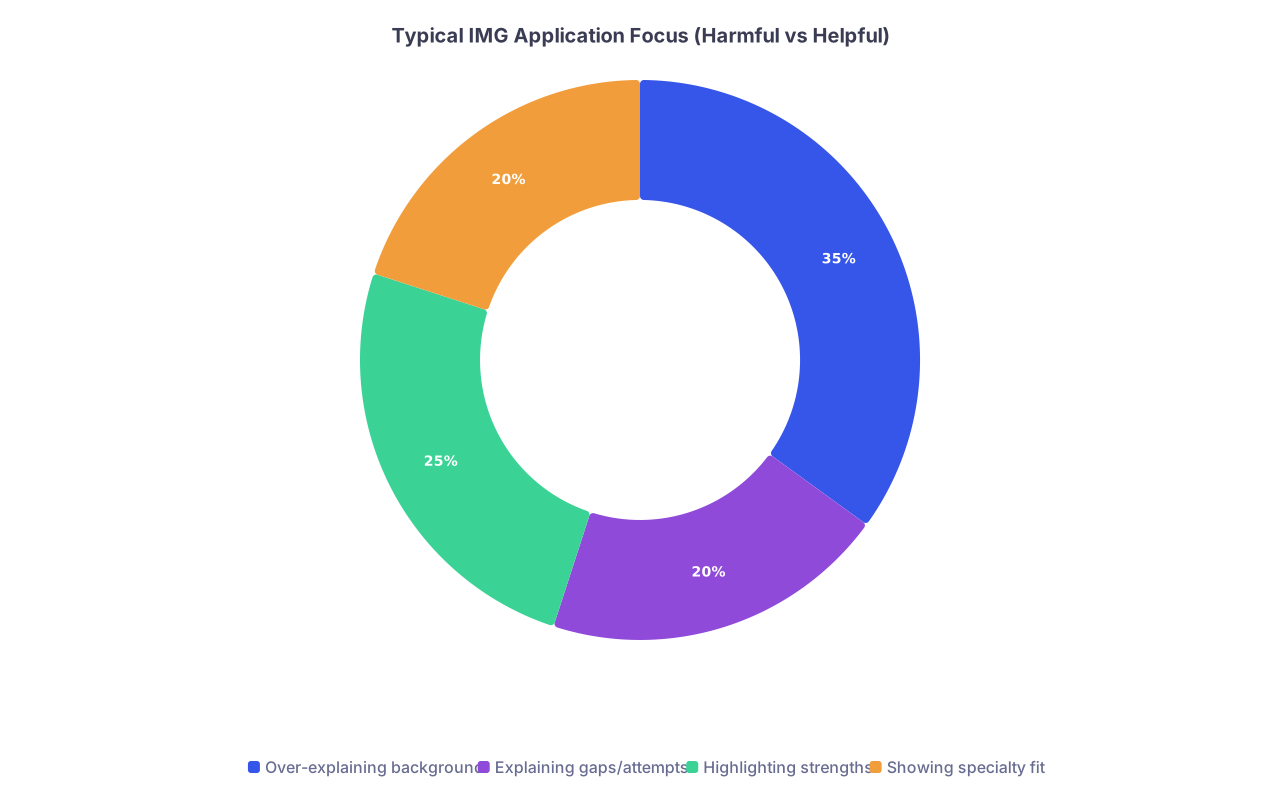
| Category | Value |
|---|---|
| Over-explaining background | 35 |
| Explaining gaps/attempts | 20 |
| Highlighting strengths | 25 |
| Showing specialty fit | 20 |
Most IMGs pour the majority of their words into the wrong buckets. You need to shift that.
What To Do Instead: Quiet Confidence, Clear Evidence
You do not win by pretending your path is identical to a US grad’s. It’s not.
You win by:
- Owning your path without dramatizing it
- Showing that you operate at the expected level
- Proving you’re teachable, stable, and reliable
- Speaking like a colleague, not like someone asking for a favor
That means:
- Neutral description of your background
- Emphasis on recent, relevant, clinical or research work
- Concise explanations only when needed
- No self‑put‑downs. Not even “jokes” like “I know we IMGs have it hard.”
They’re not your friends. They’re evaluating you.
Quick Before‑and‑After Checklist for IMGs
Print this out if you need to.
Before you submit:
- Remove every sentence that starts with “Although I am an IMG…”, “Even though…”, or “Despite…”
- Delete references to “less competitive,” “weaker,” “disadvantage,” “less known school”
- Cut every paragraph where you’re justifying instead of informing
- Trim every explanation of a problem to 1–2 sentences, followed immediately by what you did about it
- Make sure your personal statement spends at least 70% of its length on:
- Why this specialty
- What you’ve done in this specialty
- How you function in teams
- What you want from training and what you bring

| Step | Description |
|---|---|
| Step 1 | They ask about issue? |
| Step 2 | Do NOT bring it up |
| Step 3 | State fact in 1-2 sentences |
| Step 4 | Describe corrective action |
| Step 5 | End with current strength/result |
| Step 6 | Yes or No |
That’s the only time you explain. When asked. Briefly. With a solution.
FAQs
1. If I don’t explain my weaknesses, won’t programs think I’m hiding something?
No. Your file already shows your scores, attempts, year of graduation, and experience. That is not “hiding.” You explain selectively when:
- There’s a major gap
- There’s a repeat attempt or extreme outlier
- They directly ask you about it
And even then, you explain like a professional: brief, factual, focused on what you did to correct it. Not like someone giving a confessional speech.
2. Should I mention being an IMG in my personal statement at all?
Usually, no. Being an IMG is obvious from your ERAS data. You don’t need to open your statement with “As an IMG…” If there is something unique about your training that directly strengthens your specialty fit (e.g., heavy exposure to infectious disease for ID, rural primary care for FM), then mention that experience—not the label “IMG.”
3. How do I know when I’ve crossed into over‑explaining in interviews?
If your answer:
- Goes longer than 60–90 seconds for a single question
- Includes personal hardship details they did not ask for
- Repeats the same weakness in multiple answers
…you’ve crossed the line. Practice with a timer and a trusted person. Have them interrupt you the moment you drift from facts and actions into long emotional justification.
4. Can explaining my struggles ever help me stand out positively?
Yes—but only when it’s handled with discipline. Short, specific, and tied directly to growth or performance. Example:
“I had a failed attempt on Step 1. I restructured my study strategy, added daily UWorld blocks, and simulated test conditions weekly. I passed on my next attempt and then scored 246 on Step 2, which reflects those changes.”
That works. What does not work is a one‑page story about how devastated you were, how unfair everything felt, and how much harder it is for IMGs compared to others.
Open your personal statement and ERAS entries today and highlight every sentence that defends, apologizes for, or justifies your background. If it doesn’t clearly strengthen your case as a future resident, cut it or rewrite it in half the words.