
Understanding ECFMG Certification as a Caribbean IMG
For a Caribbean international medical graduate, ECFMG certification is the gateway to U.S. residency training. Without it, you cannot start an ACGME-accredited residency or obtain an unrestricted license in most states. Knowing how to get ECFMG certified—step by step—can mean the difference between a smooth path to the Caribbean medical school residency of your dreams and years of delay.
At its core, ECFMG certification confirms that:
- You graduated from a medical school that meets specific standards
- You passed the required licensing exams (USMLE Steps)
- You verified your credentials and identity according to ECFMG requirements
For Caribbean IMGs, there are unique advantages and challenges:
- Advantage: Many Caribbean schools (like SGU, AUC, Ross, Saba, etc.) are highly experienced with the US system and have structured support for ECFMG certification and the SGU residency match process.
- Challenge: State licensing rules, school recognition issues, and perception biases mean you must be more organized, earlier, and more strategic than most U.S. MDs/DOs.
This guide breaks down:
- What ECFMG certification is and why it matters
- Concrete steps and timelines for Caribbean IMGs
- Strategy to integrate ECFMG with your USMLE prep and residency plans
- Common pitfalls—and how to avoid them
ECFMG Certification Basics: What Caribbean IMGs Must Know
What Is ECFMG Certification?
The Educational Commission for Foreign Medical Graduates (ECFMG) certifies IMGs who wish to enter U.S. residency. As of 2025, ECFMG certification generally requires:
Medical school eligibility
- Your medical school must be listed as “recognized/approved” in the World Directory of Medical Schools (WDOMS) with an ECFMG-eligible note.
- Your school must meet additional quality criteria required by ECFMG and, increasingly, by state licensing boards.
Examination requirements
- USMLE Step 1 (Pass)
- USMLE Step 2 Clinical Knowledge (CK) (Pass)
- There is no Step 2 CS anymore; its communication and clinical reasoning components are incorporated into other ECFMG requirements and residency expectations.
Medical education credential verification
- Primary-source verification of your medical diploma and transcript through ECFMG/EPIC.
- This is the part many IMGs underestimate in terms of time—especially if your school or home country has slow administrative processes.
Meeting ECFMG’s policies & professionalism standards
- Identity verification, truthful applications, proper use of ECFMG services.
- No involvement in exam irregularities or fraudulent documentation.
Why ECFMG Certification Is Essential for Caribbean IMGs
You need ECFMG certification to:
- Start a U.S. residency in an ACGME-accredited program
- Begin certain clinical fellowship programs
- Apply for some state medical licenses post-residency
- Be eligible for J-1 visa sponsorship (the primary visa pathway for IMGs in residency)
For Caribbean IMGs aiming at competitive programs (e.g., internal medicine at mid-to-large academic centers, family medicine in desirable locations, or subspecialty pathways), early and clean completion of ECFMG certification sends a strong signal of professionalism and organization.
The ECFMG 2024+ Landscape: What Changed?
Several shifts are particularly relevant:
USMLE Step 1 is now Pass/Fail
Programs place significantly more emphasis on Step 2 CK. This makes:- Higher Step 2 CK performance critical
- Earlier, structured prep even more important
Clinical skills and communication now assessed more holistically
- Programs look closely at U.S. clinical experiences, letters of recommendation, and interview performance to judge your bedside manner and team fit.
Step-by-Step Path to ECFMG Certification for Caribbean IMGs
This section lays out a detailed roadmap from the first semester of medical school to receiving your ECFMG certificate. Tailor the timeline based on your school’s curriculum, but the structure applies broadly to Caribbean students.
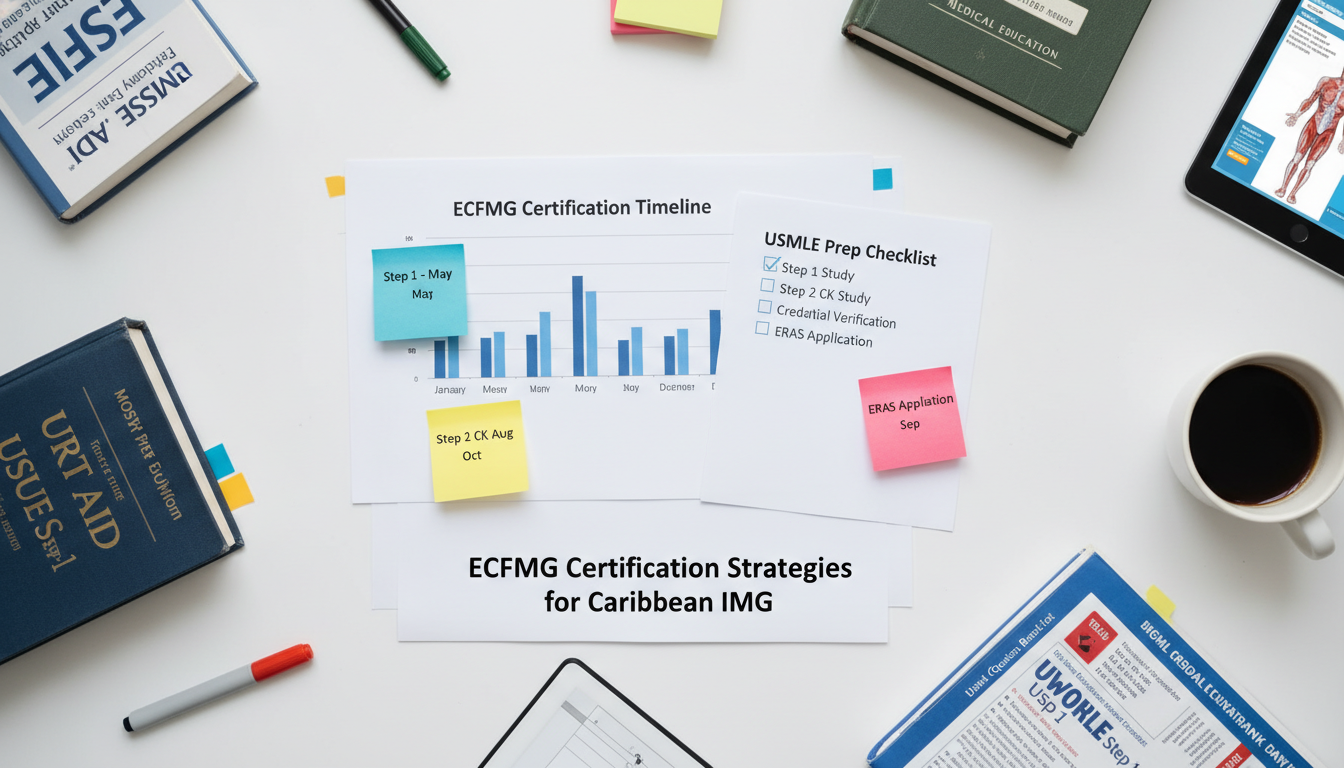
Step 1: Confirm School and Personal Eligibility Early
1. Verify your school’s status
- Go to the World Directory of Medical Schools (WDOMS) website.
- Search for your Caribbean medical school (e.g., St. George’s University, American University of the Caribbean, Ross University, etc.).
- Confirm:
- There is an ECFMG-eligible sponsor note.
- The conditions, if any, listed in the note (such as graduation after a certain date).
If your school is a large and established Caribbean institution, it is almost certainly ECFMG-recognized, but you must still confirm details like graduation year restrictions.
2. Create an ECFMG account early
- Many Caribbean schools advise students to do this in Med 1 or Med 2.
- On the ECFMG website, create your ECFMG/USMLE ID.
- Complete initial registration carefully:
- Use legal name exactly as in your passport.
- Use a stable email (ideally, not your school email if it might change after graduation).
- Keep a copy of your ECFMG ID and login details.
3. Understand school-specific ECFMG processes
Top Caribbean schools often have:
- A dedicated Office of Career Guidance/Dean of Students/Registrar to assist with ECFMG paperwork.
- Institutional timelines for exam eligibility forms and transcripts.
- Experience with thousands of students obtaining ECFMG certification and entering the SGU residency match and similar match outcomes from other schools.
Schedule a meeting or attend the information session these offices offer. Ask them specifically:
- “What are our school’s standard procedures for ECFMG forms and diploma/transcript verification?”
- “What do you recommend as the optimal timing for Step 1 and Step 2 CK for U.S. residency?”
Step 2: Satisfy Exam Requirements Strategically
The core of ECFMG certification is your USMLE performance. For Caribbean IMGs, your score profile is heavily scrutinized.
USMLE Step 1 (Pass/Fail) – Foundation for Everything
Even though Step 1 is pass/fail, the downstream effects of your prep are real. A solid Step 1 foundation is often reflected in a stronger Step 2 CK.
Ideal timing (for Caribbean schools):
- Typically after basic sciences (end of Med 2 or Med 2.5, depending on school curriculum).
Strategic tips:
- Treat Step 1 as if the score still matters:
- Use question banks (UWorld, Amboss, etc.) thoroughly.
- Simulate multiple NBME practice exams.
- Avoid rushing:
- Caribbean schools may push to keep you “on track,” but a marginal Step 1 pass with shaky knowledge can lead to poor Step 2 CK performance—and that will hurt your residency chances.
A strong Step 2 CK is your primary numerical differentiator in the residency application; Step 1 prep is the foundation.
USMLE Step 2 CK – Your Key Differentiator
For Caribbean IMGs, Step 2 CK performance can:
- Mitigate biases about being an IMG
- Offset a slower Step 1 or academic hiccups
- Open doors to more competitive programs or locations
Timing:
- Many Caribbean students take Step 2 CK:
- After core clinical rotations (internal medicine, surgery, pediatrics, OB/GYN, psychiatry, family medicine)
- Roughly 3–8 months before the September ERAS application for their target match year
Strategic timing example:
- If you plan to apply for the 2027 Match:
- Aim to take Step 2 CK between January–July 2026 so your score is available by ERAS opening in September 2026.
Preparation approach:
- Use UWorld Step 2 CK as your main QBank during and after core clerkships.
- Pair UWorld with a strong review resource (OnlineMedEd, boards-style notes, etc.).
- Take NBME practice exams and adjust your test date based on predicted performance.
- Seek out strong U.S. clinical rotations (especially at affiliated hospitals your Caribbean school sends students to), where you gain:
- U.S.-style clinical reasoning habits
- Strong letters of recommendation, which complement your Step 2 score and ECFMG credential.
Step 3: Understand and Complete Credential Verification
This phase often delays Caribbean graduates who were otherwise on track. Start early, especially if your home country’s bureaucracy is slow.
Documents ECFMG Typically Requires
- Your final medical diploma (MBBS, MD, or equivalent)
- Your final transcript showing dates and completion of medical education
- Identification documents (passport, etc.)
These must be:
- Submitted according to ECFMG’s instructions (often through the online EPIC/ECFMG portal)
- Verified directly from your medical school (primary-source verification)
How the Process Works for Caribbean IMGs
- You graduate (or are about to graduate).
- Your school’s registrar issues:
- Diploma
- Final transcript
- You upload or submit documents:
- Via the ECFMG/EPIC system
- Following ECFMG’s document upload guidelines (file types, notarization if needed, etc.)
- ECFMG contacts your school:
- To confirm the documents are genuine and issued by the institution.
- Once verification is complete:
- ECFMG updates your status toward certification.
Tip: Ask your school:
- “How long does ECFMG verification usually take from our institution?”
- “Do you batch send documents, or is it done individually?”
- “Are there any forms I must complete with the registrar specifically for ECFMG?”
Larger Caribbean schools are typically very familiar with the process and often have:
- Dedicated staff to handle ECFMG document requests
- Standardized timelines (e.g., 4–8 weeks post-graduation)
Step 4: Monitor Your ECFMG Status and Resolve Issues
In your ECFMG OASIS or IWA account, you can see:
- Exam results
- Credential verification status
- Any pending items for certification
Common issues to watch for:
Name mismatches:
Example: Passport has “María González-López,” diploma says “Maria Gonzalez.”- Solution: Follow ECFMG instructions for name change or submit supporting legal documents (marriage certificate, affidavits, etc.).
Incomplete documents:
- Missing signatures or seals
- Transcripts not indicating graduation date
Slow school response:
- Follow up politely with your registrar or dean’s office.
- Use your school’s established ECFMG contact channels if available.
Keep a personal ECFMG checklist and update it monthly until you are fully certified.
Aligning ECFMG Certification with Residency and Match Strategy
One of the most common Caribbean IMG mistakes is treating ECFMG certification and residency planning as separate projects. In reality, they are tightly linked—and bad timing can cost you an entire application cycle.
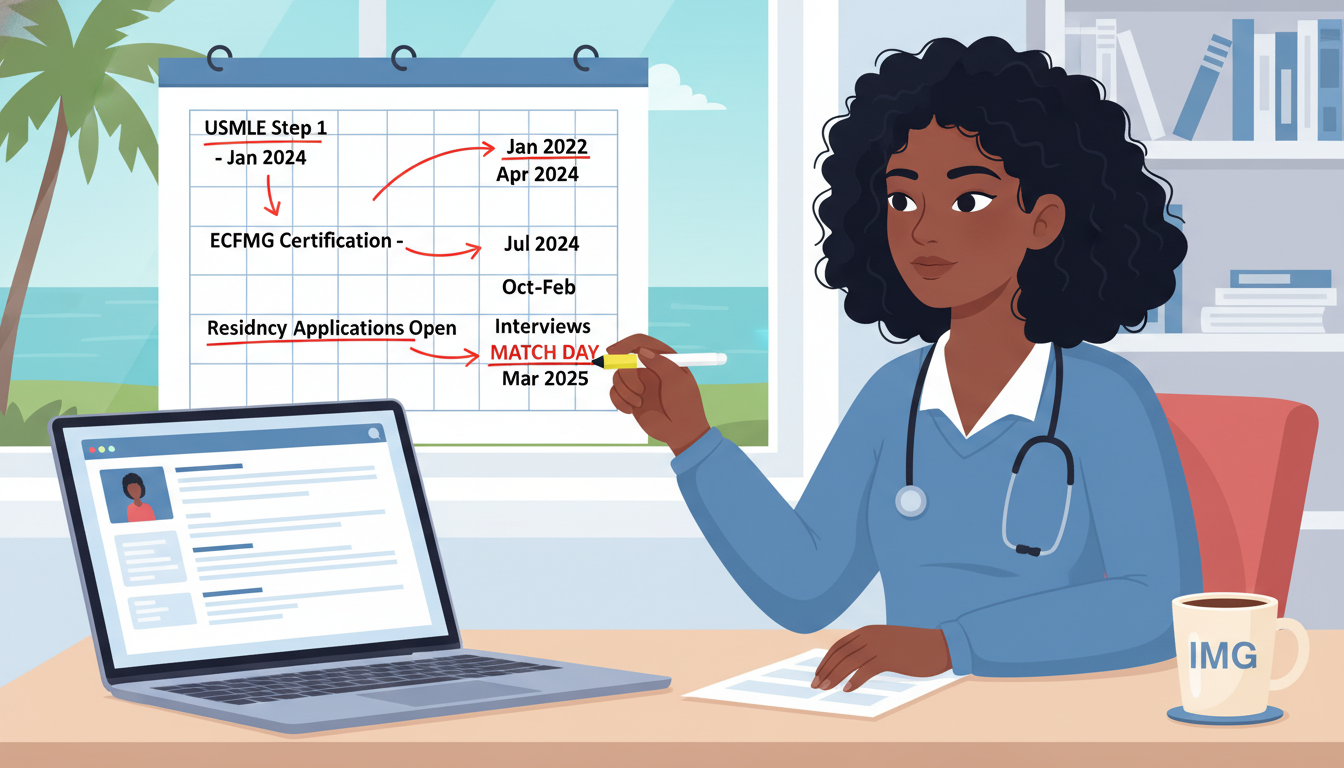
When Do You Need ECFMG Certification for the Match?
- You do not need ECFMG certification to submit your ERAS application in September.
- You must have ECFMG certification by the time you actually start residency (July 1 in most programs).
However, many program directors prefer applicants who:
- Have already passed Step 1 and Step 2 CK before interviews
- Are on track with credential verification
In competitive programs, if your ECFMG process looks uncertain, it can be a red flag.
Practical target for Caribbean IMGs:
- Aim to complete all exam requirements and submit diploma and transcripts for verification by March–April of the year you plan to start residency (the year of Match Day).
Example Timeline: Caribbean IMG Planning for 2027 Match
Let’s assume a typical 4-year Caribbean MD program with U.S. clinicals:
Med 1–2 (Years 1–2):
- Basic sciences; create ECFMG account; confirm school eligibility.
- Begin Step 1 prep in parallel with coursework.
End of Year 2 / Early Year 3:
- Take Step 1
- Start core clinical rotations (IM, surgery, peds, OB/GYN, psych, FM).
Year 3–4:
- Core and sub-internship rotations in U.S. hospitals.
- Prepare for Step 2 CK with UWorld and NBME assessments.
- Take Step 2 CK between Jan–Aug 2026.
Mid–Late 2026:
- Receive Step 2 CK score.
- Assemble ERAS: letters of recommendation, personal statement, MSPE, and transcripts.
- Submit ERAS in September 2026 for the 2027 Match.
Early 2027 (Jan–March):
- Interview season complete.
- Graduate (if not already).
- Submit diploma/transcripts to ECFMG for verification.
Spring 2027:
- Receive ECFMG certification (assuming all requirements met).
- Match Day (March 2027) and begin residency in July 2027.
This alignment ensures no last-minute surprises that could jeopardize your start date.
Strategic Edge: Caribbean-Specific Tips for ECFMG Success
Being a Caribbean IMG comes with both stigma and strength. Programs know many Caribbean schools are effectively “US-focused” institutions that prepare large cohorts of IMGs for the match (e.g., the SGU residency match statistics are widely referenced).
Use that ecosystem to your advantage.
1. Treat Your School’s Advising Office as a Partner
Major Caribbean schools have:
- Data on where graduates match (specialty and state)
- Advising on how to get ECFMG certified on time
- Templates for CVs, personal statements, and LOR requests
Ask them specifically:
- “Based on recent grads with my profile, when do they typically finish Step 2 CK and ECFMG certification?”
- “What common ECFMG paperwork problems have our students had?”
2. Plan Around State Licensing Requirements Early
ECFMG certification is necessary but not always sufficient. Some states (e.g., California, Texas, New York) have extra requirements:
- Specific approvals or listed recognition of your medical school
- Limits on the number of attempts at USMLE Steps
- Minimum scores or timelines
As a Caribbean IMG, research the licensing boards for states you’re most interested in. This is particularly important if you dream of practicing in:
- New York, Florida, California, Texas, or other states with large IMG populations.
3. Use U.S. Clinical Rotations to Complement ECFMG Credential
Program directors use your:
- USMLE performance (part of ECFMG requirements)
- U.S. clinical evaluations
- Letters of recommendation
- Interview performance
to judge if you can function in a U.S. system.
During clinical rotations:
- Take initiative: present cases clearly, read around your patients, volunteer for presentations.
- Ask for feedback early so your attending sees your growth.
- Request letters from attendings who can speak to:
- Your clinical reasoning
- Communication skills
- Professionalism and teamwork
This practical performance, combined with ECFMG certification, makes you a strong Caribbean medical school residency candidate.
4. Minimize Exam Retakes and Irregularities
Caribbean IMGs are often under financial and time pressure. Cutting corners with USMLE prep or exam-day professionalism is dangerous.
- Avoid:
- Scheduling exams too early “just to get them done.”
- Taking the exam while ill or under extreme stress.
- Any irregular behavior (using banned materials, cheating, sharing questions online).
Any exam irregularity flagged by ECFMG lasts on your record and can derail both ECFMG certification and residency prospects.
Putting It All Together: A Practical Checklist
Use this compact checklist as you move through your Caribbean medical journey:
Year 1–2 (Basic Sciences):
- Confirm your school’s ECFMG eligibility in the World Directory.
- Create ECFMG account and record your ECFMG/USMLE ID.
- Clarify ECFMG-specific procedures with your dean’s or registrar’s office.
- Begin Step 1 prep with solid course-study integration.
End of Basic Sciences:
- Schedule Step 1 with adequate prep time and practice NBMEs.
- Pass Step 1 and review weaknesses to inform clinical learning.
Clinical Years:
- Start UWorld Step 2 CK early (ideally during your first core rotation).
- Complete core rotations, aiming for strong clinical evaluations and LORs.
- Aim to take Step 2 CK 3–8 months before ERAS opens for your match year.
- Build relationships with attendings for U.S. letters.
Pre-ERAS Application:
- Confirm both Step 1 and Step 2 CK are passed.
- Request MSPE, transcript, and Dean’s letter from your school.
- Draft and refine personal statement and CV.
Post-Graduation (or Late Final Year):
- Obtain your diploma and final transcript.
- Upload and submit documents for ECFMG credential verification.
- Track your ECFMG status monthly and respond promptly to any issues.
Before Residency Start Date:
- Verify that your ECFMG certification is complete.
- Have documentation ready for program onboarding and, if applicable, visa processing (J-1).
With this structure, ECFMG certification becomes a predictable pathway rather than a source of last-minute panic.
FAQs: ECFMG Certification for Caribbean IMGs
1. When should I start the ECFMG process as a Caribbean medical student?
Begin in your first or second year:
- Create your ECFMG account
- Confirm your school’s eligibility
- Learn your school’s internal procedures
You don’t need to submit credentials early, but understanding how to get ECFMG certified from the start helps you plan exams and rotations more strategically.
2. Do I need to be fully ECFMG certified before applying to residency?
No. For ERAS and the Match, you must:
- Have your USMLE exams done (ideally by application time).
- Be fully ECFMG certified by the time you start residency (July 1 for most programs).
However, many program directors prefer applicants who already have all exams behind them and a clear path to certification—so earlier is better for competitiveness, even if not strictly required.
3. How long does credential verification take for Caribbean graduates?
It varies:
- For large Caribbean schools with efficient registrars, it may take a few weeks to a few months after you submit your diploma and transcripts.
- Delays can occur if:
- Your school is slow to respond
- There are mismatched names or incomplete documents
That’s why it’s wise to submit documents and initiate verification at least 3–6 months before your planned residency start date.
4. As a Caribbean IMG, can strong ECFMG status and USMLE scores offset school stigma in the residency match?
They can help significantly, but they are part of a broader package. Strong Step 2 CK performance, completed ECFMG certification, and excellent U.S. letters of recommendation make you far more competitive. Programs familiar with Caribbean schools (and with strong SGU residency match or similar track records) are often reassured by:
- Clean, timely ECFMG certification
- Solid exam performance
- Professional behavior during rotations and interviews
In short, ECFMG certification doesn’t erase the Caribbean label, but it proves you meet U.S. standards—if you pair it with strong clinical performance and a well-planned application strategy, you can absolutely match into solid U.S. residency programs.