
The residency game does not end with a low Step 1. It just stops forgiving sloppy strategy.
If you are an IMG with a low Step 1 but a strong CK, you are not dead in the water. You are in a narrower lane that demands discipline, clarity, and a very intentional narrative. Programs will not connect the dots for you. You must spell it out.
Here is how you rebuild your story so that a shaky Step 1 becomes a data point, not a death sentence.
1. Get Your Facts Straight: Where You Actually Stand
Before you “craft a narrative,” you need a cold, unsentimental look at your numbers and profile. Not vibes. Data.
Ask yourself, and write this down:
- Step 1: exact score and percentile (or “Pass” with context if old scoring)
- Step 2 CK: exact score and percentile
- Attempts: any failures or repeats?
- YOG (year of graduation)
- Gaps: any >6 months off
- Visa: required or not
- Clinical experience: USCE? Observerships vs hands-on electives
- Letters: how many strong U.S. letters from core specialties?
- Research: yes/no, and in what field
Now put your Step 1 and CK in context.
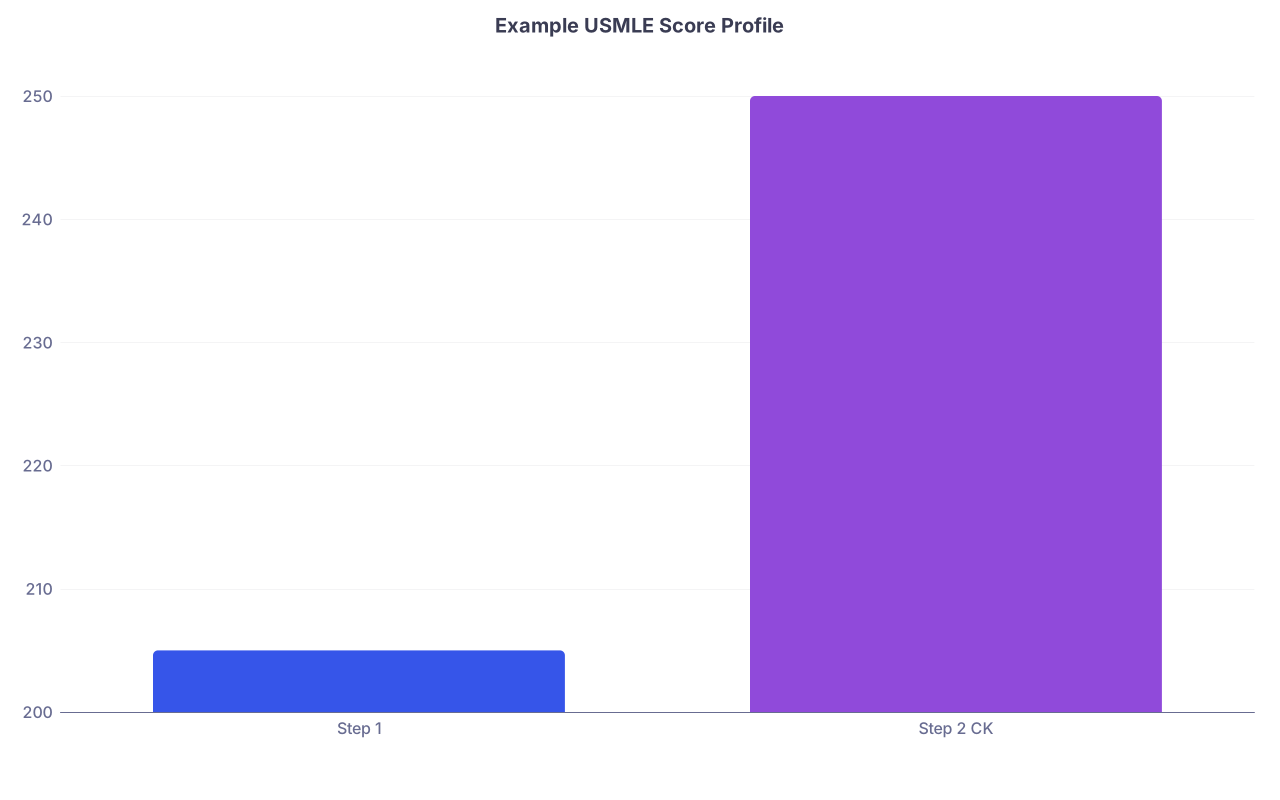
| Category | Value |
|---|---|
| Step 1 | 205 |
| Step 2 CK | 250 |
If your profile looks like that—Step 1 ~205, CK ~250—you fall into a common pattern I see with IMGs:
- Early adjustment / inadequate prep for Step 1
- Real capacity to perform at or above U.S. grad level once you adapt
- Programs need help believing the second line more than the first
Your job is to make that trajectory the center of your story.
2. Understand What Program Directors Actually Think
Let me be blunt: directors are not sitting around psychoanalyzing you. They are pattern-matching risk.
Here is what a low Step 1 / high CK signals in many PDs’ heads:
- “First exam was poor. Did this person mature and adapt? Or was Step 1 a fluke the other way?”
- “Are they going to pass boards on first attempt? Because I am held accountable if they do not.”
- “If this person struggles in training, will this be a repeat of Step 1 or of CK?”
The CK is currently the better predictor of specialty board passage for many programs. Many PDs know this. But they are conservative. They want:
- A clear upward trend
- A plausible explanation that does not sound like excuses
- Evidence in other domains that matches the CK, not the Step 1
You must design your entire application to scream those three points.
3. Build the Core Narrative: From Weak Start to Reliable Clinician
Your “narrative” is not a sob story. It is the professional explanation for a performance curve that now points in the right direction.
You need a 2–3 sentence backbone that everything else in your application supports.
Example backbone narrative:
“My Step 1 score reflects a period where I underestimated how different the U.S.-style multiple-choice exam is from how I trained. After that experience, I restructured my study system entirely, sought targeted mentorship, and focused on applying knowledge clinically. The result was a substantial improvement on CK and significantly stronger performance in my clinical rotations and USCE.”
That is it. No drama. No blaming COVID, family, or the universe.
What this does:
- Admits the problem without defensiveness
- Shows insight and specific correction
- Links CK and clinical performance as proof of change
Your job now is to backfill this backbone across:
- Personal statement
- ERAS experiences
- LoRs
- Interview answers
If anything in your application contradicts that upward trajectory, fix it.
4. Personal Statement: Stop Writing Like a Victim
Most weak Step 1 candidates destroy their chances in the personal statement by either:
- Ignoring Step 1 completely (programs notice), or
- Oversharing a disaster story (they remember the disaster, not the growth)
You need one tight paragraph that handles Step 1 + CK and then moves on.
Structure it like this:
- One sentence acknowledging the low Step 1
- “My Step 1 score does not reflect my current ability or work ethic.”
- One to two sentences of cause + insight (not excuses)
- Focus on what you did wrong, not what happened to you.
- One to two sentences of what changed + CK result
- Show new system, mentorship, discipline.
- One line connecting this improvement to residency readiness
Example:
“My Step 1 score does not reflect the physician I have become. Early in my training, I treated exam preparation as passive content review and underestimated how much U.S. exams demand pattern recognition and timed decision-making. That approach failed. I responded by building an active system of daily problem-solving, timed blocks, and feedback from residents and faculty, and I carried that discipline into my clerkships. The result was a 247 on Step 2 CK and consistently strong evaluations in my internal medicine and sub-internship rotations, which better represent how I will perform in residency.”
Then you stop talking about scores.
The rest of the statement must:
- Highlight clinical judgment
- Show reliability and work ethic
- Echo “I learn from setbacks and come back stronger”
No “ever since I was five I wanted to be a doctor” paragraphs. You do not have score privilege to waste space.
5. ERAS Application: Make Every Section Support the Turnaround
Every part of ERAS is either neutral, hurts you, or helps you. With a low Step 1, you cannot afford neutral.
Focus on these levers:
A. Experiences Section
Pick experiences that prove:
- Consistency (long-term commitments > random 1–2 month projects)
- Clinical readiness (USCE, sub-Is, inpatient exposure)
- Ownership and responsibility
When you describe experiences, keep the pattern:
- Challenge → Action → Result → Reflection
Example for a sub-I:
“During my internal medicine sub-internship at [Hospital], I managed a patient panel under supervision, presenting daily plans and adjusting management based on overnight events. Initially I struggled with prioritizing tasks during busy call days, leading to delays in order entry. After feedback from my senior, I started structuring my day with time-blocked checklists and pre-rounding note templates. This change shortened my pre-rounding time by about 30 minutes and allowed me to independently complete admission H&Ps before evening sign-out.”
That kind of description says: this person learns, adjusts, and improves quickly. It matches a low Step 1 → strong CK story.
B. US Clinical Experience (USCE)
If you have weak or no USCE, that is now your second problem after Step 1. You must address it.
Prioritize:
- Sub-internships or acting internships in your target specialty
- At least 2–3 months total of U.S.-based inpatient or strong outpatient rotations
- Sites with U.S. teaching programs, not purely private shadowing
If you already finished med school, you may need:
- Paid clinical researcher roles with patient contact
- Pre-residency fellowships (clinical or research)
- Hospital-based observer-to-hands-on type programs (some community hospitals allow this for trusted observers)
Your narrative: “I underperformed early, then went into U.S. clinical settings and proved I belong here.”
C. LoRs: What They Must Say (and Not Say)
Letters of recommendation are your voice in someone else’s mouth. With a low Step 1, you need at least one letter that explicitly addresses your improvement.
You cannot tell them what to write. But you can guide the frame when you request it.
When you ask a faculty member for a letter, say something like:
“I am an IMG with a weaker Step 1 but much stronger CK and clinical performance. It would help me if you could comment on my clinical reasoning, work ethic, and how I handled feedback or growth during the rotation.”
What you want to see in a strong letter:
- “Rapid learner”
- “Takes feedback and applies it”
- “Functioned at or above the level of a U.S. senior medical student”
- “I have no concerns about [his/her/their] ability to pass board exams and succeed in residency”
If a letter writer hesitates or seems lukewarm, do not use them. A bland letter from a big name hurts you more than a strong letter from a mid-tier institution.
6. Specialty Choice and Program Targeting: Play in the Right League
The biggest unforced error I see: IMGs with low Step 1 / strong CK applying to hyper-competitive specialties and top-heavy programs. Then acting shocked when interviews do not come.
Here is the reality:
- Dermatology, plastics, ortho, ENT, neurosurgery: nearly impossible. I am not sugar-coating it.
- Radiology, anesthesia, EM: very uphill as an IMG with a low Step 1, unless you have serious U.S. connections, research, and visas are not an issue.
- Internal medicine, family medicine, pediatrics, psych: This is where you can absolutely match with the right plan.
You need a targeted, not delusional strategy.
| Tier | Specialty Examples | Realistic? |
|---|---|---|
| 1 (Very Hard) | Derm, Ortho, ENT, Plastics, Neurosurg | Almost never |
| 2 (Hard) | Radiology, Anesthesia, EM, Urology | Rare, needs heavy connections |
| 3 (Moderate) | IM, Peds, Psych (university programs) | Selectively possible |
| 4 (Most Realistic) | Community IM, FM, Psych, Peds | Yes, with strong strategy |
If you insist on a harder specialty, you must:
- Build multi-year research and networking in that field
- Be ready to fail once, regroup, and reapply
- Accept that even with a fantastic CK, the low Step 1 will shut some doors permanently
For most IMGs in your position, a smart move is:
- Primary target: community-based categorical positions in IM/FM/Peds/Psych
- Stretch: some mid-tier university-affiliated programs where IMGs have matched with similar profiles
- Backup: prelim IM, transitional year, or SOAP as last resort
Your program list should be large and realistic. 80–120 applications for IMGs with a weak Step 1 is not excessive. If you require a visa, push higher.
7. Interview Season: How to Talk About Your Step 1 Without Crumbling
You will be asked about Step 1. Pretending otherwise is fantasy.
You need one clean, practiced answer. Not robotic. But rehearsed.
Framework:
- Own it directly.
“My Step 1 score is lower than I wanted, and I understand that raises concerns.” - Briefly explain the cause (one or two factors, max).
- Transition to a new system
- Wrong study approach
- Lack of feedback / not enough question practice
Avoid: big personal tragedies unless they truly destroyed your ability to study. And even then, keep it short.
- Describe what you changed in your process in concrete terms.
“I switched from passive reading to 2–3 timed blocks a day with Anki review and weekly performance review with a senior resident.” - Point to evidence that your new system works.
“With that system, I scored 248 on CK and my evaluations consistently mention strong preparation and reliability.” - Connect to residency behavior.
“The lesson for me was that my effort is not enough if the system is wrong. I am very proactive now about asking for feedback early and adjusting quickly when something is not working. I expect to bring that mindset to residency.”
Example answer:
“Yes, my Step 1 score is below what you typically see in your matched residents. I came into that exam underprepared for the style and depth of U.S. board exams, relying too much on reading and not enough on timed problem-solving. I was disappointed, and I realized that if I did not change, I would not be ready for residency here. So I built a much more structured system for CK—daily timed blocks, thorough error logs, and regular check-ins with mentors—to force myself to think clinically, not just memorize. That led to a 249 on CK and much stronger performance in my sub-internships. The bigger takeaway for me is that when I fall short, I do not just work harder; I redesign the way I work. That is exactly how I plan to approach residency.”
Say it calmly. No apology tour. Just ownership and evidence.
8. Board Readiness: Prove You Will Not Be Their Problem Child
Program directors wake up at night thinking about one thing: board pass rates. If they think you are a board failure risk, you are done.
Your job is to scream low risk.
Concrete actions:
Strong CK score (you already have this).
This is your main currency. If your CK is not yet taken and you already have a low Step 1, you must absolutely crush CK. No second low score. If CK is done and strong, good.If allowed, take & pass an in-training style exam or additional certs.
- Some candidates add things like the NBME CCSE, but honestly, PDs rarely care unless it is part of a formal program.
- What they do care about: strong performance in standardized evaluations during U.S. rotations.
Get letters that explicitly state board confidence.
Ask faculty:“Programs may be concerned about my early exam performance. If you feel it is accurate, would you be comfortable commenting in your letter that you have no concerns about my ability to pass specialty boards?”
Demonstrate consistency in other demanding areas.
Long-term research, multi-year clinical roles, leadership in busy settings. Reliability in high-load environments suggests that your Step 1 was an outlier, not your baseline.
9. If You Are Early: Retroactive Damage Control Before You Apply
If you are not applying this cycle yet, good. You have time to strengthen the story.
Here is a 6–12 month rebuild plan if you already have a low Step 1:

| Step | Description |
|---|---|
| Step 1 | Now: Low Step 1 |
| Step 2 | Months 1-3: CK Prep Intensive |
| Step 3 | Month 4: Take CK and Score Strong |
| Step 4 | Months 5-8: USCE / Sub-Is |
| Step 5 | Months 6-10: Secure Strong LoRs |
| Step 6 | Months 9-12: Research or Clinical Job |
| Step 7 | Finalize ERAS + Apply |
Breakdown:
Months 1–4: CK or OET/English exams if needed
- Go all-in on a high CK. Use UWorld, NBME practice exams, mixed timed blocks from early.
- Target at least 240+ as IMG with a low Step 1; higher is better.
Months 5–8: USCE
- Aim for sub-Is or solid inpatient electives in your target specialty.
- Focus on performance and relationship-building to secure letters.
Months 6–10: Letters & Mentors
- Identify at least one U.S. faculty member who knows your clinical work well.
- Ask for feedback mid-rotation, improve, then ask for a letter near the end.
Months 9–12: Research or Clinical Work
- If you can, attach yourself to a professor or department in your target specialty.
- Even small contributions show engagement and persistence.
10. Common Mistakes That Sabotage IMGs With Low Step 1
I have watched people blow decent chances with avoidable errors. Do not repeat these.
Applying too broadly but not strategically.
- 100+ applications to every IM program, including ones that never interview IMGs or low Step 1 scores. Waste of money.
- Spend time looking at actual past IMG matches, program visa policies, and Step cutoffs.
Overexplaining Step 1.
- Pages in the personal statement about family illness, economic hardship, etc.
- Mention it briefly, own it, move on. Or it becomes your entire identity.
Ignoring red flags in other areas.
- Gaps with no explanation.
- No USCE at all but aiming for university programs.
- Weak or generic letters.
Playing the prestige game you cannot win.
- Only ranking university programs that rarely match IMGs.
- Then going unmatched when you could have secured a solid community spot.
Being vague about improvement.
- Saying “I worked harder” is useless. Everyone says that.
- You must describe concrete changes: schedules, methods, feedback loops.
11. An Example Rebuilt Profile (What “Fixed” Looks Like)
Here is what a successfully rehabilitated IMG profile can look like:
- Step 1: 203
- Step 2 CK: 249
- YOG: 2021
- Visa: Needs J-1
- USCE: 3 months IM (one sub-I at community program, one university-affiliated elective, one outpatient clinic)
- Letters:
- 1 from community IM PD: “Performed at level of U.S. senior, no concerns about board passage.”
- 1 from university IM faculty: “Rapid improvement with feedback, strong clinical reasoning.”
- 1 from home institution department head.
- Experiences:
- 1 year as full-time clinical research coordinator in cardiology at U.S. institution
- Several QI projects with posters at regional meetings
- Narrative:
- Brief Step 1 acknowledgment → process change → CK improvement → consistently strong clinical performance.
That candidate, with a realistic list and decent interview skills, can match into community IM or FM quite reliably. Maybe even some mid-tier university-affiliated IM programs.
12. Your Job Now: Align Everything Around One Simple Story
Stop thinking of your application pieces as separate: personal statement, letters, ERAS entries, interviews. They are not. They are all chapters in the same short book.
The story you are telling:
- I started below where I wanted to be (Step 1).
- I analyzed what went wrong and changed my approach.
- That change produced a much stronger CK and better clinical performance.
- What you see now is who I actually am: a reliable, coachable, board-ready future resident.
If anything in your application does not reinforce one of those four points, rework it or cut it.
Bottom Line
Three things I want you to walk away with:
- A low Step 1 plus a strong CK is not fatal, but it demands a disciplined, aligned narrative across every part of your application.
- You must own the weakness, show specific process changes, and then back it up with USCE, strong letters, and a realistic program list.
- Programs are not looking for perfection. They are looking for trajectories and board-safe, coachable people. Your job is to prove you are one of them.