
You are not “disqualified” because you have no US clinical experience. You are behind. That is different. And it is fixable with a ruthless, organized plan.
I have seen IMGs match internal medicine at university programs with zero USCE at the moment they realized the problem. They turned it around in 12–18 months. The people who fail are not the ones who start late. It is the ones who drift and keep hoping “maybe it will be enough.”
Let us build you a real recovery plan.
Step 1: Get Clear on How Bad (or Fixable) Your Situation Is
Do this before you email a single program or pay for a single observership. You need an honest status check.
1.1 Diagnose your current profile
Write this out on one page:
- Graduation year (YOG)
- Country / school
- USMLE status:
- Step 1: Pass/Fail + number of attempts
- Step 2 CK: score + attempts
- Visa need: Yes/No; which (J‑1, H‑1B, undecided)
- Current clinical work:
- In home country? In what role? How recent?
- Research:
- Any publications, posters, audits, QI projects?
- US exposure:
- Absolutely none?
- Conferences? Short visits? Online electives?
Now, label yourself honestly into one of these buckets:
| Profile Type | YOG | USMLE Status | USCE |
|---|---|---|---|
| Early Planner | 0–2 years | In progress | None |
| On-Time Applicant | 0–5 years | Steps done | None |
| Late / At-Risk | 5–10 years | Steps done | None |
| Very Late / High-Risk | 10+ years | Steps done | None |
Your strategy changes with each profile:
- Early Planner: You can build 4–12 months of USCE before applying. Strong position.
- On-Time Applicant: You must compress USCE, letters, and ERAS prep into 6–12 months.
- Late / At-Risk: You can still match, but you need a heavier load of USCE and ongoing clinical work.
- Very Late / High-Risk: You must be extremely strategic. Likely need continuous clinical engagement (home country or US) and be realistic about specialty and program tiers.
1.2 Understand what “No USCE” actually costs you
Here is what programs really care about with USCE:
- Can you function in the US system (EMR, notes, orders, rounding style)?
- Do US physicians recommend you, in US language, to a US program director?
- Have you shown commitment to the US, not just a random application blast?
No USCE usually means:
- Fewer or no US letters of recommendation (LoRs)
- Doubt about your ability to work in a US team
- You get filtered out at the “safe” programs that already have 2,000+ applications
You are solving three problems at once:
- Get US-based clinical exposure
- Convert it to strong US letters
- Package it into an ERAS application that looks deliberate, not desperate
Step 2: Decide Your Timeline: When Are You Actually Applying?
Stop saying “I want to match soon.” Pick a match cycle.
2.1 Backward plan from an ERAS cycle
ERAS opens in June; submission mid‑September; interviews October–January.
Now count backward from the ERAS you are targeting:
- To apply this year (September this year):
- You need at least some USCE (even 1–2 months) completed or ongoing before September.
- To apply next year:
- Ideal: 3–6 months of USCE spanning the next 12 months.
If you already missed your ideal window, do not panic. You can:
- Do short observerships now
- Schedule longer hands-on rotations across the next 6–9 months
- Apply this year but build a clear “re‑application plan” if needed
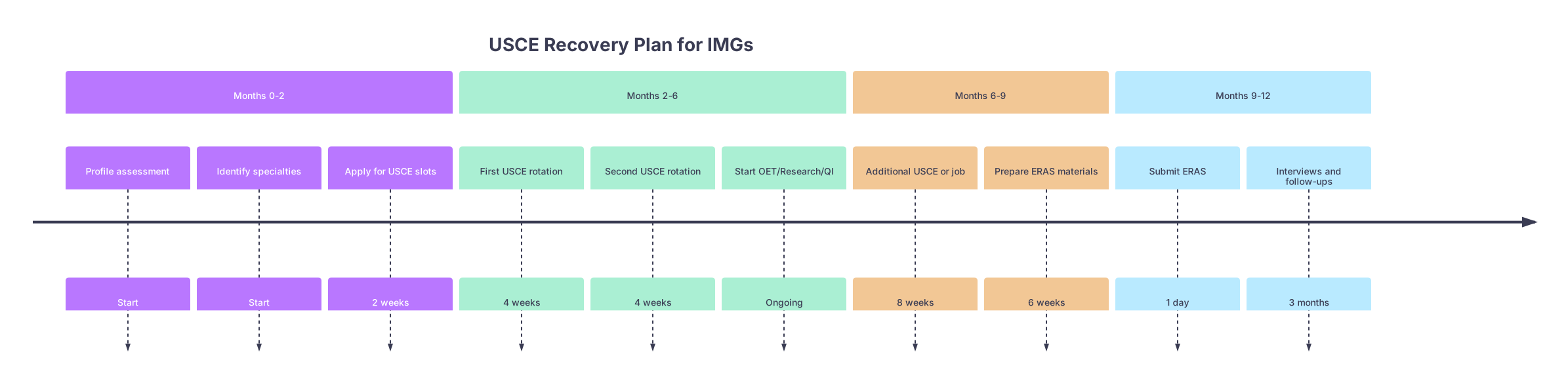
| Period | Event |
|---|---|
| Months 0-2 - Profile assessment | Start |
| Months 0-2 - Identify specialties | Start |
| Months 0-2 - Apply for USCE slots | 2 weeks |
| Months 2-6 - First USCE rotation | 4 weeks |
| Months 2-6 - Second USCE rotation | 4 weeks |
| Months 2-6 - Start OET/Research/QI | Ongoing |
| Months 6-9 - Additional USCE or job | 8 weeks |
| Months 6-9 - Prepare ERAS materials | 6 weeks |
| Months 9-12 - Submit ERAS | 1 day |
| Months 9-12 - Interviews and follow-ups | 3 months |
Step 3: Pick the Right USCE Type for Your Situation
Not all “US experience” is equal. Some things impress program directors. Some are just expensive tourism.
3.1 Understand the USCE ladder
From weakest to strongest, in the eyes of most PDs:
- Virtual observership / virtual elective
- In‑person observership (shadowing only; no orders, no notes)
- Inpatient elective / sub‑internship (hands‑on)
- Outpatient clinic rotation with real responsibilities
- US paid clinical job (prelim year, non‑resident physician, research + clinic hybrid roles)
You cannot always jump directly to #3 or #4. But your goal should be to climb up this ladder as fast as your visa and budget allow.
3.2 Match your profile to the right USCE mix
Here is a blunt guide:
| Profile | Main Goal | Recommended USCE Mix |
|---|---|---|
| Early Planner | Build depth | 2–4 months electives/sub‑Is |
| On-Time Applicant | Get LoRs + credibility | 1–2 months hands‑on + 1–2 observ. |
| Late / At-Risk | Show recent activity | 3–6 months continuous USCE |
| Very Late / High-Risk | Prove active clinician | Longitudinal USCE or US job |
If you are >5 years from graduation, short random observerships alone will not save you. You need:
- Consistent clinical activity (home or US)
- USCE spread over several months, not a 2‑week vacation
Step 4: Build a Concrete USCE Acquisition Plan (Not Wishful Thinking)
You are going to treat USCE like a job hunt, with structure.
4.1 Set a target: number and length of rotations
Minimum targets if you have no USCE:
- Internal medicine / FM / psych / peds:
- At least 2 months of USCE, ideally 3–4
- More competitive specialties (neuro, anesthesia, EM):
- 3–6 months USCE and often some research
If your budget is tight: 1 month of strong, well-chosen USCE with excellent letters beats 3 months of random, low‑quality observerships.
4.2 Where to find USCE, realistically
You have four main routes:
- Your school’s official electives (if still enrolled)
- Paid USCE placement companies
- Directly arranged observerships with physicians
- Research + clinic hybrid positions
If you are still a student (IMG, but not graduated yet)
You are in a much better position.
- Push your dean’s office for:
- Official electives at US partner institutions
- Exchange programs
- Target:
- 2–3 audition electives in your desired specialty
- At hospitals with residency programs that take IMGs (critical point)
If you are already graduated
You will lean more on:
- Structured USCE companies (AMO, Chicago Clerkships, etc.)
- Cold emails to program coordinators / chiefs of department / clinic owners
- Alumni networks: “Do any graduates of our school work in the US?”
Do not just buy whatever the company is selling. Ask:
- Will I see inpatients or only outpatients?
- Will I:
- Present patients on rounds?
- Write notes (even if not in EMR)?
- Be allowed direct patient contact?
- Will the attending write letters on letterhead with designation and program name?
If the answer is vague, assume the answer is no.
Step 5: Structure Each Rotation So It Actually Produces a Strong Letter
Most IMGs waste their first month of USCE just learning where the bathrooms are. You cannot afford that.
5.1 Before the rotation starts
Send a concise email to your attending one week before:
- Introduce yourself (1–2 sentences)
- Attach a brief CV
- State your goals:
- Learn US clinical workflow
- Contribute to patient care
- Earn an honest letter evaluating your readiness for residency
Ask explicitly: “Is there anything I should read or prepare in advance?”
They may not respond. But they will notice that you are serious when you arrive.
5.2 Week 1: Learn fast and be extremely visible
Your job in week 1:
- Learn:
- How the team rounds
- Basic EMR navigation (if allowed)
- Note templates / handoff style
- Show:
- Punctuality (15 minutes early; not 1 minute early)
- Respect for all staff, not just attendings
- Basic clinical competence
Concrete actions:
- Volunteer to present patients early:
- “I can present the new admission on bed 12 if you are comfortable with that.”
- Ask for feedback at the end of the week:
- “Doctor, do you have any feedback on how I presented? One thing I can improve next week?”
This does two things: gives you actual improvement targets, and plants the idea that you care about growth.
5.3 Weeks 2–3: Take ownership without overstepping
Now your goal is to behave like a supervised intern.
- See patients first when allowed
- Offer to draft:
- Assessment and plan bullets
- Brief updates on problem lists
- Volunteer for:
- Follow‑up calls to primary physicians (with supervision)
- Discharge summaries (drafts at least)
Keep a log of:
- Patients you saw
- Conditions managed
- Procedures observed or assisted
- Any QI / mini‑project you did (e.g., improved discharge instructions for diabetics)
This log is gold for:
- Your CV
- Your personal statement
- Reminding your attending what you actually did when they write your letter
5.4 Week 4: Convert performance into letters
Do not leave this to chance.
A few days before the end:
“Doctor Smith, I have really appreciated working with you. I am planning to apply to internal medicine this coming ERAS season. If you feel you know my work well enough, I would be honored to have a letter of recommendation from you. I am very open to your honest assessment.”
Key points:
- You give them an honorable exit if they feel they cannot write a strong letter.
- You ask early enough that they can write while they still remember you.
- You then follow up with:
- Your CV
- ERAS letter request form
- Brief bullet points of your work with them (from your log)
Step 6: Fix the Rest of the Application Around Your New USCE
USCE alone does not rescue a weak ERAS. You need to align every other piece.
6.1 Update your CV aggressively
After each rotation, update:
- “Clinical Experience” section:
- US hospital / clinic name
- Dates
- Specialty and brief description of your role
- “Skills” section:
- EMR systems you observed/used
- Types of patients / pathologies
- Multidisciplinary team exposure
Do not write fluffy nonsense like “learned the importance of communication.” Write specifics:
- “Presented 3–5 patients daily on inpatient internal medicine rounds”
- “Drafted progress notes and discharge summaries for attending review”
6.2 Rewrite your personal statement to tell a clear US‑commitment story
Your problem is no longer “no US experience.” It is “recently obtained US experience and actively building more.”
Your statement should:
- Acknowledge your path:
- “After practicing as a general practitioner in X for three years, I transitioned to US clinical observerships at Y to adapt to the US system.”
- Highlight specific US experiences:
- A patient you followed
- A moment you saw the US workflow differ from your home system
- Connect to your target specialty in a way that shows:
- Maturity
- Realism
- Understanding of US training demands
6.3 Reference your USCE clearly in ERAS
You want program reviewers to see “USCE” in 5 seconds:
- In the Experiences section:
- Mark location as “United States – City, State”
- Use “Clinical Clerkship / Observership” appropriately
- In the “Meaningful Experiences”:
- Choose one or two strongest USCE blocks
- Explicitly state what you learned that applies to residency
Step 7: Target Programs That Actually Care Less About Prior USCE (But Value It When Present)
Some programs explicitly require USCE. Others prefer it. Others care much more about recent clinical activity and board scores.
You will not know this from glossy website language alone.
7.1 Build a program list that matches your new profile
Use:
- FREIDA
- Program websites
- SDN / Reddit (with caution; cross‑verify)
Track this in a simple spreadsheet with columns:
- Program name
- Specialty
- IMG friendly (yes / maybe / no)
- Published USCE requirement:
- “At least 3 months US clinical experience”
- “Hands‑on USCE preferred”
- Visa:
- J‑1 only
- J‑1 and H‑1B
- None
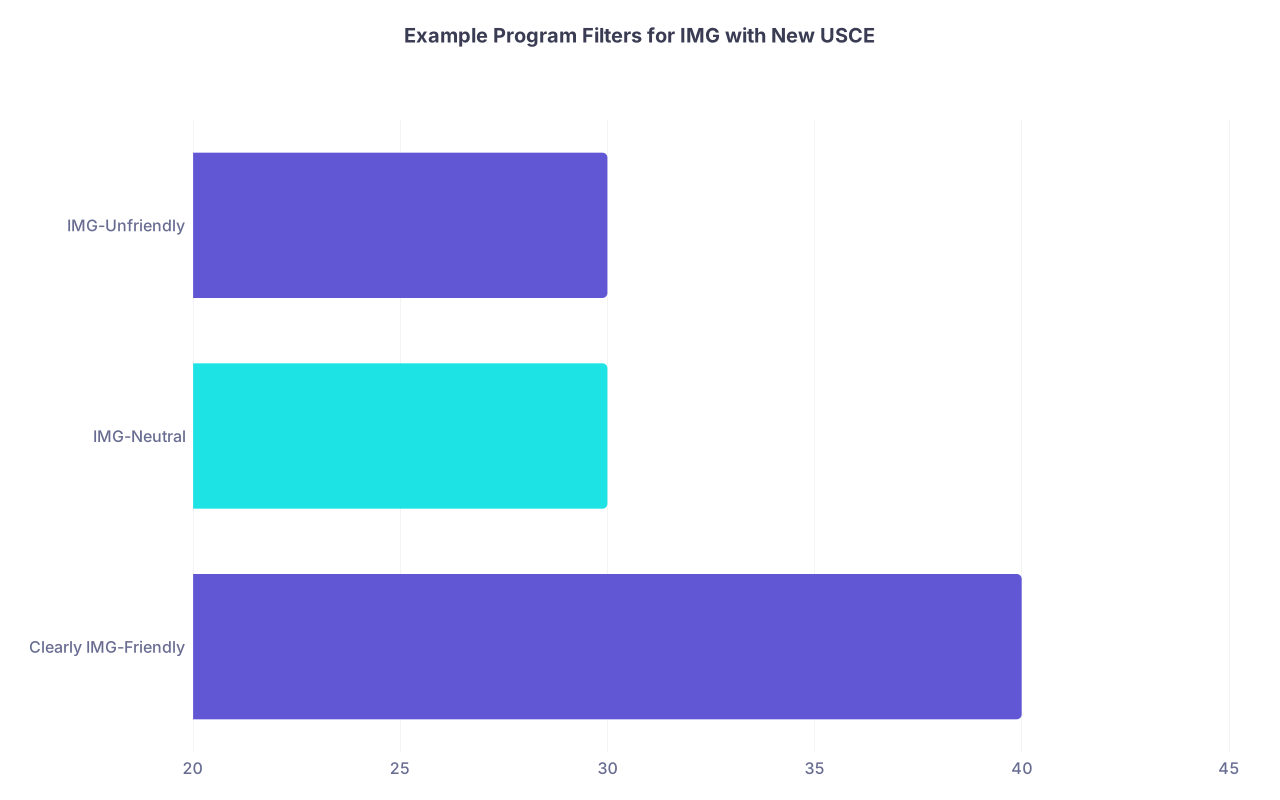
| Category | Value |
|---|---|
| Clearly IMG-Friendly | 40 |
| IMG-Neutral | 30 |
| IMG-Unfriendly | 30 |
You want to:
- Avoid programs that flat‑out say:
- “No IMGs”
- “Must be a US med school graduate”
- De‑prioritize programs that require:
- “US graduates only” or “USCE 12 months mandatory” if you cannot meet that threshold
- Focus on:
- Community programs
- University‑affiliated community programs
- Places that already have multiple IMGs in current classes
Step 8: If You Are Very Late or Very “Cold” Clinically, Add One More Layer
No USCE is not your only problem if:
- You graduated 7+ years ago
- You have been out of clinical practice for >2–3 years
Then your real problem is: are you still a working physician at all?
8.1 Maintain or restart clinical activity in your home country
If USCE slots are months away, you must:
- Work in a clinic or hospital locally
- Record:
- Hours per week
- Types of cases
- Any procedures / responsibilities
- Get local letters that emphasize:
- Your reliability
- Clinical judgement
- Volume of patients
Programs would rather see:
- “Actively practicing full‑time in home country + 2–3 months USCE”
than:
- “Unemployed for 3 years while studying for Step 2 + 1 month USCE”
8.2 Consider research or hybrid positions in the US
If you can get to the US:
- Research assistant in a department that:
- Has a residency program
- Lets you attend grand rounds and clinics
- Outcomes:
- A US supervisor who can write a letter
- Potential co‑authorships
- Evidence that you function in an academic US environment
Do not spend 2 years in pure bench research with zero patient contact if you are already clinically “cold.” You are trying to show you are ready for residency, not a PhD program.
Step 9: Put It All Together into a 12‑Month Recovery Blueprint
Here is what a realistic one‑year recovery plan looks like for an IMG with no USCE, already graduated, aiming for internal medicine:

| Step | Description |
|---|---|
| Step 1 | Month 0: Honest Profile Audit |
| Step 2 | Month 1-2: Secure 2-3 USCE Rotations |
| Step 3 | Month 3-4: First USCE Rotation + 1st LoR |
| Step 4 | Month 5-6: Second USCE Rotation + 2nd LoR |
| Step 5 | Month 6-7: Optional Third USCE or Home Clinical Work |
| Step 6 | Month 7-8: Finalize Personal Statement & CV |
| Step 7 | Month 8-9: Verify LoRs Uploaded, Program List Finalized |
| Step 8 | Month 9: Submit ERAS Early |
| Step 9 | Month 10-12: Interviews / Prepare for Possible Reapplication |
Alongside that, you keep:
- Continuous clinical or research engagement
- OET (if needed) completed
- USMLE Step 3 planned or done (especially helpful for older grads and visa‑requiring IMGs)
Common Pitfalls That Will Kill Your Recovery
Let me be blunt about what I have seen sabotage IMGs who started exactly where you are.
Chasing “name prestige” over real responsibility
- A no‑touch, pure‑shadow month at a shiny Ivy League name is less valuable than a solid hands‑on experience at a mid‑tier community hospital, for letters and skills.
Doing rotations that cannot yield letters
- If the attending never sees you present, never watches you think, your letter will be generic. Generic letters are almost as bad as no letters.
Trying to cover six specialties
- One month cardiology, one month neurology, one month GI, one month psych. It looks unfocused. You are not trying to build a tourist CV; you are building a residency‑ready one.
Pretending your “no USCE” did not matter
- In interviews, own your path:
- “I recognized that my lack of US experience was a limitation, so I arranged rotations at X and Y to adapt to the US system. Here is what I learned…”
- In interviews, own your path:
Programs respect that level of self‑correction.
Quick Reality Check: What You Can Reasonably Expect
Let us align expectations with reality, using a rough picture.
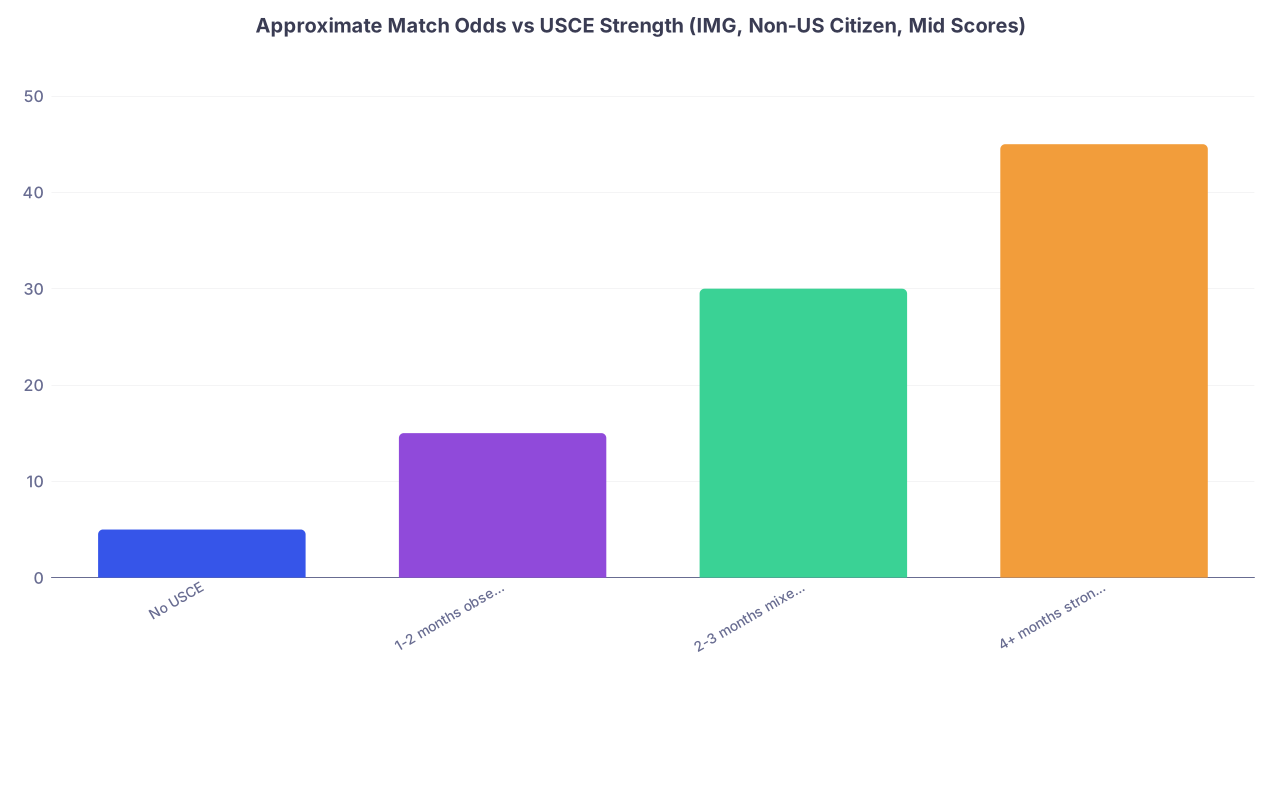
| Category | Value |
|---|---|
| No USCE | 5 |
| 1-2 months observerships | 15 |
| 2-3 months mixed USCE + LoRs | 30 |
| 4+ months strong USCE + LoRs | 45 |
These are not official NRMP numbers; they are pattern recognition from years of watching cases:
- No USCE at all: your odds in IM/FM can be in the single digits unless everything else is exceptional.
- 1–2 months observerships: some improvement, especially if letters are strong and specific.
- 2–3 months mixed USCE with good US letters: now you are in a competitive zone for IMG‑friendly programs.
- 4+ months of strong USCE: you look like someone who has actively integrated into the US system.
You are trying to move yourself from the left bars toward the right, as efficiently as your time and money allow.
Summary: What You Need to Do Next
Let me compress this into 3 non‑negotiable actions:
Commit to a specific match year and build a backward plan.
No more vague “someday.” Pick a September ERAS cycle and map your USCE months before that.Secure at least 2–3 months of targeted USCE that can produce real letters.
Prefer depth over brand name, responsibility over glamour. Aim for at least 2 US attendings who know your work and can vouch for you.Rebuild your entire application around your new USCE and active clinical status.
Update your CV, personal statement, and program list to reflect a clear, recent, and deliberate move toward the US system.
If you execute this with discipline, “no US clinical experience” turns from a permanent label into a temporary stage. And that is the whole point.
FAQ (Exactly 4 Questions)
1. I am applying this September and currently have zero USCE. Is it still worth trying to get something now?
Yes. Even a single 4‑week observership completed or ongoing before ERAS submission is better than nothing. It gives you:
- At least one potential US letter
- A concrete US experience to reference in your personal statement and interviews
You will likely still be building your profile for a possible reapplication, but it is absolutely worth starting now rather than waiting a full extra year doing nothing.
2. Does virtual USCE or online shadowing actually help?
It helps only marginally. Programs know the difference between real wards and Zoom. Virtual USCE can:
- Fill a gap if you are locked out of travel temporarily
- Show some initiative
But it does not replace in‑person rotations for letters or for proving you can function in the US system. Use virtual options as a supplement, not your main strategy.
3. How many months of USCE do I really need as an older graduate (7+ years since graduation)?
Aim for 3–6 months, spread over time if needed, plus continuous clinical activity in your home country or in the US. Programs will ask:
- “Has this person been clinically active?”
- “Can they adapt to our system?”
Short bursts of USCE with long periods of inactivity look weak. A more convincing path is: continuous practice at home + multiple USCE blocks + strong US letters.
4. Are paid USCE companies a red flag for programs?
Generally, no. Program directors know many IMGs have to use these services. What they care about is:
- The quality of your experience
- The content of your letters
If your letter says “observed rounds and was punctual,” it is useless whether you paid for it or not. If it says “functioned at the level of an intern in presentations and clinical reasoning,” and comes from a credible attending, they will not care who arranged the rotation.