
It is August. ERAS is about to open.
You have your USMLE transcript in front of you and your stomach drops every time your eyes hit the word: “Attempt(s): 2”. Or worse, 3.
You are not asking “what does this mean” anymore. You already know:
- Fewer invites
- More auto-filters
- More silence in your inbox while classmates with one clean pass casually complain about “too many interviews”
You are asking a different question now:
How do I salvage this? What can I still control?
Good. That is the right question. Let us fix what can be fixed and frame what cannot.
This is a playbook for IMGs with multiple attempts who still want a US residency. It is not soft encouragement. It is a hard, specific strategy.
1. Understand Exactly How Programs See Multiple Attempts
You cannot offset something you do not understand.
What a “multiple attempt” signals to PDs
Program directors are busy and they use shortcuts. Multiple attempts often trigger these assumptions:
- Risk of failing in residency
- “If they struggled with Step 1, will they struggle with in-service exams, Step 3, boards?”
- Poor judgment or planning
- “Did they sit for the exam unprepared? Will they show the same judgment with patient care?”
- Lower ceiling compared to other applicants
- “With 200 applicants and 8 spots, why choose someone with more risk?”
Is that always fair? No. But it is the reality.
How common it is (roughly)
For IMGs, multiple attempts are not rare. But programs do not care about averages. They care about their risk.
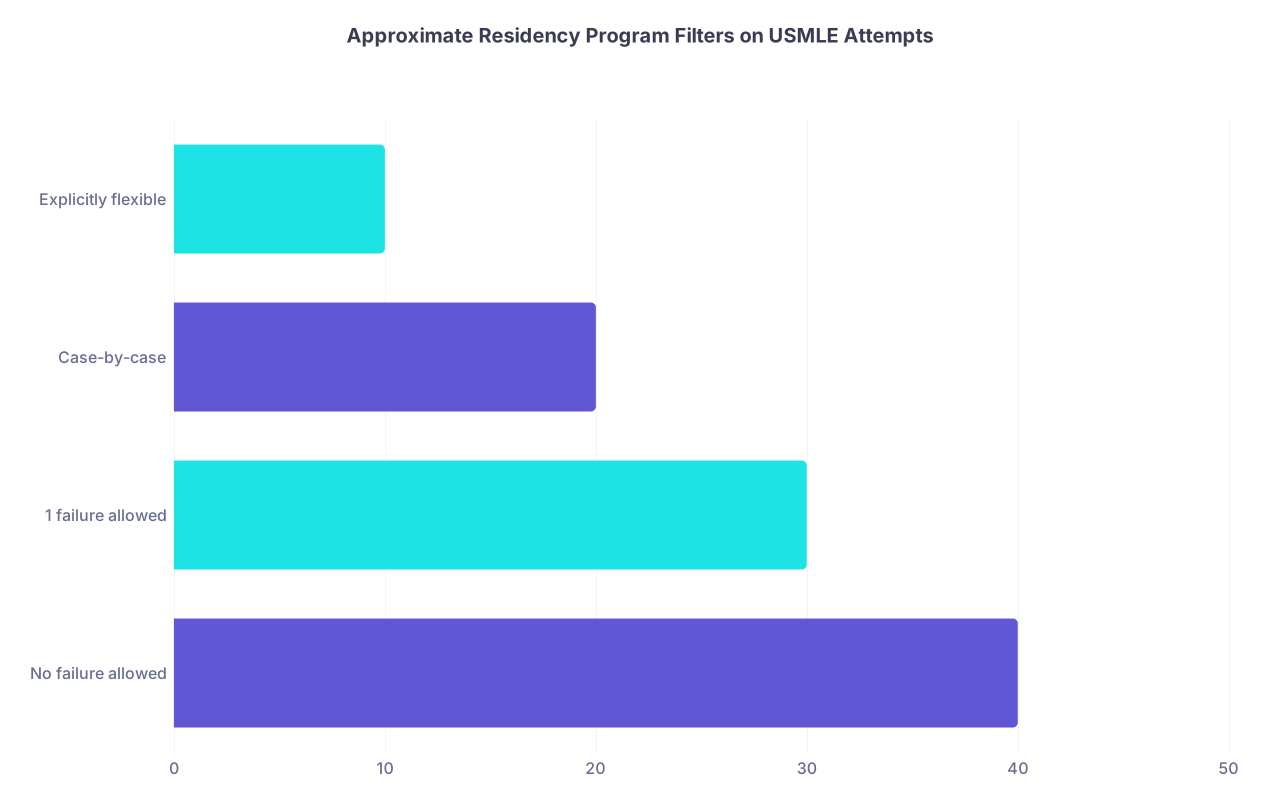
| Category | Value |
|---|---|
| No failure allowed | 40 |
| 1 failure allowed | 30 |
| Case-by-case | 20 |
| Explicitly flexible | 10 |
The rough pattern I see:
- Around 40% of programs auto-screen out any failure
- Another chunk will “consider,” but only if there is something exceptional to offset it
- A minority truly read the whole story
So your job is clear:
- Stop applying blindly to programs that will never read your file.
- Make your file so strong and so clearly framed that the rest are forced to pause.
2. Triage: Are You Still in the Game?
Before talking about narrative and framing, you need a hard look at your numbers and profile.
Snapshot your risk profile
Write these down:
- Step 1: score ___, attempts ___
- Step 2 CK: score ___, attempts ___
- Step 3 (if done): score ___, attempts ___
- YOG (year of graduation) ___
- Gap years: any gap > 6 months? Y/N
- US clinical experience: ___ months
- Publications: ___
- US LORs: # and from where? (specialty, university vs community)
- Specialty target: ___
Now match yourself roughly into buckets:
| Bucket | Description | Matchability* |
|---|---|---|
| A | 1 fail only, high subsequent scores, recent grad, solid USCE | Reasonable with strategy |
| B | 1–2 fails, average scores, some USCE, older grad | Difficult but possible with heavy offset |
| C | 2+ fails, low scores, no USCE, older grad | Very low; may need different path |
*“Matchability” assumes you apply intelligently (we will get there).
If you are in Bucket C and want dermatology or radiology, stop. That is not realism, that is denial.
For Internal Medicine, Family Medicine, Psych, Pediatrics – there is still a path for many in buckets A and B, if you execute well.
3. Specialty Selection: Play a Winnable Game
This is where a lot of IMGs lose before they start. They aim for competitive specialties while carrying two Step 1 attempts and then wonder why they have zero interviews.
If you have multiple attempts and you are an IMG, this is the blunt truth:
Competitive specialties (Derm, Ortho, Plastics, ENT, Optho, Rad Onc, etc.)
→ Off the table. You are burning money applying here.Moderately competitive (Radiology, Anesthesia, EM, some OB/GYN, some Surgery)
→ Almost always no, unless you have something extraordinary AND no failures in more recent exams.More feasible (Internal Medicine, Family Medicine, Psych, Pediatrics, Pathology, Neurology)
→ Where you should focus 95–100% of your energy.
If you already know your passion is something else, two options:
- Match in a core specialty (IM/FM/Psych) first, then consider fellowship that leans closer to your interest.
- Be honest with yourself that US residency may not be the right path.
You do not fix multiple attempts by “dreaming harder.” You fix them by picking battles you can win.
4. Offset Strategy: What Actually Moves the Needle
You cannot erase attempts. You can only outweigh them.
Here is what genuinely offsets multiple attempts for IMGs. Ranked roughly from most powerful to least.
1. Strong Step 2 CK and/or Step 3
If you failed Step 1 or had multiple attempts there, your Step 2 CK and Step 3 become crucial evidence of recovery.
You want at least:
- Step 2 CK: > 235 is good, > 245 is strong, > 250 is excellent (for IM/FM/Psych)
- Step 3: Pass on first attempt, ideally during application year
If you already took them and the scores are average, you cannot change that now. But if you have not yet taken Step 3, and you are out of school with multiple attempts → strongly consider Step 3 before or during your application year.
Programs see Step 3 as:
- Proof you can pass US boards
- Reduced risk for visa issues (for some J-1/H-1B programs)
- Evidence your previous failures were not permanent limitations
2. Real, hands-on US clinical experience (USCE)
I am not talking about random three-week observerships you got by paying a company.
I mean:
- 3–6 months of inpatient, hands-on or near-hands-on experience
- Preferably at community hospitals that actually take IMGs, not only university hospitals that never rank them
- With letters from people who actually supervised your clinical work
If you had multiple attempts but:
- You showed up early
- You owned your patients
- You wrote real notes (with supervision)
- You asked for feedback and improved
- You got LORs that say this clearly
Those letters can neutralize a lot of fear about your exams. I have seen PDs say: “Scores are ugly, but Dr. X’s letter is gold – I trust him.”

3. A track record of academic or research work
Not “I helped with a poster once.”
You want:
- Multiple abstracts/posters/papers, preferably in the specialty you are applying to
- Something where you are at least 2nd or 3rd author
- A mentor in the US who can write:
“This applicant is reliable, intelligent, and productive. They handled complex data, wrote drafts, and learned fast.”
Research alone will not fix triple attempts and low scores. But:
- It separates you from other multiple-attempt applicants who have nothing.
- It shows delayed maturity. You got hit, then you rebuilt.
4. A realistic, focused program list
Failing with multiple attempts is often less about your profile, more about applying like you have no idea how programs think.
You must:
- Target community and lower-tier university programs
- Focus on IMG-friendly programs with known history of taking IMGs (and ideally some with past residents from your country/med school)
- De-emphasize famous institutions or geographic hotspots (NYC, California, Boston) unless there is clear evidence they take people like you
If you have multiple attempts and apply to 80 programs, most being university, big-name, or “nice city” programs – do not be surprised by 0–1 interviews.
I have seen applicants with 1–2 attempts match with 40–60 well-chosen applications and others with 120 apps and 0 interviews because their list was fantasy.
5. How to Frame Multiple Attempts in Your Application
You cannot hide attempts. You also cannot pretend they do not matter.
Your job is to control the story.
Where the explanation belongs
You have three main places:
- Personal Statement – Should you mention it? Sometimes.
- ERAS “Additional Information” section – Better place for a short explanation.
- Interviews – You absolutely need a tight, rehearsed answer.
Let us structure it.
Rules for explaining attempts
Use this formula:
- Own it – Clear, no excuses, no blaming.
- Context, not drama – One or two sentences that give background.
- Change – Concrete actions you took afterward.
- Results – What improved (study strategies, scores, other achievements).
- Link to residency – Why this actually makes you a safer bet now.
Bad explanations
- “The exam was unfair and my school did not prepare me.”
- “I had personal issues and my family was going through a hard time.” (and then 6 paragraphs of detail)
- “I was anxious.” (Full stop, no follow-up on what changed.)
Stronger written explanation (ERAS Additional Info)
During my first attempt at Step 1, I underestimated the level of integration and did not use question banks effectively. I failed that attempt.
After this, I restructured my preparation: I completed two full passes of a major question bank, developed a daily schedule with spaced repetition, and met weekly with a faculty mentor to review weak areas. On my second attempt, I passed Step 1 and subsequently scored [XXX] on Step 2 CK on my first attempt.
This experience changed how I approach high-stakes tasks. I learned to seek feedback early, build structured plans, and test myself under exam-like conditions. I have applied this same approach in my clinical work and research, where it has helped me perform reliably under pressure.
That is the shape you want: brief, responsible, action-focused, with proof.
Should you mention attempts in the personal statement?
Only if:
- The failure is central to your story of growth AND
- You can keep it to one short paragraph and avoid the tone of a confession letter
Most of the time, I prefer:
- Personal statement: Focus on who you are clinically, why this specialty, what you bring.
- Additional Info / Interviews: Handle the attempts briskly and professionally.
If you turn your personal statement into “My journey of failing and rising again” for 700 words, some PDs will roll their eyes and stop reading.
6. Letters of Recommendation: Use Them to Indirectly Offset
Your LORs are not the place to detail your Step failures. But they can counter the doubts those failures create.
The main doubts are:
- Can this person handle complex information?
- Can they function under pressure?
- Are they reliable and safe?
So your letter writers should be prompted (yes, you can gently guide them) to talk about:
- Your ability to quickly learn and apply new knowledge
- Your performance on rotations: organization, follow-through, ownership of patients
- Specific cases where you showed resilience or handled a high workload
- How you compare to other students they have worked with (e.g., “top 10–20%”)
When you ask for a letter, say something like:
“Doctor, I want to be transparent. I had multiple attempts on Step 1, but I passed and did better on Step 2 CK and Step 3. Programs may worry about my ability to handle clinical work and exams. If you feel you can honestly comment on my reliability, capacity to learn, and performance on the rotation, that would be extremely helpful.”
Do not script their letter, but make the target clear.
7. Targeting Programs: Build a Smart List
You need to think like someone managing risk. Because that is what PDs are doing.
Characteristics of more forgiving programs
Look for programs that:
- Are community-based or “university-affiliated community” hospitals
- Have a high percentage of IMG residents
- List “must have Step 2 CK on first attempt” – if they do, and you do not, skip them
- Are in less saturated locations:
- Midwest, South, smaller cities
- States like Ohio, Michigan, Pennsylvania (non-major cities), Texas (outside big metro), etc.
| Program Type | Usual Stance on Attempts | Priority for You |
|---|---|---|
| Big-name university | Very strict, often 0 failures | Very low |
| Mid-tier university | 0–1 failure sometimes ok | Low–Medium |
| University-affiliated community | More flexible, case-by-case | High |
| Pure community hospital | Most flexible, esp. IMG-heavy | Very High |
Do not waste your attempts on ERAS by spraying them at all the famous places your classmates are talking about. You are playing a different game.
8. Interview Day: How to Talk About Your Attempts Without Sinking Yourself
If you get an interview with multiple attempts, it means: someone decided you might be worth the risk.
Your goal in the interview is simple:
- Confirm that they were right.
- Do not re-open doubts they already decided to overlook.
You must have a clean, unshakable answer to:
“Can you tell me about your multiple attempts on Step X?”
Structure:
- One-sentence acknowledgement
- Brief context
- Actions taken
- Evidence of improvement
- Takeaway for residency
Example:
“Yes, of course. I had two attempts at Step 1. On my first attempt, I did not realize how different the exam was from my school exams. I focused too much on rereading and not enough on questions and integration, and I failed.
After that, I changed my approach. I treated preparation like a full-time job: 8–10 hours daily with question blocks, detailed review, spaced repetition, and weekly check-ins with a faculty mentor. On my second attempt, I passed Step 1, and I then scored [XXX] on Step 2 CK on my first attempt and passed Step 3 as well.
This experience has actually helped me in clinical work. I plan more deliberately, I seek feedback early, and I do not wait for problems to become crises. In residency, I will bring that same level of structure to my learning and patient care.”
Say it calmly. No drama. No apologies every other sentence. Then stop. Look at them. Do not keep talking out of anxiety.
If they push deeper, answer honestly, but always end with what you learned and the concrete outcomes since then.
9. Fixing What You Still Can – If You Are Not Applying This Cycle
If you are reading this a year or more before you plan to apply, you are in a better position than you think.
Here is a high-yield, brutal, 12–18 month rebuild plan for an IMG with multiple attempts:
Step 1: Academic salvage
- If Step 2 CK not yet taken → Treat it as the single most important exam of your life.
- Do a complete structured prep with:
- Full question bank (UWorld or similar)
- At least 3–4 NBME/UWSAs
- Realistic timing and conditions
- Aim: at least mid-230s.
- Do a complete structured prep with:
- If Step 3 not yet done and you are out of med school → Plan to take Step 3 within 6–9 months before ERAS.
Step 2: USCE acquisition
Target a minimum of 3 months USCE, ideally 4–6 months, spread across:
- Internal Medicine / Family Medicine core rotations if that is your target
- At least one sub-internship–style month where you are treated like an intern (under supervision)
Leverage:
- Alumni from your school already in US programs
- Attendings from your country working in US hospitals
- Cold emails to community program coordinators with a short, tight CV attached
Step 3: Research or QI work
Especially helpful if you aim for IM or Psych.
- Join an ongoing project with a US-based mentor (even remotely)
- Aim to be on 2–3 posters/abstracts and ideally 1 publication in 12–18 months
- Focus on doing the work (data collection, analysis, drafting) instead of just attaching your name
Step 4: Fix your story
During this year:
- Document your habits – schedules, systems, feedback loops
- Collect evidence: emails praising your work, informal feedback, etc.
- By the time you apply, your narrative is not “I failed.”
It is “I failed, rebuilt systematically, and here is the track record that proves it.”
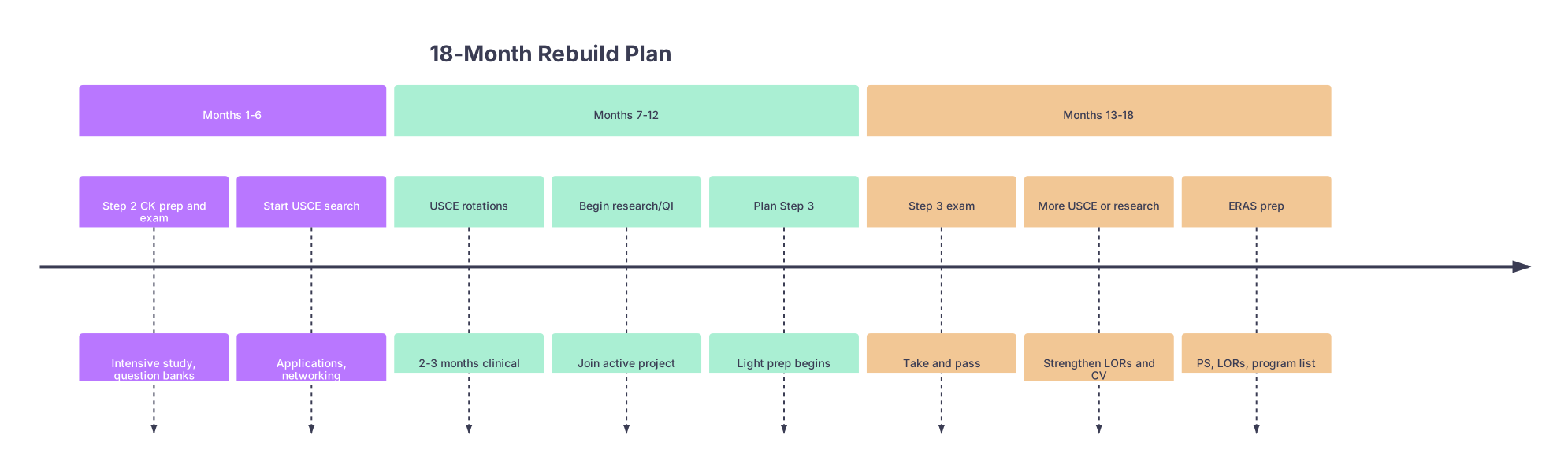
| Period | Event |
|---|---|
| Months 1-6 - Step 2 CK prep and exam | Intensive study, question banks |
| Months 1-6 - Start USCE search | Applications, networking |
| Months 7-12 - USCE rotations | 2-3 months clinical |
| Months 7-12 - Begin research/QI | Join active project |
| Months 7-12 - Plan Step 3 | Light prep begins |
| Months 13-18 - Step 3 exam | Take and pass |
| Months 13-18 - More USCE or research | Strengthen LORs and CV |
| Months 13-18 - ERAS prep | PS, LORs, program list |
10. Mental Framework: How to Think About This Without Destroying Yourself
One last piece. Because I have watched this part break applicants more than the exams.
Multiple attempts feel like a scarlet letter. You start:
- Comparing yourself to classmates with 250+ and clean passes
- Internalizing every rejection as proof you are “not good enough”
- Writing in a way that begs programs for forgiveness instead of offering them value
You cannot think like that and still present strongly.
You are not asking programs for charity. You are offering:
- A person who has already been punched in the face by failure
- Who rebuilt under pressure
- Who has lived experience with resilience and deliberate practice
That is not a weakness. Programs complain constantly that some “perfect” applicants crumble at the first sign of stress. You, if you handled this well, are different.
Own that. Calmly. Without over-selling.
Your Next Action Today
Do one concrete thing today, not ten.
Open a blank document and write a 6–8 sentence explanation of your multiple attempts using this structure:
- What exam and how many attempts
- One sentence of context (no drama)
- 2–3 sentences on what you changed in your approach
- 1–2 sentences on the improved results (scores, Step 3, clinical/research performance)
- One sentence linking this growth to how you will function in residency
Then read it out loud.
Tighten it until it sounds calm, responsible, and confident.
That explanation becomes the backbone of your ERAS “Additional Information” section and your interview answer. And it is the first brick in reframing your entire application from “I failed” to “I rebuilt.”