
Most of what you have heard about IMG letters of recommendation is incomplete. Or just wrong.
You have probably heard some version of:
“US programs only care about US letters.”
“If you don’t have US clinical experience, you’re done.”
Or my personal favorite: “Home-country letters are basically useless.”
Nonsense.
Are US letters of recommendation (LORs) usually stronger currency? Yes.
Are home‑country LORs automatically weak? No.
Can you make an application with only home‑country LORs competitive enough to match? In many cases, yes—if you stop playing defense and start engineering those letters properly.
This guide will show you exactly how.
1. Understand the Real Problem (It Is Not That Your Letter Is “Foreign”)
Programs are not rejecting your home‑country letters because they are from India, Egypt, Nigeria, or Poland.
They are rejecting them because they cannot interpret them.
Here is what makes many home‑country LORs weak in the eyes of US programs:
- Vague, generic praise (“hard‑working, kind, punctual”)
- No comparison to peers
- No concrete clinical examples
- No sense of the writer’s credibility in the US system
- Outdated letters (2–3+ years old)
- Over-the-top superlatives that sound fake
- Poor formatting, unclear letterhead, or missing contact info
None of that is about geography.
It is about signal quality.
You are not trying to convince programs that you are “good.”
You are trying to give them enough US‑interpretable data to estimate:
- Your clinical competence
- Your work ethic and reliability
- Your communication skills
- Your ability to function in a Western-style healthcare environment
- How you compare to other trainees
Once you understand this, your question changes from “How do I hide that my letters are foreign?” to “How do I make my foreign letters speak fluent ‘residency program director’?”
That is fixable.
2. Decide Your Strategy Based on Your Profile
Before we get tactical, you need a clear strategy. Different backgrounds require different moves.
| Profile Type | LOR Priority |
|---|---|
| Fresh grad, no USCE | Maximize strong home LORs + research/remote US exposure |
| Old grad (>5 years), no USCE | Get at least 1 recent clinical LOR + home academic LORs |
| Some US observerships | Turn every US interaction into at least 1 credible US LOR |
| Research-heavy, low clinical | Mix PI/research LOR + best home clinical LORs |
| Strong scores, weak letters | Repair letter content + add one new strong referee |
If you have only home‑country LORs this year, your job is:
- Upgrade the content, structure, and credibility of those letters.
- Compensate in other parts of your application (personal statement, CV, experiences) to show what US letters normally prove: reliability, clinical maturity, and fit for the system.
- If time allows, generate one stronger, more recent letter—even from non‑US settings—to anchor your file.
Let me walk you through how.
3. Engineer Strong Home‑Country LORs (Instead of Hoping)
You cannot write your own letter. But you absolutely can structure it.
If you email a busy professor, “Can you please write me a strong LOR for US residency?” you will often get:
- A generic, 3‑paragraph, copy‑paste letter
- No specific details
- A letter that sounds identical to 50 others
That kills you.
What you do instead is create a LOR support packet that makes it almost effortless for your referee to write something detailed and US‑readable.
3.1. Who You Should Ask (Prioritize Like This)
Pick 3–4 writers. You usually need 3 for ERAS; aim for 1 extra as backup.
Prioritize:
- Supervisors who directly observed your clinical work
- Department heads who actually know you
- Ward/clinic attendings
- Residency training supervisors
- People who can compare you to peers
- Program director of your internship
- Clerkship director or course coordinator
- People with any US or international connection
- Trained in US/UK/Canada/Europe
- Collaborative projects with US institutions
- Has published in international journals, speaks at international conferences
Avoid:
- Distant deans who met you twice
- Famous professors who barely know your name
- Friends of family who are doctors but never saw you work
“Famous but vague” is weaker than “relatively unknown but specific.”
3.2. What You Give Them (Your LOR Support Packet)
You send them a clear, respectful request email plus attachments. Here is exactly what should be in the packet:
- Updated CV
- Personal statement draft (or at least a career goals paragraph)
- ERAS target specialties and sample programs
- 1–2 page bullet list of specific things they supervised you doing
That last piece is the secret weapon.
It might contain items like:
- “Managed 10–12 inpatients daily on internal medicine ward during internship”
- “Led morning handoffs, presented cases succinctly and logically”
- “Recognized early sepsis in a postoperative patient and escalated appropriately”
- “Communicated sensitive diagnosis to family with empathy (hepatocellular carcinoma case, July 2023)”
- “Stayed after hours to stabilize DKA patient when team was short-staffed”
Do not write paragraphs. Just factual bullets with dates and context.
You are not telling them what to say.
You are reminding them of real cases and behaviors they can describe.
4. Structure: What a Competitive Home‑Country LOR Should Look Like
I will outline the exact architecture of a strong letter so you can guide your referees.
4.1. Non‑negotiable Elements
Every LOR must have:
- Official letterhead (hospital/university, not personal)
- Date (within last 12–18 months ideally)
- Writer’s:
- Full name
- Academic/clinical title
- Department
- Institution
- Email and phone
- Qualifications (including any US/UK/Canada training if applicable)
- Addressed “To the Residency Program Director” or “To Whom It May Concern”
If any of that is missing, programs start questioning authenticity or relevance.
4.2. Ideal LOR Flow
Share this outline directly with your referee. Many will appreciate the clarity.
- Introduction and relationship
- Who the writer is
- How they know you
- For how long
- In what capacity (attending, PD, supervisor)
- Context of your work
- Type of facility (tertiary academic hospital, community clinic, etc.)
- Patient volume, acuity
- Your role (student, intern, resident, fellow)
- Clinical skills with examples
- Professionalism and work ethic with examples
- Communication and teamwork with examples
- Comparison to peers
- Clear, strong recommendation statement
- Contact invitation
4.3. Concrete Language That Programs Understand
Weak:
“Dr. X is very hard working and always on time. He is good with patients.”
Strong:
“Dr. X independently managed 10–12 internal medicine inpatients daily during his rotating internship, including admission workups, day‑to‑day management, and discharge planning. His documentation was consistently organized, legible, and timely. He routinely stayed beyond scheduled hours to stabilize unstable patients before sign‑out.”
Notice the difference: numbers, scope of responsibility, specific tasks.
Programs are used to US letters containing:
- Specific rotations and durations (“3‑month full‑time internal medicine internship, April–June 2023”)
- Language about entrustability (“I trusted her to manage initial assessment and plan for new admissions with minimal supervision.”)
- Clear rankings (“in the top 10% of interns I have worked with in 10 years”)
You can absolutely get that from a hospital in Karachi, Lagos, or São Paulo—if you ask for it correctly.
5. Fix the Biggest Weak Spots in Home‑Country Letters
There are recurring, fixable problems I see in IMG LORs.
5.1. Problem: Vague, Copy‑Paste Praise
Typical lines:
- “He is very sincere, honest, and punctual.”
- “She is hardworking and cooperative.”
- “He is an asset to our institute.”
Solution:
In your support packet, add a one‑page document called “Areas programs care about” with headings like:
- Clinical judgment
- Reliability
- Communication skills
- Ability to learn and integrate feedback
- Teamwork and leadership
- Adaptability under pressure
Under each heading, put 1–2 specific bullets from your real experiences. You are not writing the letter; you are giving your referee raw material so they are less likely to rely on clichés.
5.2. Problem: No Comparison to Peers
Many letters say, “One of our best interns.” No context. Meaningless.
You want language like:
- “In the top 5 of 45 interns I have supervised this year.”
- “In the top 10% of over 300 students I have taught in my career.”
- “Among the top 2 residents I have worked with over the last 5 years.”
You cannot demand this, but you can plant the idea.
In your email request, you might write:
“US programs place high value on comparative statements (for example, ‘top 10% of interns I have supervised’). If you honestly feel comfortable including any comparison like this, it would be very helpful for my application.”
Ethical, transparent, and surprisingly effective.
5.3. Problem: No Understanding of US Residency Demands
Some writers have never seen a US residency. They do not know what to emphasize.
Add a one-paragraph briefing in your email:
“US internal medicine residencies are very service-heavy and expect interns to manage high patient volumes, take primary responsibility for initial assessments and daily plans, and communicate effectively with multidisciplinary teams. Letters that comment on my ability to handle workload, accountability, and communication are particularly valuable.”
You are not lecturing them. You are giving them context.
6. If You Have Zero USCE: Build “US-Relevant” Credibility From Home
You cannot retroactively do an observership this year. Fine. But you can still shape your letters to show you can function in a Western-style system.
Focus on three angles:
6.1. Systems and Protocols
Ask your letter writers to mention when you:
- Used evidence‑based guidelines (e.g., ACC/AHA, IDSA)
- Participated in morbidity and mortality (M&M) meetings
- Implemented standardized order sets or protocols
- Took part in quality improvement projects
That tells US programs: “This person operates in a system, not chaos.”
6.2. Communication in English
If your setting used English for documentation, handovers, or presentations, make sure the letter says that explicitly:
- “Dr. Y conducted all patient presentations and medical documentation in English.”
- “She presented complex cases in English during weekly academic rounds, responding to questions clearly and concisely.”
That helps a program director nervous about communication barriers sleep a little better.
6.3. Multidisciplinary Teamwork
Residency is all about functioning in teams.
Have your writers reference:
- Working with nurses, pharmacists, social workers
- Coordinating discharges
- Family meetings
- Leading or participating in handoff rounds
Again, you give them bullets. They pick what they actually observed.
7. Formatting and Practical Details That Quietly Matter
You would be surprised how many applications get silently downgraded because the letters look sketchy.
7.1. Make the Letter Visually Professional
Guide your writers (gently) to:
- Use department or hospital letterhead (PDF or scanned letter is fine)
- Use a professional font (Times New Roman, Arial, Calibri, 11–12 pt)
- Keep it to one page, maximum 1.5 pages
- Include signature above typed name
If your institution lacks formal letterhead, suggest adding:
- Hospital logo (if allowed)
- Address block at top
- Website URL in footer
7.2. Upload Method: Who Does What
For ERAS:
- You create the LOR entry, generate a Letter ID, and send it to the writer.
- They upload directly to ERAS, or send you a signed PDF that you upload through the “LOR Portal” if the system allows your role (check current rules).
Do not alter content or metadata. That crosses ethical and procedural lines.
But you can and should:
- Check the PDF for missing signatures
- Ensure letterhead and date are visible
- Confirm the name matches what you entered in ERAS
7.3. Timing
Aim for letters written within the last 12 months. Up to 18 months is usually acceptable if you have been continuously clinically active.
If your strongest interaction was 2–3 years ago, solve it this way:
- Email the writer with:
- Summary of what you did then
- Updates on your clinical progress since
- Ask if they would feel comfortable writing a letter reflecting both:
- Your performance then
- Their updated impression with your recent activities (if they have kept in touch)
If they barely remember you, move on.
8. Compensate in Other Parts of Your Application
You cannot entirely “patch” the lack of US letters. So you must use other pieces of your application to make the same argument those letters would have made.
8.1. Personal Statement: Prove You Are Trainable and Reliable
Your personal statement should:
- Show a specific, grounded understanding of US residency (not fantasy)
- Demonstrate that you handle responsibility and stress
- Highlight times you learned quickly in a new environment
- Show you seek and accept feedback without ego
Avoid vague narrative. Use 2–3 concrete moments that show:
- Ownership of patient care
- Ethical judgment
- Communication under pressure
8.2. ERAS Experiences: Make Your Home‑Country Work Look Like Real Work
Fill experience entries with:
- Numbers: patients per day, clinics per week, on‑call frequency
- Tasks: admitting, rounding, discharging, performing procedures, counseling
- Systems: use of EMR (if any), protocols, guidelines
Align the language with what your letters say. Consistency reinforces credibility.
8.3. Research and Courses: Signal US Alignment
If you have time before application submission, add:
- Online US‑based CME or certificate courses
- AHA ACLS/BLS
- Online QI or patient safety courses
- US‑based telemedicine or remote observership programs (if reputable)
- Research with US collaborators (even small roles, if legitimate)
These will not replace USCE, but they show forward motion and system awareness.
9. Target Programs Strategically (Stop Wasting Shots)
Some programs will not seriously consider IMGs without US LORs. Chasing them is a waste.
Instead, focus where your improved home‑country letters actually matter.
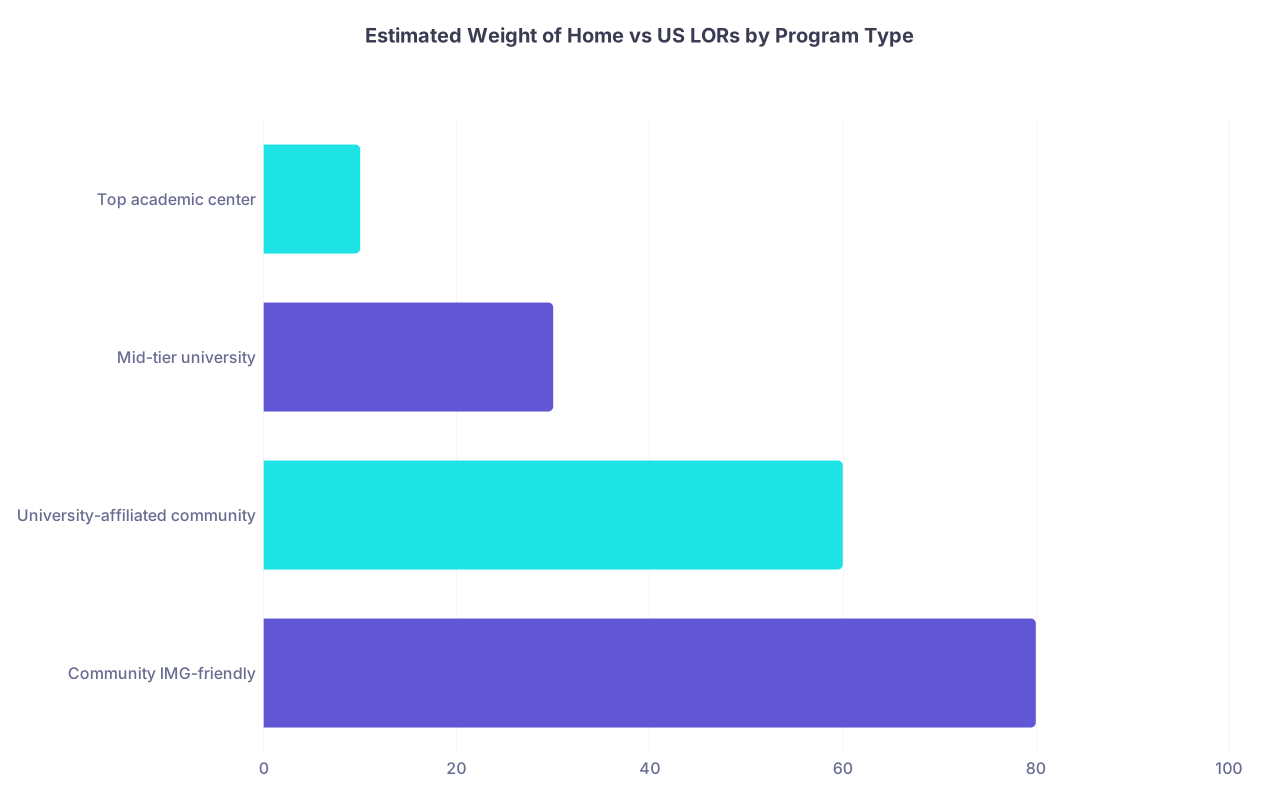
| Category | Value |
|---|---|
| Community IMG-friendly | 80 |
| University-affiliated community | 60 |
| Mid-tier university | 30 |
| Top academic center | 10 |
Interpretation (rough, but directionally correct):
- Community IMG‑friendly programs: will read your home‑country letters closely
- University‑affiliated community: mixed; strong home letters can still help
- Mid-tier/university: want US letters but may consider strong foreign letters if other metrics are excellent
- Top academic centers: typically require US LORs; move on for now
Translate that into action:
- Use resources like FREIDA, program websites, and past IMG match lists to identify IMG-friendly programs.
- Look for programs that:
- Explicitly mention “international graduates welcome”
- Have current residents from your region or medical school
- Do not state “US clinical experience required” (or at least say “preferred” instead of “required”)
Then allocate your applications heavily towards those programs.
10. Example: Turning a Weak Home‑Country LOR Into a Competitive One
Let me show you the before-and-after pattern so you see what “fixed” looks like.
Original (typical weak letter extract):
“Dr. A was a hardworking and sincere intern in our medicine department. He is punctual, honest and treats patients kindly. He has good knowledge and will be an excellent doctor in the future. I recommend him for any position he may seek.”
Engineered, competitive version (after you provided proper input):
“I am Dr. B, Associate Professor of Internal Medicine at XYZ Teaching Hospital, a 750-bed tertiary care center. I supervised Dr. A directly for three months during his full-time internal medicine internship from April to June 2023.
During this rotation, Dr. A independently managed 10–12 inpatients daily, including initial history and physical examinations, formulation of differential diagnoses, and daily progress notes. He consistently used evidence‑based guidelines (e.g., ACC/AHA for heart failure, ADA for diabetes) when formulating management plans, and I trusted him to present concise, accurate plans on morning rounds.
One example stands out. Dr. A evaluated a 62‑year‑old man presenting with shortness of breath and hypotension after recent surgery. He promptly recognized signs of early septic shock, escalated care appropriately, coordinated with the ICU team, and remained at the bedside until the patient was stabilized. His clinical judgment and composure under pressure were notable for a first-year intern.
Dr. A communicated effectively with both patients and the multidisciplinary team. All documentation and case presentations were in English, and he routinely presented complex cases during our weekly academic rounds, responding clearly to probing questions from faculty.
In terms of overall performance, I would rank him in the top 10% of the approximately 60 interns I have supervised over the past five years. He is reliable, accountable, and receptive to feedback, often seeking additional learning opportunities beyond routine duties.
I strongly recommend Dr. A for an internal medicine residency position in the United States. I am confident he will adapt quickly to the demands of a US training program and contribute positively to any team he joins. I am happy to provide further information if needed.”
Same intern. Same hospital. Different outcome.
11. Build One New, High‑Yield Letter if Time Allows
If you still have 6–12 months before you apply or reapply, use that time to secure at least one new strong letter—even if not from the US.
High-yield options:
- A full‑time job as a medical officer / junior doctor in an accredited hospital
- A clinical fellowship position in your home country
- A structured clinical attachment in a private or university hospital with English documentation
Your goal is a referee who can honestly write:
- “I have worked with Dr. X for 6–12 months in a full‑time clinical role.”
- “She has taken primary responsibility for patient care and on‑call duties.”
- “I would trust her with the responsibilities of a first‑year resident.”
This kind of letter, even from outside the US, carries weight, because it proves you can function as an independent doctor – not just as a student observer.
12. When You Reapply: Upgrade Without Burning Bridges
If you are reapplying and considering reusing old letters:
- Keep strong ones from last cycle (if they are already US‑style and detailed)
- Replace generic or very old letters with new ones
- Politely request updated versions from key writers
Approach for updates:
“Dear Dr. X,
I am reapplying to US residency this year and would be very grateful if you could update my previous letter of recommendation. Since we last worked together, I have [brief summary of new clinical work]. I have attached my updated CV and a brief list of duties and cases you supervised. If you feel you can support my application again, an updated letter dated this year would be extremely valuable.”
You keep the relationship positive and professional. Some will update; some will not. Move with the ones who do.
13. Put It All Together: A Simple Workflow You Can Follow
Here is a practical, no-excuses plan:

| Step | Description |
|---|---|
| Step 1 | Identify 4 potential referees |
| Step 2 | Rank by strength & familiarity |
| Step 3 | Email top 3 with structured request |
| Step 4 | Send LOR support packet |
| Step 5 | Follow up politely in 1-2 weeks |
| Step 6 | Review for completeness (not content) |
| Step 7 | Assign strongest 3 in ERAS |
And parallel to that:
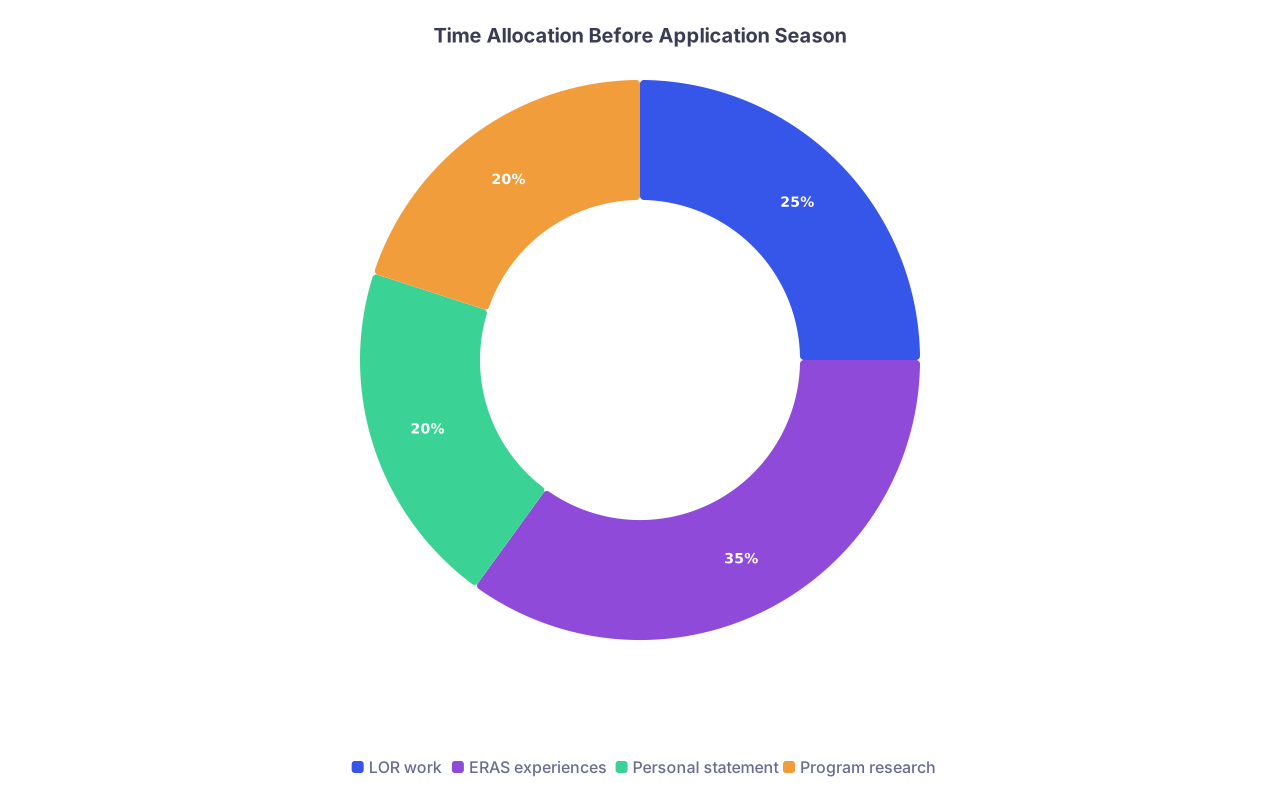
| Category | Value |
|---|---|
| LOR work | 25 |
| ERAS experiences | 35 |
| Personal statement | 20 |
| Program research | 20 |
If you devote around 25% of your pre‑application effort to engineering better letters (instead of obsessively rewriting your personal statement five times), you will get a much bigger payoff.
14. Your Next Step Today
Do not just nod and move on.
Right now, open a document and list:
- The 4 best people who could write you a letter this year. Use the criteria above.
- For each, write 5–7 bullets of concrete things you did with them:
- Real patients
- Real responsibilities
- Real outcomes
Then draft a short, respectful email template requesting a LOR and offering your support packet.
By the time you send those three emails, you will have stopped passively “hoping” your home‑country LORs are enough—and started actively turning them into something that can compete.