
The biggest mistake IMGs make is hiding or downplaying their non‑clinical work. That is exactly backward.
Non‑clinical work is often the only thing that shows US programs you can function in their system. If you treat it like filler, that is how it will read. If you treat it like evidence, it becomes content that moves the needle.
You want the second option.
Below is the playbook I use with IMGs to turn “random jobs” and “gaps” into strong ERAS entries that survive scrutiny and actually help you.
1. Change the Frame: Non‑Clinical ≠ Useless
Program directors are not allergic to non‑clinical work. They are allergic to:
- Vagueness
- Gaps they cannot explain
- Red flags (visa issues, professionalism, instability)
If your CV has 18 months of “Data entry, 2019–2020” and you shrug when asked about it, that looks like hiding. If the same 18 months is framed as:
“Full‑time medical data abstractor for a national quality registry: handled 300+ charts/week, collaborated with hospitalists and coders, improved abstraction error rate from 9% to 3% in 6 months.”
Now you look like someone who:
- Knows US documentation
- Works with teams
- Cares about quality and accuracy
Same job. Different framing.
Your rule going forward:
Every non‑clinical role must prove at least one residency‑relevant competency.
Examples of competencies programs respect:
- Reliability and work ethic
- Communication (especially with patients or interdisciplinary teams)
- Leadership and initiative
- Data handling / QI / research mindset
- Teaching or mentorship
- Systems knowledge (EHR, US health system, billing, coding)
We are going to convert your experience into those.
2. Do a “Residency Relevance Audit” of Your Work
Take each non‑clinical role you have held and run it through this 3‑step audit.
Step 1: List the raw tasks
No editing. Just dump everything you actually did.
Example: Call center job, “Patient Services Representative”
- Answered calls
- Scheduled appointments
- Dealt with angry patients
- Checked insurance eligibility
- Sent messages to providers
- Explained clinic policies
Alone, this list is boring. But it is raw material.
Step 2: Map tasks to residency skills
Now connect each task to something PDs care about:
- Answered calls → triage, communication under time pressure
- Scheduled appointments → workflow management, prioritization
- Dealt with angry patients → conflict management, empathy, professionalism
- Checked insurance → system navigation, understanding barriers to care
- Sent messages to providers → closed‑loop communication, teamwork
- Explained policies → patient education, clarity, cultural sensitivity
Step 3: Extract results and scale
Residency selection is about probability. They want evidence, not feelings. So you need numbers, outcomes, or scope.
Ask yourself:
- How many? How often?
- Did anything improve?
- Did anyone trust you with new responsibilities?
- Did you train others? Lead anything? Fix a process?
Example rewrites:
- “Handled 70–90 patient calls per day while maintaining >90% quality score on internal audits.”
- “Trained 4 new hires on call workflows and documentation templates.”
- “Helped redesign appointment template for high‑risk patients, cutting average wait time from 8 to 4 days.”
Now you are not “just call center staff.” You are a high‑volume, performance‑measured communicator in a healthcare environment.
3. Translate Non‑Clinical Work into Strong ERAS Entries
ERAS gives you limited space. You cannot waste it on fluff.
Your structure for non‑clinical experiences:
- One‑line role summary in “residency language”
- 2–4 bullet points with action → scope → result
- One bullet that explicitly connects to a clinical or systems skill (if possible)
3.1. Use Residency‑Fluent Role Titles
Stop underselling yourself with titles like “Job” or “Office Work.”
You cannot lie about your job title, but you can add clarity. ERAS allows a “Position/Title” that can be slightly more descriptive than a payroll system.
Examples of better titles:
- “Medical Data Abstractor – Quality Improvement” (instead of “Data Entry”)
- “Patient Services Representative – Internal Medicine Clinic” (instead of “Call Center Agent”)
- “Clinical Research Coordinator (Non‑licensed)”
- “Medical Scribe – Emergency Department”
- “Health Outreach Volunteer – Community Clinic”
If your official title was generic (e.g., “Associate”), you can use:
“Associate (Medical Records / Data Abstraction)”
That is honest and clearer.
3.2. Bullet Formula That Works
Use this pattern:
[Action verb] + [what you did] + [scale or context] + [impact/result]
Examples for typical IMG non‑clinical roles:
Example: Medical data entry / abstractor
- Entered and validated 250–300 patient encounters per week into the hospital’s EMR and national registry, maintaining >98% accuracy on random audits.
- Collaborated with hospitalists, coders, and quality staff to resolve documentation discrepancies, reducing chart rejection rate from 12% to 5% in 4 months.
- Designed a simple checklist for new abstractors that shortened training time by 30% and reduced early errors.
Example: Community health worker / outreach
- Conducted 150+ one‑on‑one counseling sessions for patients with diabetes and hypertension, focusing on medication adherence and lifestyle changes in a low‑income population.
- Coordinated weekly support group for 10–15 patients, working with a family physician to develop simple educational materials in both English and Spanish.
- Identified barriers to follow‑up (transportation, work schedules), communicated with clinic staff, and helped increase follow‑up attendance from 40% to 65% over 6 months.
Example: Teaching / tutoring (non‑medical)
- Tutored high‑school math and science for 20–25 students per semester, tracking progress and adjusting plans based on weekly assessments.
- Developed new problem sets and review sessions that increased average test scores by 15 percentage points across the cohort.
- Mentored two first‑generation college applicants through exam preparation and application process; both gained admission to 4‑year universities.
You see the pattern: concrete, measurable, no fluff.
4. Plug the “Gaps” Without Lying
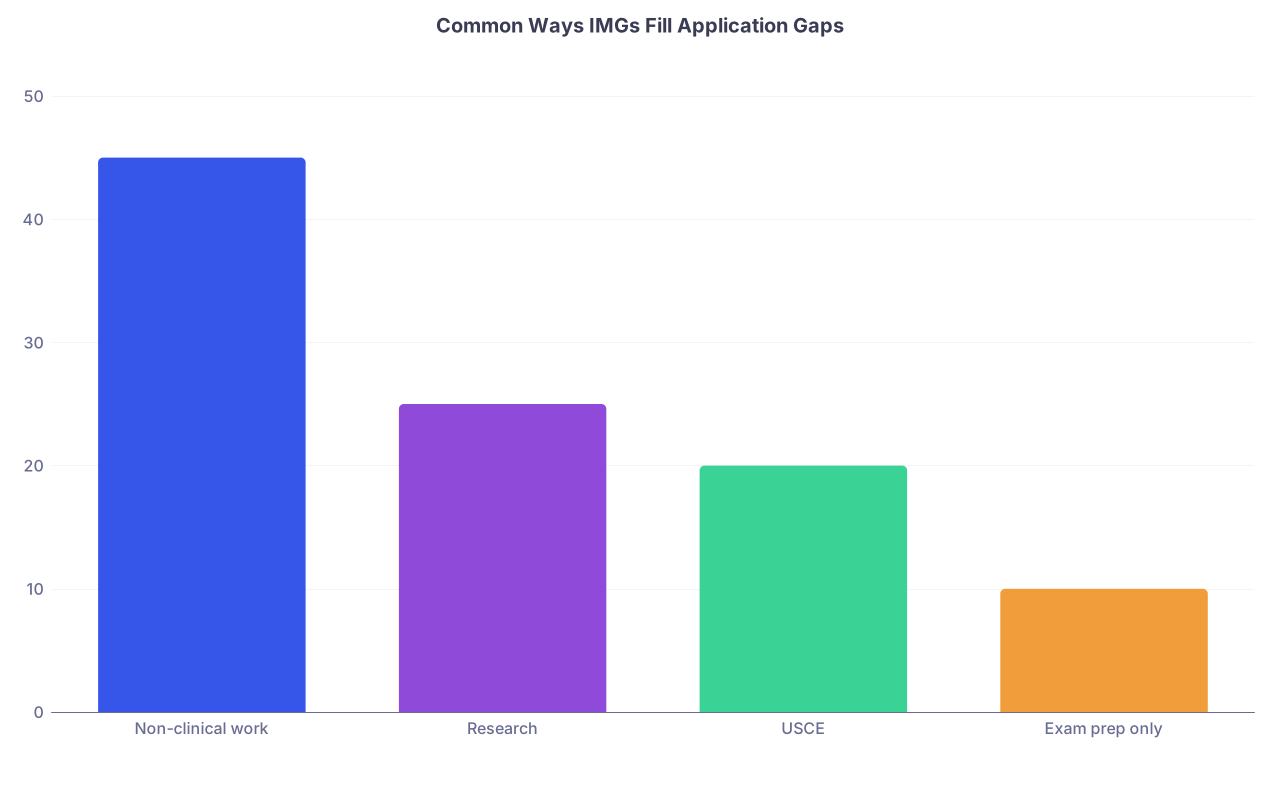
Programs hate unexplained time gaps. Non‑clinical work, if framed well, is the cure.
| Category | Value |
|---|---|
| Non-clinical work | 45 |
| Research | 25 |
| USCE | 20 |
| Exam prep only | 10 |
Notice that “non‑clinical work” is actually how most IMGs explain their timeline.
Scenario A: You worked full‑time outside medicine
Example: Business, IT, retail, rideshare, warehouse.
You do not hide this. You own it and connect it to stability and maturity.
ERAS entry:
Position: Warehouse Associate (Full‑time employment during US transition)
Description bullets:
- Maintained 98–100% on‑time order fulfillment while processing 150–200 items per shift.
- Frequently assigned to train new staff on safety procedures and workflow.
- Helped support family financially during immigration process while studying for USMLE exams on evenings and weekends.
This shows:
- You are not idle.
- You handle hard work.
- You can talk about time management when they ask about studying + work.
Scenario B: You studied for exams and “nothing else”
You cannot have “USMLE prep” as your only content for 2–3 years. It reads poorly.
If that is your reality right now, fix it for the next cycle, not by inventing the past.
Minimum fix:
- Add structured volunteering (clinic, community, crisis line, health education)
- Add small, consistent part‑time roles (scribe, MA, front desk, data assistant)
- Document them clearly for at least 6–12 months
Use ERAS “Other Experience” if paid options are limited.
If the past is already fixed and you have a long “exam only” phase, your strategy is:
- One concise “Independent Study” entry with clear, honest dates
- Very strong recent experiences (clinical or non‑clinical) that show you are now embedded in the system
5. ERAS Categories: Where to Put What
Here is how I typically sort non‑clinical roles for IMGs:
| Type of Role | ERAS Section |
|---|---|
| Paid healthcare-related work | Work Experience |
| Non-healthcare paid work | Work Experience |
| Unpaid clinic / hospital roles | Volunteer Experience |
| Community outreach / teaching | Volunteer Experience |
| Long-term exam prep only | Other Experience |
Some tips:
- If it touched patients, a clinic, or a hospital at all → lean toward “Work” or “Volunteer,” not “Other.”
- “Other” is for things that are important but do not fit neatly, like structured exam prep, a long unpaid research project, or caregiving responsibilities.
- Do not double‑count. One role goes in one section, not both.
6. Connect Non‑Clinical Work to Your Specialty Choice
This is where most IMGs drop the ball. They write decent bullets, then never link them to why they are a good fit for internal medicine or psychiatry or FM.
You need two connections:
- Inside the ERAS entry (one bullet that is clearly relevant to the specialty)
- Inside your personal statement and interviews
Example: Non‑clinical → Internal Medicine
Non‑clinical role: Quality improvement data abstractor for CHF and COPD readmissions.
ERAS bullet:
- Abstracted detailed clinical and social data from >500 hospitalizations for CHF/COPD, which deepened my understanding of how comorbidities, medication adherence, and social factors drive readmissions in internal medicine patients.
Personal statement connection:
“My quality work on CHF and COPD readmissions made something very clear: the difference between readmission and stability is rarely a single lab value. It is medication reconciliation, follow‑up, transportation, and family support. That is internal medicine’s daily work, and it is why I want to train in a program where I can continue combining bedside care with system‑based improvements.”
Now your “data job” is part of your IM story.
Example: Non‑clinical → Psychiatry
Non‑clinical role: Hotline counselor (suicide, crisis, or domestic violence line).
ERAS bullet:
- Managed >200 crisis calls, using structured assessment tools and safety planning under real‑time supervision, which strengthened my skills in risk assessment, boundary setting, and empathic listening.
Interview line:
“That role taught me to sit with intense emotions without reacting impulsively, to clarify risk, and to collaborate on safety planning. Those are exactly the skills I want to build further in psychiatry training.”
This is what “turning non‑clinical into valuable content” really means.
7. Personal Statement: Weaving Non‑Clinical Work Without Making Excuses
You do not write a personal statement that reads like a justification for working. Programs understand you needed money, visas, or time.
Instead:
- Acknowledge the phase briefly.
- Extract what it taught you that matters for residency.
- Move on to your clinical now and your future.
Template for a “work gap” paragraph:
“After graduation I moved to the United States and spent two years working full‑time as a [job] while preparing for the USMLE exams. That period was demanding but valuable. I learned to [2–3 concrete skills: manage high call volume, de‑escalate upset patients, understand how insurance constraints shape care]. Those experiences changed how I think about [patients/healthcare access/communication] and continue to shape how I approach clinical encounters in my current observership at [site].”
This does three things:
- Owns the gap without sounding defensive
- Converts it into skills
- Bridges into your current clinical involvement
8. Answering the “Why So Much Non‑Clinical Work?” Question in Interviews
Programs will ask. You cannot mumble.
Here is a clean 4‑step answer format that works:
Context (1–2 sentences)
- “I moved to the US in 2019, and at that point I needed to support my family and secure my immigration status.”
What you did (1–2 sentences)
- “I worked full‑time as a patient services representative at a large internal medicine clinic and studied for the USMLE exams on evenings and weekends.”
What you learned that matters now (2–3 sentences)
- “That job exposed me to the reality of chronic disease management in the US—no‑shows, insurance denials, language barriers. I became much more practical in my communication and much more aware of system constraints. It also proved to me that I can handle high workload and stay reliable under pressure.”
How you transitioned back toward clinical (1–2 sentences)
- “Once I completed my exams, I gradually shifted into more clinical roles, including my current [observership/research/volunteer] in [department], where I apply those communication and system‑navigation skills on the clinical team.”
That is a confident, non‑apologetic narrative. Interviewers will move on.
9. Build One “Anchor Experience” from Your Non‑Clinical Work
You want at least one non‑clinical role that is strong enough to be a central pillar of your application. Not just something you list.
Criteria for a good anchor experience:
- At least 6–12 months long
- Clear environment (clinic, hospital, research team, community organization)
- Measurable responsibilities
- At least one mini‑project, improvement, or leadership component
- Ties logically to your specialty
Examples of anchor experiences for IMGs:
- 18 months as ED scribe with one QI project on sepsis documentation
- 1 year as research coordinator on a cardiology outcomes study
- 14 months as community health navigator for diabetic patients in a safety‑net clinic
- 12 months as a medical data analyst working with infectious disease team on infection control metrics
If you do not have one yet and you are not in the middle of application season, your priority is to build one. Do what you must (volunteer, part‑time, remote) but make it:
- Consistent
- Documented
- Connected to medicine
10. Common Mistakes IMGs Make With Non‑Clinical Work (And How to Fix Them)
Mistake 1: Listing the job, skipping the environment
Weak:
“Customer service agent, 2020–2022.”
Better:
“Patient services representative, outpatient multi‑specialty clinic (customer service, scheduling, call center).”
Even if it was a generic call center, if it served a health organization, say so.
Mistake 2: Over‑explaining personal hardship
Residency applications are not therapy sessions. You can mention challenges, but do not make your entire narrative about struggle.
Fix: 1–2 sentences on hardship; 3–4 sentences on what you did and learned.
Mistake 3: Hiding “non‑medical” jobs
Trying to cover gaps always backfires. A short, honest, well‑framed entry is safer than a missing year.
Example:
“Rideshare driver (full‑time employment during US transition and USMLE preparation). Managed 1000+ rides with 4.95/5.0 rating; balanced variable schedule with exam study and family responsibilities.”
You are showing responsibility and time management. No need for shame.
Mistake 4: Using non‑clinical entries as a dumping ground of buzzwords
“I gained leadership, communication, teamwork, and empathy” tells me nothing.
Fix: Tell one specific story or metric that demonstrates the buzzword. Then stop.
11. Quick Workflow: Turn Any Non‑Clinical Role into ERAS Content in 20 Minutes
Use this whenever you add a job.

| Step | Description |
|---|---|
| Step 1 | List all tasks |
| Step 2 | Map tasks to residency skills |
| Step 3 | Quantify scope and results |
| Step 4 | Write 3-4 ERAS bullets |
| Step 5 | Add 1 specialty-relevant connection |
Walk‑through:
- Set a timer for 5 minutes. List every task you did.
- Take 5 minutes. Next to each task, write one skill it shows (communication, data, systems, etc.).
- Take 5 minutes. Add numbers: how many, how often, any changes or improvements.
- Take the last 5 minutes. Write 3–4 bullets using the action → scope → result pattern, with one bullet explicitly linked to your intended specialty.
Done. That is already better than what 80% of applicants submit.
12. Example: Full Before‑and‑After Makeover
Let me show you a realistic transformation.
Original CV line (real pattern I see constantly):
06/2020–08/2022 – Call center job, Company X, City, State
Duties: Answered calls, scheduled appointments, other tasks as needed.
This looks like noise.
After transformation for an IMG applying to Internal Medicine:
Patient Services Representative – Internal Medicine Clinic, Company X Medical Group, City, State
06/2020–08/2022
- Handled 70–90 calls per day for a busy internal medicine clinic, including appointment scheduling, medication refill requests, and coordination of lab and imaging appointments.
- Maintained >92% quality score on monthly call audits by adhering to scripts, documenting in the EMR, and closing communication loops with nursing staff and providers.
- Regularly assisted elderly and limited‑English‑proficiency patients with complex instructions, which strengthened my ability to communicate clearly and confirm understanding over the phone.
- Worked closely with physicians and nursing staff to prioritize urgent concerns (chest pain, shortness of breath, suicidal ideation) and route them appropriately, which reinforced my interest in comprehensive adult care and internal medicine.
Same job. Now:
- It plugs a gap.
- It proves specific competencies.
- It ties into internal medicine.
- It gives you several strong interview talking points.
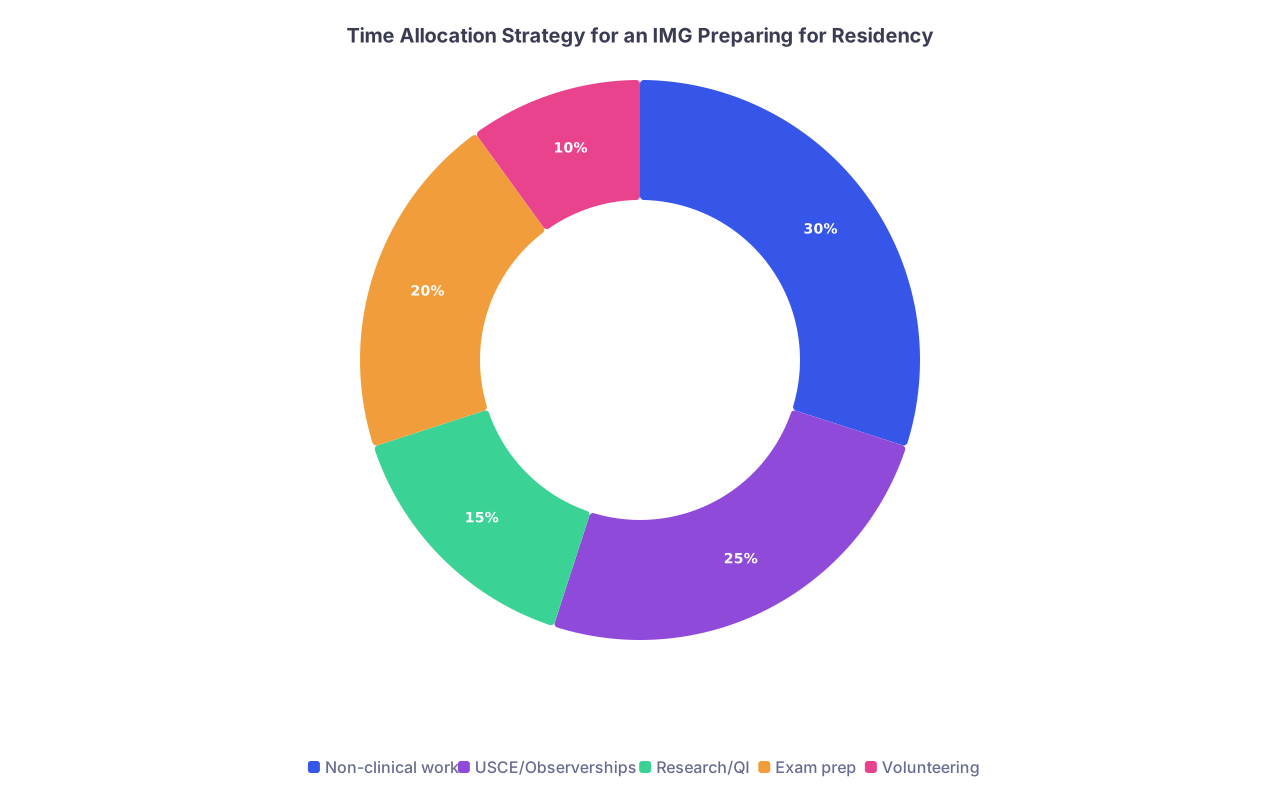
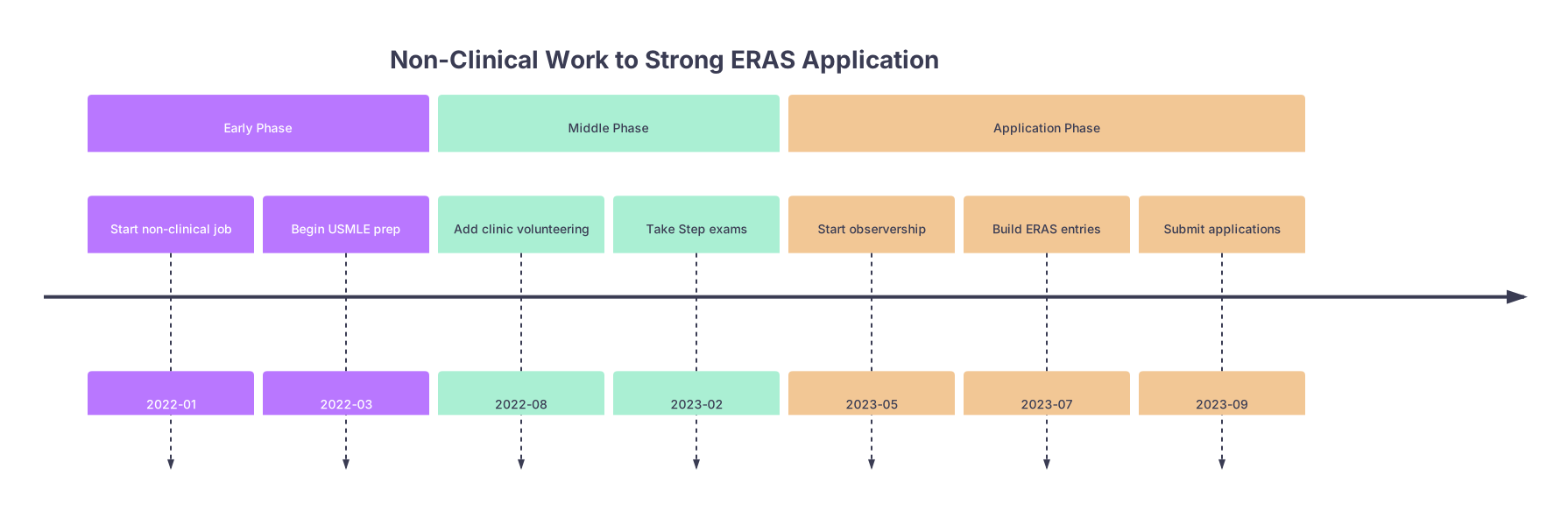
That is the goal for every non‑clinical role.
| Category | Value |
|---|---|
| Non-clinical work | 30 |
| USCE/Observerships | 25 |
| Research/QI | 15 |
| Exam prep | 20 |
| Volunteering | 10 |

| Period | Event |
|---|---|
| Early Phase - Start non-clinical job | 2022-01 |
| Early Phase - Begin USMLE prep | 2022-03 |
| Middle Phase - Add clinic volunteering | 2022-08 |
| Middle Phase - Take Step exams | 2023-02 |
| Application Phase - Start observership | 2023-05 |
| Application Phase - Build ERAS entries | 2023-07 |
| Application Phase - Submit applications | 2023-09 |


Key Takeaways
- Non‑clinical work is not filler. It is evidence. If you quantify it and link it to residency skills, it strengthens your application.
- Every role must pass the “residency relevance audit”: concrete tasks, mapped to skills, with scope and results.
- Do not hide gaps or non‑medical jobs. Own them, frame them honestly, and show how they matured you and prepared you for US training.
FAQ
1. Should I include short non‑clinical jobs (1–2 months) on ERAS?
If they fill a very small gap and do not add meaningful skills, you can omit them. If they explain location changes, visa transitions, or show continuity of work ethic, include them but keep the description brief (1–2 bullets). Avoid clutter; prioritize roles that lasted at least 3–6 months.
2. Can non‑clinical work compensate for limited US clinical experience (USCE)?
It cannot replace USCE, but it can significantly soften the weakness. A strong, healthcare‑related non‑clinical role (scribe, coordinator, data abstractor, patient services) shows you understand US systems and can work on teams. Combine even modest USCE (a few observerships) with robust non‑clinical work and clear narratives, and you are far stronger than someone with observerships only and nothing else.
3. How many non‑clinical experiences are “too many” on ERAS?
There is no fixed number, but you do not want a wall of tiny roles. Aim for 3–6 substantial non‑clinical experiences across work, volunteering, and other categories. Merge minor or similar roles when possible, emphasize length and depth over quantity, and make sure at least one becomes an “anchor” experience you can talk about in detail.