You are in your apartment, it is 11:47 p.m., and you have Zoom open on your laptop.
You just replayed today’s practice interview.
You can hear it clearly:
- Long pauses while you search for words.
- “Umm… how to say…”, “Sorry, what is the word…”, “Can you repeat?”
- You finish your answer and realize you never actually answered the question.
The scary part: your first real residency interview is in three weeks.
Your medical knowledge is strong. Your CV is fine.
But your English? On camera, under pressure? Wobbly.
Here is the truth:
Programs do not expect you to speak like a native.
They do expect:
- Clear communication with patients and colleagues
- Reasonable fluency without painful pauses
- Confidence and structure in your answers
You can absolutely get there. But not with random YouTube videos and vague “practice my English” goals.
You need a protocol. A training plan. Like preparing for Step 2, but for spoken English and interview performance.
That is what we will build now.
Step 1: Stop Guessing – Diagnose Your Actual Problem
Most IMGs lump everything under “My English is bad.” That is lazy thinking and it keeps you stuck. You need to be precise.
Your weaknesses usually fall in 3 buckets:
Language mechanics
- Vocabulary gaps
- Grammar patterns that break under pressure
- Pronunciation that makes you hard to understand
Processing speed
- You understand the words, but too slowly
- You need the question repeated
- You cannot think and speak at the same time
Interview performance
- Answers are disorganized or too long
- You forget the point halfway
- You do not sound like someone I want on my team at 3 a.m.
Quick 1‑hour diagnostic
Do this today. Not next week.
Record a mock interview (30 minutes)
Use Zoom, Google Meet, or your phone.Questions:
- Tell me about yourself.
- Why this specialty?
- Tell me about a time you made a mistake.
- Tell me about a conflict with a colleague.
- What are your weaknesses?
Answer as if it is a real interview. Suit, posture, everything.
Self-review with a scoring sheet (15 minutes)
Rewatch and rate from 1–5 for each:- Fluency (do you keep stopping, restarting?)
- Clarity (can you understand yourself without subtitles?)
- Organization (does each answer have a clear beginning–middle–end?)
- Content (did you actually answer the question?)
- Confidence (eye contact, posture, voice tone)
External review (15 minutes)
Send the recording to:- One friend who speaks strong English (ideally a resident or senior student)
- Optionally one non-medical friend (to assess basic clarity)
Ask them to answer 3 questions:
- Where do you get stuck? Words, grammar, or ideas?
- Which answers were confusing or too long?
- Would you be comfortable if I was your colleague in a U.S. hospital?
Now categorize your main issues. Do not say “everything.” Pick 2 primary problems.
| Profile | Main Problems | Primary Focus |
|---|---|---|
| The Silent Thinker | Long pauses, slow responses | Speed and automatic phrases |
| The Grammar Fighter | Correcting self mid-sentence | Simple, reliable sentence patterns |
| The Mumbler | Hard to understand, unclear words | Pronunciation and pacing |
| The Rambler | Long, unfocused answers | Answer structure and scripts |
| The Blank Face | Good English, but freezes | Repetition of key stories under pressure |
Once you know your profile, then you build the right protocol.
Step 2: Set a 4‑Week Fluency Training Schedule
You are an IMG. You understand plans and schedules. Treat this like a rotation.
You need two parallel tracks:
- General spoken English training – mechanics + speed
- Interview-specific training – answers, stories, professionalism
Weekly time commitment
Bare minimum if interviews are soon:
- 30 minutes / day – general spoken English
- 30–45 minutes / day – interview practice
- 1 full mock interview / week (45–60 minutes)
If your interviews are > 2 months away, you can stretch it. But if they are within 4 weeks, this is not optional.
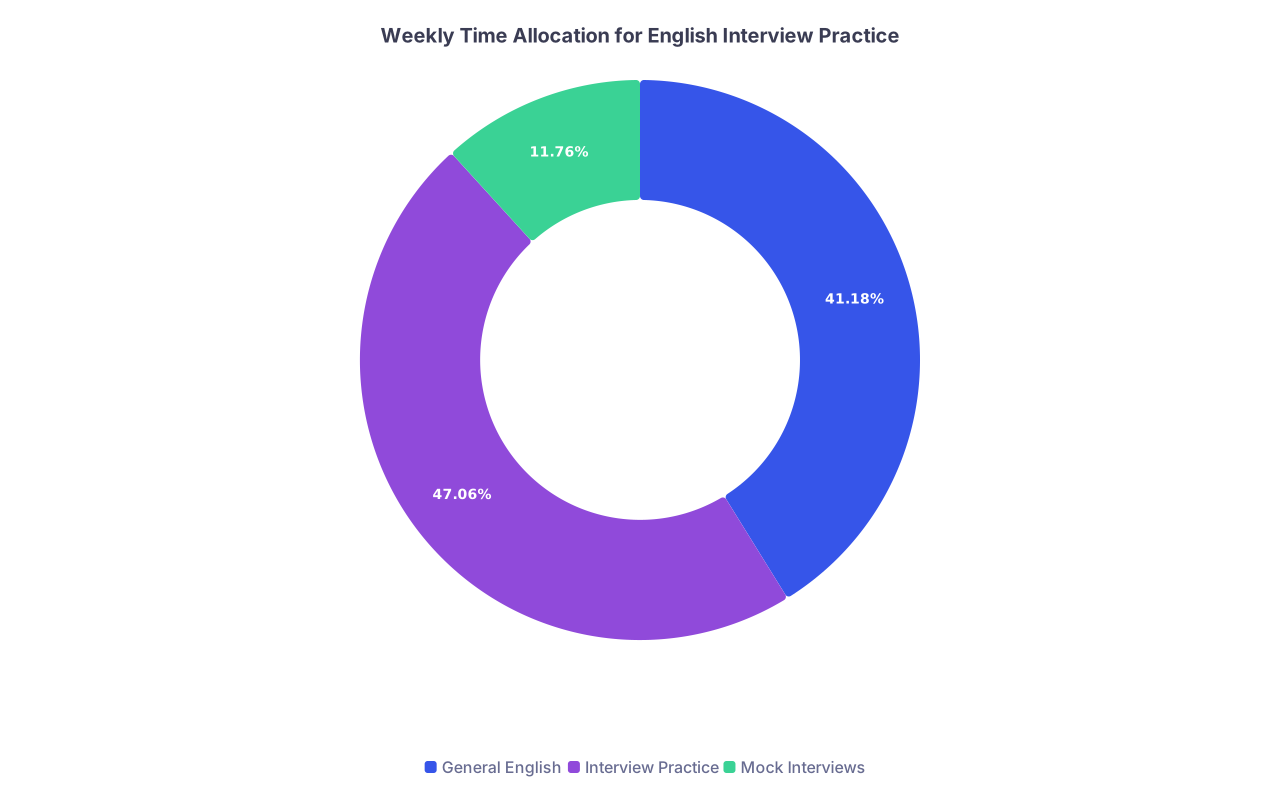
| Category | Value |
|---|---|
| General English | 210 |
| Interview Practice | 240 |
| Mock Interviews | 60 |
Step 3: Fix the Mechanics – Simple, Targeted English Practice
You are not trying to become a novelist. You need efficient, predictable, professional English.
A. Core daily drill (20 minutes)
Use this script every day:
Shadowing (8 minutes)
Shadow = listen and repeat exactly what you hear. Immediately.Material:
- Short clips from:
- NEJM interviews
- Cleveland Clinic YouTube physician interviews
- TED talks by doctors (e.g., Atul Gawande, Abraham Verghese)
Protocol:
- 1-minute clip
- Play sentence by sentence
- Pause after each sentence and repeat aloud, copying intonation and speed
- Do the same clip 3 times
Purpose: train your mouth and brain to move faster in English.
- Short clips from:
Summarize out loud (4 minutes)
After shadowing, close the video.Say out loud:
- “The main idea was…”
- “First, they said…”
- “Then, they explained…”
- “Finally, they concluded…”
Record yourself. Review weekly.
Pronunciation focus (8 minutes)
Use a tool like:- YouGlish
- Forvo
- Google pronunciation (type the word + “pronunciation”)
Daily list:
- 5 medical words (e.g., ischemia, arrhythmia, rheumatoid)
- 5 common interview words (e.g., resilience, conflict, empathy, accountable)
Speak each word 10 times:
- Slowly
- Normal speed
- In a short sentence
Example: “I developed resilience after failing my first exam.”
B. Kill the “complex sentence” habit
A lot of IMGs try to sound smart with long, complicated sentences. Under stress, that collapses. You start a sentence and cannot finish it.
You need simple, strong patterns. Memorize and overuse them.
Examples:
- “The main reason is…”
- “There are three points I want to mention.”
- “First… Second… Finally…”
- “One example of this is…”
- “In that situation, what I did was…”
Drill:
- Take one common question each day.
- Force yourself to use only short sentences (10–15 words) for the whole answer.
- Speak it out loud 3 times.
You are training your brain to default to simplicity when anxious. That is exactly what you want.
Step 4: Build Interview Answer Templates (Then Fill Them)
You do not need 80 unique answers. You need 10–12 strong stories and 3–4 answer structures.
A. Core answer structures
Tell me about yourself – “Present → Past → Future”
- Present: who you are now
- Past: 2–3 key experiences that shaped you
- Future: what you want and how their program fits
Example skeleton:
- “Currently, I am a clinical observer at ___ focusing on ___.”
- “I trained in ___ where I developed an interest in ___, especially after ___.”
- “Going forward, I hope to train in a program that offers ___, and I feel your program is a strong fit because ___.”
Behavioral questions – “STAR” (Situation, Task, Action, Result)
- Situation: brief context
- Task: what needed to be done
- Action: what you did
- Result: outcome and lesson
Keep it tight:
- Situation + Task: 2–3 sentences
- Action: 3–4 sentences
- Result: 2 sentences
Why this specialty / program – “Interest → Experience → Fit”
- Interest: how you got interested
- Experience: 1–2 specific experiences that confirmed it
- Fit: why their program matches your goals
Weakness / failure – “Problem → Response → Growth”
- Problem: short, honest, but not fatal
- Response: concrete steps you took
- Growth: what changed, how you behave now
B. Script first, then simplify
Step-by-step:
- Write your answer in your best written English.
- Read it out loud. You will notice it feels unnatural.
- Rewrite using shorter sentences and your natural speaking words.
- Record yourself answering without reading, using the structure, not exact words.
- Repeat on 3 different days until it sounds automatic.
You are not memorizing exact sentences. You are memorizing:
- Order of ideas
- Transitions
- Key phrases
Step 5: Daily 45-Minute Interview Fluency Protocol
Here is a concrete session you can repeat almost every day.
1. Warm‑up (5 minutes)
- Speak nonstop about your day for 2 minutes. No pausing, no translation in your head.
- Say the alphabet slowly, focusing on clear sounds.
- Say: “Today I will speak clearly, slowly, and simply” 5 times. Sounds silly. Works.
2. One-question drill – depth, not quantity (15 minutes)
Pick 1 interview question. Yes, just one.
Examples:
- Tell me about yourself.
- Why internal medicine?
- Tell me about a time you had a conflict with a colleague.
Protocol:
- Answer once, no notes, recorded.
- Listen immediately. Identify:
- 2 unclear phrases
- 2 grammar problems
- 1 point where you lost structure
- Answer again, focusing only on fixing those issues.
- Answer a third time, focusing on speaking slightly slower and more confidently.
Three high-quality repetitions beat ten bad ones.
3. Story repetition set (15 minutes)
Pick 2 key stories:
- One success (e.g., leadership, teamwork, difficult patient)
- One failure/weakness
For each story:
- Tell it using STAR in under 2 minutes.
- Immediately tell it again but change:
- The introduction
- Some transitions
- The conclusion sentence
You are training flexibility. The worst thing is sounding memorized. The content is stable; the words can change.
4. Spontaneous question lightning round (10 minutes)
Use a random question list (you can compile from Reddit, SDN, program websites).
- Set a timer for 10 minutes.
- Ask yourself a question. Start answering within 3 seconds. No long pause.
- Speak for 45–60 seconds.
- Move to the next question. No replay, no fixing.
You are training fast thinking in English. Perfection is not the goal here. Speed and comfort are.
Step 6: Fix Comprehension and “Can You Repeat?” Moments
If you keep asking interviewers to repeat questions, that is a problem. It signals poor listening or slow processing.
A. Daily audio processing drill (15 minutes)
Choose a 3–5 minute English audio:
- Short podcast segment
- News clip
- Physician interview
Listen once without pausing.
Immediately write or say out loud:
- The main point
- 3 key details
- One phrase you remember exactly
Listen again and compare.
You are training your brain to grab the main idea quickly, not every word.
B. “Question capture” technique for interviews
During an interview:
While the interviewer is speaking, you are not thinking of your answer. You are doing one thing:
- Mentally capturing 2–3 key words from the question.
Example:
Question: “Tell me about a time you received difficult feedback and how you responded.”
Your key words: “difficult feedback – response – example.”As soon as they finish, say a short anchor phrase:
- “Yes, I can think of a good example.”
- “That is a very relevant question.”
- “One situation comes to mind from my internship.”
While you say that, your brain is pulling the right story and STAR structure.
If you truly did not understand:
Bad version:
“Can you repeat?”
Better version:
- “I apologize, the connection cut out for a second. Could you please repeat the last part of the question?”
- “I want to make sure I answer correctly. Are you asking about feedback from attendings, or from patients?”
You look precise, not lost.
Step 7: Pronunciation – Fix Only What Matters
Your accent is not the problem. Unclear pronunciation is.
There are some sounds that regularly confuse listeners for many IMGs:
- “V” vs “W”
- “Th” sounds (this, think)
- Past tense endings (“worked”, “called”)
- Word stress (EM‑pathy vs em‑PATH‑y)
Targeted pronunciation protocol (10–15 minutes / day)
Build a personal confusion list
After every mock interview or conversation, write down:- Words people ask you to repeat
- Words you stumble on
Drill with minimal pairs
Example:- “very / wary”
- “think / sink / tink”
- “worked / walk / word”
Speak each group 10 times. Record. Compare with online pronunciation.
Slow down under pressure
In real interviews, cut your normal speaking speed by 10–20%.
Slightly slower + clear is much better than fast + unclear.
Step 8: Weekly Full Mock Interview Protocol
One serious mock per week. Non‑negotiable.
A. Structure of the mock (45–60 minutes)
Ask a friend, resident, mentor, or paid tutor to help. If no one is available, you can simulate with recording, but a real person is better.
Professional setup (5 minutes)
- Wear interview clothes
- Same camera, lighting, and background you will use
- Sit up straight, look into camera
Question block 1 – General (15 minutes)
- Tell me about yourself.
- Why this specialty?
- Why our program?
- What are your strengths?
Question block 2 – Behavioral (15–20 minutes)
- Conflict with colleague
- Mistake with a patient
- Managing workload
- Dealing with stress or burnout
Question block 3 – Curveballs (10–15 minutes)
- Why your gap?
- Why low score in ___?
- What will you do if you do not match?
- How will you handle language barriers with patients?
Feedback and debrief (10–15 minutes)
Ask for specifics:- Were any answers confusing or too long?
- Any phrases or grammar that sounded off?
- How was my speed and clarity?
B. Data tracking
You are a doctor. Treat this like patient data.
After each mock, log:
- Top 2 language mistakes
- Top 2 content issues
- 1 thing that improved since last week
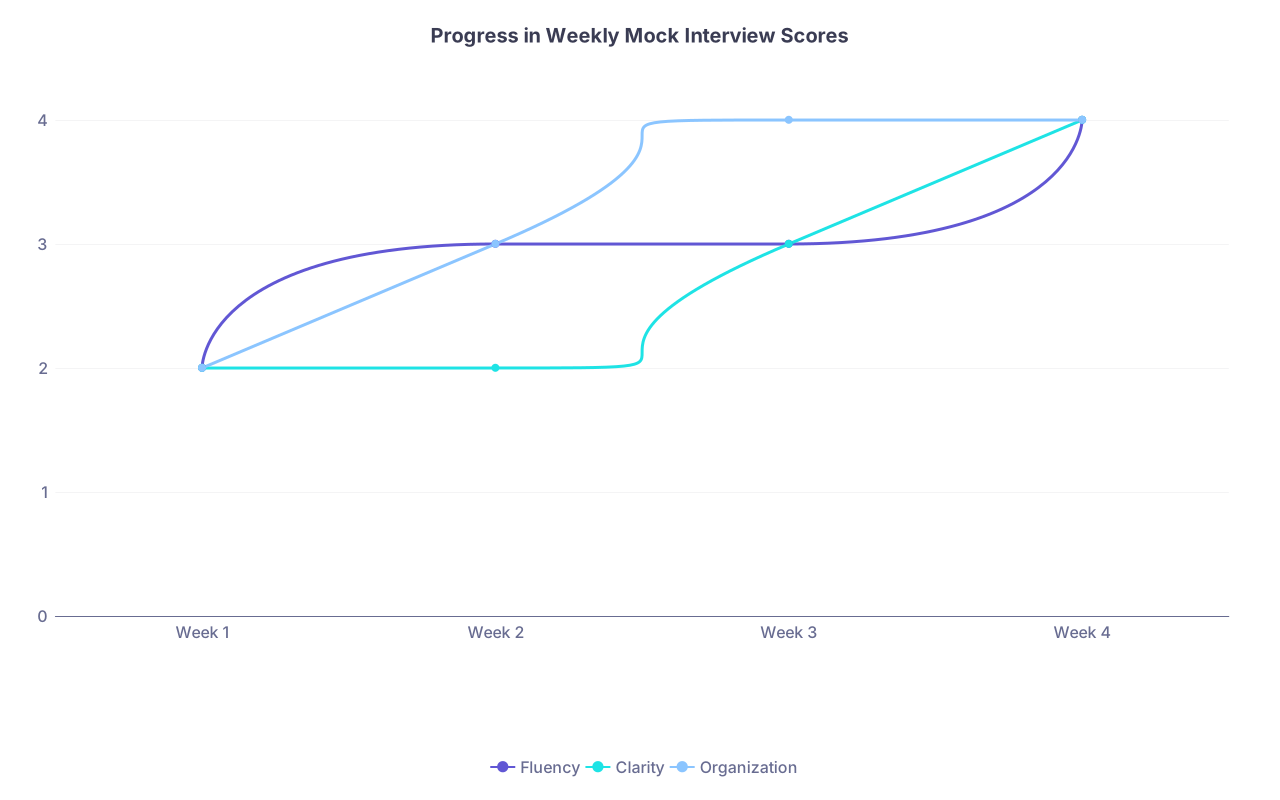
| Category | Fluency | Clarity | Organization |
|---|---|---|---|
| Week 1 | 2 | 2 | 2 |
| Week 2 | 3 | 2 | 3 |
| Week 3 | 3 | 3 | 4 |
| Week 4 | 4 | 4 | 4 |
Watch the scores climb. Slowly, but they will.
Step 9: Program-Specific Preparation – Don’t Speak Generic
Weak English plus generic answers is a disaster. You want the opposite: clear English + specific content.
A. 15-minute prep per program
For each interview program:
Check:
- Program website: curriculum, tracks, unique features
- Social media: resident life, culture
- Any IMGs or your med school alumni there
Make a one-page sheet:
- 3 specific things you like (examples: “strong cardiology exposure,” “safety-net hospital,” “resident-run clinic”)
- 1–2 questions you will ask them
- Any red flags you want to clarify
Practice saying out loud:
- “I am particularly interested in your ___ rotation because…”
- “I noticed your program emphasizes ___. This aligns with my interest in ___.”
- “I saw that many of your residents present at ___ conference. I hope to contribute in that way as well.”
You are building ready phrases that are easy to say and feel natural.
Step 10: The 7 Days Before Your First Interview
Last week is not for “learning new English.” Too late for that. It is for stabilizing, simplifying, and rehearsing under realistic pressure.
Daily plan for the final 7 days
Day 7–5:
- 1 full mock interview each day (can be self-recorded)
- Focus on fluency, not perfect grammar
- Review your 10–12 key stories
Day 4–3:
- Short, intense sessions
- 30 minutes: one-question deep drill (like above)
- 15 minutes: pronunciation and speed control
- 15 minutes: program-specific phrases
Day 2:
- Light practice only
- 1 short mock (20 minutes)
- Check tech: camera, audio, Zoom link, time zone
Day 1:
- No new material
- 10 minutes: speak out loud your “Tell me about yourself” and “Why this specialty” 2–3 times
- Go for a walk, sleep on time
A Few Things You Can Stop Worrying About
Let me be blunt:
- Your accent will not prevent you from matching if your answers are clear and structured.
- Tiny grammar mistakes (“he don’t” vs “he doesn’t”) are not fatal if you are otherwise understandable.
- Saying “let me think for a moment” is better than filling silence with “umm… uh… uh…”
What actually hurts you:
- Long rambling answers that never get to the point
- Repeating the same vague phrases (“I am hard working, I am passionate”)
- Sounding memorized and robotic
- Looking terrified every time you open your mouth
This protocol addresses all of that.
If You Have Only 10 Days Before Interviews
You do not have time for everything. Do this minimum:
Daily (45–60 minutes)
- 20 minutes: one-question deep drill
- 10 minutes: shadowing + short summary
- 10 minutes: story repetition with STAR
- 5–10 minutes: pronunciation on your confusion list
Twice before your first interview
- 1 full mock interview with real-time feedback.
Every day
- Say your “Tell me about yourself” out loud once.
- Say your “Why this specialty” out loud once.
That alone will move you from “weak and scary” to “acceptable and improving.”
Final Word
You are not trying to become a perfect English speaker. You are trying to become:
- Clear
- Organized
- Reliable under pressure
Do that, and your accent will not matter. Your IMG status will not matter nearly as much either.
Three key points to keep:
- Diagnose your actual problem first: fluency, comprehension, or answer structure. Do not just say “my English is bad.”
- Use a daily, structured protocol: shadowing, one-question deep drills, and repeated STAR stories. Small, consistent reps beat random long sessions.
- Simulate the real thing weekly: full mock interviews, same setup, serious feedback, and simple tracking of progress.
Follow this for 3–4 weeks and you will not suddenly sound like a native speaker. You will sound like what programs actually want: an IMG who can communicate clearly, think on their feet, and function safely on a U.S. team. That is enough.