
“Any position is fine” is the fastest way for an IMG to end up in the wrong residency—or with no match at all.
I hear this exact sentence every application season. Usually said by a tired IMG who has burned through savings on exams, visas, and 80+ ERAS applications. By January, fear takes over. The goal quietly shifts from “a good fit” to “anything that will take me.”
That is how expensive, life‑altering rank list mistakes happen.
If you are an IMG, you do not have the margin of error that many U.S. grads have. You cannot afford sloppy ranking, blind trust in “any program,” or magical thinking that “I can survive anything for 3 years.”
You will not “just survive” a toxic program. You will burn out, damage your CV, or both.
Let me walk you through the most common—and most dangerous—rank list errors IMGs make when they are chasing “any position,” and how to avoid them.
1. Treating Your Rank List Like a Lottery Ticket
Most IMGs secretly think the rank list is just a formality. They rank everything they interviewed at, in any order, and hope “the algorithm will be kind.”
The algorithm does not care about you. It only cares about the order you enter.
Core truth: The Match algorithm favors the applicant’s preferences. But if your preferences are chaotic, desperate, or uninformed, the algorithm will faithfully execute your bad plan.
Classic IMG “lottery” behaviors
Ranking all programs you interviewed at, no matter how bad the fit.
“I hated that place, but I will put it on the list just in case.”
Translation: “I am willing to be miserable for three years because I am scared.”Random ranking with no criteria.
Ordering programs by:- Interview date (earliest to latest)
- How well you slept the night before
- Which faculty seemed nicest on Zoom
I have literally seen people sort by alphabetical order and leave it that way.
Ignoring your own dealbreakers.
You told yourself:- “I cannot handle q3 28‑hour calls.”
- “I need enough time to study for boards.”
- “I must be near family support.”
Then you rank a malignant, under‑resourced program in a city where you know nobody…because it is “a position.”
Why this is so dangerous for IMGs
- You often get fewer interviews, so each one feels gold‑plated. That emotional attachment clouds judgment.
- Many IMGs have visa pressure, so they over‑prioritize “H‑1B friendly” without asking, “Will I even succeed here?”
- You may be less familiar with U.S. training culture, so you underestimate what a truly dysfunctional program feels like day‑to‑day.
How to avoid the “lottery ticket” mistake
Write your non‑negotiables first. Before you touch the rank list screen, write:
- 3–5 absolute dealbreakers
- 3–5 strong preferences
If a program breaks more than one true dealbreaker, it does not belong on your rank list at all.
Rank with conscious intent, not vibes. For each program, ask yourself:
- “If this is where I match, will I be able to safely finish training and progress to my career goals?”
If your honest answer is no, it should not be ranked—no matter how scared you are.
- “If this is where I match, will I be able to safely finish training and progress to my career goals?”
Use tiers, not chaos. Group programs into:
- Tier 1: I would be genuinely happy to train here
- Tier 2: I can realistically do well here; neutral feelings
- Tier 3: Only if everything else falls through, but still acceptable
Then order within each tier rationally.
2. Ranking Clearly Malignant Programs “Because At Least They Sponsor Visas”
This one is brutal, and I see it every year.
IMG applicant says: “They were rude to me, residents looked dead inside, faculty bragged about 24‑hour calls…but they sponsored H‑1B and they said they like IMGs, so I ranked them #1.”
You do not have to like this, but you need to hear it:
A bad program that sponsors visas is still a bad program.

Red flags you must not ignore
If you noticed any of these during interview day, treat them as serious:
- Residents could not speak freely.
Faculty present during “resident only” time. Residents giving short, rehearsed, robotic answers. - Proud of overwork.
Leadership bragging:- “Our residents are the workhorses of this hospital.”
- “You will be too tired to get into trouble.” (Yes, I have heard this.)
- Obvious understaffing.
One intern covering 30+ patients on nights. Chronic unfilled positions. - Zero support for exams.
Residents repeatedly failing Step 3 / board exams, no dedicated study time, no remediation plan. - High attrition.
“We had a couple of residents leave last year” with vague explanations. If you hear “they were not a good fit” more than once, you should worry. - Abusive culture.
Stories of attendings yelling, public humiliation, or retaliation.
Why IMGs walk into this trap
- Visa panic: “If I do not accept this, I may have to leave the country.”
- Survivor mindset: “I already survived med school in a tough system. I can handle anything.”
- Lack of local mentors who say: “Do not rank that place. Seriously.”
Reality check
A malignant program can:
- Destroy your confidence
- Block your fellowship plans
- Lead to failed board exams
- Push you to resign early—leaving you with visa problems and no completed residency
You do not escape immigration risk by entering a place that may force you out after a year.
How to handle visa pressure without ranking toxic programs
- Distinguish “tough but fair” from malignant.
Heavy workload + supportive leadership can be survivable.
Heavy workload + fear, blame, and chaos is not. - Ask pointed questions (before ranking):
- “How many residents left your program in the last 5 years, and why?”
- “What support do residents receive for board exams?”
- “Has the program ever been on probation by the ACGME?”
- Talk to off‑cycle or ex‑residents. The ones who left mid‑program will tell you the truth.
If, after all that, a program still screams “this feels wrong,” do not rank it. Even if they promise an H‑1B and free meals and a parking spot with your name on it.
3. Believing Myths About the Match Algorithm
IMGs get fed a lot of nonsense in WhatsApp groups and Telegram chats about how the rank algorithm “really works.”
Let me kill a few myths that lead to dangerous rank list decisions.
| Myth | Reality |
|---|---|
| Rank programs where you think you are more competitive higher | Rank strictly by preference; the algorithm already accounts for competitiveness |
| Do not rank reach programs because it hurts your chances | Ranking them never hurts you if you honestly prefer them |
| Programs see your rank list and punish you | They do not see it; they only see you ranked them or not |
| Shorter rank list = higher chance to match at top choice | Longer list (of acceptable programs) increases overall chance to match |
| Put “safety” programs first, dream programs later | Backwards; put dream programs first if you prefer them |
The big mistake: Gaming instead of ranking by preference
Typical IMG logic:
- “This university program is too competitive; I will rank the small community program higher even though I liked it less.”
- “That program interviewed only 20 IMGs; I must be low on their list. I will move them down.”
This is wrong. The NRMP algorithm is applicant‑favorable. That means:
- You should always rank programs in the exact order of where you want to be, not where you think you will be accepted.
- The only thing that hurts you is ranking a less desired program above a more desired one.
You are not smarter than the algorithm. Stop trying to manipulate it. You will lose.
How this mistake punishes IMGs
- You match at your “safety” that you ranked artificially high
→ while the more desirable program actually had an open spot for you. - You end up regretting not giving your dream program a real chance
→ and you carry that regret into every call night.
How to avoid this trap
- Forget your guess of where you stand. You do not know their rank list. You never will. Stop pretending.
- Make one simple rule:
If I would rather be at Program A than Program B, Program A must be ranked higher. Always. - Include reach programs at the very top if you love them.
If they do not rank you, the algorithm simply moves on. You lose nothing.
4. Over‑Ranking Programs That Will Not Realistically Rank You
Now the other extreme: putting 10 extremely competitive university programs in your specialty at the top…when your application profile does not support that level.
Yes, I just told you to rank by preference. That still stands.
But here is the mistake: using fantasy instead of informed preference.
Preference is: “Knowing my profile and their history, this is still where I would realistically see myself training.”
Delusion is: “This program has never matched a single IMG, but I will be the exception.”
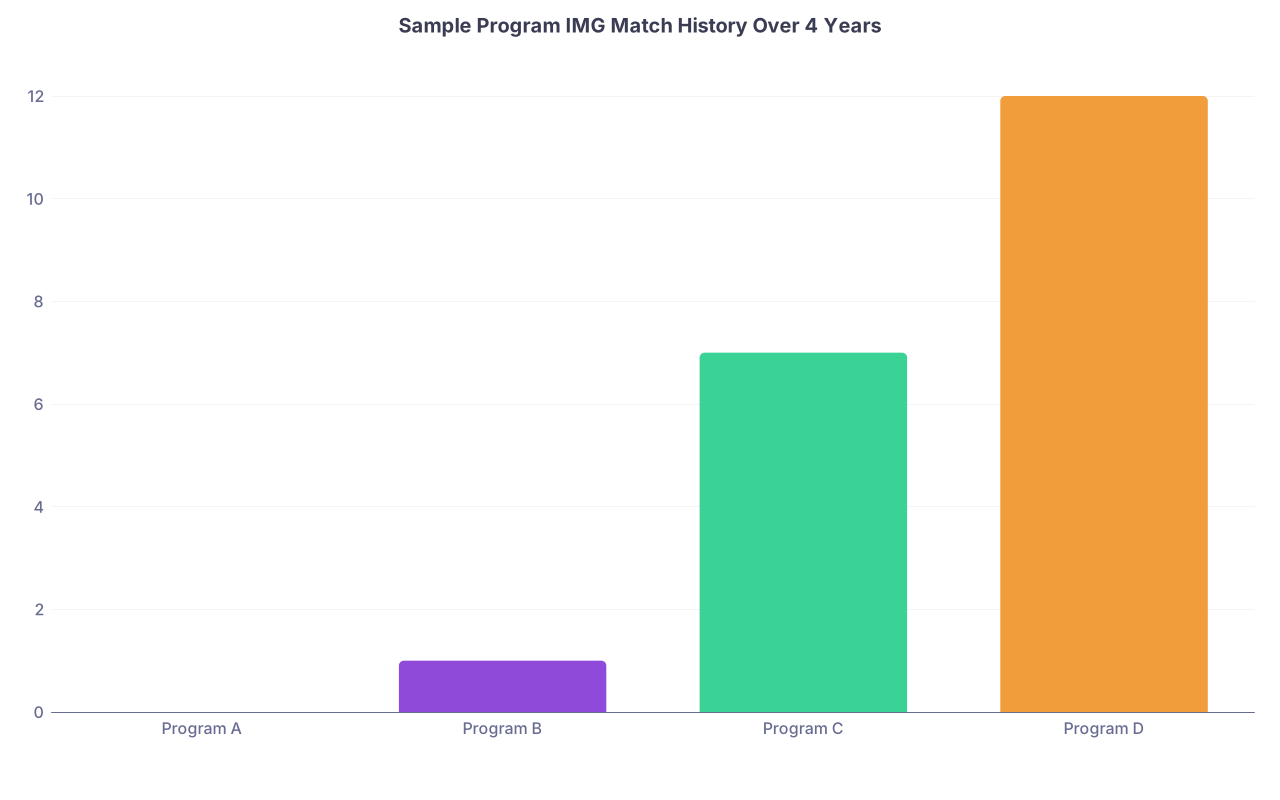
| Category | Value |
|---|---|
| Program A | 0 |
| Program B | 1 |
| Program C | 7 |
| Program D | 12 |
In this example:
- Program A: 0 IMGs over 4 years.
- Program D: 12 IMGs over 4 years.
If you are an IMG with average scores and no U.S. degree, ranking Program A #1, #2, and #3 (categorical vs prelim vs research track) while putting Program D at #8 is just self‑sabotage.
How to recognize “fantasy” rankings
- Programs that never or almost never match IMGs
- Programs that explicitly state: “We do not sponsor visas” but you still rank them top 3 as an IMG needing a visa
- Programs that require Step 1 > 245, Step 2 > 250, strong U.S. research, and your application is nowhere near that
Key nuance
- Should you still include a dream university program that interviewed you?
Yes. If they gave you an interview, they are at least open to you. - Should you stack your top 5 with historically IMG‑hostile, visa‑unfriendly programs while pushing genuinely IMG‑friendly programs down?
That is the mistake.
Safer approach
- Seek actual match lists, not rumors. Check:
- Program website alumni pages
- Doximity / LinkedIn for current residents
- Look for:
- Number of IMGs in residency
- Number of IMGs like you (from your region / visa category / similar school)
- Use this information to create a weighted preference:
- Programs you love + have realistic precedent for IMGs like you → top
- Programs you love but have almost zero IMG precedent → still on the list, but do not let them push 8 more realistic options too far down.
You want dreams plus realism. Not dreams instead of realism.
5. Ignoring Program–Applicant Fit: “I Can Adapt to Anything”
You probably heard this from co‑applicants: “I do not care where I go, I will adapt.”
That is how people end up miserable, clinically unsafe, and sometimes pushed out.
For IMGs, fit matters even more, because you may be adapting to:
- New healthcare system
- New language or accent
- New documentation rules
- New patient expectations
- New hierarchy culture
Throwing yourself into a program that does not fit you at all and hoping pure willpower carries you through is reckless.
Common dimensions of bad fit IMGs ignore
Location reality, not postcard fantasy
- Ultra‑rural towns with:
- No public transport
- No ethnic community
- Harsh winters when you have never seen snow
- Extremely high cost cities (NYC, SF) when you are sending money home and already in debt
- Ultra‑rural towns with:
Program size and support
- Very small programs (4–6 residents per year) with heavy call
- Limited ancillary staff (you drawing all your own labs, starting IVs, transporting patients)
Teaching culture
- “Service first, education later” ethos
- No protected didactics or they are chronically cancelled for “patient care”
Subspecialty exposure
- You want cardiology fellowship, but the program has:
- No cardiology fellowship
- Minimal cath lab or echo exposure
- No research culture
- You want cardiology fellowship, but the program has:
How to assess fit honestly
Ask yourself for each program:
- Location:
“Can I see myself living here, without my entire support system, for 3–5 years, on a resident salary?” - Culture:
“When I listened to the residents, did they sound tired or trapped? Or just busy but supported?” - Training:
“Will this program help me pass boards and reach my long‑term goals, or will it simply use me as labor?”
If the answer to all three is shaky, that program should not be in your top ranks just because “they were nice to me.”
6. Failing To Use Independent Data and Only Trusting Interview Day Smiles
Residency interview days are performances. Polished, curated, and occasionally dishonest.
IMGs—especially those who have never rotated in the U.S.—often take everything at face value. They do not dig.
Huge mistake.

| Step | Description |
|---|---|
| Step 1 | Interview Day |
| Step 2 | Resident Conversations |
| Step 3 | Online Data Check |
| Step 4 | Contact Current/Former Residents |
| Step 5 | Compare to Personal Priorities |
| Step 6 | Finalize Rank Position |
Places where IMGs forget to fact‑check
- ACGME status:
- Is the program on probation? Recently lost accreditation in any area?
- Board pass rates:
- Do residents consistently pass ABIM/ABFM/ABP boards on first try?
- Attrition:
- How many residents left or were dismissed in the last few years?
- Service load:
- Patient caps, call frequency, night float structures.
- Fellowship match history:
- Especially if you want competitive subspecialties.
Basic data you should check for every program on your list
- ACGME listing and any public citations
- Program’s own website: alumni outcomes, board pass statements
- NRMP / specialty‑specific reports (some list board pass rates, some do not)
- Doximity / LinkedIn searches for:
- Current residents’ backgrounds
- Fellowship placements
Never rank a program highly when your only real information is: “The PD was nice, and the food on interview day was good.”
7. Oversimplifying Visa and Contract Issues
Desperate IMGs often make sloppy assumptions:
- “They said they sponsor visas, so I am safe.”
- “They have one J‑1 resident, so they can easily do H‑1B for me.”
- “Immigration will sort itself out after I match.”
This can cost you your career.
Specific errors to avoid
- Not confirming visa type and patterns
- Some programs:
- Only sponsor J‑1
- Rarely or never do H‑1B
- Have done H‑1B once, five years ago, but practically never since
- Some programs:
- Ignoring contract red flags
- Unclear policies about:
- Moonlighting
- Outside employment
- Termination clauses
- Unclear policies about:
- Assuming program will bend rules for you
- “They liked me so much, they will figure out an exception.”
No. They will not override institutional policy for one IMG.
- “They liked me so much, they will figure out an exception.”
How to protect yourself
Before finalizing your rank list, clarify with each program:
- “For IMGs, which visas do you currently sponsor?”
- “How many residents in your program are currently on each visa type?”
- “Have there been any residents who could not start due to visa issues in the last 5 years?”
If they are vague, evasive, or inconsistent, assign that program a lower rank, no matter how “friendly” they felt.
8. Making the Rank List Alone, in Your Head, at 2 AM
Final mistake: treating your rank list like a secret exam you must solve solo.
This is how late‑night anxiety creates a list driven by fear instead of clarity.
You stare at the screen, second‑guess every memory, and end up with:
- Toxic but visa‑friendly programs in your top 3
- Good‑fit programs pushed down because you are scared they will not rank you
- No reality check from anyone who has actually trained here
What you should do instead
- Talk to at least two people who have been through the Match.
- Ideally: one IMG in your specialty, one U.S. grad or attending who knows the system
- Show them your draft rank list and your reasoning.
- Do not just show the order. Explain:
- Why Program X is above Program Y
- What you are afraid of (visa, not matching, location, etc.)
- Do not just show the order. Explain:
- Ask them bluntly:
- “Is there any program on this list that you would refuse to rank if you were me?”
Their shock at certain program names can be very educational.
- “Is there any program on this list that you would refuse to rank if you were me?”
You are not weak for asking. You are smart. The stakes are too high to operate in a vacuum.
Final Checks Before You Lock Your Rank List
Use this as a quick audit. If you answer “yes” to the wrong questions, fix your list before it is too late.
Ask yourself:
- Am I ranking any program I actively dread, just because it is “a position”?
- Is there any program here I would be embarrassed to tell a mentor I matched at, because they know it is malignant?
- Have I ranked programs strictly in order of where I want to be—not where I guess I will be most competitive?
- Did I verify visa policy, board pass rates, and at least a little bit of match history for IMGs?
- Have I removed programs that violate more than one serious dealbreaker for me?
If you have not done this work, you are not “being flexible.” You are gambling with three to seven years of your life.
The Core Lessons You Cannot Afford To Ignore
Let me strip it down to the essentials:
- Never rank a program you know is toxic, malignant, or structurally unsafe. “Any position” is not better than a delayed or different path.
- Rank programs in the exact order of where you want to train, based on informed preference, not fear or guesswork about competitiveness.
- Use real data, IMG‑specific patterns, and outside mentors to pressure‑test your rank list—do not build it alone in a panic at midnight.
You worked far too hard to hand your future to desperation in the final step. Guard this rank list like the career‑defining decision it is.