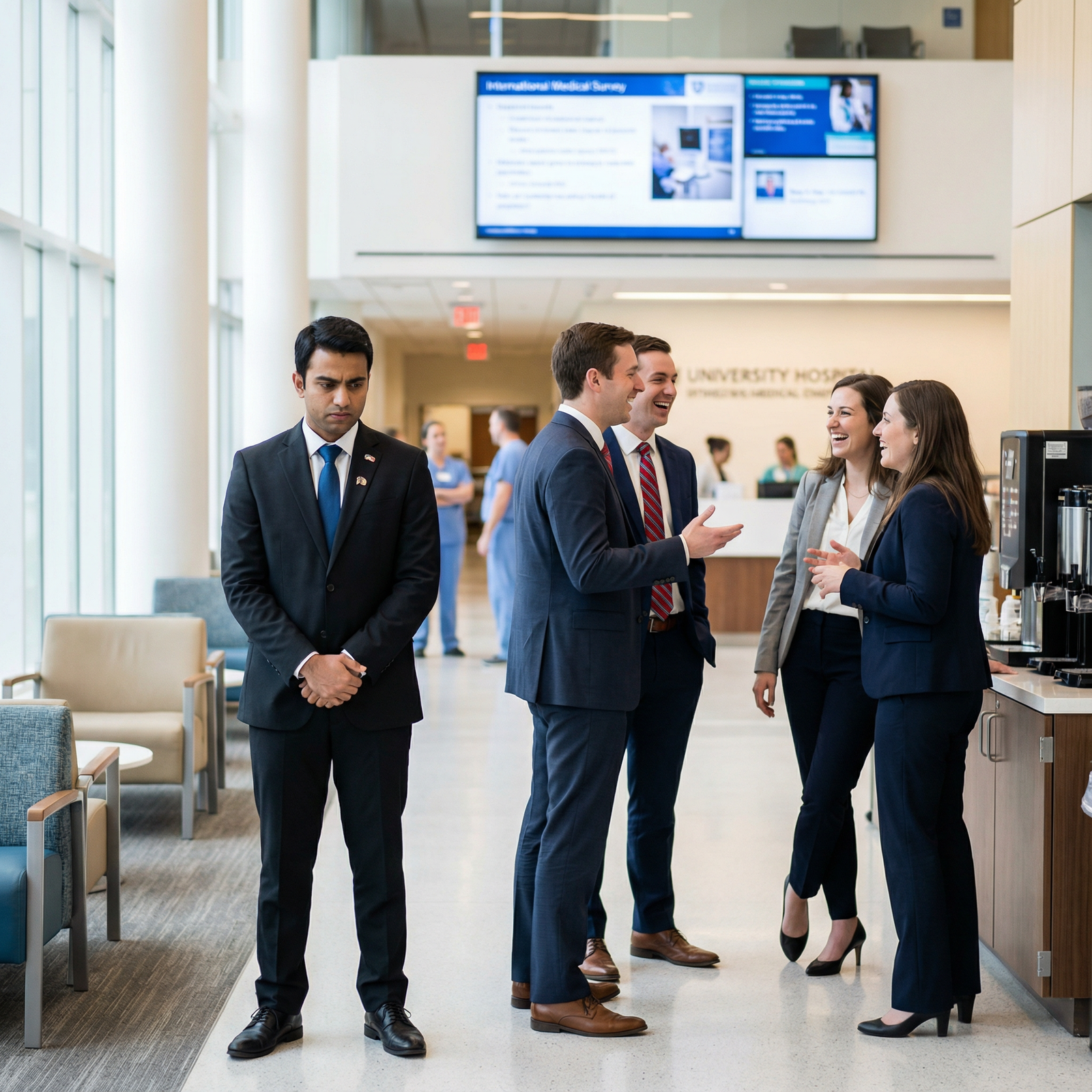
It’s 7:45 a.m. in a US hospital lobby you’ve never seen before. You flew in last night. You slept badly. You’re clutching a leather folder a little too tightly.
The residents are laughing about some inside joke from last week’s call. The “locals”—US grads—slide right into the rhythm: casual small talk, shared abbreviations, jokes about specific EMR systems.
You? You’re standing there thinking:
“Should I introduce myself to the program director? Is it rude? Am I supposed to be talking to the coordinator? Is everyone else doing something I’m not?”
This is where a lot of IMGs lose ground. Not because they are less qualified. But because they make interview day mistakes that US grads don’t even realize are “things” to avoid—because they were trained in the culture that created the rules.
I’m going to walk you through those rules. And the traps.
1. Acting Like It’s an Oral Exam Instead of a Job Interview
US grads usually know: this is a job interview, not a viva. IMGs? Many walk in like they’re being examined by a board of professors.
Common mistakes here:
- Giving long, lecture-style answers
- Waiting to be “called on” instead of engaging as a peer
- Overly formal language, stiff posture, zero warmth
- Treating every question as if it has a single “correct” answer
Red flag behavior I’ve literally seen:
Interviewer: “Tell me about yourself.”
IMG: “My name is Dr. X. I did my MBBS at…” then proceeds with a 4-minute chronological monologue listing every exam, every grade, every rotation. No story. No personality. Just CV read aloud.Interviewer asks: “How do you handle disagreement with a senior?”
IMG responds like they’re answering a short essay question: “There are three important points. Firstly… Secondly… Thirdly…” in a flat, rehearsed tone.
Here’s what locals do differently (without thinking about it):
- They talk like this is a conversation, not a defense
- They let their personality out—some humor, some reflection
- They show opinions, not just “correct” textbook behavior
Don’t make this mistake:
- Stop memorizing full paragraphs. Bullet points only.
- Practice conversational answers out loud with another human who will interrupt you.
- Aim for 60–90 seconds per answer. If you’re going longer, you’re lecturing.
If you feel like you’re “presenting,” you’re doing it wrong. You should feel like you’re talking to a future colleague over a cup of coffee—still professional, but human.
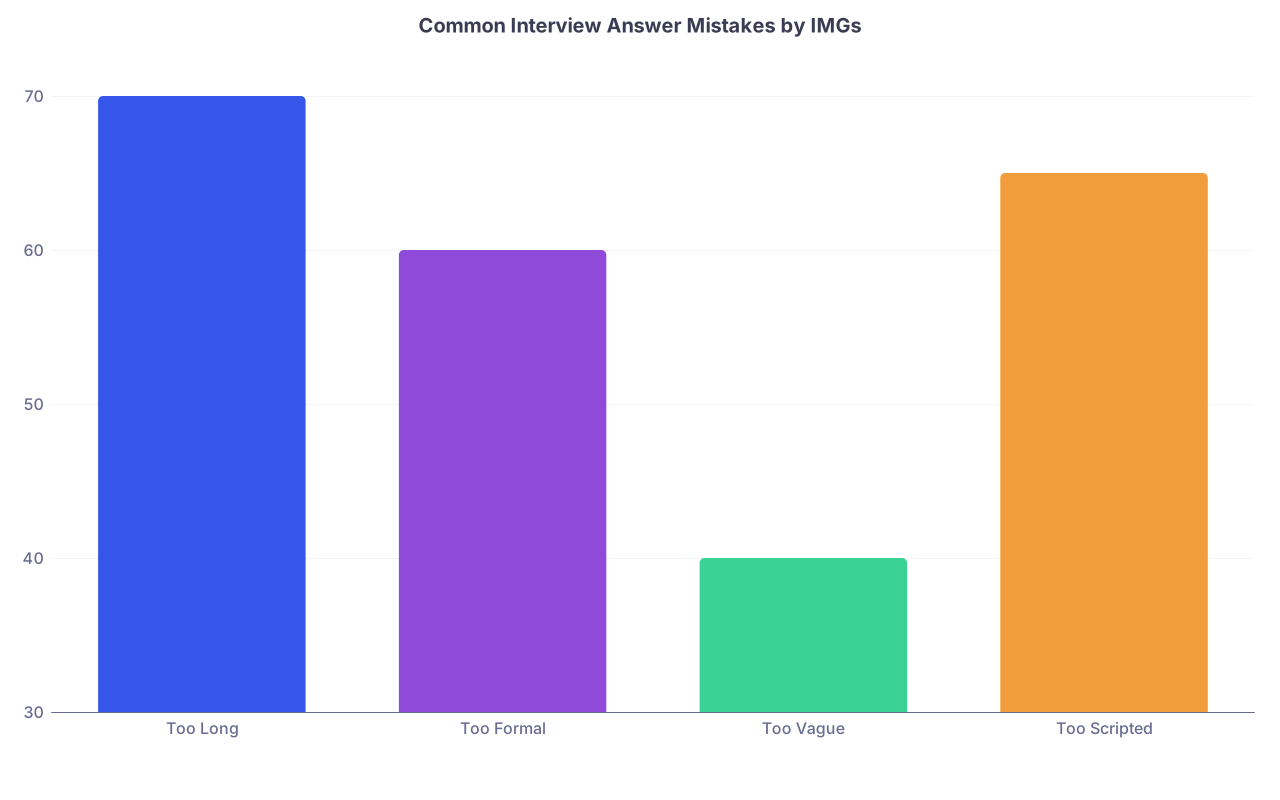
| Category | Value |
|---|---|
| Too Long | 70 |
| Too Formal | 60 |
| Too Vague | 40 |
| Too Scripted | 65 |
2. Treating the Coordinator Like a Ticket Clerk, Not a Gatekeeper
You’d be shocked how many IMGs are polite to faculty but transactional with the coordinator. Locals know better. They’ve heard stories.
Big mistakes:
- Barely greeting the coordinator
- Ignoring instructions in the pre-interview email
- Asking questions that were clearly answered in the packet
- Acting annoyed if something runs late or changes
Here’s the ugly truth: coordinators talk. To the PD. To the chair. To the chief residents.
Comments I’ve heard:
- “He was rolling his eyes at the schedule in front of me.”
- “She was rude when I asked for her photo for the file.”
- “He asked me if lunch would be ‘real food or just snacks.’”
Guess who did not end up high on the rank list.
Don’t make this mistake:
- On arrival: introduce yourself to the coordinator by name, thank them for organizing.
- Read every email and PDF carefully before asking a single question.
- If something is confusing, be humble: “I might have missed this in the email—could you clarify…?”
- Treat every interaction with the coordinator as if it’s being recorded and summarized to the PD. Because functionally, it kind of is.
3. Over-Explaining Weaknesses the Wrong Way
Many IMGs think they need to “confess” every flaw and over-justify every gap, attempt, or low score. Locals are usually better at controlled disclosure.
Common disasters:
- Volunteering damage that was never asked about
- Turning a 20-second explanation into a 5-minute saga
- Sounding defensive or blaming systems/people/country
Example of what NOT to do:
- “Yes, I failed Step 2 on my first attempt because the test center had issues, and also my grandfather was sick, and then there was a political situation, and the exam was very unfair…”
You’ve just raised 10 more red flags.
Compare that with what a savvy US grad would do (and you should too):
- Short, factual, accountable:
“I did not pass on my first attempt. I underestimated how different the exam style was from my school’s tests. I adjusted by doing X, Y, Z, and passed with [score] on the second attempt. That experience really changed how I study and manage risk.”
Then stop talking.
Don’t make this mistake:
- Make a list of your “red flags”: attempts, gaps, visa, transfers, failures.
- Write a 2–3 sentence explanation for each:
- Fact
- Accountability
- Growth
- Practice stopping. Silence is allowed. Let the interviewer move on.
If you feel a strong urge to keep explaining, that’s anxiety talking. Not strategy.

4. Misreading the Social Parts: Lunch, Pre-Interview Dinner, Resident Chats
Locals understand something many IMGs underestimate: the “informal” parts are not informal. They’re just less structured evaluation.
Common IMG missteps:
- Being silent the entire lunch
- Hovering at the edge of groups, not joining conversations
- Only talking to other IMGs
- Turning resident Q&A into an interrogation about visas, moonlighting, and fellowship stats—and nothing else
And the killer: acting differently with residents than with faculty. Residents absolutely report their impressions.
Things I’ve heard from residents after a lunch:
- “He didn’t say a single word unless we asked him a direct question.”
- “She only spoke to other applicants from her country.”
- “Every question was: ‘How many of your residents got cardiology fellowship?’ Nothing about the actual training.”
Don’t make this mistake:
- At lunch:
- Sit near residents, not just at the end with your phone.
- Ask about their life, not just their CV: “What surprised you about this program?” “What do you do on your rare days off?”
- Speak at least a few times in each group interaction, even if briefly. Silence reads as lack of interest, not “respect.”
- With other IMGs: of course connect. But do not form a visible clique. That looks bad.
Remember: they are asking, “Do I want to be on call at 3 a.m. with this person?” If you feel like a wall, the answer is no.
5. Over-Formal, Overdressed, and Over-Intense Body Language
IMGs often come from cultures where medical hierarchy is very rigid. So they try to “look professional” and overshoot into robotic.
Things that make you feel “off” to American interviewers:
- Zero smiling until someone “earns it”
- Never interrupting, even to respond to something clearly directed at you
- Sitting on the edge of the chair like you’re in trouble
- Keeping hands locked on your folder the entire day
- Saying “Sir” or “Madam” every other sentence
Locals don’t do this. They:
- Smile. A lot.
- Use first names when told to.
- Look comfortable in their body.
- Laugh at small jokes without waiting for permission.
Don’t make this mistake:
- Yes, you should be respectful. Not submissive.
- Drop the constant “Sir/Madam/Professor.” Once someone says, “Call me John,” do that. Immediately.
- Practice your posture on camera:
- Back supported
- Hands relaxed on lap or table
- Chin neutral, not down (looks timid)
- Occasional nodding and facial reactions
If you feel like a statue, you look like a problem.
6. Asking the Wrong Questions (or None at All)
Some IMGs walk in with a list of aggressive, transactional questions. Others ask nothing because “I do not want to bother them.”
Both are mistakes.
Bad IMG question patterns:
- Only asking about:
- Visa sponsorship
- Fellowship match numbers
- Moonlighting opportunities
- Salary and benefits
- Asking questions already clearly answered on the website
- Speaking for 2 minutes just to ask a 5-second question
What locals tend to do better:
- They ask questions that show they are already picturing themselves working there:
- “How are interns supported on their first night float?”
- “How do you handle struggling residents?”
- “What changes are you hoping to make to the curriculum in the next few years?”
Don’t make this mistake:
Prepare 6–8 questions, split like this:
- 2–3 for faculty/PD:
- “What qualities do you see in your most successful residents?”
- “How has the program changed in the last 3 years?”
- 3–4 for residents:
- “What is something you wish you had known before you started here?”
- “How responsive is leadership when residents give feedback?”
Visa/fellowship questions are fine, but not as your first and only topics. Show you care about training, not just extraction.
| Situation | Good Question | Risky Question |
|---|---|---|
| To Program Director | How do you support struggling residents? | How many fellows matched cardiology last year? |
| To Residents | What surprised you about intern year here? | How many weekends do we get off exactly? |
| To Chief Resident | How is feedback usually delivered to residents? | Can I moonlight and how soon can I start? |
7. Ignoring the Hidden Curriculum: Small Cultural Signals
There’s a layer of “unspoken rules” US grads swim in without noticing. IMGs often crash right through them.
Subtle but costly missteps:
- Not making eye contact with women interviewers but doing so with men
- Interrupting habitually, especially senior people
- Being too casual with controversial topics: politics, religion, patient complaints
- Sharing stories that sound normal in your country but horrifying here (e.g., “We had 30 patients per bed,” “We had to reuse supplies,” without context)
Or the opposite: refusing to acknowledge any system differences at all and pretending everything is the same.
Don’t make this mistake:
- Before interviews, spend time listening to US-based content:
- Residency program podcasts
- EM/IM podcasts where attendings and residents talk about culture
- Note:
- How they talk about hierarchy
- How they discuss mistakes
- What they joke about—and what they never joke about
If you’re going to compare US and home-country medicine, do it with respect and care. Example:
- “Where I trained, we had far fewer resources, which forced us to be very hands-on and efficient. I’m excited to combine that with the structured, evidence-based approach here.”
Not: “We saw much more pathology and worked much harder back home.”
That sounds arrogant and clueless.
8. Underestimating How Much the Tour and Hallway Time Count
A lot of IMGs treat the program tour like a formality. They mentally switch off: “The real interview is over.” Wrong.
The tour is where:
- Residents see if you’re actually interested
- Faculty overhear how you interact in low-stakes time
- PDs sometimes “randomly” join and watch
IMG mistakes during tours:
- Walking at the back, stuck to their phone
- Not asking a single question
- Whispering in their own language with another applicant
- Looking obviously bored or exhausted
Locals know this is still game on.
Don’t make this mistake:
During tours and hallway times:
- Stay off your phone unless you’re checking logistics or there’s a break and no one is talking.
- Ask at least one situational question: “What’s your favorite rotation here?” “Where do people usually live around here?”
- Show basic curiosity. Nod. Look around. React like a human who might spend 3+ years in this building.
If everything about you says, “I’d rather be anywhere else,” they’ll happily give you that wish.

| Step | Description |
|---|---|
| Step 1 | Arrive & Check In |
| Step 2 | Coordinator Interaction |
| Step 3 | Program Overview |
| Step 4 | Faculty Interviews |
| Step 5 | Resident Lunch |
| Step 6 | Hospital Tour |
| Step 7 | Final Q&A / Wrap Up |
| Step 8 | Thank You Emails |
9. Blowing the Post-Interview Follow-up
Locals screw this up too, but IMGs often hit two extremes: anxiety spam or complete silence.
Common IMG mistakes:
- Sending long, emotional, multi-paragraph thank-you essays
- Sending the same generic sentence to every interviewer
- Writing awkward, overly formal emails with strange salutations
- Emailing repeatedly about ranking, visas, or “chances”
- Confessing ranking decisions (which you should not do in writing)
Here’s what a normal US grad thank-you looks like:
- 3–5 sentences
- One specific callback to something they discussed
- Simple closing
Don’t make this mistake:
For each interviewer:
- Subject:
Thank you – [Your Name], [Specialty] Interview - Body:
- Thank them for their time yesterday/today.
- Mention something specific you discussed (“I especially appreciated our conversation about…”)
- One line reaffirming interest in the program.
- Close with “Best regards” or “Sincerely,” + your full name.
And then stop. No follow-up to your follow-up unless they ask you something specific.
10. Forgetting It’s a Two-Way Fit (and Sounding Desperate)
The final, subtle mistake: projecting pure desperation. I get it. Visa. Limited interviews. High stakes.
But if every word out of your mouth screams, “I will accept anything, anywhere,” you sound like a bad fit for this place in particular.
Things IMGs say that locals usually don’t:
- “I’ll work as hard as you want, no matter what. I do not care about hours or location.”
- “Anywhere in the US is fine. I just need a chance.”
- “You are my only interview, I must match here.” (Do not do this. Ever.)
Programs want motivated residents, not hostages.
Don’t make this mistake:
- Yes, you can show strong interest:
- “I’m particularly drawn to your program because X, Y, Z concrete reasons.”
- Avoid sounding like: “I will tolerate anything; I have no standards.”
- Come in with 2–3 genuinely specific things about that program you like:
- A rotation unique to them
- A community they serve that aligns with your experience
- A curriculum cornerstone (simulation, ultrasound, global health, QI)
Be enthusiastic, not desperate.
FAQ (Exactly 3 Questions)
1. Should I tell a program they are my “number one choice” as an IMG?
Only if it’s absolutely true, and even then, be careful and specific. One short, sincere email closer to rank list deadline is enough:
“Your program is my top choice, and I will rank it first.”
Do not send that to multiple programs. They do talk. Do not send it months before ranking when you might change your mind.
2. Is it a problem if my accent is strong during interviews?
A strong accent is not the problem. Lack of clarity is. Programs care whether patients and colleagues can understand you. Practice speaking a bit slower, enunciating clearly, and pausing between ideas. Record yourself. Ask a US-based friend or mentor to be brutally honest about which words are hard to understand and work on those. Do not fake a new accent; just make your natural speech clear and paced.
3. What if I completely freeze on one question?
It happens—even to locals. Do not panic and unravel the rest of the day. You can say:
“That’s a great question. I need a second to think about it.”
Pause. Breathe. Answer simply.
If you truly blank, redirect with honesty and recovery:
“I’m having trouble thinking of an example right now, but in general, I approach that by…”
One shaky answer won’t sink you. A full-day meltdown might.
Open your interview prep document right now and pick the three mistakes from this list you’re most at risk for—scripted answers, over-formality, silence at lunch, whatever they are. Write a concrete fix for each and practice it out loud tonight. That’s how you stop being the IMG who “felt off” and become the one they remember—in a good way.