It’s late January. The interviews are basically done. You’re back home, refreshing your email compulsively, replaying that one awkward joke you made on Zoom with the PD at 8:10 a.m. three weeks ago.
You think the game is over.
It isn’t.
Somewhere in a conference room or a Zoom “faculty debrief” call, your name is being said out loud. And here’s the part nobody tells you: some IMGs quietly move up the rank list during these conversations. Sometimes by a little. Sometimes by a lot.
And it’s almost never for the reasons you think.
Let me walk you through what actually happens in those rooms—and why a few IMGs get unexpected rank-list boosts while others, with better scores and flashier CVs, quietly slide down.
What Really Happens in the Rank Meeting
Let me strip away the mythology.
Rank meetings are not perfectly objective algorithm festivals. They’re messy, human, political, and constrained by time. They pretend to be formulaic; they are not.
At a typical medicine or IM-heavy program, the sequence looks something like this:

| Step | Description |
|---|---|
| Step 1 | Interview Season Ends |
| Step 2 | Initial Score Spreadsheet |
| Step 3 | Faculty Rank Meeting |
| Step 4 | Discuss Fit, Risk, Visa, Service Needs |
| Step 5 | Adjust Positions Up or Down |
| Step 6 | Finalize Rank List |
| Step 7 | IMG or US Grad? |
On paper, applicants have pre-interview scores:
USMLE, MSPE, letters, research, red flags, etc. Then each interviewer adds their numeric evaluation and narrative comments. These get dumped into a spreadsheet that someone—usually the APD or chief—turns into an “initial rank order.”
Then the real game starts: the meeting.
This is the part you never see. The Zoom squares of tired faculty. The PD watching the clock because they have clinic. The chief resident whose unofficial job is: “Tell us who will actually help us not drown on wards.”
This is where certain IMGs suddenly look more valuable than they did on paper.
Not because they’re charming. Not because they “really want our program.” Because they solve real problems the program has—and that gets said out loud, in very specific ways.
The Quiet Hierarchy: How IMGs Are Actually Classified
Most IMGs think programs see “IMG” and then decide yes/no based on bias. That’s not how it works behind closed doors.
IMGs get mentally sorted into rough categories. No one writes this down (HR would have a stroke) but I’ve heard these exact phrases in rank meetings.

The buckets look like this:
“No-risk workhorses.”
These are IMGs with solid scores, clean histories, good communication, and evidence they can handle service-heavy environments. PDs love them. Not flashy. But safe and reliable.“High-variance stars.”
Very strong academics, great research, maybe fellowships in their sights. But there’s uncertainty: communication, culture fit, or the worry they’ll be miserable in a non-elite program. These can move up or down drastically.“Visa headache but worth it?”
Great on paper, but visa will be complicated, late, or uncertain. The entire discussion becomes: is this worth the institutional hassle?“Too risky.”
Score issues, professionalism concerns, weird gaps, vague stories. One negative comment from an interviewer here can sink them.
The IMGs who get rank-list boosts? They’re almost always in categories 1 or 2, and they hit one specific nerve: they reduce the program’s anxiety.
Not increase it. Reduce it.
The Real Triggers That Move IMGs Up After Interview Day
Let me be blunt: nobody is re-ranking you because you sent a heartfelt thank-you email with three exclamation points.
The boosts come from concrete signals that came out during the interview—things that are not obvious to you in the moment, but absolutely crystal for the people in the room later.
Here are the big ones.
1. You Solve a Service Problem
This is the dirty secret: programs match to survive the next three years of service coverage.
Someone in that rank meeting is doing math in their head:
“Who is actually going to carry 10-12 patients on gen med and not implode by October?”
IMGs who’ve clearly worked in real hospital environments, especially abroad or as prior physicians, get a hard look here.
Example of what gets said in the meeting:
“She was a practicing internist for 3 years abroad, did 2 years of U.S. hospitalist research time, night float won’t scare her at all.”
That’s rank-list rocket fuel.
If during the interview you told detailed stories like:
- Managing high-volume wards
- Handling codes, night shifts, sick patients alone
- Writing real notes, not “observer” shadows
…then your faculty interviewer may explicitly say:
“Keep them higher, they’ll survive here.”
That single sentence can move you 10, 20, 30 spots.
2. A Trusted Insider Champions You
This is the biggest cheat code. And almost nobody talks about it publicly because it sounds unfair.
If one person in that room has worked with you directly and strongly vouches for you, you’re playing a different game. Especially if that person is:
- A core faculty member
- A chief resident
- An APD or PD
- A senior faculty who “always predicts who will be good”
I have seen an IMG with average scores and a normal CV jump over US grads because a chief said, on Zoom, in that exact tone:
“Listen, I worked with him on nights. He was basically functioning like a second-year. I’d rather have him than half the people we’ve interviewed this year.”
Nobody argues with that. They just move your name up.
Where did this come from?
- You did an away rotation there and actually worked
- You were a research fellow who showed up at 6 a.m. and never complained
- You helped chiefs with QI projects and showed reliability over time
This “trusted insider” effect is the real reason home-rotating IMGs at certain university-affiliated community programs match over stronger-on-paper IMGs the faculty have only met for 30 minutes on Zoom.
| Type of Applicant | Likely Strength of Advocacy | Impact on Rank |
|---|---|---|
| IMG, no rotation, Zoom only | Weak/moderate | Minimal move |
| IMG, did 4-week rotation | Moderate/strong | 5–20 spots |
| Research fellow at program | Strong | 10–30+ spots |
| Worked closely with chief/PD | Very strong | Can jump tiers |
3. You Reduced Their Fear About Communication and Liability
This part is ugly but real.
Programs are terrified of residents who can’t communicate clearly—because that’s where errors, patient complaints, and malpractice nightmares come from. Rightly or wrongly, IMGs start with a “maybe-risk” flag in some minds.
If, during your interview day and any pre/post-interview socials, you:
- Spoke clearly, smoothly, and concisely
- Understood questions the first time
- Didn’t need things repeated multiple times
- Asked sharp, relevant questions
…you effectively removed one of the biggest unspoken IMG barriers.
I’ve heard this exact statement after a strong IMG interview day:
“Honestly, whatever concern I had about communication is gone. I’d put them like any US grad.”
That is code for: move them up to the regular tier. Sometimes above US grads with mediocre interviews.
The IMGs who get boosts here are not the ones trying to sound fancy. They’re the ones who sound clear, grounded, easy to work with, and clinically oriented.
4. You Showed You Understand This System, Not Just “Medicine”
There’s a cognitive tax to training someone who has never worked in the U.S. system. Every attending knows it.
An IMG who convincingly shows they already understand:
- U.S.-style documentation and notes
- Basic ACGME structure (PGY-1/2/3 roles, duty hours)
- How consults, ED admits, transfers work
- Team dynamics (who calls who, when, and why)
…is much lower risk.
I’ve heard PDs say:
“She knows how EPIC works, she’s done signout, she knows what a ‘handoff’ actually is—she’ll ramp up fast.”
Another line that moves you north on the list.
If you dropped specific details in your answers—“When I took signout from the night float on my sub-I, I…”—faculty mentally reclassify you from “fresh off the boat” to “mostly plug-and-play.”
That matters in programs already stretched thin.
The Other Conversation: Visa, Commitment, and Flight Risk
You feel this part even if nobody says it out loud on interview day. The visa and commitment talk.
Here’s how it really plays out in the room.
Visa Status: The Uncomfortable Math
Someone will ask, flatly:
“What’s their visa situation?”
If you’re an IMG needing a visa, that doesn’t automatically hurt you. But the cleaner and more predictable your situation, the less resistance you get.
Strong:
- Clear J-1 expectation (standard, routine)
- Institution already sponsors your exact visa type
- No last-minute conversion games (“maybe I’ll get a green card by then”)
Weak:
- Uncertain plans
- Late Step 3 when they need it for H-1B
- Programs that don’t usually sponsor, being asked to “make an exception”
The IMGs who rise on the list are the ones where someone says:
“Visa’s standard, GME said no issue.”
End of discussion. You’re treated like everyone else.
Perceived Commitment: Will You Bail For Something “Better”?
Another brutal truth: programs are afraid of IMGs who view them purely as a stepping stone. Especially competitive-leaning ones.
If you came across as:
- Clearly “shopping” for any U.S. spot, no particular interest in this program
- Obviously planning to reapply to a more competitive specialty
- Unclear about location (“I kind of want somewhere warmer… or closer to family… or academic… or community…”)
…someone will name it:
“I’m not sure he really wants to be here. If he gets a late offer from X or Y, he’s gone.”
That can quietly nudge you down a tier.
IMGs who get boosted are the ones where somebody says some version of:
“She has family in this region, did two rotations here, knows our hospital—she’s staying if she matches.”
Programs love perceived stability. Especially in tough locations (Midwest winters, rural areas, lower-cost cities).
The Single Most Underestimated Factor: How You Made Residents Feel
Faculty like to believe they decide the rank list. They don’t, not entirely.
Residents have more influence than you’d guess. Not always through formal scorecards, but with one or two pointed comments.
You’re thinking: “But the PD told us resident input matters!”
Sure. What you didn’t see is how subtly it matters.
Here’s a very real pattern:
- Residents meet you in the pre-interview or social
- They type brief impressions into a shared form or Slack
- In the rank meeting, the PD asks: “Any comments from the residents?”
- One or two resident comments color everything
I’ve watched an IMG move up because a senior resident said something like:
“He asked really smart questions about workflow, and honestly, I’d be happy to have him on my team. Seems low-maintenance and hard-working.”
That phrase—“I’d be happy to have them on my team”—carries more weight than your Step score at that moment.
Flip side, I’ve seen applicants sink with one resident remark:
“Kind of intense. Felt like he was interviewing us. Not sure he’d fit our culture.”
You want to know why some mediocre-on-paper IMGs suddenly climb? It’s this. Residents felt they’d be a relief on call, not another problem.
How Small Signals Turn Into Big Rank Moves
Let me tie this together with what actually happens when the spreadsheet is open.
Picture a screen with 200+ names. There’s a rough “score.” There are comments. There are colors.
Someone scrolls. People call out names:
- “Too risky, drop him down.”
- “She was great, move her up, I’d put her with the second tier.”
- “Visa’s messy, let’s not anchor too high.”
- “Residents really liked him, can we bump him 10 spots?”
For IMGs, these are the exact moments where your fate changes.
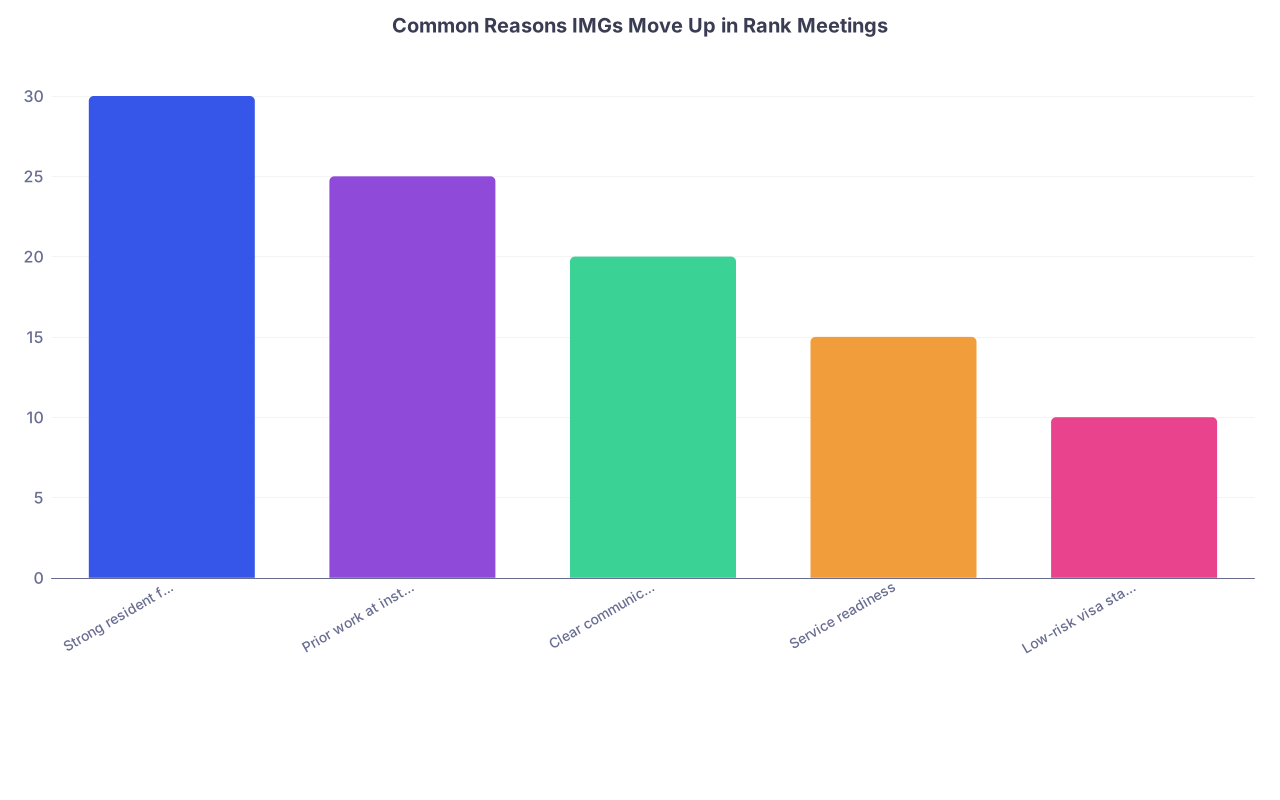
| Category | Value |
|---|---|
| Strong resident feedback | 30 |
| Prior work at institution | 25 |
| Clear communication | 20 |
| Service readiness | 15 |
| Low-risk visa status | 10 |
Nobody says: “Let’s reward him for expressing strong interest.”
They say: “I trust this person to do the job without drama.”
Quite a few IMGs rise after interview day because:
- A chief or faculty found your narrative credible
- Your previous U.S. work experience clicked with their pain points
- Residents felt you’d share the load, not add to it
- Your visa story felt clean and non-chaotic
- You removed, rather than added, uncertainty
That’s the throughline. You didn’t impress them. You reassured them.
What This Means For You (That You Can Still Use)
You can’t retroactively create U.S. clinical experience or rewrite your visa status. But there are tactics you can use, even late:
- In interviews, answer with specific examples of your clinical workload and responsibility—not generic “I worked hard.” They need to picture you on their wards.
- When asked about location or program, commit. “I would be very happy training here, and I can see myself spending the next three years building roots in this city.” Yes, actually say that.
- Talk like someone who’s already functioning in a U.S. system: signouts, pages, consults, cross-cover. Those words matter.
- If you have legitimate ties to the region or hospital, state them clearly and calmly. Do not assume they “saw it in your application.”
You’re not trying to be memorable. You’re trying to be obvious: the kind of IMG they’d be relieved to see on the schedule.
Years from now, you will not remember these rank meetings you never saw. You’ll remember walking into a hospital on July 1st and realizing: somehow, behind closed doors, enough people in a room decided to move your name just high enough.