
The clinical experience section is where program directors decide if you’re an asset or a risk.
Not your personal statement. Not your “I’m passionate about internal medicine” paragraph. The IMG clinical experience section is where they decide: can I trust this person with my patients, my residents, and my accreditation?
I’ve sat in those rank meetings. I’ve watched PDs scroll right past glowing letters and stop dead at the clinical experience list. And I’ve heard the exact phrases they use when your entries look weak, confusing, or fake.
Let me walk you through what they’re really reading between the lines.
What PDs Actually Use Your Clinical Experience For
Here’s the part nobody tells you: your clinical experience section is not just a list of activities. It’s a risk assessment tool.
When a PD or APD scans that section, they’re silently asking:
- Can this person function in a U.S. hospital on Day 1?
- How much supervision will they need?
- Are they going to drown my senior residents in extra work?
- Is there any red flag I’ll have to justify to my chair or GME?
They are not trying to “appreciate your journey.” They’re trying to avoid a problem.
So when they look at your IMG clinical experiences, they’re inferring five big things:
- How close you are to being “plug-and-play” in a U.S. system
- How real and hands-on your experience is vs. pure observership fluff
- How honest you are, based on how you describe what you did
- How serious and focused you are about their specialty
- Whether your path looks coherent or desperate
If you don’t build this section with those in mind, you’re leaving it to chance. And chance is not on an IMG’s side.
The Hidden Hierarchy of Clinical Experience: What Counts and What Doesn't
Let me be blunt. PDs mentally rank your listed experiences in a hierarchy the second they see them. They may not admit it in polite company, but they do.
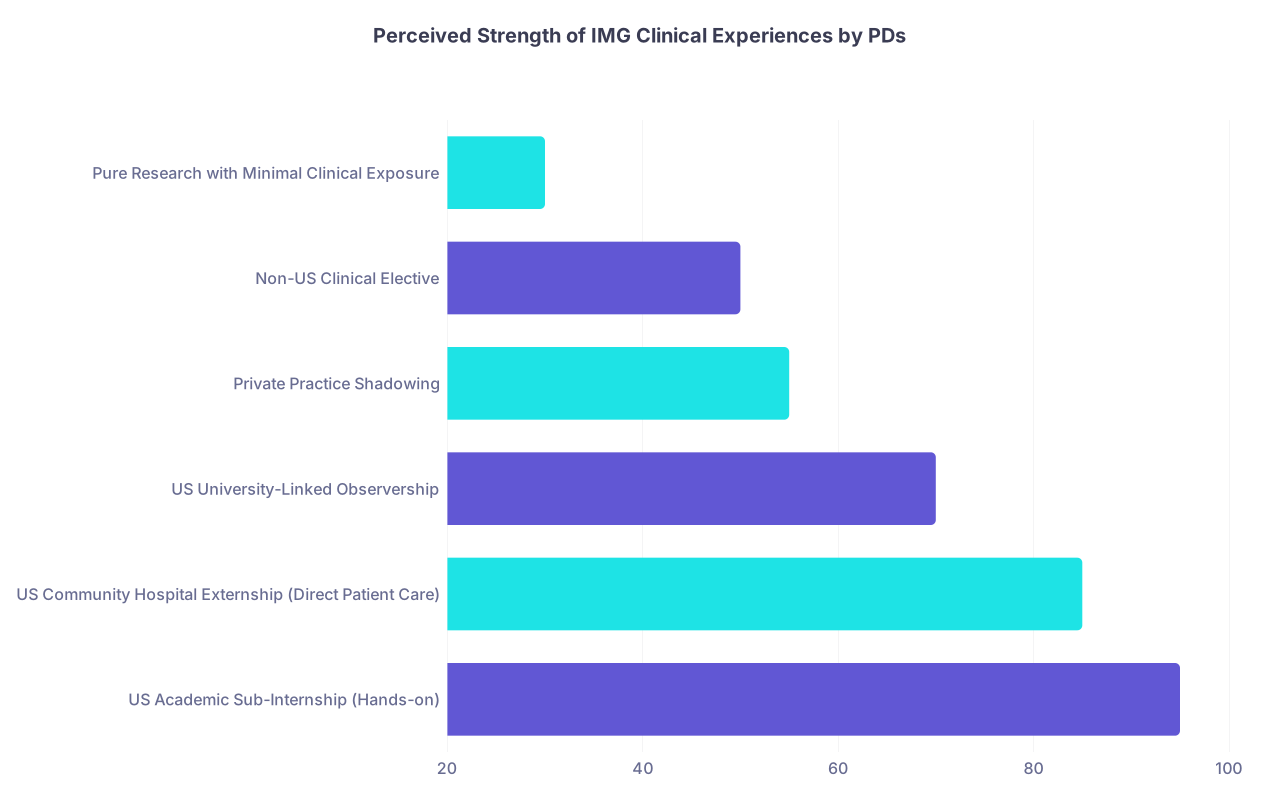
| Category | Value |
|---|---|
| US Academic Sub-Internship (Hands-on) | 95 |
| US Community Hospital Externship (Direct Patient Care) | 85 |
| US University-Linked Observership | 70 |
| Private Practice Shadowing | 55 |
| Non-US Clinical Elective | 50 |
| Pure Research with Minimal Clinical Exposure | 30 |
Here’s how it really breaks down.
Top Tier: Real U.S. Hands-On Clinical Work
Stuff like:
- Sub-internships (AI, acting internship) in the U.S.
- Externships with documented responsibility: notes, orders (co-signed), presentations, call
- Transitional/Prelim year rotations in the U.S.
When a PD sees this, the internal monologue goes: “Ok, someone’s already trusted them with real work here. Less risk for me.”
If that sub-I is in their specialty at a reputable institution? You’ve just separated yourself from 80% of the IMG pile.
Middle Tier: Structured U.S. Observerships / Shadowing With Substance
This is where most IMGs live.
Observerships in academic centers, hospital-linked programs, or clearly structured shadowing in a relevant specialty can still help. But only if described honestly and specifically.
When you oversell this—using “managed” and “treated” for shadowing—the PD assumes you’re inflating everything else too.
Lower Tier: Random, Unstructured, or Foreign-Only Experience (for U.S. Match)
Foreign clinical experience is necessary for graduation, but for U.S. PDs, it doesn’t tell them if you can function in their system.
It’s not useless. But it’s not what moves the needle. They see it as baseline, not as a distinguishing factor.
And pure research without clinical contact? That helps your academic profile, but not your Day 1 readiness.
How PDs Read Each Line of Your Experience (Yes, They Read It Like This)
Picture this: it’s 11:40 pm. PD has 40 more ERAS files to skim before a meeting tomorrow. Here’s what happens when they open your application and hit the clinical experience section.
They don’t start with the description. They scan four things first:
- Location – U.S. vs non-U.S., academic vs private, name recognition
- Role Title – “Subintern” vs “Observer” vs “Volunteer” vs “Extern”
- Dates – Recency and continuity
- Total time – Two weeks vs three months
Only after that do they look at what you wrote.
And this is the part that trips most IMGs: PDs “translate” your wording into their own internal meaning. I’ve heard them do it out loud.
Let me show you the translations.
What Specific Phrases Make PDs Trust You (And What Makes Them Roll Their Eyes)
There are certain words and patterns in the clinical experience descriptions that instantly set off either confidence or suspicion.
Words that Make You Look Realistic and Trustworthy
PDs like:
- “Observed”
- “Assisted with”
- “Presented on rounds”
- “Wrote draft notes under supervision”
- “Participated in case discussions”
- “Pre-rounded on assigned patients and reported findings”
- “Called consults under supervision”
- “Discussed management plans with residents and attendings”
These signal that you understand your actual level and respect boundaries. They also tell the PD you’ve seen a real workflow and know where you fit.
Words that Make You Look Dishonest or Naive
I’ve watched PDs read these and physically lean back in their chairs.
- “Managed a panel of patients”
- “Independently treated patients in the ICU” (as an observer… no, you didn’t)
- “Performed multiple central line insertions” (as an IMG on a 4-week elective… unlikely)
- “Was responsible for all medical decisions”
- “Led the code team”
When your title is “Observer” or “Visiting Medical Student” and your description sounds like you were a PGY-3, you lose credibility. Not just for that experience. For your whole application.
Here’s the mental shortcut PDs use: “If they’re exaggerating this, what else are they exaggerating? Letters? Research?”
Once that doubt creeps in, you’re done.
Recency and Continuity: The Quiet Filter Nobody Explains to You
Another ugly truth: PDs silently downgrade stale or fragmented experience.
Two key inferences they make:
- Recent USCE = you still remember how to be in a hospital
- Big gaps = I’m going to have to ask, “What were you doing?”
If you graduated in 2018, did one month of observership in 2019, then nothing until now, the PD is asking themselves: “Can this person handle 28 inpatients on a short-staffed Sunday?”
They’re also wondering: “Why was no one willing to let them back into a hospital for years?”
You can fight this, but not with wishful thinking. You fight it by:
- Stacking multiple recent experiences
- Showing progression (observer → more responsibility → maybe a clinical job)
- Making your non-clinical years look intentional (research, structured study, family obligations) rather than drift

| Step | Description |
|---|---|
| Step 1 | Open Clinical Experience Section |
| Step 2 | Questions about readiness |
| Step 3 | Lower risk perception |
| Step 4 | Neutral, look at details |
| Step 5 | Check gaps and explanation |
| Step 6 | Consider interview if other metrics good |
| Step 7 | Flag as possible inflation |
| Step 8 | Recent USCE? |
| Step 9 | Hands-on or Observership? |
| Step 10 | Clear, honest description? |
This is the mental flow, whether they admit it or not.
The Subtle Signals PDs Scan For (That You Don’t Realize You’re Sending)
Let me go deeper. Because this is where the “insider” piece actually matters.
When PDs look at your IMG clinical experience section, they’re not just scoring “yes/no USCE.” They’re pulling character data out of your choices and wording.
They infer:
1. How you’ll behave as an intern
If you list experiences that show you:
- Showed up consistently over months
- Did unglamorous work (discharge summaries, follow-ups, clinic flow)
- Worked in teams, presented to seniors, took feedback
They assume you’ll adapt faster and complain less.
If your experiences are all 2-week “rotations” with grandiose descriptions but zero mention of real tasks, they assume you like the picture of medicine more than the grind.
2. Whether you understand hierarchy and professionalism
Any line that smells like boundary violation is lethal.
Examples I’ve seen:
- “I counseled patients alone and adjusted medications” (as an observer)
- “I explained to nurses what to do” (don’t ever write this)
- “I often disagreed with the residents about management” (this is not the flex you think it is)
PDs see that and think: “This person will argue with my seniors, ignore protocol, and then I’ll be the one in front of the CMO trying to explain why.”
3. Whether you’re actually committed to their specialty
Patterns matter. If you’re applying to internal medicine but your clinical experience is:
- 2 months of plastic surgery in Turkey
- 1 month of dermatology in private practice
- 1 month of radiology observership
- And then a single 2-week “internal medicine observer” at a random community clinic
You’re making their life harder. They have to work to believe you want IM and not “anything that takes me.”
On the other hand, three IM-focused experiences in different settings (academic inpatient, community clinic, maybe cardiology or ICU exposure) screams: “I know what IM looks like. I still want it.”
That matters. Especially when scores are average and they have to justify your file to the committee.
How Different Patterns of Experience Look to PDs (Side-by-Side)
Let me put some structure on this, because I’ve watched these patterns play out in discussion.
| Pattern | What PDs Infer |
|---|---|
| Multiple recent US inpatient experiences in same specialty | Serious, focused, lower risk, likely understands workflow |
| Scattered short observerships across random specialties | Desperate, unfocused, unclear career commitment |
| Long gap then sudden cluster of brief observerships | Last-minute scramble, questions about prior years |
| Strong home-country clinical work + 1 solid US rotation | Potentially strong, needs careful interview to assess system fit |
| All research, no meaningful clinical since graduation | Academic interest maybe, clinically rusty, higher risk |
No one tells you this explicitly. But this is exactly how cases get discussed behind closed doors.
The “Too Perfect” Problem: When Your Description Looks Fabricated
There’s another trap that IMGs fall into when they try too hard to “optimize” this section. The over-polished, copy-paste problem.
PDs are very good at spotting:
- Identical wording across different experiences
- Overly formal, brochure-like descriptions
- Phrases that sound like they were lifted from a hospital website, not a human being’s memory
When three different IMGs from three different countries and three different “externship companies” all describe their role with the same phrases—“participated in multidisciplinary patient-centric care in a high-volume tertiary center”—you think we don’t notice?
We do. And it cheapens all of you.
Your descriptions need to sound like what someone who actually showed up would say. Concrete, specific, slightly imperfect.
“Pre-rounded on 3–5 patients daily, then presented findings on morning rounds to the senior resident and attending.”
That’s real. PDs recognize it.
Red Flags PDs Quietly Blacklist Over
There are a few patterns that raise blood pressure instantly. You usually don’t hear about them because no one wants to be quoted saying this in public.
Here’s what gets whispered in ranking meetings:
- Chronological nonsense – overlapping “full-time” experiences in different cities with no explanation
- Unrealistic procedures – IMGs on short electives claiming independence in procedures that U.S. med students rarely get to do
- Location inflation – listing a big-name university hospital as the site when you were actually in a loosely affiliated private clinic down the road
- Title inflation – “Resident” or “House Officer” in a foreign country, described as though it were equivalent to a U.S. PGY-2 when it clearly isn’t
Once a PD feels “played,” they don’t just move on. They anchor on that feeling. And it poisons your whole file.
How to Rewrite Your Clinical Experience So PDs See the Best Version of You
Let’s be practical. You can’t change what you actually did, but you absolutely can change how PDs interpret it.
You want to hit three things in each entry:
- Context – Where you were and at what level
- Scope – What you actually did, at a believable level
- Integration – How you fit into a team or system
Bad:
“Managed multiple inpatients, led rounds, performed procedures, and coordinated multidisciplinary care.”
PD translation: “No you didn’t. Next.”
Better:
“Shadowed internal medicine residents on an academic inpatient service. Pre-rounded on assigned patients, collected data from chart and bedside, and presented daily updates on rounds. Observed procedures including paracentesis and thoracentesis and participated in post-procedure monitoring under supervision.”
Now the PD thinks: “Ok, observer, but they actually saw the real work. They know what rounds look like. They understand hierarchy.”
If you had true hands-on:
“Completed a 4-week sub-internship on a general medicine service at [Hospital]. Carried 3–4 patients, wrote daily progress notes and admission H&Ps in the EMR for co-sign, presented on rounds, called consults with resident supervision, and participated in cross-cover and weekend call.”
This is the language of someone who’s actually been there.
Common IMG Myths About Clinical Experience That Need to Die
You’re getting bad advice from forums. Let me kill a few myths directly.
Myth 1: “Any U.S. experience is enough as long as it’s in my CV.”
No. Low-quality, obviously purchased, or heavily inflated experiences hurt you. They send the message: “I don’t understand what real clinical work is.”
Myth 2: “I should always make my experiences sound as impressive as possible.”
Wrong. You should make them sound as real as possible. PDs can smell “impressive” from a script. They trust specific and modest much more than dramatic.
Myth 3: “If I don’t say I did procedures, I’ll look weak.”
If you’re an IMG observer claiming to have done a dozen central lines at a major U.S. hospital, you look dishonest, not strong. It’s better to be accurate and have the PD think, “They know their scope, they’ll be safe.”
How PDs Compare You to Other IMGs With Similar Scores
When scores and graduation year are similar, the IMG clinical experience section becomes the tiebreaker.
Here’s how those conversations sound when you’re not in the room:
- “Applicant A has 3 months of recent US IM wards + a strong letter from one of those rotations.”
- “Applicant B has 2 months of U.S. observership—one in derm, one in cardiology clinic—descriptions are vague.”
Same Step scores, same year of graduation. Applicant A gets ranked higher. Every time. Not because they’re “smarter.” Because the PD can picture them working in their hospital without chaos.
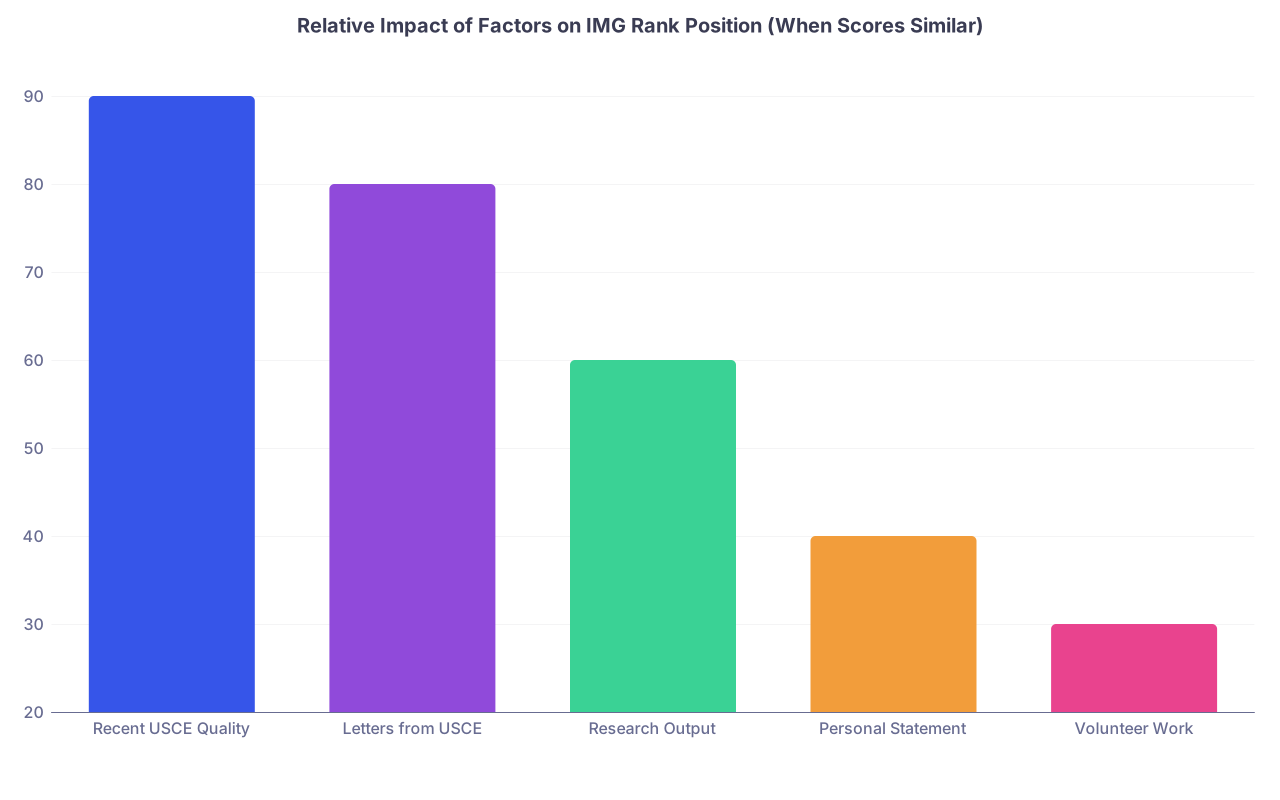
| Category | Value |
|---|---|
| Recent USCE Quality | 90 |
| Letters from USCE | 80 |
| Research Output | 60 |
| Personal Statement | 40 |
| Volunteer Work | 30 |
This is why obsessing over phrasing in your personal statement while treating your clinical experience section as an afterthought is backwards. PDs don’t care how beautifully you say “I love internal medicine” if your experience list says, “I’ve barely seen it.”
Final Reality Check
Here’s the uncomfortable truth: as an IMG, you’re already starting from behind in the eyes of many programs. The clinical experience section is where you can either confirm their bias or shatter it.
Three things decide how they read it:
- The type and recency of your U.S. experience
- How honestly and concretely you describe what you did
- How coherent your experiences look with your chosen specialty
You can’t change your past, but you can stop sabotaging yourself in how you present it.
If your descriptions sound like a brochure, fix them.
If your roles sound superhuman for an observer, tone them down to reality.
If your pattern screams “scattered and desperate,” start building one more solid, recent, specialty-aligned experience—even if it’s not glamorous.
That’s how you turn your clinical experience section from a liability into your strongest argument.