
The way most IMGs write their CVs is fundamentally incompatible with how US residency programs read applications.
They bring a European‑style, narrative, 5‑page monster CV and try to shove it into a US context. Then they wonder why their “great experience” is invisible to program directors scrolling through 60 applicants between cases.
Let me break this down specifically: a strong US‑style CV for an IMG is short, structured, brutally clear, and aligned with how ERAS and program coordinators actually work.
You are not writing for a committee of professors in your home country. You are writing for:
- A coordinator who screens 1,000+ applications for basic filters.
- An associate program director skimming your file for 60–90 seconds.
- Faculty scanning for specific signals: USCE, research, gaps, red flags.
Your CV must reinforce, not contradict, what is in ERAS. It also needs to be ready for emails to attendings, observership applications, research contacts, and pre‑interview communication.
This is a section‑by‑section template of what a US‑style CV for residency should look like—specifically for IMGs.
Core Principles of a US‑Style Residency CV for IMGs
Before we go section by section, you need the rules of the game.
Length: 2–3 pages is ideal. Four is almost always too long for a residency‑focused CV. One page is usually too thin for an IMG unless you are extremely early.
Structure order (for residency applications):
- Contact and identity
- Education
- Exams and licensing
- Clinical experience (US first, then international)
- Research and publications
- Teaching and leadership
- Awards and honors
- Skills and certifications
- Conferences, presentations, other
Formatting:
- Use a clean, boring, professional font (Calibri, Arial, Times New Roman, 10.5–12 pt).
- No graphics, colors, headshots, logos, or fancy templates. This is not LinkedIn.
- Use consistent date format and alignment (e.g., “Aug 2022 – Jun 2023”).
- Use reverse chronological order in every section.
Content style:
- Bullet‑based, not narrative paragraphs.
- Strong action verbs: “Led”, “Developed”, “Analyzed”, “Coordinated”, “Taught”.
- Add 1–3 focused bullets per experience. Not 10.
- Always quantify when you can: numbers, frequencies, scale.
Alignment:
- CV must not contradict ERAS. Dates, titles, roles, and publications must match.
- CV can contain a bit more detail than ERAS, but not different facts.
Now, let us build it from the top.
Section 1: Header and Contact Information
This is where many IMGs start behaving like it is a Europass document. Do not.
What you include:
- Full Name (bold, larger font – this is your “brand”)
- Current Location (City, State, Country)
- Email (professional, stable; ideally your name)
- Phone (with country code if abroad)
- Optional: LinkedIn URL, personal academic website (if it is actually current and professional)
What you do not include for a US‑style residency CV:
- Photo
- Date of birth
- Marital status
- Religion, nationality (unless strategically helpful in a niche context and even then, rarely)
- Visa type in the header (better to mention in a short profile line or at the bottom if necessary)
Example layout:
Dr. Priya Sharma, MBBS
Houston, TX, USA
Email: [email protected] | Phone: +1 (713) 555‑0123
LinkedIn: linkedin.com/in/priyasharmamd
Keep it tight. Four lines. No more.
If you need to signal visa dependence, you can add a single line later:
“Citizenship: India | J‑1 Visa Sponsorship Required”
Not in the header.
Section 2: Professional Summary (Optional but Powerful for IMGs)
US‑trained students usually skip this. For IMGs, I find a 2–3 line professional summary can be very useful if done correctly.
Use it if:
- You have a prior residency, fellowship, or strong niche experience.
- You are reapplying and want to frame your profile.
- You are career‑switching (e.g., surgery at home, applying IM in US).
Do not use it if:
- You are going to write vague filler: “hard‑working, dedicated, passionate.” Nobody cares.
What it should do:
- State your training background.
- State your target field.
- Mention 1–2 concrete strengths (USCE, research, teaching, procedural exposure).
Example:
“International medical graduate with completed internal medicine residency in Egypt and over 18 months of US clinical experience in academic settings. Strong interest in hospital medicine and quality improvement, with 3 first‑author publications and experience teaching medical students and interns.”
Three lines. Concrete. No fluff.
Section 3: Education
US readers expect education high up. Do not bury it after experience.
Format:
Degree | Institution | City, Country | Dates
For IMGs, be extremely clear:
- Degree: MBBS, MD (clarify if it is an MD equivalent in your country), MBChB, etc.
- Include medical school only; optionally include undergraduate degree if distinct (e.g., BS in Biology).
- Include class rank or GPA only if it is strong and somewhat understandable.
Example:
Doctor of Medicine (MD)*
Universidad Nacional de Colombia, School of Medicine – Bogotá, Colombia
Aug 2013 – Dec 2019
- Graduated top 10% of class (Rank 12/150)
- Thesis: “Epidemiologic patterns of diabetic nephropathy in urban Colombia”
If your degree name confuses Americans (e.g., MBChB), you can put a footnote or parenthetical once:
“Bachelor of Medicine, Bachelor of Surgery (MBBS) – equivalent to US MD”
Do not list every course you took. Do not list high school.
If you have significant post‑graduate training abroad (e.g., completed specialty training):
Postgraduate Training (Non‑US)
Internal Medicine Residency
All India Institute of Medical Sciences (AIIMS) – New Delhi, India
May 2019 – Apr 2022
You will later have a section for “Clinical Experience” and/or “Postgraduate Training,” but major formal residency goes here or in its own clearly titled section.
Section 4: Exams and Licensing (USMLE, ECFMG, Others)
For residency, this section is critical. Program directors look for it fast.
Title it clearly:
“US Licensing Exams and Certification”
Or:
“Examinations and Certification”
Include:
- USMLE Step 1 – Pass (if numeric score, only if it is strong for your story, and if allowed; with pass/fail era you usually just say “Pass”).
- USMLE Step 2 CK – Score, Date (if competitive, include; if weak, still include but do not dress it up).
- USMLE Step 3 – if taken.
- ECFMG Certification – and whether complete or pending.
Format example:
USMLE Step 1 – Pass, Apr 2021
USMLE Step 2 CK – 251, Sep 2022
USMLE Step 3 – Pending (scheduled Mar 2025)
ECFMG Certification – Expected Jun 2025
Or, if already done:
ECFMG Certified, Jan 2024
Add IELTS/TOEFL only if highly relevant (e.g., visa/ECFMG language requirements still applicable) or very strong:
IELTS Academic – Overall 8.0 (Listening 8.5, Reading 8.0, Writing 7.5, Speaking 8.0), 2023
Do not hide scores if they are already known from ERAS. This is more for off‑ERAS use (emails to attendings, research mentors, etc.), but keep it aligned.
Section 5: Clinical Experience – US First, Then Home Country
This is where IMGs either shine or sink. US eyes expect a particular structure.
First: split experience clearly:
- “US Clinical Experience” (USCE)
- “International Clinical Experience” or “Clinical Experience – Home Country”
Within each, reverse chronological order.
For each entry:
Role | Department / Service | Institution | City, State, Country | Dates
Then 2–4 bullets max.
US Clinical Experience Example
US Clinical Experience
Clinical Observer, Internal Medicine
Department of Hospital Medicine, Cleveland Clinic – Cleveland, OH
Sep 2023 – Nov 2023
- Completed 8‑week observership on hospital medicine service, attending daily rounds and case discussions.
- Observed management of high‑complexity patients with sepsis, advanced heart failure, and multi‑organ dysfunction.
- Participated in journal club presentations on inpatient diabetes management and coagulopathy.
If you had genuine hands‑on experience with orders and notes (rare but possible under specific roles like “extern” or “pre‑residency fellow”), be precise and honest. US programs are sensitive to misrepresentation.
Do not write “Managed patients independently” if you were an observer. You will get crushed in an interview when they dig.
For clerkships during med school in the US, name them clearly:
Visiting Medical Student, Sub‑Internship in Internal Medicine
Johns Hopkins Hospital – Baltimore, MD
Aug 2022 – Sep 2022
- Functioned as acting intern on general medicine team under direct supervision of residents and attendings.
- Performed H&Ps, wrote daily progress notes, and presented patients on rounds.
- Received “Honors” evaluation with commendation for clinical reasoning and professionalism.
International Clinical Experience Example
Clinical Experience – Home Country
Internship (Rotating House Officer)
King Edward Medical University / Mayo Hospital – Lahore, Pakistan
Jan 2021 – Dec 2021
- Rotations: Internal Medicine (3 months), General Surgery (3), Pediatrics (2), Obstetrics & Gynecology (2), Emergency Medicine (2).
- Performed initial evaluations, daily rounding, procedures (NG tube insertion, Foley catheterization, venipuncture), and basic wound care under supervision.
- Managed 10–15 inpatients daily on internal medicine service and participated in weekly mortality and morbidity meetings.
If you have completed a full residency abroad and are now applying again in the US, you may want a separate section titled “Postgraduate Clinical Training” or “Residency Training – Non‑US,” placed either before or within Clinical Experience.
Section 6: Research Experience
IMGs chronically mislabel this section. Posters and one paper do not equal “Extensive Research Background.” But you can absolutely present what you did in a way US readers respect.
Separate “Research Experience” (positions, projects) from “Publications and Presentations” (outputs).
Structure for research positions:
Title | Lab/Group | Institution | City, Country | Dates
Then 2–4 bullets focused on:
- Your role (not just what the lab did)
- Methods you actually used
- Type of data and outcomes
- Any tangible outputs (papers, abstracts, QI implementation)
Example:
Research Fellow, Division of Pulmonary and Critical Care
Massachusetts General Hospital – Boston, MA
Jul 2022 – Present
- Coordinated prospective cohort study on long‑term outcomes of ARDS survivors (n=180).
- Collected and managed patient‑reported outcomes using REDCap; performed data cleaning and basic statistical analysis in Stata.
- Co‑authored 2 abstracts presented at ATS 2023; manuscript under review.
If your “research” was a small med school thesis with limited rigor, still list it, but do not oversell:
Medical Student Research Project – “Patterns of antibiotic resistance in community‑acquired UTIs”
University of Lagos College of Medicine – Lagos, Nigeria
Jan 2018 – Nov 2018
- Designed cross‑sectional study under faculty supervision; enrolled 120 patients.
- Analyzed culture and sensitivity patterns using SPSS; identified high resistance to fluoroquinolones.
- Findings presented at local departmental conference.
Do not dump every small school poster into the “Research Experience” section as a separate role. Group small internal projects logically.
Section 7: Publications and Presentations
This section must be organized, not a random wall of text. And your citations need to be consistent and readable.
Recommend splitting:
- Peer‑Reviewed Publications
- Abstracts and Conference Presentations
- Other Publications (book chapters, non‑indexed journals, etc.)
You are not writing for PubMed indexing staff. You are writing for busy clinicians. Keep citations clean and short.
Basic format:
Author Last Name Initials, Author2 Initials, Author3 Initials. Title. Journal. Year;Volume(Issue):Pages.
If in press or e‑pub ahead of print: “Epub ahead of print, 2023.”
Example:
Peer‑Reviewed Publications
- Khan A, Patel R, Lopez J. Outcomes of early versus delayed intubation in COVID‑19 ARDS: a multicenter cohort study. Chest. 2023;164(2):145‑153.
- Sharma P, Gupta M, Lee S. Hospital readmissions in patients with diabetic foot infections: a 5‑year retrospective analysis. J Hosp Med. 2022;17(9):640‑647.
Abstracts and Conference Presentations
- Sharma P, Gupta M. Predictors of 30‑day readmission in diabetic foot ulcers. Poster presented at: Society of Hospital Medicine Annual Meeting; Mar 2023; Austin, TX.
- Ahmed R, Sharma P. Implementation of a sepsis bundle in a resource‑limited ICU. Oral presentation at: Pakistan Society of Critical Care Medicine Conference; Feb 2021; Karachi, Pakistan.
Be honest about your author position. If you are 8th author out of 15, do not bold your name like first author. If you have many publications (10+), list the most relevant 5–8 to your specialty in the main CV and put “Complete list of publications available upon request” at the end, or keep a longer “academic CV” version for research positions.
Section 8: Teaching, Leadership, and Academic Roles
US programs care a lot about people who can teach and lead. Many IMGs underplay this.
Break this into:
- Teaching Experience
- Leadership and Service (if you have substantial roles)
Teaching Experience
Clinical Tutor, Internal Medicine
University of Santo Tomas Faculty of Medicine – Manila, Philippines
Jan 2020 – Dec 2021
- Taught weekly bedside sessions for 3rd‑year medical students (groups of 6–8).
- Led small‑group case discussions on chest pain, shortness of breath, and sepsis.
- Received “Best Clinical Tutor” award (2021) based on student evaluations.
Include:
- Teaching level (medical students, interns, residents, nurses, community health workers)
- Format (bedside teaching, lectures, simulation, OSCE prep)
- Frequency or duration if it is significant.
Leadership and Service
President, Medical Students’ Association
University of Belgrade Faculty of Medicine – Belgrade, Serbia
Sep 2017 – Jun 2018
- Led executive board of 12 members and represented 450 medical students in curriculum discussions with faculty.
- Organized 3 community health fairs serving ~800 participants.
Avoid listing token memberships (“Member, XYZ Association”) under leadership unless you actually did something.
Section 9: Awards and Honors
Here you separate actual merit from simple participation. Only list items with some competitive element, formal recognition, or real prestige.
Examples:
Awards and Honors
- Gold Medal, Final Professional MBBS (Rank 1/220), Dow Medical College, 2020.
- Best Intern Award, Department of Pediatrics, National Hospital, 2021.
- Distinction in Pharmacology and Pathology, 2018.
- Travel Grant Award, European Society of Cardiology Congress, 2023.
Do not list generic scholarships that every student got unless they are truly competitive. Do not list that you “organized a welcome party” as an award.
Section 10: Skills, Procedures, and Certifications
This is a minefield. IMGs often turn this into a fantasy list of procedures they “can do” that would make an American PGY‑3 blush.
Here is the standard:
- Separate technical skills from languages and IT skills.
- For procedures, be modest and specific. Focus on what is realistic for your baseline stage.
- Avoid claiming independent competency in high‑risk procedures (central lines, chest tubes) unless you can defend it in detail.
Subsections work well:
Clinical Skills and Procedures
- Performed: venipuncture, IV cannulation, Foley catheter insertion, NG tube placement, basic wound care, arterial blood gas sampling (under supervision).
- Assisted with: lumbar puncture, chest tube insertion, central venous catheter placement, endotracheal intubation.
Language Skills
- English (fluent), Spanish (native), French (conversational).
Technical / Software
- Microsoft Word, Excel, PowerPoint (advanced).
- Statistical software: SPSS, Stata (basic).
- REDCap data entry and management.
Certifications
- Basic Life Support (BLS), American Heart Association – Expires Jun 2025
- Advanced Cardiovascular Life Support (ACLS), AHA – Expires Jun 2025
Do not list “Good communication skills” as a skill. That should come across in letters and interviews, not a bullet.
Section 11: Conferences, Courses, and Other Academic Activities
This is your place for:
- Significant conferences you attended or participated in.
- Focused online courses with certificates that actually matter (e.g., Harvard’s online QI course, not random Udemy things).
- Organized workshops if you had a meaningful role.
Conferences and Courses
- Attendee, American College of Physicians (ACP) Internal Medicine Meeting, Boston, MA – Apr 2023.
- Presenter, ATS International Conference, Washington, DC – May 2022.
- Course: “Introduction to Clinical Research,” Harvard Medical School Online – Completed Dec 2021.
Do not flood this section with every local evening webinar you clicked on. Curate.
Section 12: Gaps, Non‑Clinical Work, and “Real Life”
You will inevitably ask: do I include my part‑time job at a grocery store? My year off studying for USMLE? My time in military service?
Here is the rule: if it explains a gap, shows responsibility, or demonstrates resilience, it deserves a brief, honest entry.
Example:
Non‑Clinical Experience
Customer Service Associate (Part‑Time)
Walmart – Houston, TX
Oct 2022 – Aug 2023
- Worked 20–25 hours per week while preparing for USMLE Step 2 CK.
- Managed customer interactions and problem resolution in a high‑volume retail setting.
For gaps:
You do not write: “USMLE study gap” as a job. But you can gently mention under your exams summary or in your personal statement. In the CV, if there is a multi‑year gap with nothing, I would often add:
Independent USMLE Preparation and Clinical Observership Applications
Jan 2021 – Dec 2021
- Full‑time exam preparation and coordination of US clinical observership opportunities during international relocation.
It is better than a blank 12‑month hole.
A Simple Visual: Recommended Section Order by Applicant Status
| Applicant Type | Top Priority Sections Order (after Header) |
|---|---|
| Final-year med student (IMG) | Education → Exams → Clinical (Clerkships/USCE) → Research → Teaching |
| Recent graduate (<3 years) | Education → Exams → Clinical (US then Home) → Research → Leadership |
| Experienced doctor (prior residency) | Education → Postgrad Training → Exams → Clinical → Research → Teaching |
| Research-focused IMG | Education → Exams → Research → Publications → Clinical → Teaching |
| Reapplicant with gap | Education → Exams → Clinical → Research → Gaps/Non-clinical → Awards |
Common IMG Mistakes That Kill a Good CV
Let me be blunt about the patterns I see repeatedly.
Overstuffed personal details
Whole paragraphs on hobbies, family, or “my philosophy of medicine” on the CV. Save it for the personal statement or the interview.Mixing languages and formats
One entry in English, another partly in your home language, random untranslated award names with no explanation. Translate titles and, if needed, add a short parenthetical.Dishonest enhancement of roles
Calling an observership “externship” or “clinical fellowship” when it was shadowing. Overclaiming procedures. Listeners in the US are more conservative about what “performed independently” means.Poor date transparency
Missing years. No months. Program directors are very sensitive to hidden gaps. If you did something part‑time, say so, but still give a date range.Confusing ERAS vs CV purpose
The CV is an adjunct, not the main actor. It should be consistent with ERAS but more readable in one glance. It is not the place to create an alternate reality.
A Quick Process Flow for Building Your US‑Style CV
Just so you have a mental model of the steps, not just the sections.

| Step | Description |
|---|---|
| Step 1 | Gather All Raw Data |
| Step 2 | Decide Target Specialty and Priorities |
| Step 3 | Choose Section Order |
| Step 4 | Draft Core Sections: Education, Exams, Clinical |
| Step 5 | Add Research, Teaching, Leadership, Awards |
| Step 6 | Trim to 2-3 Pages and Remove Filler |
| Step 7 | Cross-Check Against ERAS for Consistency |
| Step 8 | Get Feedback from US-Trained Mentor |
| Step 9 | Finalize Master CV and Create Variants |
Have one “master CV” with everything. Then, depending on context (research email vs observership application vs interview day), strip it to a leaner 2–3 page version emphasizing what that person cares about.
How This CV Plays With ERAS, Emails, and Interviews
You are not building this CV in isolation.
ERAS vs CV
- ERAS is standardized, clunky, and ugly. Everyone uses it.
- Your CV is your controlled, readable version that you can attach to emails, bring to interviews, and use for non‑ERAS opportunities (observerships, research, networking).
Emailing attendings / program coordinators
When you cold email for observerships or research, you attach a CV, not a full ERAS application. They will glance at:- Your exams
- Your USCE
- Your research outputs
- Your current status and location
Put those sections high enough that they see them on page 1.
Interview use
Some interviewers still print or open your CV, not ERAS. A clean, structured CV makes their life easier and your story clearer. You want that.
One Sample Layout (Top Half of Page 1)
Just to give you a mental image of order and density. Not full, but enough.
Dr. Maria Fernandez, MD
Miami, FL, USA
Email: [email protected] | Phone: +1 (305) 555‑0199
LinkedIn: linkedin.com/in/mariafernandezmd
Professional Summary
International medical graduate from Argentina with 12 months of US clinical experience in internal medicine and cardiology. Strong interest in academic internal medicine, with 2 first‑author publications and active involvement in teaching medical students.
Education
Doctor of Medicine (MD)*
Universidad de Buenos Aires, Faculty of Medicine – Buenos Aires, Argentina
Mar 2014 – Dec 2020
- Graduated top 15% of class (Rank 45/320).
US Licensing Exams and Certification
USMLE Step 1 – Pass, Feb 2022
USMLE Step 2 CK – 247, Oct 2022
ECFMG Certified, Jul 2023
US Clinical Experience
Clinical Extern, General Internal Medicine
Jackson Memorial Hospital – Miami, FL
Jan 2023 – Jun 2023
- Performed H&Ps and daily progress notes for 6–8 inpatients under resident and attending supervision.
- Presented new admissions on rounds and participated in discharge planning and transitions of care.
- Assisted with quality improvement project on discharge medication reconciliation.
You see the pattern: clean, compact, high‑yield data without drama.
Final Checks Before You Send This Anywhere
Before you attach this CV to an email or upload it to a program portal, go through this ruthlessly:
- One font, consistent sizes, uniform bullet style.
- Dates aligned and non‑contradictory with ERAS.
- Section headings clear and conventional.
- No unexplained multi‑year gaps.
- No exaggerations you cannot defend under questioning.
- Page count: 2–3, and the most critical information is on page 1.
If you need a mental model: your CV should look like something a US chief resident could have written. Simple, direct, slightly understated, and very clear.
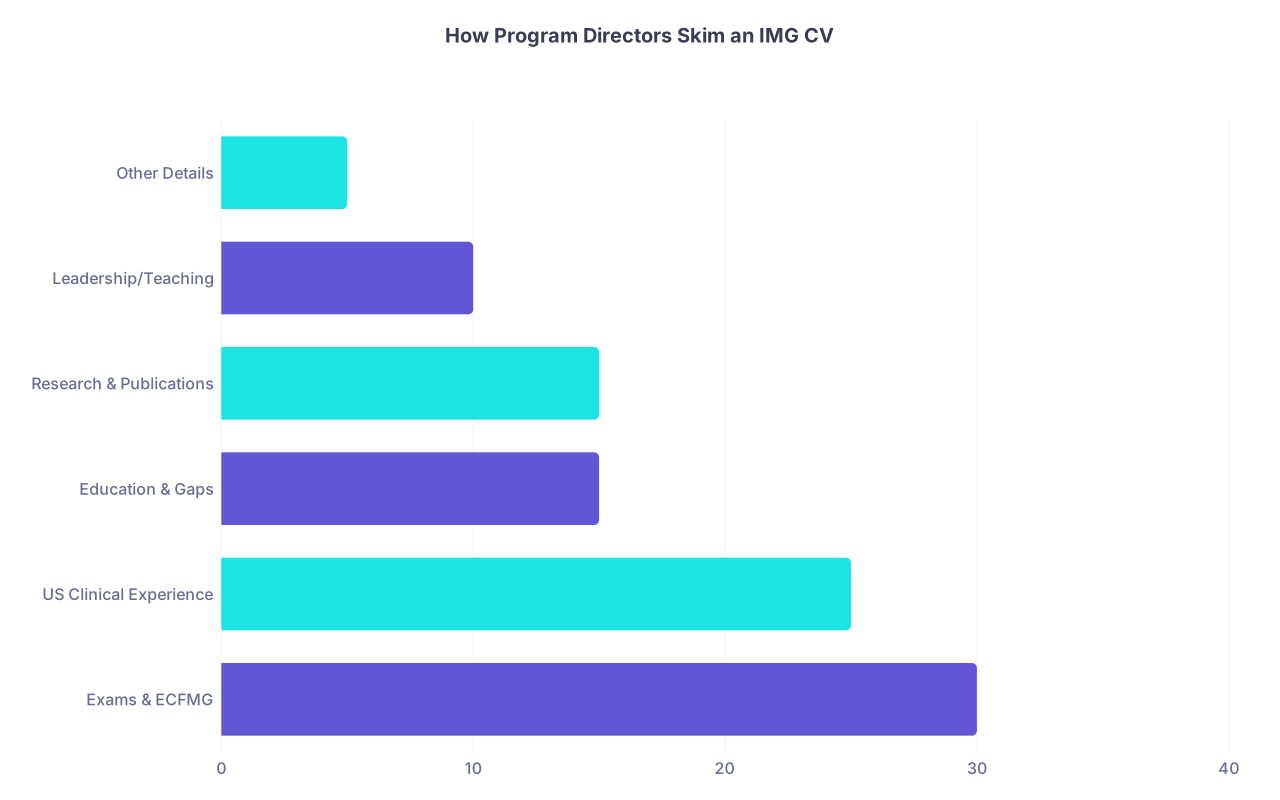
| Category | Value |
|---|---|
| Exams & ECFMG | 30 |
| US Clinical Experience | 25 |
| Education & Gaps | 15 |
| Research & Publications | 15 |
| Leadership/Teaching | 10 |
| Other Details | 5 |
Key Takeaways
- A US‑style IMG CV is lean, structured, and brutally clear—2–3 pages, with exams, education, and US clinical experience front and center.
- Separate and label your sections intelligently: USCE vs home country, research roles vs publications, teaching vs leadership, and keep everything consistent with ERAS.
- Cut the fluff, avoid exaggeration, and present the version of yourself that a busy US program director can understand in 60 seconds and still want to interview.