Most IMGs ruin their first impression before anyone ever opens their ERAS file—by sending bad emails.
I have seen brilliant applicants with strong scores and serious experience get mentally “marked down” by PDs and coordinators because of a sloppy subject line, a pushy follow‑up, or a 900‑word life story sent to a generic inbox. You are not competing only on scores; you are competing on signal vs. noise. Your emails are either signal… or spam.
Let me break this down specifically.
1. The Realities IMGs Ignore About Program Email
Most IMGs imagine a PD sitting quietly, carefully reading every message from every hopeful applicant.
That is not what is happening.
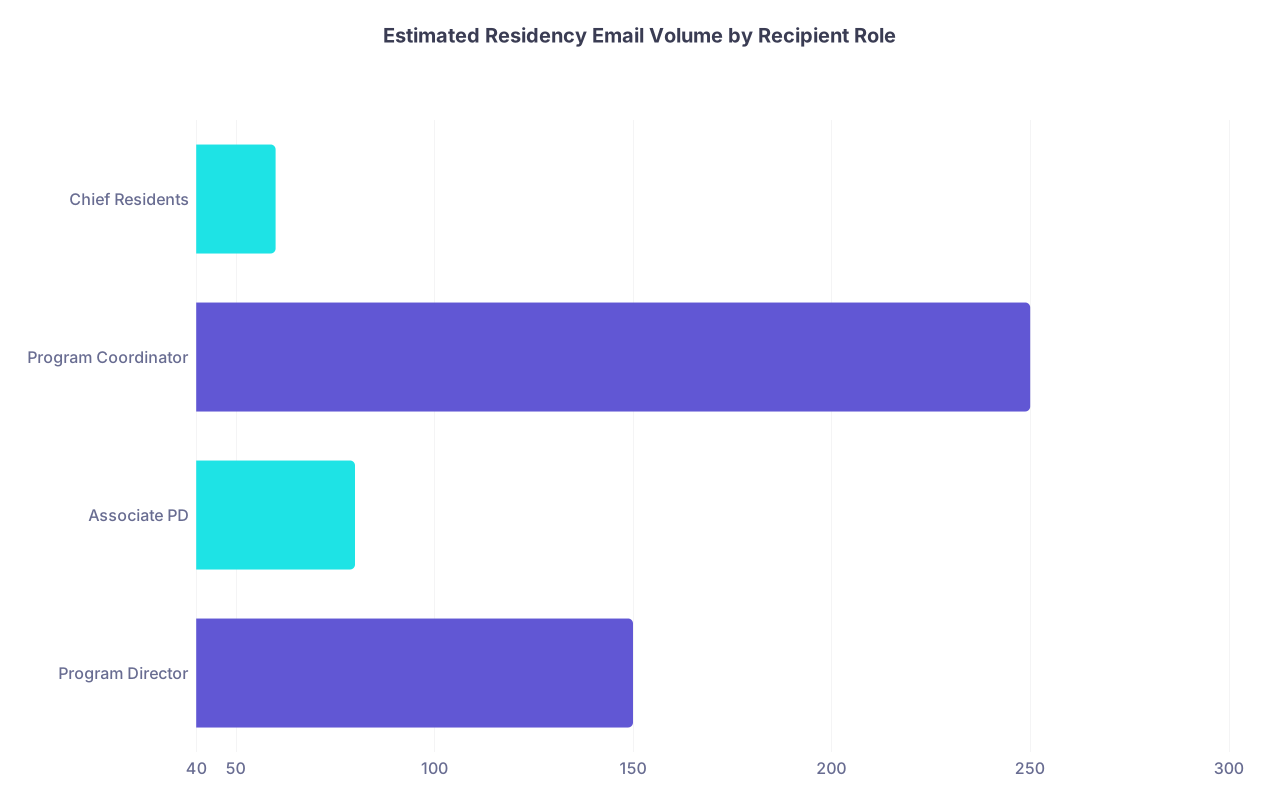
| Category | Value |
|---|---|
| Program Director | 150 |
| Associate PD | 80 |
| Program Coordinator | 250 |
| Chief Residents | 60 |
On a typical busy week during application season, per program:
- Program Director inbox: flooded with 100–200+ messages per day
- Coordinator inbox: even worse—scheduling, GME, NRMP, HR, applicants
- Chief residents: increasingly looped into recruitment logistics
So PDs and coordinators develop survival habits:
- They skim subject lines.
- They mentally classify senders in 2–3 seconds.
- They ignore anything that looks generic, desperate, or demanding.
- They remember the outliers—very good or very bad.
Your goal is not “send an email.” Your goal is “be one of the ~5–10 emails this week that register as competent, concise, and worth replying to.”
A few non‑negotiable realities:
Cold emails rarely convert into interviews by themselves.
They help at the margins—tiebreakers, context, clarifications, VSLO/observership interest.Bad emails can absolutely hurt you.
Programs remember your name in the wrong way.Coordinators matter more than you think.
Many PDs forward emails to them with “Can you handle this?” in the subject. If you are rude, unclear, or high‑maintenance with the coordinator, assume that information moves up the chain.
2. Strategic Rules Before You Ever Hit “Compose”
Most IMGs start in the wrong place: “I want to email all my dream programs.”
Wrong starting point.
Start with: “What is the legitimate reason this program would want to hear from me in their inbox?”
Here is a simple decision flow.

| Step | Description |
|---|---|
| Step 1 | Thinking of emailing program |
| Step 2 | Do NOT email |
| Step 3 | Wait until proper phase |
| Step 4 | Send brief, targeted email |
| Step 5 | Clear, specific purpose? |
| Step 6 | Already answered on website/FAQ? |
| Step 7 | Appropriate timing? |
Situations where an email makes sense
These are usually reasonable:
Clarifying objective eligibility
Example: “I am an IMG with 2018 graduation. Your website says ‘prefer within 5 years.’ Would 2018 be considered or automatically filtered?”Asking about observerships / electives / research positions
If the program or department actually mentions these on their site or VSLO.Updating significant application changes
New Step 3 pass, visa change (e.g., now eligible for J‑1), major publication acceptance.Following up on a personal connection
Met PD/faculty at a conference, completed an elective there, or someone in the program explicitly told you to email.
Situations where an email is usually a bad idea
These are common mistakes:
“Can you please review my ERAS and give me feedback?”
No. That is not their job, and they do not have time.“Can you tell me my chances at your program?”
No, and asking sounds naïve and transactional.“Why did I not get an interview?”
Guaranteed eye‑roll. Sometimes forwarded internally as a cautionary example.“I am very passionate and hardworking, please consider me.”
Everyone writes this. Contributes nothing.
If you cannot state a specific purpose in one line—do not send the email.
3. Subject Lines: Where Most IMGs Lose
Your subject line decides if anyone reads the body. Overdramatizing? Not really.
Weak subject lines I routinely see:
- “Residency Application”
- “IMG Applicant from India”
- “Hoping for your guidance”
- “Interested in your program”
- “Request”
These scream “mass email” and “time sink.”
Strong subject lines are:
- Specific
- Short (ideally under ~70 characters)
- Immediately relevant to the program
| Type | Subject Line Example |
|---|---|
| Bad | Residency Application Inquiry |
| Bad | IMG Applicant Seeking Opportunity |
| Good | Eligibility Question – 2018 IMG, Step 3 Passed |
| Good | Observership Inquiry – Internal Medicine, J‑1 Eligible |
| Good | Update: New Step 3 Score – ERAS AAMC #12345678 |
A simple pattern that works:
- Clarifier: “Eligibility Question”, “Update”, “Observership Inquiry”
- Brief context: “2018 IMG”, “Step 3 Passed”, “US Clinical Experience”
- Optional: ERAS AAMC # if you are already an applicant
Examples:
- “Eligibility Question – 2017 IMG, US Citizen, Step 3 Passed”
- “Update: New Step 2 CK Score – ERAS AAMC #12345678”
- “Observership Inquiry – Internal Medicine, J‑1 Visa”
You are helping the reader decide: Is this easy to triage/answer? If yes, your open rate goes up.
4. The Anatomy of a High‑Level Email (Line by Line)
Most IMGs either over‑write (long essays) or under‑write (too blunt, almost rude). You want concise, structured, and obviously professional.
Core structure
- Greeting
- One‑line purpose
- Micro‑summary of who you are (2–4 lines max)
- Specific question / request
- Close + signature
Target length: 120–200 words. Under 250 unless you truly have a complex scenario.
Let’s build one properly.
Example 1: Eligibility clarification email
Bad version (I have seen versions of this hundreds of times):
Dear Sir/Madam,
I am Dr. X from India. I am very hardworking and passionate about internal medicine and I am extremely interested in your prestigious program. My dream is to train in the United States and serve diverse populations. Can you please consider my application and let me know if I have any chance? I graduated in 2016 and have Step 1 222, Step 2 234, and almost 2 years of clinical experience in my home country. I have done many observerships also. Please find my CV attached. I would be very grateful for any chance or any opportunity in your program. Please consider me.
Sincerely,
Dr. X
Problems:
- No clear question.
- Sounds generic and desperate.
- Asks for “chance” evaluation.
- Attachment no one asked for.
Now the advanced version:
Subject: Eligibility Question – 2016 IMG, Step 3 Passed
Dear Dr. [Last Name] / Dear Program Coordinator,
I hope this message finds you well. I am an international medical graduate (Class of 2016) with Step 1 222, Step 2 CK 234, and Step 3 221, currently practicing internal medicine in [Country].
Your website mentions a preference for graduation within 5 years. I would be grateful if you could clarify whether 2016 graduates are still considered for categorical Internal Medicine positions, or if my application would be automatically filtered out based on year of graduation.
If applicable, I would still like to submit a thoughtful application via ERAS and do not wish to waste your team’s time if I am clearly ineligible.
Thank you for your time.
Sincerely,
[Full Name], MD
AAMC ID: [########]
[City, Country]
[Email] | [Phone (if US‑based)]
Specific, respectful, and answerable. That is what you are aiming for.
5. Professional Tone: Culture Gap That Trips IMGs
A lot of IMGs underestimate how different professional email culture is in the U.S.
Common issues:
- Over‑flattering language: “your esteemed and prestigious institution,” “most honorable professor.” This reads as insincere here.
- Over‑formal awkwardness: “Kindly do the needful.” That phrase is infamous.
- Under‑formal bluntness: jumping into demands without greeting or closing.
Simple tone rules
Avoid flowery praise. One short phrase is enough.
Acceptable: “I am very interested in your Internal Medicine program.”
Not: “It would be my greatest honor to join your most prestigious and world‑renowned institution.”Use neutral, respectful phrases:
- “I would be grateful if you could clarify…”
- “I am writing to ask whether…”
- “If possible, may I ask…”
No begging language:
- Avoid: “I beg you to consider my application.”
- Use: “I appreciate your consideration.”
Keep emotions out. No guilt trips, no frustration.
PDs see: “I have applied for 3 years and never gotten a chance…” and they mentally check out.One exclamation mark maximum. Preferably zero.
“Thank you!” once at the end is fine. Multiple exclamation points scream unprofessional.
6. Tailoring for Different Recipients: PD vs Coordinator vs Faculty
You do not email everyone the same way. Context matters.

Program Director (PD)
Reality: PDs have limited time and a high bar for signal.
Email only if:
- You have a substantive eligibility question that is not answered elsewhere.
- You are sending a concise update on something meaningful (Step 3, visa status).
- You are reconnecting after an actual interaction (conference, elective, meeting).
Keep it extremely short.
PD emails that exceed 200–250 words often go unread or skimmed at best.
Example opener:
Dear Dr. [Last Name],
I enjoyed speaking with you briefly after your talk at [Conference] about primary care for immigrant populations. I am an IMG applicant for your Internal Medicine program this cycle and had a brief question regarding…
Now you anchor the email in a real connection instead of cold outreach.
Program Coordinator
Coordinators are the operational backbone. Underestimate them and you are making a mistake.
Appropriate topics:
- Application logistics: documents, deadlines, whether updates can be uploaded.
- Interview logistics: rescheduling, time zones, technical issues.
- Simple eligibility clarifications, especially if website directs questions to them.
Tone: respectful, clear, not demanding.
Example:
Dear [Ms./Mr. Last Name],
I hope you are doing well. I am an IMG applicant to your Internal Medicine residency (AAMC ID: #######). I wanted to ask a brief question about whether your program accepts Step 3 score reports sent after ERAS submission but before rank list certification.
Thank you very much for your help and for the work you do coordinating the application process.
Best regards,
[Name]
Faculty / Research contact
If you are emailing a faculty member about research or an observership, your angle changes:
- Demonstrate specific interest in their work.
- Be clear that you are not asking for “backdoor” interviews.
- Ask a narrow question or a defined opportunity.
Example:
Subject: Research Interest – [Topic], Prospective IMG Resident
Dear Dr. [Last Name],
I recently read your paper on [specific topic] in [journal]. I am an IMG applying to Internal Medicine this cycle with a strong interest in [related field], and I have prior research experience in [very brief description].
I understand that you receive many such requests, but I wanted to ask whether your group ever involves external collaborators or observership participants, particularly IMGs who are physically present in the U.S.
If not, I fully understand. I remain very interested in your work and appreciate your time.
Sincerely,
[Name]
You are showing: you did your homework, you understand “no” is likely, and you respect their time.
7. Formatting, Language, and Technical Details IMGs Overlook
Small technical errors make you look careless. Or worse, scammy.
Email address
Use something professional:
- Good:
[email protected] - Acceptable:
[email protected] - Avoid:
doc4life89@…,usmlewarrior@…,futurecardio@…
Display name
Make sure your email display name shows as:
- “First Last, MD” or “First Last”
- Not “Galaxy Note 9” or an old nickname.
Signature block
Clean, consistent signature:
- Full name, degree(s)
- AAMC ID (if applicable)
- Current role / location
- Contact info
Example:
[Full Name], MD
International Medical Graduate, Class of 2017 – [University]
AAMC ID: [########]
[City, Country]
Email: [address] | Phone: [US number if available]
Do not put your full CV in your signature. And definitely not quotes or inspirational lines.
Attachments
General rule: do not attach anything unless it is explicitly requested.
- Do not attach CV, MSPE, personal statement, publications in cold emails.
- PDs and coordinators do not want to download random attachments from unknown senders.
If absolutely needed:
- Mention: “I have attached [single document] for your reference” in one line.
- Keep it to PDF, with a clean filename:
Lastname_CV_2026.pdf.
Language and grammar
You are not expected to write like a native English professor. But your language must be:
- Clear
- Non‑colloquial
- Free of obvious errors that change meaning
Use tools. Spellcheck. Read it aloud once before sending. If you cannot do that consistently, you are telling the PD you will also write notes and orders this carelessly.
8. Timing, Follow‑up, and Not Crossing the Line into Harassment
One of the biggest IMG errors is aggressive follow‑up that crosses from “motivated” into “needy and unprofessional.”
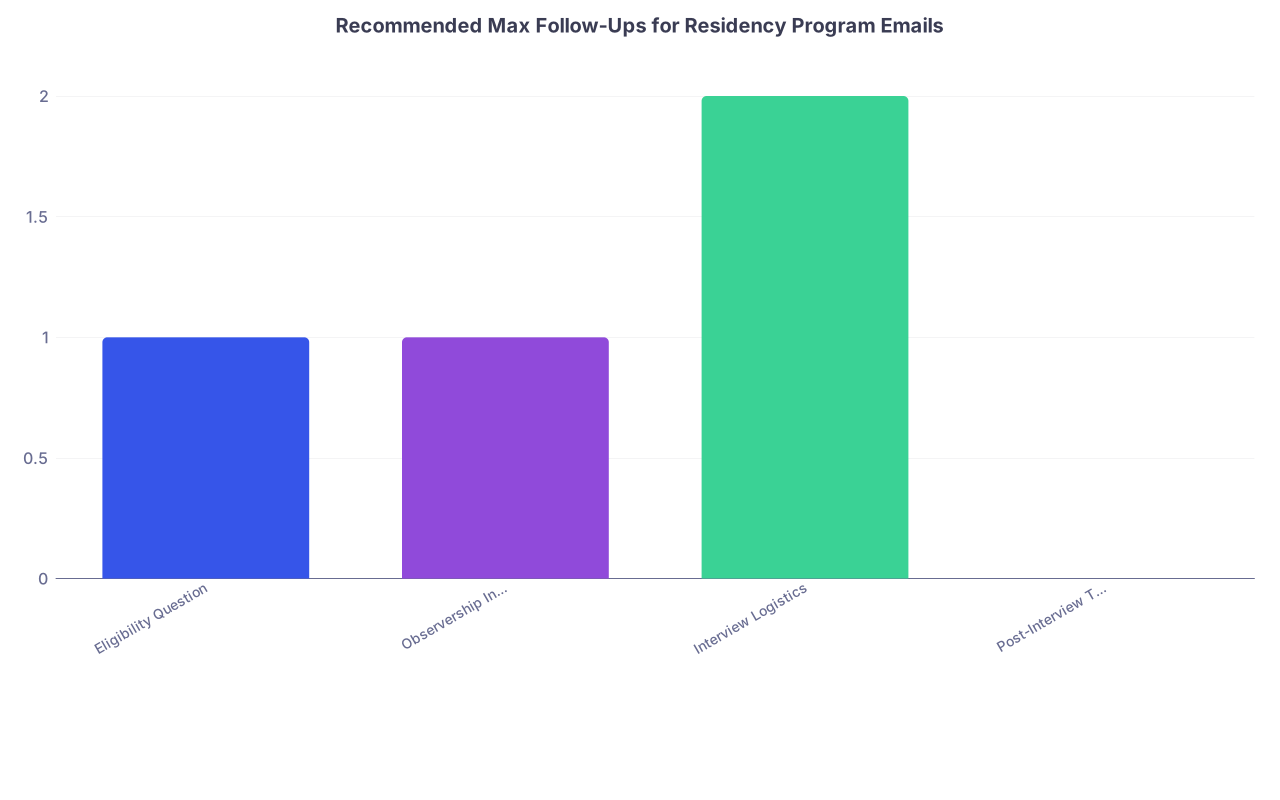
| Category | Value |
|---|---|
| Eligibility Question | 1 |
| Observership Inquiry | 1 |
| Interview Logistics | 2 |
| Post-Interview Thank You | 0 |
When to send
Eligibility / general question:
Early in the application season (September–October), before or shortly after applying.Updates (Step scores, visa change):
Once, when the change occurs. If it is after interviews, only if clearly impactful (e.g., now have Step 3).Observership / research inquiries:
Any time of year, but expect slower responses around Match season (Jan–Mar) and right during ERAS review spikes (Sept–Oct).
Follow‑up rules
One polite follow‑up after 10–14 days is acceptable.
Example:Dear [Title Last Name],
I wanted to follow up briefly on my email below regarding [topic], in case it did not reach you. I completely understand if you are busy and this is not possible; I would be grateful for any guidance whenever convenient.
Thank you again for your time.
Sincerely,
[Name]If there is no reply after 2 emails (original + follow‑up), stop.
Repeated follow‑ups will harm you.Do not send “read receipt” requests. PDs hate them.
During interview season
If you got an interview:
- Logistics questions → coordinator, not PD.
- One reschedule request is acceptable; multiple changes look flaky.
- For virtual interviews: confirm time zone yourself, do not offload basic planning to them.
If you did not get an interview:
- Do not beg for an interview via email after invitations have gone out.
Exception: If you have a strong and genuine connection (home rotation, mentor calling on your behalf), they might ask you to send a short “still very interested” email. That is different.
9. Post‑Interview Emails and Thank‑You Notes (The Overrated Ritual)
Most IMGs obsess over thank‑you emails. PDs and faculty… do not.

Reality:
- Some programs explicitly say: “No post‑interview communication required.” Obey that.
- Many PDs do not change rank lists based on thank‑you emails.
- Bad or over‑the‑top emails can actually backfire.
If you do send a thank‑you
- Send within 24–48 hours.
- Keep it to 4–6 sentences.
- Mention one specific detail from the conversation or program.
- No ranking promises like “You are my #1” unless you truly mean it and the program allows that communication.
Example:
Dear Dr. [Last Name],
Thank you for the opportunity to interview for your Internal Medicine residency program on [date]. I appreciated our discussion about caring for underserved populations in [city], and I was particularly impressed by your program’s emphasis on [specific feature].
I remain very interested in the possibility of training at [Program Name] and am grateful for your time and consideration.
Sincerely,
[Name]
Do not send:
- Mass‑template emails that mention wrong program names.
- Long emotional letters about destiny and lifelong dreams.
- Multiple follow‑ups about being “very, very interested.”
If a program explicitly says “no post‑interview emails,” take them seriously.
10. Common Scenarios and How to Handle Them
Let me walk through a few IMG‑specific situations that come up all the time.

Scenario 1: You improved your Step 2 CK score later
You applied early with a weaker Step 2 CK and have now improved on a retake (or got a strong Step 3).
Email to PD or coordinator:
Subject: Step 2 CK / Step 3 Score Update – ERAS AAMC #12345678
Dear [Title Last Name],
I hope you are doing well. I am an IMG applicant to your [Specialty] program (ERAS AAMC #12345678). Since submitting my ERAS application, I have received an updated USMLE score: Step 2 CK [new score] on [date] / Step 3 [score] on [date].
I understand that you receive many applications and may not be able to update each file individually, but I wanted to share this information in case it is helpful for your review process.
Thank you very much for your time and consideration.
Sincerely,
[Name]
You are not demanding re‑evaluation. You are providing data.
Scenario 2: You need to confirm visa sponsorship
Many IMGs send vague visa emails. Be exact.
Subject: Visa Eligibility Question – J‑1 for IMG Applicant
Dear [Ms./Mr./Dr. Last Name],
I am an IMG planning to apply to your [Specialty] residency program. I wanted to clarify your visa policies.
I am currently [citizenship/residency status explained briefly – e.g., ECFMG‑certified IMG, Indian citizen, currently on F‑1 status in the U.S.]. I am fully eligible for a J‑1 sponsored by ECFMG and would not require H‑1B sponsorship.
Does your program consider IMG applicants who require J‑1 sponsorship?
Thank you very much for your guidance.
Best regards,
[Name]
Clear. Answerable. Shows you did some homework.
Scenario 3: You rotated at the program and want to signal interest
If you had a genuine relationship (attending knows you, letters from there), you can send a brief “signal of interest” email.
Subject: Former Sub‑Intern – IMG Applicant to [Program Name]
Dear Dr. [Last Name],
I hope you are doing well. I had the privilege of completing a sub‑internship with your team in [month/year]. I am now applying to Internal Medicine this cycle and have applied to [Program Name].
My experience on your wards confirmed for me that your program’s focus on [specific aspect you actually saw] aligns very strongly with my goals. If selected for an interview, I would be highly interested in training at [Program Name].
Thank you again for the teaching and mentorship I received during my rotation.
Sincerely,
[Name]
AAMC ID: [########]
No need for score breakdowns unless they specifically ask later. The main point is the authentic connection and clear interest.
11. Mass Email vs Targeted Email: Do Not Be Lazy
You can tell in 2 seconds if an IMG copied and pasted the same email to 200 programs.
- Vague interest.
- No reference to specific program features.
- Generic wording that could apply to anywhere.
If you insist on emailing multiple programs, use a base template but customize:
- Program name, obviously.
- One line about something verifiable and specific (3+ hospitals, strong nephrology exposure, global health track, etc.).
- If you rotated there, mention names or experiences unique to that place.
You are not writing poetry. You are showing you know where you are writing.
12. Quick Reference: Do / Do Not Matrix
| Area | Do | Do Not |
|---|---|---|
| Purpose | Ask narrow, specific questions | Ask about "chances" or demand interviews |
| Length | 120–200 words, focused | 600+ word life stories |
| Tone | Neutral, respectful, non‑emotional | Desperate, flattery‑heavy, angry |
| Subject Line | Clear purpose + brief context | Vague titles like "Residency Application" |
| Attachments | Only when requested | Attach unsolicited CVs, PS, publications |
| Follow‑up | 1 follow‑up after 10–14 days | Multiple emails or daily nudges |
| Recipient | PD for big‑picture/eligibility, coordinator for logistics | CC entire department randomly |
Final Takeaways
Three points, and then you are done:
- Your email is often your first clinical writing sample. Programs judge you on clarity, brevity, and professionalism long before they ever meet you.
- Most IMGs fail by being vague, emotional, or pushy. Precise purpose, targeted subject lines, and one concise question already put you in the top tier.
- Email will not magically create interviews, but bad email can quietly kill opportunities. Send fewer messages, each one sharper, and you will stand out in exactly the right way.