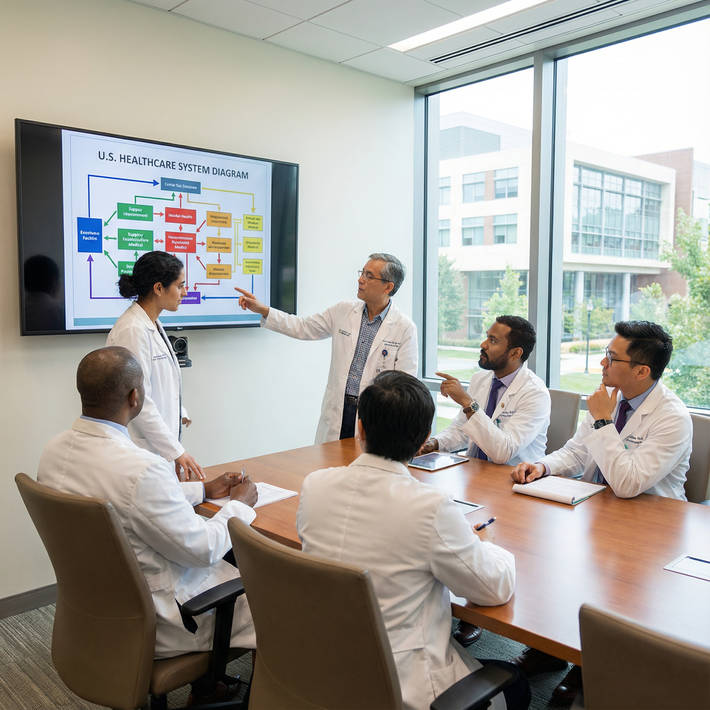
The way most IMGs collect USCE is backwards. They chase whatever observership or externship they can get, then later try to explain it in their application. That is the wrong order.
You design your USCE around your target match, not around what your uncle’s friend’s cousin can arrange.
Let me break this down specifically.
1. Start With the End: What Are You Building This USCE For?
Before we even touch observership vs externship, you need a sharp answer to three questions:
- Which specialty are you actually targeting, realistically?
- What tier of programs are within reach for you?
- What story do you want your application to tell about your U.S. clinical experience?
If you cannot answer those, you are not “designing a portfolio”; you are just collecting random certificates.
Specialty and program tier matter more than you think
A strong USCE plan for:
A 240+ Step 2, recent grad, targeting Internal Medicine university programs
is very different fromA 210 Step 2, 5+ years since graduation, targeting community FM/IM
And very different again from:
- A Pathology or Psychiatry applicant with a non‑traditional background.
Your USCE portfolio has to be specialty-aligned and signal-aware.
What I mean by “signal-aware”: You pick experiences that send clear, interpretable signals to program directors:
- “This person has functioned in a U.S. inpatient team.”
- “This person has seen high patient volume in American primary care.”
- “This person has worked under faculty who understand the NRMP game and will actually write a real LOR.”
You want PDs to look at your CV and think, “Yes, this makes sense for someone applying to my program.”
2. Observership vs Externship: Clear Definitions, No Marketing Nonsense
Most of the confusion comes from bad advertising language by agencies and private hospitals. So let’s strip it down.
Observership: Shadowing with a badge
Core features:
- You observe. You do not touch the EMR. You do not write notes. You do not enter orders.
- You may attend rounds, clinics, conferences.
- You might be allowed to present a patient verbally or give a short talk, but you remain a passive learner in terms of documentation and responsibility.
- Often not ACGME-affiliated; some are in private clinics; some are in big-name academic hospitals.
What observerships do well:
- Give you exposure to U.S. hospital/clinic culture.
- Help with communication and professionalism norms.
- Sometimes yield a faculty LOR if the attending actually engages with you.
What they do not do:
- Prove you can function as an intern on Day 1.
- Demonstrate EMR proficiency, billing understanding, or real workflow skills.
Externship (true externship): Functioning like a supervised junior resident/medical student
Genuine externships (not the fake ones):
- You see patients independently or semi-independently.
- You participate in H&P, progress notes, assessments, and plans.
- You may place orders in EMR (often pending co-sign).
- You present on rounds, get pimped, answer pages sometimes.
- Often run through:
- University-affiliated IMG programs
- GMEs that allow non-LCME/non-DO students as “visiting externs”
- Some structured private programs with real EMR access and documentation roles.
They are significantly more powerful in showing “ready-to-start” capability.
The dirty little secret: many “externships” are just glorified observerships
If you cannot:
- Log into the EMR
- Write at least draft notes
- Be formally evaluated on clinical participation
then you are not in a true externship, no matter what the flyer says.
3. How PDs Actually Read USCE on Your CV
Program directors are not reading your USCE the way you think. They do not care how “difficult” it was to obtain that Cleveland Clinic observership. They care about three things:
Setting
- Academic vs community
- Inpatient vs outpatient
- Specialty alignment
Role
- Passive observer vs active participant
- Documented responsibilities
Output
- Strong U.S. LORs from known faculty or at least from people who understand U.S. LOR expectations
- Evidence of performance (evals, comments, MSPE-like language)

How they interpret observerships vs externships
A pure observership at a big-name place (Mayo, Hopkins, Cleveland Clinic):
- Good for branding, shows exposure to high-level medicine.
- Weak on proving functional readiness.
- LOR impact highly variable. Many big centers have boilerplate, lukewarm letters for observers.
A hands-on externship in a decent but not famous community hospital:
- Strong demonstration of readiness.
- Often much better narrative LORs (“She wrote notes, took pages, presented 4–6 patients daily.”)
- Especially valuable for FM/IM/Peds/OB-GYN where day-1 function matters enormously.
Given that, the right move is obvious: stop obsessing over brand names. Obsess over role clarity and LOR strength.
4. Designing a Targeted USCE Portfolio: Stepwise Strategy
Now the actual design. I will split this roughly by applicant profile, then talk composition.
Step 1: Decide your USCE ratio — observership vs externship
You should consciously choose an approximate ratio, not just take what comes.
For most IMGs applying to core specialties (IM, FM, Peds, Psych):
- Ideal target: ≥ 2–3 months of true hands-on USCE (externship/sub-I/USMLE-friendly clerkship)
- Supplement: 1–2 months of observerships mainly for networking or brand name if accessible
For non-core or procedural specialties (Neuro, EM, GS, Anesth, etc.):
- Often harder to get legitimate externships.
- Realistic target: mixed model
- 1–2 months hands-on in IM/FM (to show intern readiness)
- 1–3 months observerships in the target specialty.
For pathology and purely diagnostic fields:
- Observerships are largely acceptable, but:
- You still want U.S. letters.
- You want enough time for faculty to actually know your work ethic and analytic ability.
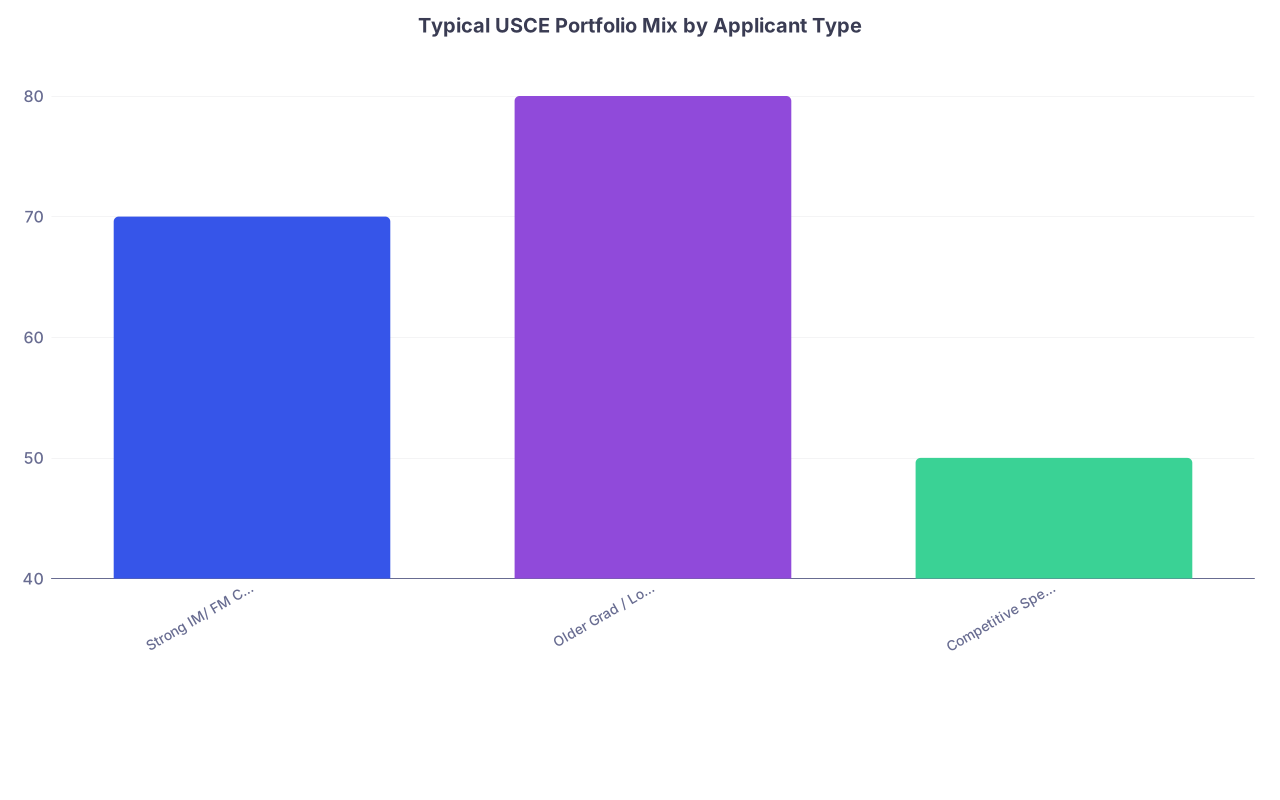
| Category | Value |
|---|---|
| Strong IM/ FM Candidate | 70 |
| Older Grad / Lower Scores | 80 |
| Competitive Specialty IMG | 50 |
(Think of the values as “percent of total USCE time that should be hands-on” — not exact numbers, but a useful mental anchor.)
Step 2: Map USCE to your application timeline
If you are in the Residency Match and Applications phase, timing is everything.
Basic rule:
Your most meaningful USCE should finish 2–6 months before ERAS submission so:
- LORs are fresh.
- You were performing at your best stage of preparation.
- Faculty remember specific details about you.
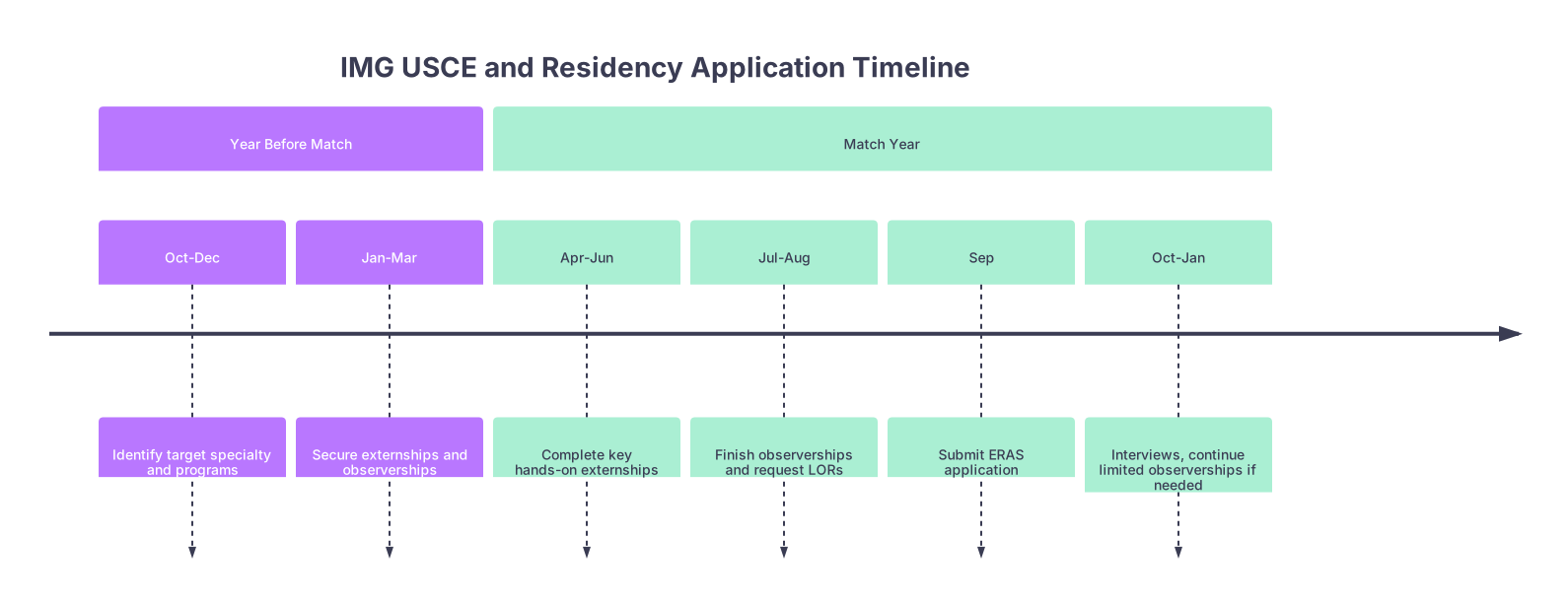
| Period | Event |
|---|---|
| Year Before Match - Oct-Dec | Identify target specialty and programs |
| Year Before Match - Jan-Mar | Secure externships and observerships |
| Match Year - Apr-Jun | Complete key hands-on externships |
| Match Year - Jul-Aug | Finish observerships and request LORs |
| Match Year - Sep | Submit ERAS application |
| Match Year - Oct-Jan | Interviews, continue limited observerships if needed |
Two pitfalls I see repeatedly:
Doing all the “good” USCE after ERAS is submitted.
Result: No LORs in time. Zero impact on your current match cycle.Doing early weak observerships, then running out of money or time before getting any hands-on experience.
Design backwards from your ERAS date, not forwards from your visa status.
Step 3: Choose settings that match your target
Here is how to prioritize:
ACGME-affiliated hospital in your target specialty
- Best if they have residency in that specialty.
- Even if they never interview you, the LOR speaks the same language PDs speak.
Community hospitals with residency programs in IM/FM/Peds/Psych
- Often more IMG-friendly.
- More hands-on opportunities.
- Attendings may actually spend time on your LOR.
Strong outpatient sites
- FM, Psych, some IM programs like to see continuity clinic exposure.
- But do not build your entire portfolio outpatient-only. Inpatient experience still matters for most.
5. Observership vs Externship: How Many Months and In What Order?
You want your portfolio to look intentional on paper.
For a typical IMG targeting Internal Medicine
A strong, targeted USCE portfolio might look like this on ERAS:
- 8–10 weeks: Hands-on externship in Internal Medicine at a community teaching hospital (inpatient heavy, some clinic).
- 4 weeks: Observership in Cardiology or Pulm at a major academic center.
- 4 weeks: Hands-on experience in outpatient primary care or continuity clinic.
Order that makes sense:
- Start with a shorter observership if you are totally new to the U.S. system. Use it to:
- Learn basic etiquette, legal restrictions, documentation style.
- Fix English and communication issues before hands-on.
- Then do the main externships in IM.
- Finish with brand-name observership if you can get one near ERAS time for a “fresh” big-name letter.
For Family Medicine
FM PDs care deeply about:
- Longitudinal patient interaction
- Breadth of pathology
- Community/underserved exposure
So:
- 8–12 weeks hands-on FM or IM/FM mix in community setting.
- 4 weeks outpatient FM, urgent care, or underserved clinic setting.
- Optional: 4 weeks big-name observership, but this is less critical than for IM.
For Psychiatry
Psych externships are harder but not impossible:
- 4–8 weeks: Hands-on IM or FM (shows you can handle medical issues on psych inpatients).
- 4–8 weeks: Observerships in inpatient or consult-liaison psychiatry.
- If you can get any partial hands-on role in psych (notes, assessments with attending), that is gold. Take it.
6. Evaluating Specific Offers: Is This Rotation Actually Worth It?
Before you pay anyone or commit your time, interrogate the rotation.
Here is the decision matrix I tell my own IMGs to use:
| Question | Red Flag Answer |
|---|---|
| Do I have EMR access and write notes? | “No, observers are not allowed.” |
| Will I be formally evaluated? | “We can give you a certificate of attendance.” |
| Will faculty know me well enough to comment on my clinical reasoning? | “You can rotate with multiple attendings for a few days each.” |
| Is there an ACGME residency at this site in my specialty? | “No, but we have a lot of students.” |
| Who signs my LOR? | “The program director may sign a generic letter for you.” |
A single “red flag” answer does not kill the opportunity, but several together should make you pause hard.
If you are paying thousands for a rotation where:
- You cannot write notes.
- You are rotated between 6 different attendings in 4 weeks.
- The LOR is a one-paragraph template.
then you are burning money, not building a portfolio.
7. How To Extract Maximum Value From Each Type of USCE
This is where many IMGs lose half the value of what they already have.
Make observerships work for you, not just sit on your CV
You are limited legally, but you are not helpless.
During an observership:
- Ask to present patients verbally on rounds.
“If acceptable, may I present Mr. X on tomorrow’s rounds after I read his chart tonight?” - Offer to prepare a short 5–7 minute teaching talk.
Make it crisp, with 2–3 key clinical takeaways. Faculty remember that. - Ask for specific feedback emails at the end.
This sometimes turns into much richer LOR content (“She actively sought feedback and improved her presentations over the rotation”).
And yes, directly express your residency goals to the attending. Too many of you hide your intentions and then expect a personalized letter.
Script it:
“Dr. Smith, I am applying to Internal Medicine this September. My goal for this rotation is to understand inpatient workflow here and show you that I can function at a PGY-1 level with proper supervision. I would appreciate any feedback on what I need to improve.”
Squeeze every ounce of evidence out of externships
If you are in a real externship and you still walk away with a generic letter, you have wasted a huge opportunity.
During a hands-on externship:
- Ask to be assigned a small census of patients that you follow daily.
- Request to write full notes (even if they are not billed) that the attending edits.
- Volunteer for “intern-level tasks” under supervision:
- Calling consults
- Following up labs
- Updating families with the team
- Seek mid-rotation feedback and adjust.
End of rotation, have a LOR meeting with your main supervising physician:
- Bring your updated CV.
- Bring a 1-page summary of:
- Number of patients you followed daily
- Types of cases
- Any mini QI or teaching projects
- Explicitly say:
- “If you feel you can write a strong and detailed letter, I would be honored to have you as a recommender for my ERAS application.”

8. Common Portfolio Mistakes That Hurt IMGs
I have seen these patterns so many times that I can almost predict which profiles will struggle.
Mistake 1: Five random observerships, zero hands-on
Your CV reads:
- 4 weeks Cardiology obs – private clinic
- 4 weeks Endocrine obs – solo practitioner
- 4 weeks Gastro obs – private endoscopy center
- 4 weeks Nephro obs – office only
- 4 weeks Internal Medicine obs – hospital-based
Looks busy. Does not impress PDs. They see:
- No real proof of intern-level functioning
- Fragmented exposure
- Likely generic letters, possibly all from non-academic or non-teaching physicians
Mistake 2: One incredible externship done too late
You nailed a 3-month IM externship at a strong community program… from November to January. ERAS went in September.
So in the cycle that matters:
- Your application shows minimal USCE.
- PDs cannot see your eventual performance.
- The excellent LOR arrives for the next cycle, which you might not reach if you never get interviews this time.
Mistake 3: Overestimating “brand name” observership value
That 4-week medicine observership at Harvard is not equivalent to a 4-week sub-I there. PDs know the difference. They work there.
Big brands help if:
- You also have hands-on somewhere.
- The letter is detailed and individualized.
Big brands do not rescue an otherwise empty, observation-only application.
9. Example Portfolios: Weak vs Strong
Let me show this in compact form.
| Portfolio | Description | PD Impression |
|---|---|---|
| Weak A | 3 x 4-week private clinic observerships (cardio, endocrine, GI), no residency programs, all outpatient | No proof of inpatient readiness, weak LORs, unclear commitment to IM vs subspecialty shadowing |
| Weak B | 1 x 4-week IM observership at big academic center, nothing else | Slight brand boost, but still minimal USCE, no functional skills demonstrated |
| Strong A | 8 weeks hands-on IM externship at community teaching hospital + 4 weeks FM clinic + 4 weeks IM observership at academic center | Clear IM focus, hands-on experience, decent mix of inpatient/outpatient, good LOR potential |
| Strong B | 12 weeks hands-on IM externships across two community teaching hospitals + 4 weeks Cardiology observership at university hospital | Very strong IM signal, intern-ready, subspecialty interest supported, LORs likely detailed |
You want to look like Strong A or B, with your own specialty flavor.
10. Final Integration: How To Talk About Your USCE in Personal Statements and Interviews
Designing the portfolio is half the job. The other half is how you frame it.
In your personal statement and interviews, your USCE should come across as:
- Deliberate: “I chose these rotations to progressively increase my responsibility and exposure to U.S. Internal Medicine settings.”
- Reflective: You can state specific insights you gained about U.S. healthcare differences.
- Actionable: You can connect your USCE directly to how you will function as a PGY‑1.
Example framing in an interview:
“My first rotation was an observership where I focused on learning communication norms and team structure. After that, I completed two hands-on externships at community teaching hospitals where I managed 4–6 patients per day, documented in the EMR, and presented on rounds. By the end of my last externship, I felt comfortable functioning at a supervised intern level, especially in managing common inpatient conditions like DKA, decompensated heart failure, and sepsis.”
That tells a story. PDs listen to stories, not just lists of months.
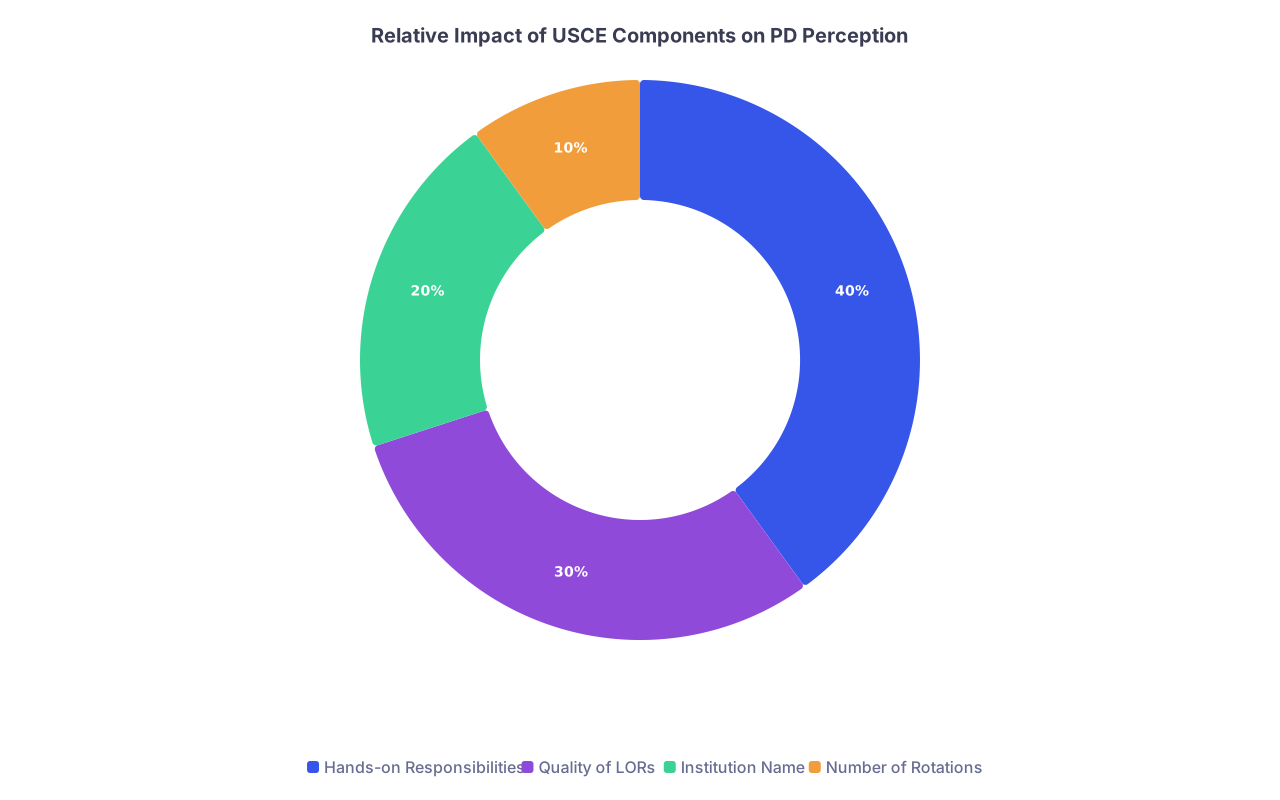
| Category | Value |
|---|---|
| Hands-on Responsibilities | 40 |
| Quality of LORs | 30 |
| Institution Name | 20 |
| Number of Rotations | 10 |
FAQ (Exactly 6 Questions)
1. If I can only afford 3 months in the U.S., should I prioritize externships or observerships?
Prioritize externships. One or two solid hands-on IM/FM externships beat four scattered observerships almost every time. If money is tight, aim for 8–12 weeks of true hands-on in an ACGME-affiliated hospital and skip expensive big-name observerships unless they are low cost or scholarship-based.
2. Does a university observership LOR outrank a community hospital externship LOR?
Not automatically. PDs care much more about specificity and evidence of performance. A detailed letter from a community IM PD describing your patient load, notes, and reliability can easily outweigh a one-paragraph “He was punctual and interested” from a famous academic name who barely interacted with you.
3. Can I build a competitive application with only outpatient USCE?
For FM or Psych, outpatient experience is helpful, but even there, only-outpatient is a handicap. For IM, Peds, and OB-GYN, lacking inpatient exposure is a red flag. If all you have is outpatient, you should actively seek at least one rotation that involves wards, ED, or hospital consults before applying.
4. How recent should my USCE be for it to still matter?
Within 1–2 years of applying is ideal. Older than 3 years starts to look stale, especially if you have a gap with no clinical work. If your only USCE is old, try to add at least one fresh rotation (even a short one) in the year you apply, so PDs know you are up to date with current practices and EMR use.
5. Do virtual observerships or tele-rotations help my application?
Very little. Most PDs give minimal weight to virtual rotations because they do not reflect real-world clinical workflow or team functioning. They might help you understand guidelines or case discussions, but as a CV line for residency selection, they are weak compared with in-person USCE.
6. How many total months of USCE are “enough” for most IMGs?
For core specialties (IM/FM/Peds/Psych), 3–6 months is a reasonable target, with at least half of that being hands-on if possible. More than 6–7 months usually gives diminishing returns unless you are also filling a gap year and generating strong LORs from multiple sites. Under 2 months of USCE puts you at a significant disadvantage compared with other IMGs in the current market.
Key takeaways:
Design your USCE from your target specialty and match timeline backward, not from whatever is easiest to arrange. Weight hands-on externships and strong, detailed LORs far above shiny brand-name observerships. And make every single rotation—observership or externship—produce concrete, demonstrable evidence that you can show up on July 1 and function as a safe, trainable intern.