
You are staring at the ERAS “Program Signaling” screen. You have 30 signals for Internal Medicine, 5 “gold” signals, and roughly 180 programs on your list. You are an IMG with solid but not spectacular stats, one U.S. rotation, and a finite budget. You know those signals matter, but you have no idea how to prioritize them or what to actually say in those “communication” fields and emails without sounding desperate or generic.
Let me break this down specifically—for IMGs, not for the average U.S. MD.
1. What Program Signaling Really Is (And How Programs Actually Use It)
Program signaling is not a love letter. It is a filter.
Programs are drowning in applications. For competitive and even middle‑of‑the‑road IM programs, it is normal to see 2,000+ applications for 20–30 spots. They must cut aggressively. Signaling gives them an excuse to look more closely at a small subset of applicants.
Here is how many program directors actually use signals (this is based on PD survey data plus what I have heard directly on Zoom “open houses” and in faculty meetings):
- A hard filter:
- “We will only seriously review applicants who signaled us, plus a few obvious standouts.”
- A tiebreaker:
- Two similar ERAS profiles. One signaled, one did not. The signaled one gets the interview.
- A “don’t auto-reject” flag:
- Your Step 2 is a bit lower, or you are an old graduate. Normally auto-screened out. But you signaled → someone physically opens your file.
For IMGs, this can be the difference between 3 interviews and 10.
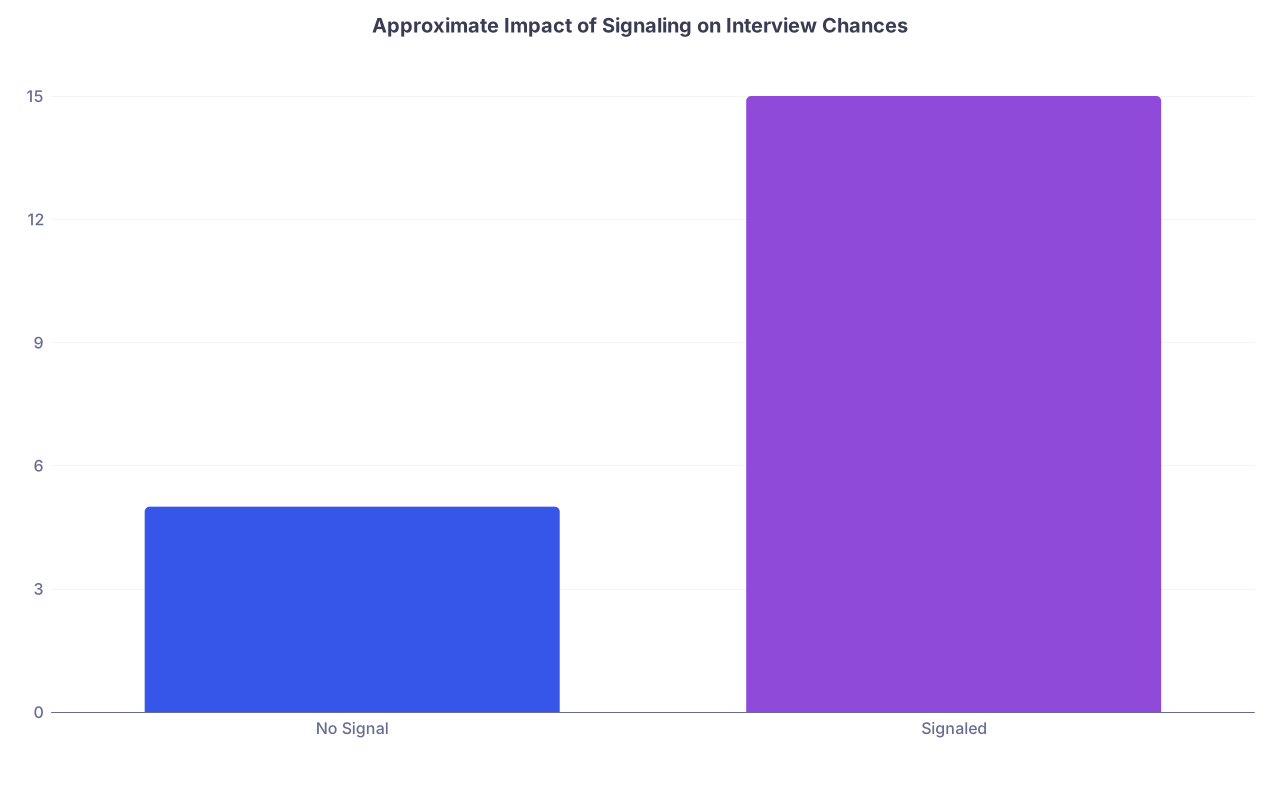
| Category | Value |
|---|---|
| No Signal | 5 |
| Signaled | 15 |
That chart is obviously illustrative, not exact, but the pattern is real: signals multiply your odds at selected programs. They do nothing for places you do not signal.
Key point: a signal is most powerful where you are on the borderline. At programs where you are clearly above or clearly below their usual bar, the effect is much smaller.
2. How Many Signals You Likely Have (And Why That Matters for IMGs)
Different specialties and cycles keep tweaking signal numbers, but the general pattern:
- “Gold” / “prioritized” signals: small number (usually 3–7)
- Regular signals: larger pool (20–30+ depending on specialty)
IMGs tend to make the same mistake: they spread signals too “aspirational.” Eight university programs that barely interview IMGs, a couple of community “maybe” programs, and almost nothing in the realistic safety range.
You have to think like this:
- Signals are not for fantasies.
- Signals are leverage. You place them where you are actually in play.
If you are an IMG applying Internal Medicine, and you have, for example:
- Step 1: Pass
- Step 2 CK: 232
- YOG: 2020
- 1–2 U.S. letters, some home-country research
You are not going to convert a “never‑takes‑IMGs” top 10 university into an interview because of one signal. Not happening. You might, however, win a spot at a mid‑tier university that commonly takes a few IMGs and cares about signals.
3. Building Your Signaling Tiers: A Concrete Framework
Let us construct an actual tier system. This is where most IMGs go wrong—they do this vaguely. You cannot afford vague.
Step 1: Build a Data Table on Your Programs
You need something like this (actual Excel/Sheets, not in your head):
| Program Name | IMG Friendly | Avg CK Range | Past IMGs | Location Priority |
|---|---|---|---|---|
| Univ A (Northeast) | 2 | 240+ | Few | 3 |
| Comm B (NYC) | 4 | 225–235 | Many | 1 |
| Univ C (Midwest) | 3 | 230–240 | Several | 2 |
| Comm D (Suburban) | 5 | 220–230 | Many | 2 |
| Univ E (Top 20) | 1 | 250+ | Rare | 3 |
- “IMG Friendly” maybe 1–5 (1 = basically never, 5 = heavily IMG)
- “Location Priority” is your personal desire (1 = top, 3 = low)
This does not need to be perfect, but you need a feel.
Step 2: Create Three Tiers
Forget the nonsense of “reach/target/safety” written in generic blogs. For IMGs, you need:
Tier 1 – Aspirational but realistic
- Programs that have:
- At least some current IMGs
- Step/CK ranges within roughly 5–10 points of yours
- Maybe a university program that is not top 10–15
- Goal: a few signals here, especially gold, for your top geographic or academic preferences.
- Programs that have:
Tier 2 – Strongly realistic
- Programs that:
- Regularly match IMGs
- Have profiles very similar to yours
- Are in locations you can live with, not necessarily love
- This should be the bulk of your signals.
- Programs that:
Tier 3 – Backup but still acceptable
- More IMG-heavy, lower average CK, or less desired locations
- You still would go if matched, but they are not top of your list.
Reasonable allocation example for 5 gold + 25 regular signals (Internal Medicine):
- Gold signals:
- 3 to Tier 1
- 2 to very high-priority Tier 2 (e.g., your spouse’s location, visa-friendly)
- Regular signals:
- 5–7 remaining Tier 1
- 12–15 Tier 2
- 3–5 Tier 3
Do not waste more than maybe 1–2 signals on extreme long-shots (e.g., programs with zero IMGs in last 3 years and strong U.S. MD bias).
4. How To Identify IMG-Friendly vs Fantasy Programs
This part separates the serious IMG applicant from the wishful thinker.
You should check:
Current resident list on website
- Count how many IMGs. Look at countries.
- If classes are 90–100% U.S. MD/DO every year, your signal is probably wasted.
NRMP/Program Director presentations or open houses
- Many PDs now say directly: “We are IMG-friendly” or “We rarely interview IMGs.”
- Write this down. Do not assume “they might change.”
FREIDA and match lists
- Look back a few years. Are there graduates from abroad? Are they all from one specific foreign school (often a partner school)?
Your specific profile match
- ECFMG certification date
- Gap years
- Step failures or attempts
- Visa situation (J‑1 vs H‑1B vs green card)
If you need an H‑1B and the program historically only does J‑1 or does not sponsor at all, your signal’s value drops sharply. You can still apply if you absolutely love the place, but do not burn a gold signal there.
5. Prioritization Strategy by IMG Profile Type
Different IMG types should signal differently. One size does not fit all.
A. Recent Grad, Strong Scores, Some U.S. Experience
Example:
- YOG 2023
- Step 2 CK 245
- 2–3 U.S. letters from IM rotations
- No major red flags
You are relatively competitive as an IMG.
Your signals:
- Aggressively target mid-tier university and strong community‑university affiliated programs that show tangible IMG presence.
- Gold: often university programs in regions you care about (NY/NJ, Midwest academic centers, Texas if visa OK).
- Regular: mix of more universities plus high-quality community programs.
Pitfall:
- Do not spend all gold signals on “name brands” that basically do not interview IMGs. Aim half‑step below your fantasy list.
B. Older Grad, Moderate Scores, Limited U.S. Experience
Example:
- YOG 2016
- Step 2 CK 225
- 1 U.S. LOR, mostly home-country practice
You must treat signals like survival tools.
Your signals:
- Heavy emphasis on known IMG pipelines: community programs in less saturated locations (Midwest, South, some rural).
- If you absolutely must stay in NY/NJ, still allocate, but realize the competition is brutal. Target specific IM-heavy borough/community programs, not just “big name” Bronx/Manhattan sites.
- Only 1–2 gold signals to university programs, and only if their resident roster clearly shows older grads or multiple IMGs.
Pitfall:
- Spreading signals too thinly across big cities just because of location preferences, then ending with 0 interviews.
C. Strong Research, Average Scores, Aiming for More Academic Programs
Example:
- CK 235
- Multiple publications, maybe U.S. research experience
- 1–2 strong academic LORs
You should play the hybrid game.
Your signals:
- Gold: research-heavy university programs with clear IMG representation, especially where your PI has contacts.
- Regular: similar but slightly less competitive academic or community-university hybrids.
- Still keep 5–8 clear IMG-heavy community “insurance” programs in your signal pool.
Pitfall:
- Overindexing on “research reputation” and underestimating how much U.S. MD bias still rules the process.
6. What Signaling Does NOT Replace
Do not confuse signaling with:
- Personalized emails
- Rotations or observerships
- Faculty advocacy
- Visa viability
Programs still heavily care about:
- USMLE performance
- YOG and gaps
- U.S. clinical experience
- How your letters read
Signaling gets eyeballs. Your application still has to be competitive once they open it.
7. Wording Inside ERAS: Short Fields, Big Signal
Depending on the specialty and cycle, some programs see only the signal icon; others see a brief answer if they asked for “Why us?” in supplemental questions.
You need a tight template. No fluff.
Anatomy of a Strong 2–4 Sentence “Why This Program” (For IMGs)
Formula:
- One concrete program feature (not generic).
- One alignment with your background or goals.
- Optional: geographic/personal rationale if relevant.
- End with a forward-looking sentence.
Example 1 – University program, research-inclined IMG:
I am particularly drawn to your program’s structured research track and the dedicated scholarly time in PGY‑2, which aligns with my prior work in outcomes research on heart failure readmissions. The diverse patient population you serve and your fellows’ strong match into cardiology fit my long-term goal of an academic IM career. Having family in Ohio, I am committed to building a long‑term career in this region.
Example 2 – Community program, older grad, strong primary care interest:
Your program’s emphasis on continuity clinic and the robust outpatient curriculum match my experience providing longitudinal care in a resource-limited setting. I appreciate that your graduates consistently pursue primary care positions in similar communities, which aligns with my plan to practice as a general internist. The supportive environment described by recent residents at your virtual open house resonated strongly with me.
What you must avoid:
- Copy‑paste garbage like “Your excellent training, diverse pathology, and strong teaching environment are very impressive.”
- Obvious generic lines (“I am excited for the opportunity to train at your esteemed institution.”).
If it could apply to 100 programs, it is useless.
8. Emailing Programs About Signals: When It Helps, When It Hurts
Not every program wants emails. Some explicitly say: “We do not consider interest emails.” Respect that.
But there are scenarios where a short, clean email from an IMG does help, especially for borderline or smaller programs.
When it can help:
- You did an observership or rotation there (or at their affiliated hospital).
- You have a real tie: spouse working in that city, visa situation already arranged there, prior research with their faculty.
- They are a small community program that values strong interest and might not even realize you exist in the ERAS pool.
When it is likely useless or annoying:
- Big, famous university programs drowning in 5,000 emails.
- Generic “I am very interested” notes sent clearly as mass‑mail.
Email Template (Adapted for IMGs)
Subject line matters. Something like:
- “IMG Applicant – Strong Interest in [Program Name] (ERAS AAMC# XXXXXX)”
- “Observership at [Hospital Name] – Residency Application [Your Name]”
Body:
Dear Dr. [Program Director Last Name],
My name is [Full Name], an IMG from [Medical School, Country], applying to Internal Medicine this cycle (ERAS AAMC# XXXXXX). I have signaled your program through ERAS because [1–2 very specific reasons: e.g., your strong nephrology exposure and history of supporting J‑1 visa holders].
I completed [brief, concrete tie: e.g., an observership at your institution in May 2024 with Dr. X in the inpatient service], which confirmed my interest in your program’s teaching culture and patient population.
I would be truly grateful if my application could be reviewed for interview consideration.
Sincerely,
[Name], MD
[ECFMG ID]
[Optional: Phone / Email]
Short. Direct. No begging. No three-paragraph biography.
If you are going to reference your signal, make it clear you did: it reinforces intent.
9. Avoiding the Most Common IMG Signaling Errors
I see the same mistakes every year.
Error 1: “All My Gold Signals on Top‑Name Places”
You allocate all 5 gold signals to:
- Mass General
- Hopkins
- UCSF
- Mayo
- Penn
You are an IMG with 228 Step 2, 2018 graduate, no U.S. rotation.
You just set those gold signals on fire. Those programs are not going to rescue your application because of a gold star. They barely interview IMGs with phenomenal metrics.
A smarter version:
- Maybe 1 true reach if you have a tie (research there, PI connection).
- The rest to realistic academic and strong community programs where IMGs are common.
Error 2: Overweighting Location, Underweighting Reality
Yes, everyone wants New York, California, Florida. Programs there are saturated with thousands of applications, including many U.S. grads.
If you are an average‑profile IMG, putting 15 of your 30 signals into NYC and none into Midwest/South programs that love IMGs is a strategic mistake.
Put bluntly: if you truly need to match, you sacrifice some geography fantasy for probability.
Error 3: Duplicating the Same Boring “Why Us” Text
PDs can smell copy‑paste from a mile away.
If multiple programs have the exact same 3 lines (“diverse pathology,” “strong teaching,” “friendly environment”), you just told them you did not bother to learn anything about them.
You do not need a fully unique essay for 100+ programs. For the ones you signal, yes. Custom MINI‑paragraphs.
Error 4: Ignoring Visa Reality in Your Prioritization
I see this constantly: applicants needing an H‑1B dumping signals on programs that only sponsor J‑1 or nothing at all.
Check:
- Program website
- FREIDA
- Open house Q&A
If it is unclear, assume J‑1 only or no H‑1B. H‑1B‑friendly programs are a smaller subset. Many are community or community/university hybrids. That is where your signals must go.
10. Timing and Coordination With Other Interest Signals
Signaling usually happens with your ERAS submission or via the supplemental application. But interest is not a one‑time event.
Here is how you coordinate:
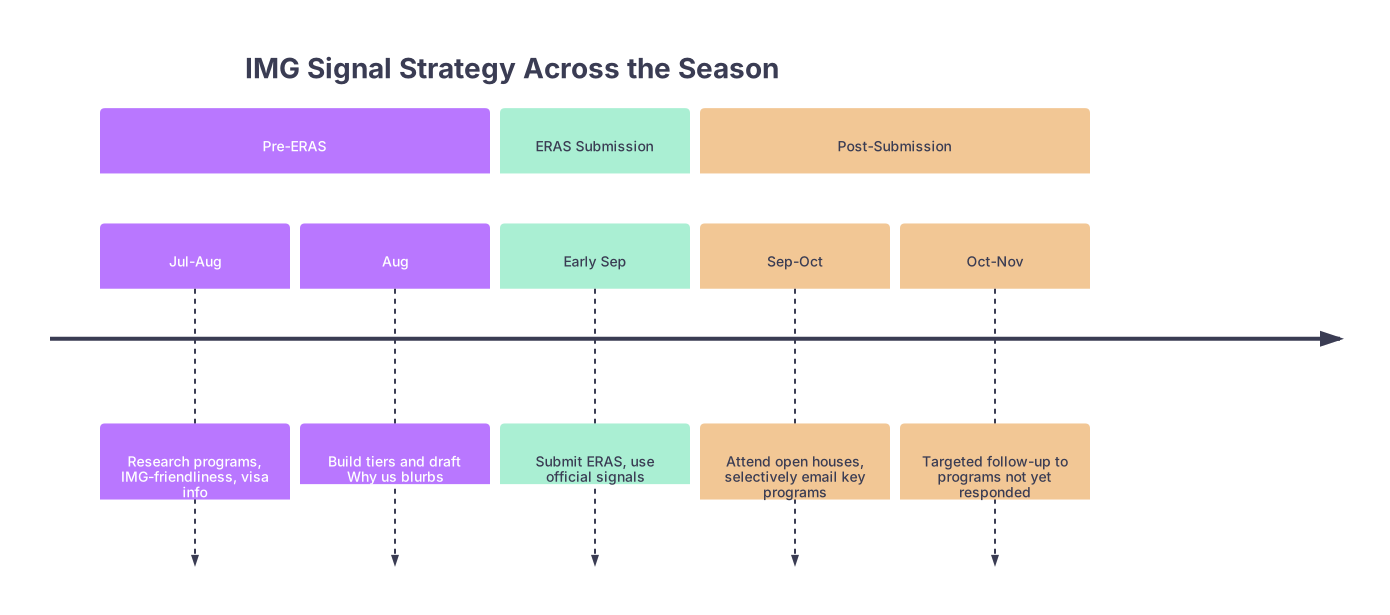
| Period | Event |
|---|---|
| Pre-ERAS - Jul-Aug | Research programs, IMG-friendliness, visa info |
| Pre-ERAS - Aug | Build tiers and draft Why us blurbs |
| ERAS Submission - Early Sep | Submit ERAS, use official signals |
| Post-Submission - Sep-Oct | Attend open houses, selectively email key programs |
| Post-Submission - Oct-Nov | Targeted follow-up to programs not yet responded |
Pre‑ERAS:
- You already know your signal targets.
- You have one or two lines on “why this program” pre‑written for each.
Week of submission:
- Submit ERAS + supplemental with signals.
- No need to spam emails on day 1. Your signal flag is already there.
2–4 weeks after submission:
- If some smaller or mid‑tier programs you signaled have not auto‑rejected or responded, one brief email (like the template above) can be helpful.
- Use this especially where you have a tie or they repeatedly say they value interest.
After interview invites start:
- Do not panic‑email every place you have not heard from yet. Desperation reads poorly.
- A single, well-timed “continued interest” email at mid-season is fine for a few truly top‑priority places. Keep it short.
11. Example Signal Allocation Maps for Different IMG Scenarios
Let me spell out two concrete maps.
Scenario 1: IMG, CK 244, YOG 2022, 3 months U.S. IM rotations, needs J‑1 only
Goal: Mix of academic and strong community, open to most of U.S., mild preference Northeast/Midwest.
You have: 5 gold, 25 regular.
Gold:
- 2 mid‑tier university programs with clear IMG presence in Northeast.
- 2 university-affiliated community programs in Midwest with strong fellowship outcomes and IMGs visible.
- 1 community program where you rotated and have a letter.
Regular:
- 5 more university programs (not top 20, but solid teaching hospitals) in Northeast/Midwest that match IMGs.
- 10 university-affiliated community programs in Midwest/South with IMG‑heavy rosters.
- 5 IMG-heavy community programs in less popular locations (Rust Belt, non‑coastal cities).
- 5 stretch programs that are a bit more competitive, but still show some IMGs and J‑1 acceptance.
Notice: No gold signals wasted on extreme long‑shot top-5 “name brands.”
Scenario 2: IMG, CK 227, YOG 2015, continuous home-country practice, 1 U.S. observership, needs any visa
You have: 5 gold, 25 regular.
Real talk: your match probability lives or dies by IMG-friendly community programs, especially away from the most saturated coasts.
Gold:
- 3 IMG-heavy community programs (Midwest / South) with documented H‑1B or J‑1 sponsorship and older-grad acceptance.
- 1 program where you did observership.
- 1 community program in your spouse’s or close family’s city that takes IMGs and older grads.
Regular:
- 12–15 more IMG-heavy community programs in Midwest/South, maybe some in less central East Coast states.
- 3–5 in your preferred state/region if you absolutely must try (e.g., NY/NJ), but only if they have consistent older grads/IMGs on the roster.
- A small number (3–5) of slightly more competitive community or hybrid programs as stretch options.
This is not glamorous, but it is realistic. That is how you signal if your priority is “match somewhere” rather than “only if it is in Manhattan.”
12. Small but Critical Wording Details IMGs Miss
A few language mistakes show up over and over:
Over‑apologizing:
- “Despite my low scores…” or “Although I am an older graduate…”
- Do not lead with weakness. Ever. Acknowledge if needed in PS, but not in a brief “interest” statement.
Overusing “I am passionate about…”
- Everyone is “passionate.” Replace with concrete behaviour:
- “I have spent the last three years working in a high-volume outpatient clinic serving underserved populations.”
- “I completed a year of full-time research in heart failure management, resulting in two first-authored manuscripts.”
- Everyone is “passionate.” Replace with concrete behaviour:
Over-explaining why you are an IMG:
- “Coming from a resource-limited setting, I have…” is fine once.
- Repeating a long narrative in every “why us” answer is not.
Sounding like a template written for U.S. MDs:
- Do not pretend you rotated at 5 U.S. academic centers if you did 1 observership.
- Instead, lean into what you actually bring: resilience, prior independent practice, research, bilingual skills, etc.
13. Visualizing Your Signal Mix
If you like numbers, visualize your distribution. Something like this is what a balanced IMG plan might look like:
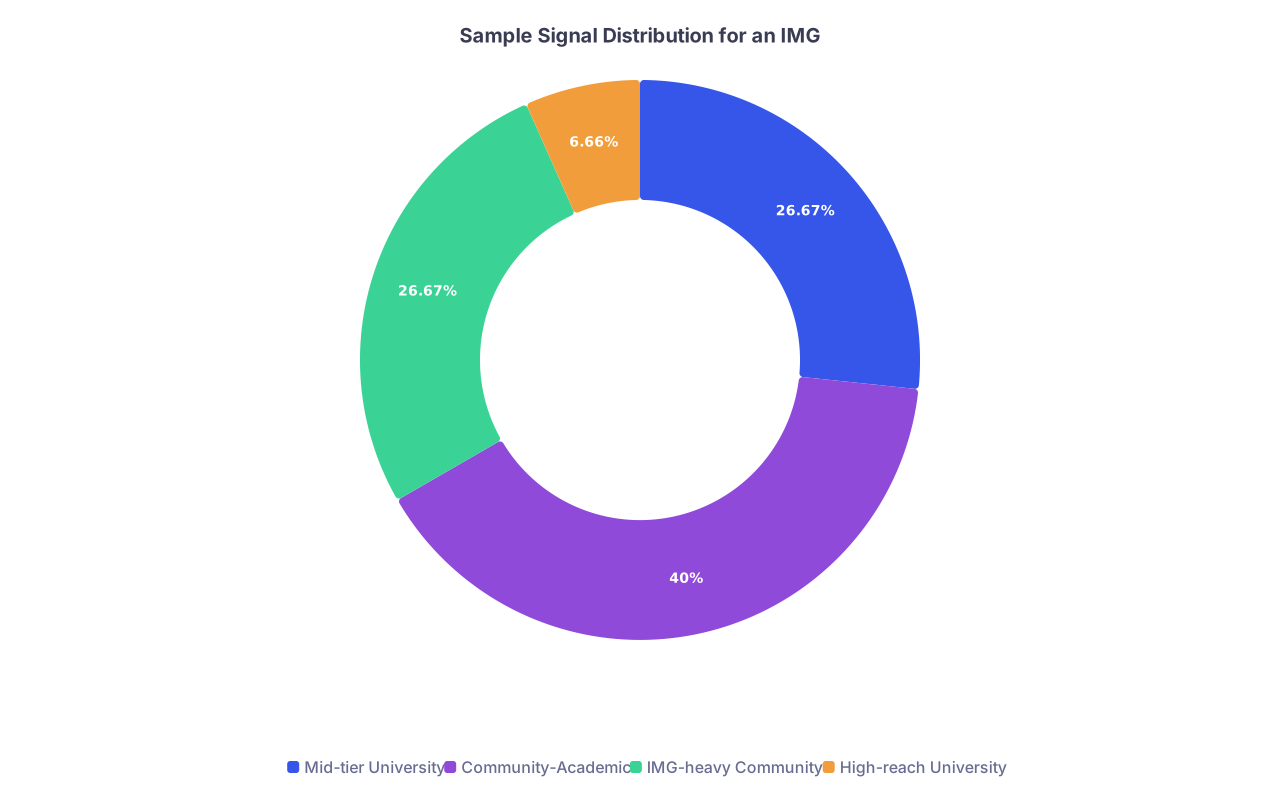
| Category | Value |
|---|---|
| Mid-tier University | 8 |
| Community-Academic | 12 |
| IMG-heavy Community | 8 |
| High-reach University | 2 |
- “High-reach University” should be the smallest slice.
- “IMG-heavy Community” and “Community-Academic” should dominate for most IMGs, with “Mid-tier University” for those with stronger metrics or research.
14. Final Checkpoints Before You Hit Submit
Run through this checklist the night before you lock your signals:

For each program you signaled:
- Can you name one concrete thing about them without looking it up?
- Do they clearly take IMGs in recent years?
- Does their visa policy match what you need?
For each gold signal:
- If you matched there, would you be genuinely happy?
- Are they “stretch but possible,” not “pure fantasy”?
For your short “why us” blurbs:
- Are at least 1–2 sentences truly specific to that program?
- Did you avoid copy‑pasting the exact same paragraph to 10 places?
If you cannot answer yes to those for a specific program, you probably should not be signaling it.
15. One More Thing: Coordination With Your Overall Application Strategy
Program signaling is a tool. It has to fit into a larger structure:

| Step | Description |
|---|---|
| Step 1 | Self-Assessment Scores, YOG, Visa |
| Step 2 | Program List IMG & Visa Filter |
| Step 3 | Signal Tiers T1/T2/T3 |
| Step 4 | ERAS & Supplemental Signals Submitted |
| Step 5 | Targeted Emails Key Programs Only |
| Step 6 | Interview Season Follow-up, Thank-you |
Your signals reflect your self‑assessment. If you lie to yourself about your competitiveness, your signals will be misallocated.
16. Brief Word on Rank List vs Signals
Some IMGs think: “If I signal a program, I must rank it higher later.” No. Signaling expresses interest at the application stage. It does not create any ethical obligation in the Match.
Rank however you genuinely prefer based on your interview impressions and priorities. Programs do not see your rank list. They might remember you signaled, but by that stage it is about how you performed in the interview and how you fit the team.
17. Two Examples of “Good vs Bad” Wording Side by Side
Let us be concrete.
| Type | Example |
|---|---|
| Weak | "I am excited to apply to your esteemed program with strong teaching." |
| Strong | "Your dedicated ultrasound curriculum and large immigrant patient base align with my prior work in resource-limited settings and my goal to practice hospital medicine in diverse communities." |
Another one:
Weak:
I am passionate about Internal Medicine and believe your program will help me become a competent physician.
Strong:
Your program’s focus on continuity clinic and community partnerships matches my five years of outpatient practice in [country], where I managed complex chronic diseases with limited resources. I am eager to bring that experience to your patient population and continue developing as a general internist.
The strong versions are specific, grounded, and do not sound like every other applicant.
18. Final Takeaways
Let me keep this tight.
Signals are leverage, not magic. They work best where you are already borderline competitive, not where you are completely out of range. As an IMG, you cannot afford to waste them on programs that never take IMGs or cannot sponsor your visa.
Prioritize with ruthless honesty. Build tiers based on actual IMG-friendliness, your scores, YOG, and visa needs. Then stack most of your signals into mid‑tier universities and IMG‑heavy community or community‑academic programs, not just coastal name brands.
Make every word of interest specific. For signaled programs, your “why us” language and any emails must reference concrete program features and your own track record. Generic enthusiasm is background noise. Specific alignment is what gets you pulled from the pile.
If you get those three pieces right—targeting, tiers, and wording—you are already playing a very different game than most IMGs in your cohort.