How IMGs Should Decode and Use NRMP Program Director Survey Data
It is late June. You just found the NRMP Program Director Survey PDF that everyone on forums keeps talking about. You download it, scroll through 80+ pages of graphs, tables, and percentages, and your first thought is: “What am I actually supposed to do with this as an IMG?”
You are not wrong to feel lost. Most applicants either misuse this document or never really use it at all. IMGs, in particular, tend to quote random statistics out of context (“83% of PDs say X is important”) and then keep applying the same way they were going to anyway.
Let me break this down specifically: the PD Survey is not a trivia document. It is a targeting and strategy weapon. If you know how to read it properly—especially through an IMG lens—you can:
- Build a smarter program list
- Decide what to fix this year vs what is sunk cost
- Rewrite your CV, PS, and email outreach around what PDs literally say they care about
We will walk through that in a structured, ruthless way.
First: What the PD Survey Actually Is (and What It Is Not)
The NRMP Program Director Survey is a national survey sent to residency PDs across specialties, usually every 2 years. The key things for you:
It tells you what percentage of PDs in a given specialty use each factor (USMLE, letters, visa status, etc.) to:
- Decide whether to offer interviews
- Rank applicants on the rank list
It also shows:
- How many programs screen with score cutoffs
- Median and mean “minimum” Step scores used for screening
- How many interviews get offered per position
- How many interview invites go to IMGs
But:
- It does not tell you individual program behavior. Averages hide extremes.
- It does not override reality at the program level—state schools, community vs university, visa quirks.
- It is historical, not prophecy. But trends are relatively stable across cycles.
Your job as an IMG is to mine this survey like a data set, not like inspirational quotes.
Step 1: Identify the 3–5 Pages That Actually Matter to You as an IMG
Stop trying to read the whole survey cover to cover. Start with a target specialty (or two) and find its section. For example:
- Internal Medicine
- Family Medicine
- Pediatrics
- Psychiatry
- General Surgery
- Neurology
- Pathology
- etc.
Within each specialty section, the same core pages repeat. For IMGs, the critical ones are:
- “Factors in Selecting Applicants to Interview”
- “Factors in Ranking Applicants”
- “USMLE/COMLEX Score Cutoffs”
- “Interview Numbers” (invites per position, etc.)
- Sometimes: “Percent of Programs Considering IMG Status / Visa” (varies by year)
If you only learned to read those correctly, your Match strategy would already improve.
Step 2: Decode “Factors for Interview” – What Gets You In the Door
This is usually a table with columns like:
- % of programs using factor
- Mean importance rating (1–5)
Common factors you’ll see:
- USMLE Step 1 score (or “Pass/Fail but used”)
- USMLE Step 2 CK score
- MSPE / Dean’s Letter
- Personal Statement
- Letters of Recommendation in Specialty
- Class Rank / Quartile
- Failed USMLE attempt
- Visa Status / US vs non-US graduate
- Previous US clinical experience
How to Read This as an IMG
You must read this table with your own profile in mind.
Example: You are an IMG aiming for Internal Medicine with:
- Step 1: Pass
- Step 2 CK: 229
- 1 attempt failure on Step 1
- 2 months US observerships, no hands-on elective
- No research, average med school
- Needs J-1 visa
Look at the IM section of the survey. You will often see (numbers approximated, they vary by year, but pattern is consistent):
- 70–90% of IM PDs: “Use Step 2 CK score to decide interview offers”
- 40–60%: “Use failed USMLE attempt as a factor”
- High percentage: “U.S. clinical experience in the specialty”
- Significant percentage: “IMG vs US grad status” and/or “Visa requirement”
The key is to map your weak spots against high-usage, high-importance factors.
If:
- Step 2 CK is heavily used and highly rated in importance → your 229 is a liability for university programs, maybe acceptable for some community ones.
- Failed attempt is flagged by >50% of PDs → your application is going to face an extra filter.
- U.S. clinical experience in specialty is important → your observerships are better than nothing but weaker than hands-on electives.
- Visa requirement is used by many programs → you must ruthlessly filter out “no visa” programs.
So, the “Factors in Selecting to Interview” page is not just academic. It tells you where you are swimming against the current.
Step 3: Decode “Score Cutoffs” – Stop Guessing
Most specialties have a chart like:
- % of programs that use a Step 2 CK minimum score to screen
- Distribution of minimum scores (e.g., 210–219, 220–229, etc.)
- Mean / median cutoff used
Let us put rough example numbers in a structure you can visualize.
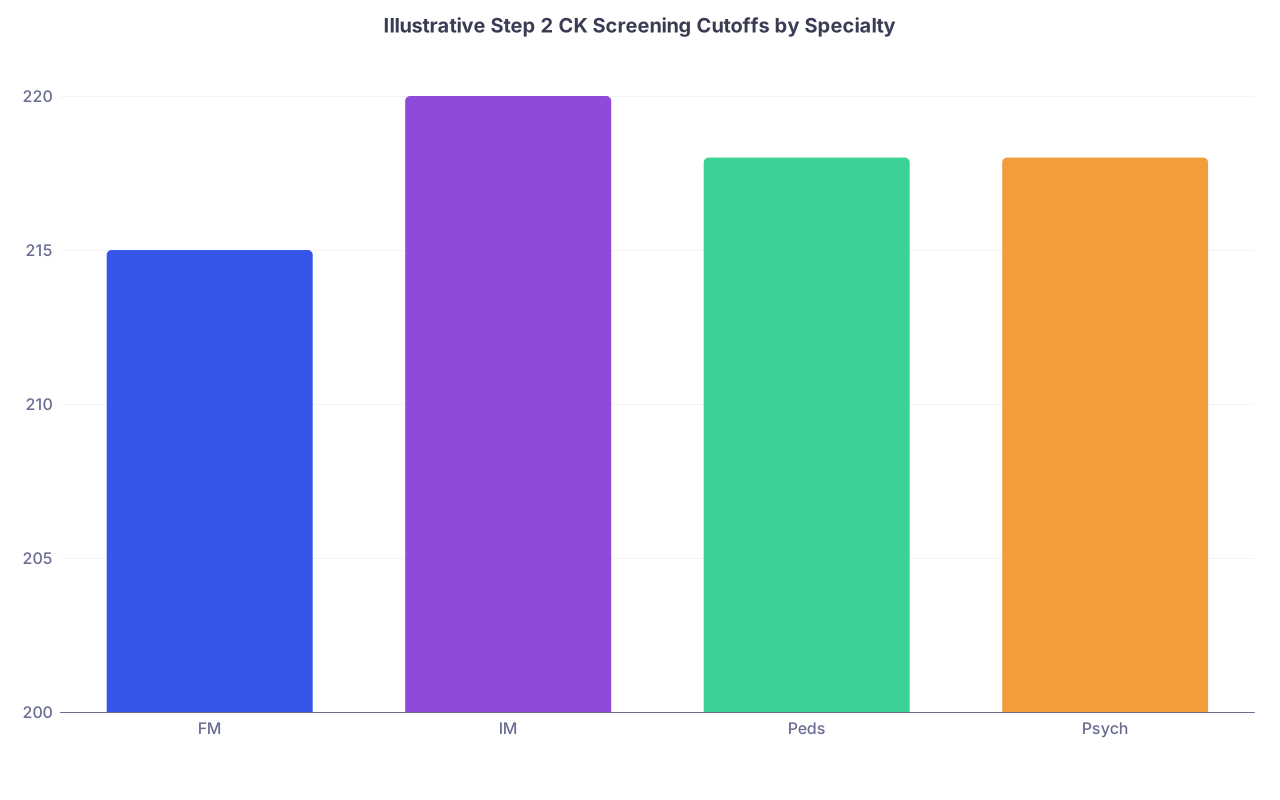
| Category | Value |
|---|---|
| FM | 215 |
| IM | 220 |
| Peds | 218 |
| Psych | 218 |
Those would be mean cutoffs, just as a working example. Actual numbers differ by year, but the relationship is similar.
What You Should Actually Do With This
If your Step 2 CK is 229 and the median cutoff in IM is around 220:
- You are above the median cutoff. But not by much.
- Programs with 230–240 cutoffs will auto-screen you out.
- Community-heavy programs and those that take more IMGs often sit at or slightly below the median.
So you:
- Do not waste 60 applications on top 30 university IM programs with historically high scores and few IMGs.
- Do push volume toward:
- Community programs
- Programs with a clear history of IMGs
- States known for more IMG-friendly internal medicine spots (NY, NJ, MI, FL, etc.)
The mistake I see often: an IMG with mid-220s Step 2 CK “applies broadly” including a ton of MGH/Mayo/UCSF-tier programs because “you never know.” You do know. The PD Survey is telling you.
Step 4: Screening vs Ranking – Two Different Battles
Another nuance the Survey spells out clearly: factors used to select for interview are not identical to factors used to rank after the interview.
Typical pattern across many specialties:
Screening (pre-interview):
- Step 2 CK / Step 1 (pass/fail interpretation)
- Failed attempts
- Visa / IMG status
- US clinical experience
- Specialty LORs
Ranking (post-interview):
- Interview performance
- Perceived “fit” with program culture
- Professionalism / interaction with staff
- LOR content
- Commitment to the specialty
As an IMG, you cannot “interview well” your way out of an auto-reject screen. But once you clear that screen, your foreign school name matters dramatically less.
So strategy:
- Use the PD Survey “Factors in Selecting to Interview” to build your application list and documentation (scores, USCE, LORs).
- Use “Factors in Ranking” to shape your interview behavior, PS themes, thank-you emails, and how you present your story on interview day.
You are fighting two different wars. Do not confuse them.
Step 5: IMG-Specific Filters Hidden Between the Lines
The PD Survey often has some data that is not labeled “IMG” but absolutely affects you disproportionately.
1. Failed USMLE Attempts
Many PDs rate “any failed attempt” as a strong negative in deciding who to interview. For IMGs, that penalty is harsher.
If the survey says, for example, 60–70% of programs consider a failed attempt:
- Assume this hits IMGs harder than US grads.
- You must multiply your application volume.
- And push extremely heavily toward IMG-heavy and community programs where PDs have explicitly stated on their websites: “We consider applicants with previous attempts.”
If you have a failure and a low Step 2 CK, and you are still applying predominantly to mid-to-upper tier university programs, you are ignoring exactly what PDs told you.
2. US vs Non-US Grad Status
Some survey cycles ask PDs directly about US-IMG and non-US-IMG status. Even when they do not, you can infer from:
- The percentage of programs that list “type of medical school” as a factor
- How many say they give preference to LCME-accredited (US/Canada) versus others
If the survey for your specialty shows that a very high percentage of PDs “use” type of school in interview decisions, that means:
- Your country of graduation and school reputation matter more than you want them to.
- But some programs (often community or safety-net hospitals) will care less if your other metrics are strong and you have U.S. clinical work and good LORs.
3. Visa Status
Some years, the PD Survey includes data on what percentage of programs accept J-1 vs H-1B vs none. Combine that with program websites and FREIDA.
If the survey says:
- Only a minority of programs sponsor H-1B in your specialty
- A larger group sponsors J-1
- A significant subset sponsor neither
Then if you:
- Need H-1B → your list must be surgically filtered. 60–70 applications max but all to H-1B-friendly programs.
- Can take J-1 → broader list, but still filter out “no visa sponsorship” programs relentlessly.
IMGs love to apply to “no visa” programs because they liked the city or heard good things. That is dead money.
Step 6: Use the Survey to Build a Rational Program List (Not a Fantasy One)
Let us construct a basic decision framework using the PD Survey as the backbone.
Example Applicant
- Non-US IMG, Caribbean school
- Step 1: Pass
- Step 2 CK: 237
- No failed attempts
- 3 months US hands-on IM electives
- 2 US IM letters, 1 home-country letter
- Needs J-1, applying Internal Medicine
You go to the IM section of the survey and find roughly (simplified pattern):
- Majority of PDs use Step 2 CK for screening
- Rough mean cutoff around 220
- Many programs use US clinical experience in specialty
- IMG / visa status considered by a significant subset
Interpretation:
- Your Step 2 CK is safely above typical cutoffs → you are competitive for many community and some mid-tier university programs.
- Your 3 months of US electives and two US LORs cover a major screening factor.
- You are still penalized for being non-US IMG, but you have compensated with USCE and decent scores.
Program list plan:
- 30–40 community IM programs in IMG-heavy states (NY/NJ/MI/IL/FL/TX)
- 10–15 lower-to-mid tier university programs with visible IMG presence on their website and J-1 sponsorship
- Avoid hyper-competitive academic centers with low IMG rates, even if scores “barely qualify”
Now compare to a tougher profile.
Weaker Example Applicant
- Non-US IMG, lower-profile school
- Step 1: Pass with one previous fail
- Step 2 CK: 220
- 1 month US observership only
- 1 US letter (observership), 2 home-country letters
- Needs J-1, applying IM
Using the same PD Survey:
- Your Step 2 CK is at or just below typical cutoffs in many programs.
- Many PDs will screen out previous failures.
- Observerships count for less than hands-on electives in the eyes of PDs.
- Visa + IMG status are still negative filters.
Implications for program list:
- 120+ applications, heavily weighted to community, safety-net, and IMG-dominant programs.
- Focus on states and programs historically known to take IMGs with lower scores and previous attempts.
- Realistic expectation: fewer interview invitations, so each one is gold.
Notice what we did. We did not quote “75% of PDs say X.” We took that table and translated it into: “You must shift your applications from top 40 universities to 80% community programs.”
That is how you actually “use” the PD Survey.
Step 7: Rewriting Your Application Materials Around PD Priorities
The PD Survey also ranks softer factors: personal statement, LOR content, perceived interest, etc. People skim this section. You should not.
Typical PD response pattern for ranking applicants (once interviewed):
- Interview performance: very high importance
- Interactions with residents/ staff: high
- LOR in specialty: high
- Commitment to the specialty: high
- Personal statement: moderate
- Research: variable, often less crucial outside very academic programs
How an IMG Should Exploit This
You cannot change your Step score in September. You can absolutely change:
- How clearly your personal statement demonstrates a sustained, believable commitment to that specialty (not generic “I like medicine”).
- How you communicate with residents on interview day.
- Whether your LORs say “one of the best students I have worked with in the past 5 years” rather than “performed adequately.”
Use the PD Survey’s ranking factors as a checklist:
Open your current personal statement.
Ask: can a PD reading this document, with the survey graph in mind, say:
- “Yes, this person has a concrete track record of interest in Internal Medicine/Psych/etc.”
- Or is it a generic immigrant hardship story with 2 lines about why you chose the specialty?
Look at your LORs (or how you request them):
- Are your letter writers in the specialty you are applying to? Survey shows those matter more.
- Did you give them specific cases/examples to mention, instead of a bland character reference?
Most IMGs underweight the PD emphasis on “specialty-specific” evidence and over-focus on generic “good student” narratives.
Step 8: Reading Trends Over Time – Are Things Getting Better or Worse for IMGs?
If you compare PD Surveys across cycles (which you should, briefly), you can see:
- The increasing importance of Step 2 CK after Step 1 became pass/fail.
- Changes in minimum score cutoffs.
- Shifts in how much weight PDs put on things like research vs clinical performance.
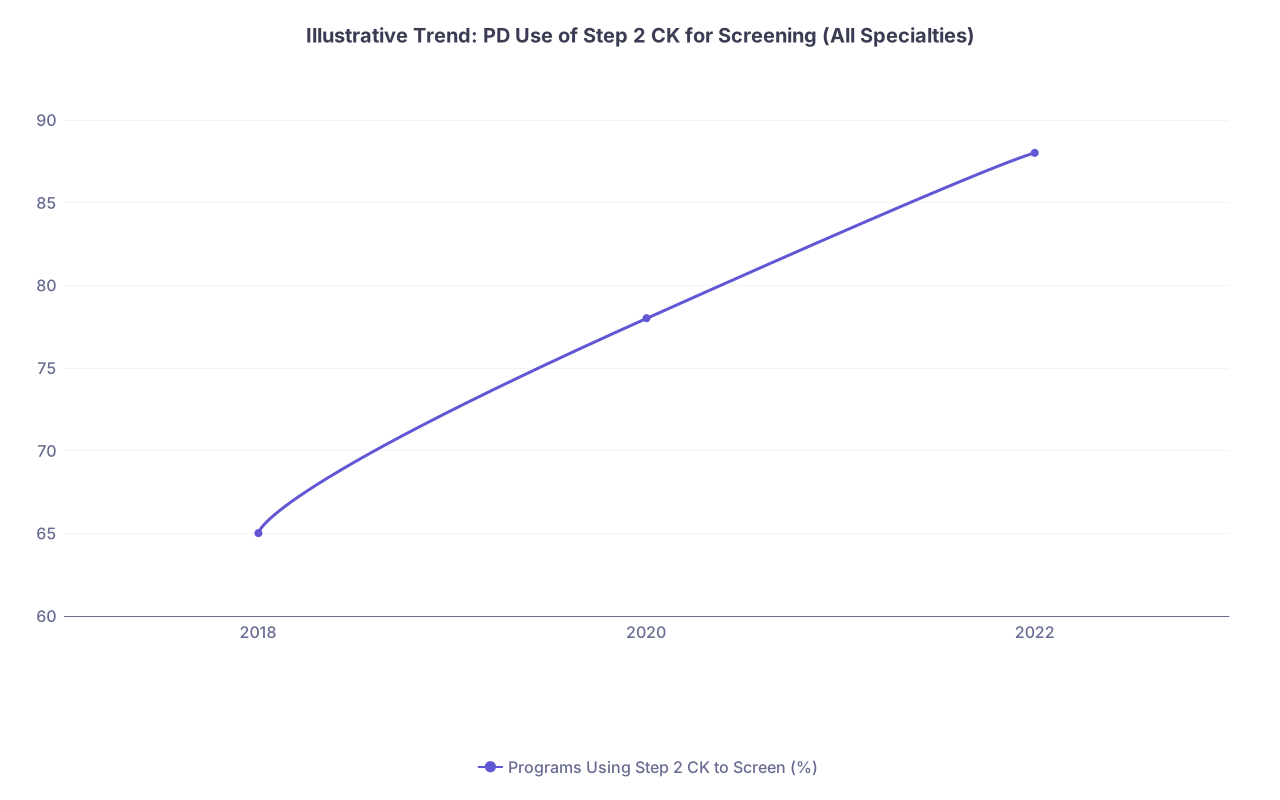
| Category | Programs Using Step 2 CK to Screen (%) |
|---|---|
| 2018 | 65 |
| 2020 | 78 |
| 2022 | 88 |
Again, those numbers are illustrative, but the real data show the same direction: Step 2 CK is now the main standardized metric.
For an IMG, the trend analysis leads to clear conclusions:
- Step 2 CK is your single most important salvage tool if Step 1 is pass/fail or weak.
- Low Step 2 CK in the current era hurts more than it did when Step 1 numeric existed.
- Extra USCE, research, or observerships help, but they will not fully compensate for a very low Step 2 CK once PDs rely on it as their main filter.
So if you are early (pre-exam), you should be building your entire timeline and rotation selection around maximizing Step 2 CK performance. The PD Survey backs that up, not Reddit.
Step 9: Using the Survey to Spot IMG-Friendly Specialties and Red Flags
Some specialties are just objectively hostile territory for non-US IMGs. The PD Survey confirms this without sentimental filter.
Look for:
- Percentage of programs that consider IMG status
- Score cutoffs very high (mean Step 2 CK cutoff in mid-230s+ in some fields)
- Heavy emphasis on AOA, class rank, and U.S. school metrics
If you see a specialty where:
- Typical minimum screening scores are far above your numbers
- PDs place huge emphasis on school reputation, Alpha Omega Alpha, or US grades
- Very few IMGs appear in resident lists online
That is not “follow your dreams” territory. That is “consider backup or alternative specialty” territory.
On the flip side:
- FM, IM, Psych, Peds, Pathology, and sometimes Neurology often show:
- Lower cutoffs
- More programs using holistic factors
- Higher IMG presence in real life
The PD Survey quantifies what you probably already suspect. Use it to justify strategic pivoting, not emotional denial.
Step 10: Turn the Survey into a Personal “Action Grid”
To make this concrete, build yourself a small table based on your specialty’s PD Survey data and your own stats.
| Factor (IM PD Survey) | PD Use/Importance (Illustrative) | Your Data | Action |
|---|---|---|---|
| Step 2 CK Used for Screening | Very high | 229 | Avoid high-tier academics, target IMGs |
| Failed USMLE Attempt | Moderate–high | None | Strength – emphasize clean record |
| US Clinical Experience in IM | High | 2 mo observership | Add 1–2 mo hands-on if time allows |
| Visa Requirement | Moderate | Needs J-1 | Filter out “no visa” programs |
| LORs in IM | High | 1 US IM, 2 home | Aim for 2–3 strong US IM letters |
| Research Experience | Low–moderate | None | Optional – not priority this cycle |
Now your PD Survey usage is personalized, not theoretical.
A Quick Word on Over-Interpreting the Survey
You can absolutely misuse this document by:
- Treating mean score cutoffs as hard rules (“they said 220, I have 219, so zero chance”). Reality is a range.
- Ignoring local program/contextual factors (e.g., an IMG-heavy community program may interview below the “national cutoff”).
- Forgetting sample bias (not all PDs respond, and response rates vary).
So treat PD Survey data as strong directional guidance, not divine law.
How This All Looks in Practice for an IMG
Let me outline a realistic workflow for using the PD Survey smartly, not performatively.
Pick your specialty (or two).
Open the latest NRMP PD Survey PDF. Go straight to your specialty’s section.
For that specialty, extract:
- Key screening factors
- Score cutoff distribution
- Ranking factors
- Anything about IMG/visa if present
Compare those factors directly with:
- Your Step scores and attempts
- Your USCE length and type
- Your visa needs
- Your LOR sources
Decide:
- Target: academic vs community balance
- Application volume required
- Which weaknesses you can still address pre-ERAS (USCE, letters, PS, Step 2 if not yet taken)
Rewrite your:
- Personal statement → to highlight exactly the ranking factors PDs list.
- CV order/structure → to push USCE and specialty commitment to the front.
- Email outreach to programs → short, data-conscious, aligning with what PDs actually value.
Re-check: Does your final program list match reality from the PD Survey, or your fantasies from Instagram and WhatsApp groups?
If those disagree, trust the survey. PDs wrote it. They are the people who will screen you.
Key Takeaways
- The NRMP Program Director Survey is not background reading. It is a blueprint: it tells you how PDs screen and rank, and IMGs ignore it at their own expense.
- Use it to do three concrete things: set realistic program tiers, align your application materials with PD priorities, and decide where you must over-apply or pivot specialties.
- Read the data through your own profile: scores, attempts, USCE, visa status, school type. The power of the survey is not the percentages. It is how brutally you are willing to apply them to your situation.