
Most IMGs ruin their strongest letters of recommendation before they are even written—by sending weak, vague, or awkward request emails.
Let me walk you through exactly what to say instead.
You are not just “asking for a favor.” You are managing a high‑stakes professional interaction with someone whose inbox is already overflowing, often in a system and culture that are not yours. The words you choose either make it easy for them to say yes and write well—or easy for them to ignore you or produce a generic two‑paragraph letter that programs will skim and forget.
We are going very specific here: exact phrases, full email templates, what works in the U.S. system, and how to adapt it if your referee is abroad and unfamiliar with U.S. residency.
1. Core Principles For IMG LOR Emails (Most People Get These Wrong)
You need three things from your email:
- A clear, respectful ask.
- A signal that you understand U.S. residency expectations.
- A structure that makes it easy for a busy attending to help you.
Weak emails fail on one or more of these. Typical bad patterns I see from IMGs:
- Overly deferential and vague:
“Dear Sir, Can you please help me by giving me a recommendation letter for my future career? I will be very grateful.” - Overloaded with life story:
Three paragraphs about childhood dreams, zero clarity on what exactly is needed and by when. - Zero U.S. context:
“I need a letter for my exam and training” – that is not how residency letters work.
You want the opposite: specific, concise, and framed in the U.S. residency context.
Here are the non‑negotiable elements your request email should include:
- Clear subject line that tells them what this is.
- Explicit question: can you write me a strong letter of recommendation.
- Brief reminder of who you are and what you did with them.
- Concise description of your target: U.S. residency, specialty, application cycle.
- Offer of supporting materials (CV, personal statement, bullet list).
- Clear deadlines and logistics (ERAS, upload, LoR Portal).
- Professional, grateful closing.
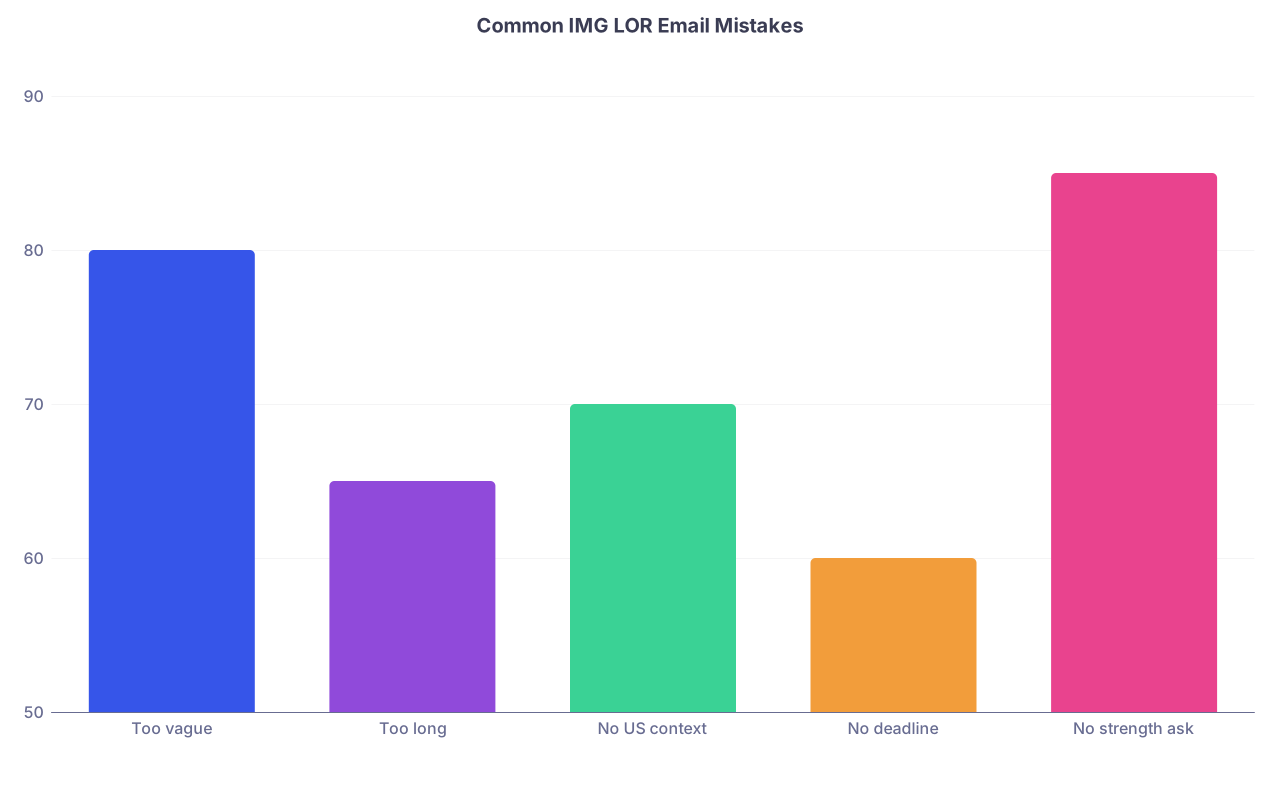
| Category | Value |
|---|---|
| Too vague | 80 |
| Too long | 65 |
| No US context | 70 |
| No deadline | 60 |
| No strength ask | 85 |
If your email does all of that in 250–350 words, you are ahead of most IMGs I see.
2. Subject Lines That Actually Get Opened
Subject lines must be boringly clear. Not poetic. Not dramatic.
Good patterns:
- “Request for Strong Residency Recommendation Letter – [Your Name]”
- “Letter of Recommendation Request for 2025 IM Residency – [Your Name]”
- “US Residency LOR Request (Internal Medicine) – [Your Name]”
- “Recommendation Letter Request from Former Intern – [Your Name]”
Bad patterns:
- “Need your help urgently!!!”
- “Small favor if you have time”
- “Hello Doctor”
- No subject at all (yes, I have seen this).
You want the attending, scanning email on their phone between cases, to immediately know:
This is about a residency letter; I know who this is.
If you did an elective / observership in the U.S., you can add that:
- “Request for Strong LOR – US Observership (Cardiology) – [Your Name]”
If the writer is outside the U.S. and not used to ERAS, keep it simple:
- “Recommendation Letter Request for US Residency – [Your Name]”
3. The Single Most Important Sentence: “Strong Letter” Wording
This is non‑negotiable in U.S. culture:
You must ask for a strong letter of recommendation.
Not because you want to pressure them, but because you want to give them a graceful way to decline if they cannot write enthusiastically.
Use one of these lines:
- “Would you feel comfortable writing a strong letter of recommendation in support of my application to U.S. internal medicine residency programs?”
- “If you are able to write a strong, positive recommendation for me, I would be honored to include your letter in my residency application.”
- “If you do not feel you can write a strong letter, I completely understand and I appreciate your honesty.”
That last sentence is crucial for IMGs in rigid hierarchies where professors feel socially obligated to say yes. You are explicitly giving them permission to say no.
What you must avoid:
- “Can you write a letter of recommendation for me?” (no qualifier)
- “I would be grateful for any letter you can provide.”
Translation in U.S. programs: maybe this is a weak or lukewarm letter.
4. Core Email Structure + Exact Phrases (Template You Can Adapt)
Let me give you a clean, IMG‑specific template and then we will dissect the phrases.
Template: For a U.S. Attending You Recently Worked With
Subject: Request for Strong Residency Recommendation Letter – [Your Full Name]
Dear Dr. [Last Name],
I hope you are well. I had the privilege of working with you on the [service/rotation, e.g., General Medicine Ward] at [Hospital Name] from [Month Year] to [Month Year] as an international medical graduate.
I am applying to U.S. [Specialty, e.g., Internal Medicine] residency programs through ERAS for the [20XX–20XX] match cycle, and I am writing to ask if you would feel comfortable writing a strong letter of recommendation on my behalf.
Working with you, I especially valued your feedback on my [clinical reasoning / presentations / patient communication / work ethic]. I remember your comments about my [specific incident or skill, 1 line], which encouraged me to pursue [Specialty] training in the U.S.
If you are able to support my application, I would be glad to provide: – My CV
– My personal statement draft
– A brief bullet list of cases and responsibilities from our time on serviceThe ERAS system will send you a secure link to upload the letter directly once I enter your email. My preference is for a waived letter (I will not see the content), as this is considered more credible by residency programs, but I will follow whatever you are comfortable with.
My goal is to finalize all letters by [date – usually 2–4 weeks before apps open or your internal deadline], so a submission by around [soft deadline] would be extremely helpful. Please let me know if this fits your schedule or if another time frame would work better.
Thank you very much for considering this request and for the teaching and mentorship you have already provided.
Sincerely,
[Full Name, Medical Degree]
[Home Country Medical School, Graduation Year]
[ERAS AAMC ID if you have it]
[Phone] | [Email]
This is lean but complete. You can adjust the formality slightly depending on your relationship, but the skeleton is solid.
5. Special IMG Situations (And The Phrases You Actually Need)
Different IMG scenarios demand different phrasing. One generic template will not cover all.
A. When You Have Not Been In Contact For A While (Gap Years, Old Supervisors)
You cannot pretend you spoke last week if it has been three years.
Use wording that:
- Acknowledges the time gap.
- Reminds them concretely who you are.
- Does not sound apologetic or desperate.
Example:
Dear Professor [Last Name],
I hope you have been well. I was an intern on your [Department] service at [Hospital] from [Month Year] to [Month Year]. During that time, I worked with you on [brief reminder: the ICU rotation, the research project on X, etc.], and you kindly provided feedback on my [presentations / procedures / research work].
Then proceed to the “I am applying…” paragraph.
You can add this line:
I realize it has been some time since we worked together, so I have attached a brief summary of my activities since graduation along with my updated CV.
Do not write a full autobiography in the email. Mention the existence of the summary; attach it separately.
B. When Your Referee Is Outside The U.S. And Has Never Done ERAS
This is common for IMGs. You must bridge two systems with a few lines.
Key phrases:
I am applying to residency training positions in the United States through a centralized application system called ERAS (Electronic Residency Application Service).
Your letter would be addressed “To Program Director” and should comment on my clinical skills, work habits, communication, and potential as a resident physician.
Once you agree, the ERAS system will generate a secure link (sent to your email) where you can upload a signed PDF of your letter. The letter is confidential; I will not see its contents if I waive my right to view it.
Many senior physicians outside the U.S. are wary of systems they do not know. Reassure them this is standard.
You can add:
If it would be helpful, I can send you a brief one‑page guide describing what U.S. residency programs typically look for in recommendation letters.
That “guide” can be something you prepare yourself (bullet points of qualities, examples) or a PDF your advisor shared.
C. When English Is Not Their First Language (But They Know You Very Well)
If you know the writer is not confident in formal English, you have two options, and you must be diplomatic.
Phrase it like this:
To make the process easier, I can provide a brief bullet‑point list of the clinical activities we shared and the qualities you observed in my work. Some supervisors also prefer that I send a draft letter for them to review and modify as they see fit. I respect whichever approach you prefer.
Never say, “I can write the letter for you.” That is unethical ghostwriting. But supplying bullet points and a rough structure is standard and expected in many settings.
Bullet points you provide should be factual and modest, not self‑worship:
- Managed X patients per day on [service].
- Presented daily on ward rounds; you commented on improvement in clarity over time.
- Took responsibility for [task] and followed through reliably.
- Communicated with patients and families in [languages].
Give them raw material; let them turn it into prose.
D. When You Are Asking for a “Chair” / Department Head Letter
IMGs often over‑prioritize “big titles” and under‑prioritize “people who actually know me.”
If you are forced by your school/hospital to get a chair letter, or if the chair actually does know you somewhat, the tone needs to be more formal and deferential, but still clear.
Key phrases:
I understand that you receive many such requests, and I am grateful for your time and consideration.
Although we did not work together as closely as with my direct supervisors, you are familiar with my performance through [departmental evaluations / presentations / exams / research involvement].
If you feel that a letter from a more direct supervisor would be more appropriate, I would fully understand and appreciate your guidance.
That last sentence is how you protect yourself from a generic chair letter that says nothing.
E. When You Want To Replace An Old Weak Letter With A New Stronger One
Delicate situation. You do not want to insult the previous writer, but you also need a better letter.
If you are asking someone new:
I already have letters from [source types – e.g., home institution internal medicine faculty], but I am hoping to strengthen my application with a letter from a U.S. clinician who observed my work directly in this system.
If you are updating the previous writer and asking for a refreshed letter:
You kindly wrote a recommendation letter for my previous application cycle. I am reapplying this year with additional U.S. clinical experience and clearer specialty focus. If you are able to update or strengthen your letter to reflect my recent progress, I would be very grateful.
You are not saying their old letter was weak. You are saying your application got stronger.
6. Exact Phrases That Signal Professionalism To U.S. Program Directors
Program directors do not read your emails, but your writers will echo your language, consciously or not.
Certain phrases you use in the email often show up in your letter. That matters. You want those phrases to match what PDs like.
Here are phrases that tend to translate well into LOR language:
- “Consistently reliable and prepared”
- “Strong clinical reasoning for level of training”
- “Communicates clearly with both patients and staff”
- “Accepts feedback and improves rapidly”
- “Hard‑working, with no concerns about professionalism”
- “I would rank them in the top [X]% of trainees I have worked with”
You do not write these into your email as self‑descriptions. You feed them as topics:
I am particularly hoping that my letters will address my clinical reasoning, reliability, and communication with patients, as these seem to be key areas that U.S. programs emphasize.
An attending reading that will mentally note:
Okay, I should comment on those three buckets explicitly.
If you are sending bullet points separately, you can divide them exactly in those domains:
- Clinical skills / reasoning
- Work ethic / professionalism
- Communication / teamwork

7. Timing, Follow‑Up, And Gentle Reminders (With Scripts)
You are not just writing one email. You are managing a mini‑project.
When To Ask
Ideal window: 2–8 weeks after you finish working with them, and at least 4–6 weeks before you need the letter.
As an IMG, you may not have that luxury, but earlier is always better.
Sentence for early ask during rotation:
As I am planning to apply for U.S. residency this coming cycle, would you be open to my following up after this rotation with a formal request for a strong letter of recommendation, if my performance continues to meet your expectations?
This plants the seed while they are still seeing you work.
First Follow‑Up (1–2 Weeks After No Response)
Assume they are busy, not malicious.
Dear Dr. [Last Name],
I wanted to follow up briefly on my email from [date] regarding a potential residency recommendation letter. I know your schedule is very busy, and I completely understand if now is not a good time.
If you are able to let me know whether you feel comfortable writing a strong letter on my behalf, I would be grateful, and I can then plan my application materials accordingly.
Thank you again for your time and consideration.
[Signature]
Short, respectful, and gives them an easy out.
Second Follow‑Up (If Still No Response After Another 1–2 Weeks)
One more try, then drop it and find someone else.
Dear Dr. [Last Name],
I realize this is a busy time, and I do not want to burden your schedule. As my residency application deadlines are approaching, I wanted to check one last time regarding a potential letter of recommendation.
If it is not possible at this time, I completely understand and appreciate your past teaching and mentorship.
With thanks,
[Signature]
Do not chase after that.
Reminder When Letter Is Promised But Not Uploaded (Time‑Sensitive)
This one makes people nervous. Use the calendar, not your anxiety, as justification.
Dear Dr. [Last Name],
Thank you again for agreeing to support my residency application with a recommendation letter. I wanted to let you know that ERAS is now open for letter uploads, and programs will begin reviewing applications on [date].
If you are still able to submit the letter, a target date of [about 1 week before programs download apps] would be extremely helpful. Please let me know if you need the ERAS link resent or any additional information from me.
I am very grateful for your time and support.
[Signature]
Most attendings appreciate the reminder. They forget. They are human.
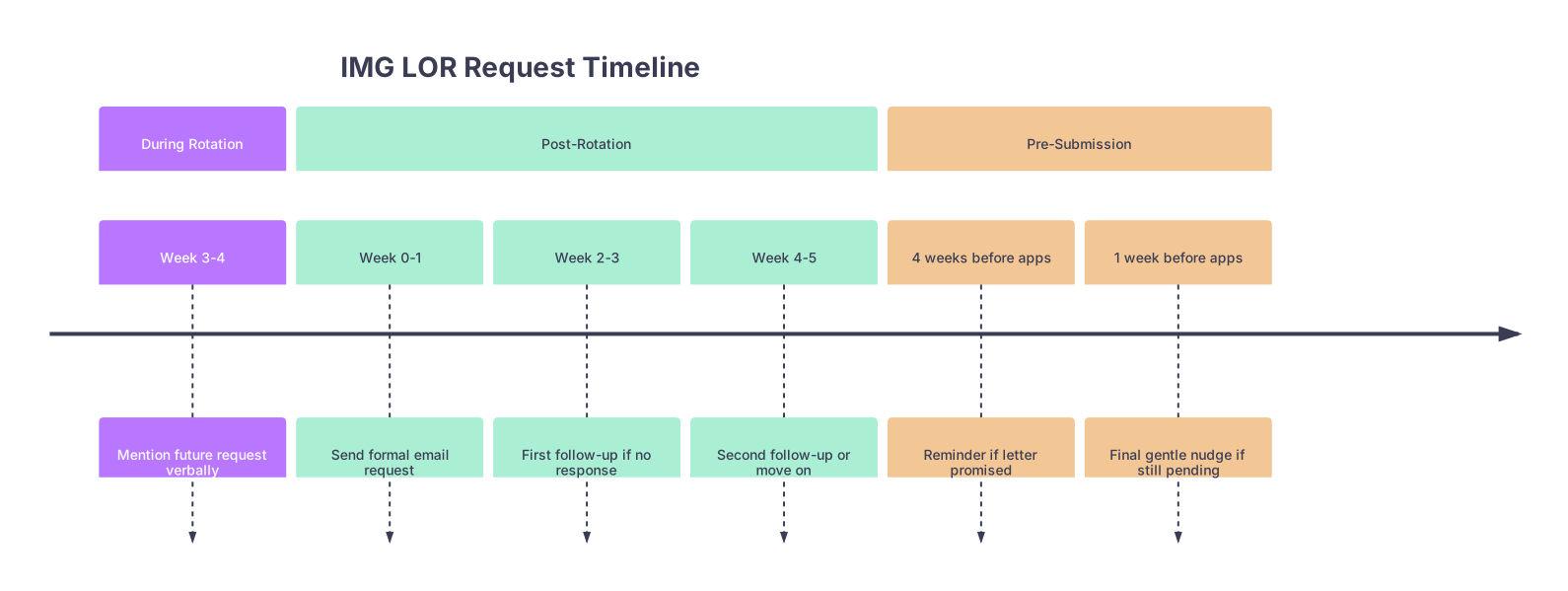
| Period | Event |
|---|---|
| During Rotation - Week 3-4 | Mention future request verbally |
| Post-Rotation - Week 0-1 | Send formal email request |
| Post-Rotation - Week 2-3 | First follow-up if no response |
| Post-Rotation - Week 4-5 | Second follow-up or move on |
| Pre-Submission - 4 weeks before apps | Reminder if letter promised |
| Pre-Submission - 1 week before apps | Final gentle nudge if still pending |
8. ERAS Logistics And What To Say About Waiving
Your email has to show that you are not clueless about the process.
Core facts:
- Letters are uploaded through the ERAS LoR Portal.
- You assign each letter to programs within ERAS.
- You can choose to waive or not waive your right to see the letter.
- U.S. programs prefer waived letters.
How to phrase it without sounding like you are reciting policy:
When I enter your name and email into the ERAS system, it will send you a secure link to the Letter of Recommendation Portal, where you can upload a signed PDF of your letter on your letterhead.
ERAS also asks whether I waive my right to view the letter. U.S. programs generally consider waived letters more credible, so my plan is to waive my right. Please let me know if you have any concerns about that.
You are signaling:
“I understand the system, I intend to waive, I am not trying to control the content.”
If they reply with confusion, you can send them the AAMC LoR portal instructions PDF (easily downloadable) and say:
I have attached a brief official guide from the AAMC that explains the letter upload process step by step.

9. Quick Comparison: Strong vs Weak Request Email
Sometimes seeing contrast is more educational than theory.
| Aspect | Strong Email Example Line | Weak Email Example Line |
|---|---|---|
| Ask clarity | "Would you feel comfortable writing a **strong** letter of recommendation...?" | "Can you please give me a recommendation for my future?" |
| Context | "I am applying to U.S. Internal Medicine residency programs through ERAS for the 2025 match." | "I want to go to USA for training." |
| Relationship reminder | "I worked with you on the General Medicine Ward at XYZ Hospital from May–July 2024." | "You may remember me from hospital." |
| Materials offered | "I would be glad to provide my CV, personal statement, and a bullet list of our shared cases." | "Tell me what you need from me." |
| Deadline framing | "A submission by around September 5 would be extremely helpful as programs begin reviewing in mid-September." | "Please send it as soon as possible." |
You do not need fancy language. You need specificity and respect.
10. Final Polish: Tone, Culture, And What IMGs Overdo
Three quick points before we wrap this up.
Cut the drama.
U.S. faculty do not respond well to “This is my only dream; you are my only hope; I will be forever in your debt.” It reads as emotional manipulation, not professionalism.Replace with calm gratitude:
I would be very grateful for your support.
Stop over‑explaining your struggles in the request email.
Your personal statement or interview can handle your immigration story, exam journey, or family hardships. The LOR email is not therapy. It is logistics plus professionalism.Be consistent with how you address them.
If you call them “Dr. Smith” in person, do not switch to “Dear Sir” in email.
“Dear Dr. Smith,” is almost always correct in U.S. settings.
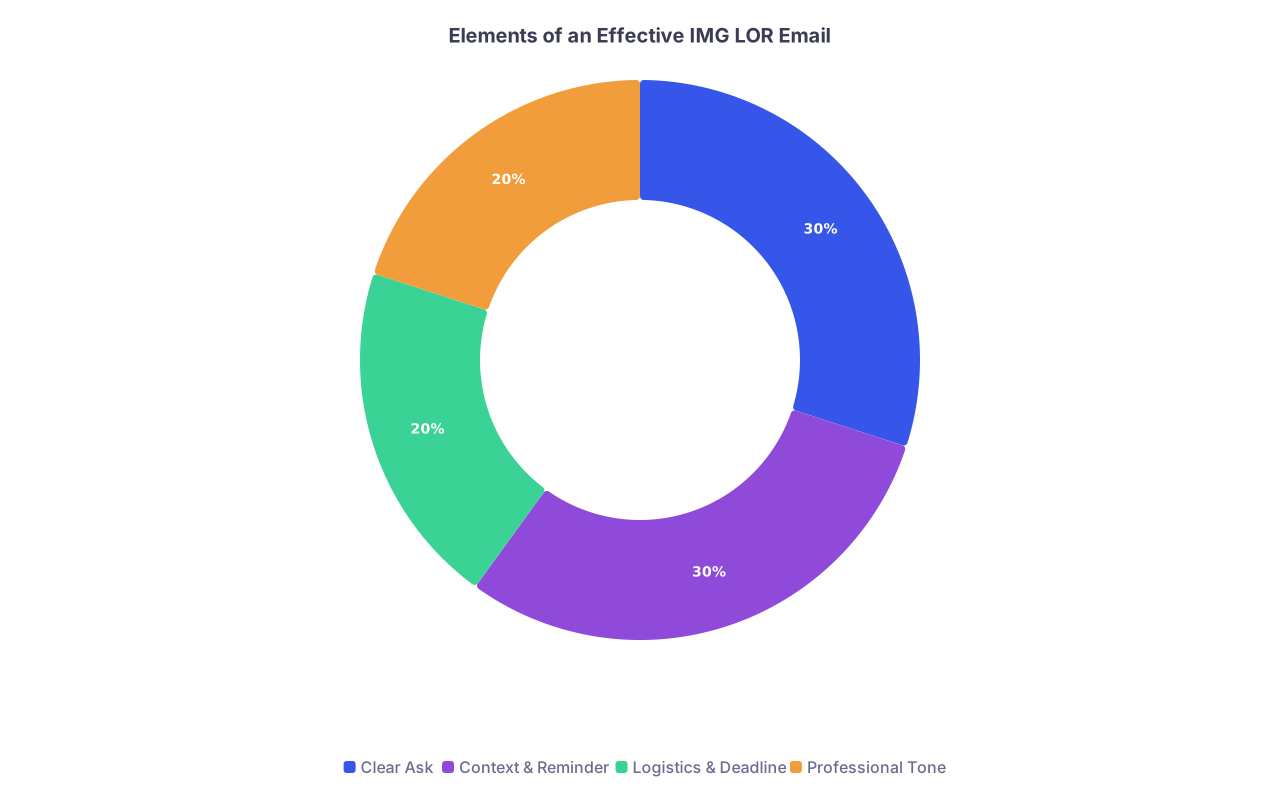
| Category | Value |
|---|---|
| Clear Ask | 30 |
| Context & Reminder | 30 |
| Logistics & Deadline | 20 |
| Professional Tone | 20 |
Key Takeaways
- Use precise, U.S.-aligned phrasing: explicitly ask for a strong letter, state your specialty and match cycle, and mention ERAS and waiving.
- Make the writer’s life easier: remind them who you are, offer CV + bullet points, give a realistic deadline, and send one or two professional follow‑ups.
- Strip out drama and vagueness: short, concrete, respectful emails get better responses and, indirectly, better letters.
FAQ (Exactly 4 Questions)
1. How many LORs should I request as an IMG, and should I tell each writer I am asking others?
Aim for 4 letters total (ERAS allows up to 4 per program). Request from at least 5–6 people, assuming 1–2 will fall through. You do not need to list all other writers, but you can mention, “Your letter would be one of my core recommendations for internal medicine programs,” which signals importance without detailing everyone else.
2. Is it acceptable to remind a senior professor multiple times about my letter?
Yes, within reason. One initial request, one follow‑up after 1–2 weeks, and one reminder closer to the deadline if they already agreed. After that, stop. If you need more than three emails to get movement, the underlying problem is not reminders; it is that they are unwilling or too busy. Move on.
3. What if my supervisor asks me to write my own letter draft?
This happens. Ethically, pure ghostwriting is problematic. The safest approach is to write a factual, modest draft that emphasizes specific observed behaviors and let them significantly edit. Better, offer a bullet‑point list instead and say, “I thought these notes might be helpful as you compose the letter,” nudging them to write it in their own words.
4. Should I send my personal statement with the LOR request, or only if they ask?
Offer it; do not force it. A good line is, “If helpful, I can send my current personal statement draft so you can see how I am presenting my background and goals to programs.” Many writers appreciate this context. Some will ignore it. Your job is to make it available without flooding their inbox.