IMG Residency Guide – Residency Match and Applications
You are sitting at your desk with your ERAS account open.
You are on that section: “Procedures” and “Experience details.”
You scroll through your memories:
Hundreds of IV cannulas.
Dozens of lumbar punctures – some supervised, some not.
You have “assisted” in maybe 50 C‑sections… whatever “assisted” really means.
Now you are stuck on one question:
How do you document your procedural skills honestly as an IMG…
…without underselling what you can actually do,
…but also without sounding like you are a fully trained specialist before residency?
Let me break this down specifically.
1. What Programs Actually Think When They See Your Procedural Claims
Program directors are not naïve. They know two things about IMGs and procedures:
- Many IMG schools do not have standardized procedure logging systems.
- A nontrivial number of applicants inflate their experience. Some just outright lie.
So anytime they see a CV that says:
- “Intubated 200 patients independently” as a pre‑residency intern, or
- “Performed 1000+ central lines” as a rotating student,
their internal alarm goes off. And once there is doubt in one area, they start doubting the rest of your application.
What they are looking for instead:
- Reasonable numbers
- Clear supervision levels
- Context that makes sense (country, role, setting)
- Consistency between your CV, personal statement, and LORs
They are not expecting you to show up as a fully polished proceduralist. They are expecting you to show maturity, insight, and honesty about what you have actually done.
If your documentation looks “too good to be true,” you lose credibility.
If your documentation is vague and underspecified, you look sloppy or inexperienced.
Your goal is a third option: detailed, realistic, verifiable.
2. Build a Honest Framework: What You Actually Mean by “Performed”
Before you write a single number, you need to define your terms clearly. Otherwise, you will accidentally overstate.
For each procedure, think in four levels:
- Observed only
- Assisted (hands on, but not primary operator)
- Performed under direct supervision (supervisor at bedside, scrubbed or ready to take over)
- Performed under indirect supervision (supervisor in unit/clinic, immediately available but not at bedside the whole time)
As a pre‑residency IMG, these boundaries matter a lot. A US program will absolutely interpret “performed” as “I was the primary person doing the procedure, not just holding retractors and watching.”
So when you write “performed lumbar punctures,” you should mean level 3 or 4 above, not “I handed the spinal needle and held the patient.”
How to implement this in your own documentation
Instead of this:
Lumbar puncture – performed 40
Write something like:
Lumbar puncture – primary operator for ~20 (all under direct supervision); assisted in ~50 additional procedures.
See the difference?
- You are clear about your role.
- Your numbers sound realistic.
- You give a sense of supervision without pretending to be independent.
3. Track and Present Numbers Like a Grown‑Up, Not a Braggart
Numbers are useful. Unrealistic numbers are poison.
If you trained in a high‑volume hospital in India, Pakistan, Egypt, Nigeria, the Philippines, or similar systems, your raw exposure may be huge. Yes, you might have “placed” hundreds of IVs or foleys. That does not mean you should write “1000+ IV cannulations” on your ERAS.
Why? Because readers interpret very large round numbers as guesses. And guessed numbers look sloppy or dishonest.
Let me show you what tends to look reasonable versus suspicious.
| Procedure Type | Reasonable Range (Student/Intern) | Starts Looking Suspicious |
|---|---|---|
| Peripheral IV | 100–300 | 500+ as a student |
| Foley catheter | 50–150 | 300+ as a student |
| Arterial blood gas | 30–100 | 200+ without ICU job |
| Lumbar puncture | 10–40 | 80+ pre‑residency |
| Central line (IJ/Fem) | 5–20 | 50+ pre‑residency |
Yes, there are exceptions. A dedicated ICU year as a house officer could legitimately push some of these higher. But then your CV must show that ICU job clearly, and your LORs should corroborate it.
Use ranges and approximations intelligently
You almost never need exact numbers. You are not submitting billing data. Use “~” and ranges. For example:
- “Performed approximately 25 lumbar punctures as primary operator (all under direct supervision).”
- “Assisted in >50 additional lumbar punctures (patient positioning, local anesthesia, post‑procedure care).”
- “Placed ~150 peripheral IV lines independently in emergency and inpatient settings.”
Do not write “27 lumbar punctures.” That looks fake‑precise. Nobody believes you kept a real‑time tally from day one unless your school forced you to use a logbook.
4. Context First: Role, Setting, and Hierarchy
A central truth: the same number means something different in different settings.
Twenty intubations as a final‑year student in a community ED in India is not the same as twenty intubations as a PGY‑2 anesthesia resident in the US. Programs know this. You should acknowledge it implicitly by giving your context.
When you describe your procedural skills, always orient to:
- Your role at the time (final‑year student, rotating intern, junior house officer)
- The type of hospital (tertiary referral center, district hospital, private clinic)
- The supervision model (consultant present; senior resident in room; consultant in unit, etc.)
For example:
As a junior house officer in the medical ICU of a tertiary care government hospital, I was the primary operator for ~15 central venous catheter placements (mostly internal jugular, ultrasound‑assisted; all with attending or senior resident at bedside).
Now that number makes sense. The reader can picture the workflow and supervision.
5. What To Log vs What To Leave Out
Not every “procedure” needs to be documented as a separate skill. Taking manual blood pressures and checking capillary refill are not CV‑worthy as a separate line item.
Here is a reasonable breakdown:
Good to explicitly document
- Central venous catheter insertion (IJ/subclavian/femoral – specify site)
- Arterial line placement
- Lumbar puncture
- Endotracheal intubation and bag‑mask ventilation
- Chest tube insertion (ICD)
- Paracentesis / thoracentesis
- Joint aspiration/injection
- Bedside ultrasound–guided procedures (if truly hands‑on)
Reasonable to summarize but not obsess over
- Peripheral IV cannulation
- Foley catheter insertion
- NG tube insertion
- Simple wound suturing
- Incision and drainage of simple abscesses
For the second group, cluster them:
“Regularly responsible for basic ward procedures (peripheral IV access, Foley catheterization, NG tube insertion, simple suturing), collectively performed on several hundred patients during my internship year.”
That is enough. No one is ranking you based on how many urinary catheters you inserted.
6. Where to Put Procedural Skills in ERAS and Your CV
You have a few realistic places to reflect procedures:
- ERAS “Experience” entries (under job/position descriptions)
- Supplemental CV (if some programs ask for one)
- Personal statement (sparingly – usually one or two key examples only)
- LORs (ideally your recommender comments on your hands‑on ability)
You are not going to see a specific “Procedural Log” upload slot in ERAS for most specialties. So you embed it in narratives.
The right way to phrase in ERAS experience section
Suppose you worked as a junior doctor in internal medicine in Pakistan for one year. Your ERAS entry might look like this in the description:
Clinical responsibilities included independent management of admitted patients under attending supervision, daily rounds, and emergency coverage. Procedurally, I was primary operator for ~20 lumbar punctures, ~15 paracenteses, and ~10 ultrasound‑guided internal jugular central venous catheters, all performed under direct supervision. I also frequently assisted with thoracentesis and temporary transvenous pacemaker placements.
Concrete. Realistic. Clear.
Where IMGs go wrong is with generic fluff:
“Extensive procedural exposure including many LPs, central lines, and other invasive procedures.”
That says nothing. And it smells like padding.
7. How To Reconstruct a Log If You Never Kept One
Most IMGs did not keep a formal log during undergrad or internship. So now you are trying to back‑calculate. That is fine if you do it systematically and conservatively.
Process I recommend:
- Pick one representative month from each major rotation.
- Ask yourself, “In a typical week on this rotation, how many of [procedure X] did I truly do as primary operator?”
- Multiply by 4 for a rough monthly number, then by number of months in that rotation.
- Discount it by 20–30% to avoid overestimation.
- Round to a sensible number or range.
Example:
You rotated 3 months in neurology as an intern.
You recall doing ~2 lumbar punctures per week as primary operator.
2 per week × 4 weeks = 8 per month
8 × 3 months = 24
Apply a 25% “honesty correction”: 1815–20 lumbar punctures as primary operator (all under supervisor).”
Round to “
Better to err low and be believed than err high and be doubted.
8. The Role of Letters of Recommendation in Backing You Up
If you are going to claim significant procedural experience, your letters should at least hint that you are competent with hands‑on skills.
What helps:
- “She quickly became proficient at bedside procedures such as lumbar puncture and paracentesis. I directly supervised her on many of these.”
- “He demonstrated safe technique and good judgment while performing central venous access under supervision.”
Notice: no numbers required in the letter. Just qualitative confirmation that you are not inventing things.
If your LORs are entirely about “hardworking, punctual, good communication skills” and contain zero mention of procedural ability, but your CV lists 40 central lines and 50 intubations, the discrepancy is obvious.
When you ask for a letter, you can explicitly mention:
“Doctor, if you feel it is accurate, it would help my application if you could briefly comment on my hands‑on procedural skills, particularly lumbar puncture and paracentesis, as those are key skills for residency programs.”
You are not telling them what to write. You are orienting them.
9. How to Talk About Procedures in Interviews Without Exaggerating
You will get this question in one form or another:
- “Tell me about your procedural experience.”
- “How comfortable are you with procedures like LP, central line, intubation?”
- “What kind of hands‑on exposure did you have in your training?”
You must be ready with calm, specific, non‑defensive answers that match your application.
Good structure:
- Start with your general volume and scope.
- Clarify the supervision level.
- Give a concrete clinical example that shows judgment, not just technical skill.
- End with humility: what you are looking forward to learning properly in residency.
Example answer:
“In my internship and subsequent ICU work, I was primary operator for around 15–20 lumbar punctures and significantly more peripheral IV and arterial blood gas draws, all performed under direct supervision. I also assisted with several central venous catheter insertions, and in about 10 of those I was the one advancing the needle and guidewire while the attending or senior resident supervised closely. One case that stands out was a suspected meningitis patient where we had to balance the urgency of LP with borderline CT findings, which taught me not just the technique but the decision‑making around when to proceed. I am comfortable with the basics but I am very aware that I will need formal, structured training during residency to standardize my technique to US standards.”
That sounds safe, credible, and teachable. You do not sound like you think you are a mini‑fellow in your specialty already.
10. Specialty‑Specific Nuances: What Matters and What Does Not
Different specialties care about different procedures.
Internal Medicine
They care more about:
- Lumbar puncture
- Paracentesis / thoracentesis
- Central line (especially IJ)
- Arterial blood gas sampling
- Basic ultrasound‑guided procedures (if you actually did them)
Peripheral IVs, foleys, and NG tubes are expected, but not application‑defining.
Family Medicine
Less focus on high‑risk inpatient procedures, more on:
- Office procedures: joint injections, skin biopsies, I&D, IUD insertion (if applicable)
- Basic urgent care skills: simple suturing, splinting
Overclaiming ICU‑level skills as a future FM resident is unnecessary and looks off.
Pediatrics
If you have done:
- Pediatric or neonatal IVs
- Pediatric LPs
- Pediatric intubations (even a few, carefully supervised)
Say so, but be extremely cautious with your numbers. Many US peds residents finish residency without large numbers of solo intubations.
Surgery / OB‑GYN
Here the word “assisted” gets abused heavily.
If you stood at the table during a C‑section, retracted, and cut some sutures, do not write “performed 80 C‑sections.” Ever.
Break it down like this:
“Assisted in ~60 cesarean deliveries (uterine retraction, suction, basic suturing). Performed skin closure independently in ~20 cases under supervision.”
Specific. Honest. Understandable to a US reader.
11. Using Visual Tools for Yourself (Not for ERAS)
You might benefit from organizing your procedures in a simple personal log or spreadsheet, even if you never upload it. It sharpens your memory and keeps you from contradicting yourself across applications.
For your own view, you might end up with something like this:
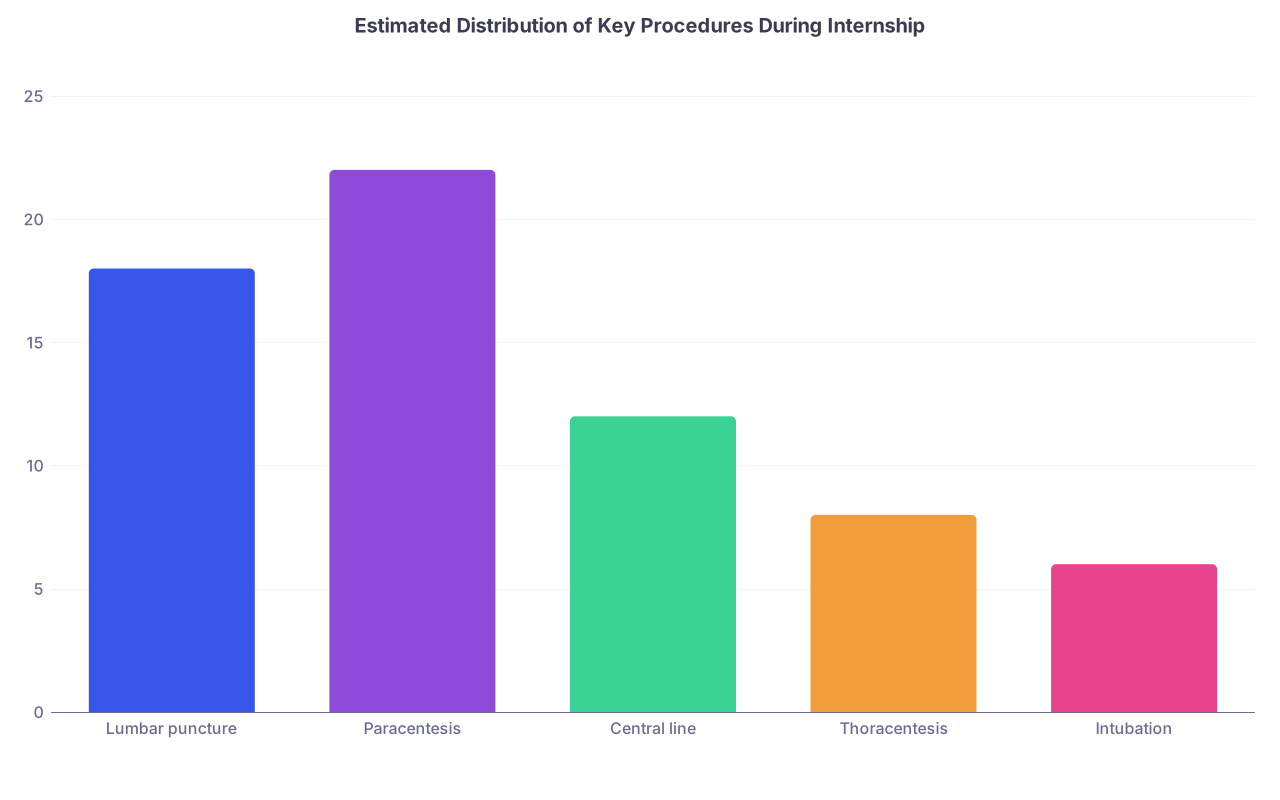
| Category | Value |
|---|---|
| Lumbar puncture | 18 |
| Paracentesis | 22 |
| Central line | 12 |
| Thoracentesis | 8 |
| Intubation | 6 |
You do not show this chart to programs. But using something like this for yourself keeps your story consistent when you write and when you speak.
12. Presenting Long Pre‑Residency Clinical Work Without Inflating
Many IMGs do 2–5 years of work as medical officers or house officers, often in under‑resourced systems. That yields high procedural volume. The temptation is to blast big numbers everywhere.
Resist it. Instead, group and describe.
Example for a 3‑year MO in a busy internal medicine department:
Over three years as a medical officer in internal medicine at a tertiary care hospital, I routinely performed ward‑level procedures such as peripheral IV insertion, Foley catheterization, and NG tube placement (collectively several hundred cases). For more advanced procedures, I was primary operator for approximately 30 lumbar punctures, 25 therapeutic paracenteses, 10 ultrasound‑guided internal jugular central venous catheters, and 8 thoracenteses, all performed under the supervision of an attending or senior resident.
No wild claims of “300 central lines.” No need to impress by big numbers. The mix and the tone already tell them you had significant, real‑world exposure.
13. A Simple Internal “Filter” Before You Write Anything
Before you finalize how you document anything procedural, run it through this checklist:
- If they call my supervisor and read this line out loud, would the supervisor agree?
- If they ask me for a concrete example of one procedure I did, do I have a clear memory that matches the number and supervision level I wrote?
- Would this number still seem reasonable if they compare it to my total time in that rotation or job?
- If another IMG from my same hospital read my CV, would they nod or roll their eyes?
If you fail any of those, adjust down.
14. A Quick Example: Bad vs Good Procedural Documentation
Let me show you a full “before / after” style difference.
Bad version (what I see too often on IMG CVs)
Performed >100 lumbar punctures, >50 central lines, >80 intubations, >200 ABGs, and numerous other procedures independently during internship and clinical work.
Problems:
- Volume does not match typical pre‑residency experience.
- “Independently” is likely false and makes attendings nervous.
- No context about role or setting.
- Sounds like bragging and padding.
Better version
During my internship and subsequent 18 months as a junior doctor in a mixed medical ICU, I gained consistent hands‑on procedural experience. I was primary operator for approximately 20–25 lumbar punctures, 15–20 ultrasound‑guided internal jugular central venous catheters, and 10–15 non‑difficult endotracheal intubations, all under the direct supervision of an attending or senior resident. I also frequently performed arterial blood gas sampling and assisted in additional central line and intubation procedures, focusing on preparation, patient positioning, and post‑procedure monitoring.
This version will not get you “disqualified for being too junior.” No one expects more than this. It will, however, make you sound like a serious, honest clinician.
15. Include Process and Judgment, Not Just Numbers
The strongest way to “sell” your procedural skills without overstatement is to show judgment and process. Not just: “I did X.” But: “I understood when and why to do X, and I did it safely.”
You can reflect this with phrasing like:
- “Including informed consent, sterile preparation, and post‑procedure monitoring.”
- “With particular attention to indications, contraindications, and complication recognition.”
- “Under close supervision, focusing on proper technique rather than speed.”
For example:
“Performed ~15 therapeutic paracenteses under direct supervision, from consent and ultrasound localization through sterile technique and post‑procedure monitoring for hypotension and bleeding.”
That reads as someone who actually did the work, not someone reciting a textbook sentence.

| Step | Description |
|---|---|
| Step 1 | Student - Observer |
| Step 2 | Student - Assistant |
| Step 3 | Intern / HO - Primary under direct supervision |
| Step 4 | Medical Officer - Primary with indirect supervision |
| Step 5 | US Resident - Structured competency-based training |
This is what you are implicitly communicating: where you are on this progression. Do not pretend to be at step E before you enter residency.

16. The Bottom Line: How Not To Shoot Yourself in the Foot
If you remember nothing else, remember this:
- Programs do not rank you higher because you claim to have done 60 central lines instead of 15.
- They will absolutely rank you lower if they think you are exaggerating or careless with details.
Your goal is to sound like someone they will trust with real patients, under real supervision, on day one. That trust starts with how you talk about what you have already done.

FAQ (Exactly 4 Questions)
1. Should I create a formal procedure log now and upload it with my ERAS application?
Generally no. Most programs do not ask for an uploaded pre‑residency procedure log, and an elaborate, self‑made log can look artificial if it appears retroactively constructed. Use a log for yourself to ensure consistent numbers and narratives, but reflect your experience in ERAS through job descriptions and let letters of recommendation support your claims.
2. Can I count procedures I only “assisted” with, or should I list only those where I was primary operator?
You can mention both, but you must separate them clearly. Programs care most about what you have done as primary operator under supervision, because that reflects your motor skills and procedural judgment. Assisted experience is still valuable, especially for complex procedures, but never mix the numbers. For example: “Primary operator in ~10 central venous catheters; assisted in ~25 additional cases.”
3. What if my procedural numbers are actually low compared with peers? Will that hurt me?
Not nearly as much as exaggeration will. Many US graduates start residency with minimal procedural experience, especially in competitive or non‑procedural specialties. A realistic profile like “5–10 LPs, a few paracenteses, and a handful of lines or none” is entirely acceptable. Programs want teachable residents who know their limits, not self‑declared experts. You can frame lower volume positively by emphasizing your eagerness for structured training.
4. How do I handle a situation where my home country allowed independent practice that would be unsafe by US standards?
State your experience honestly but anchor it firmly in supervision and humility. If you truly worked unsupervised in resource‑limited settings, acknowledge that and emphasize the constraints, then clearly state that you look forward to learning and standardizing your technique under formal supervision in the US system. Do not glorify risky independence. Programs respond better to an applicant who recognizes the difference in systems and expresses a strong commitment to evidence‑based, supervised practice.
Key takeaways:
- Use realistic ranges, clear role descriptions, and explicit supervision levels when you document procedures.
- Let your context and letters support your claims; do not chase big numbers just to look impressive.
- In writing and interviews, emphasize sound judgment and teachability over sheer procedural volume.