
Most IMGs spend too much time rehearsing “Tell me about yourself” and almost no time on the questions that actually sink them: culture, systems, and “How things work in the U.S.”
Let me be blunt: U.S. programs do not doubt that you know medicine. They doubt that you understand their medicine. Their system. Their culture. Their expectations.
This is where you either look like a safe hire—or a risk.
Below is a structured, high‑yield question bank specifically for IMGs, focused on cultural and systems topics that come up again and again in U.S. residency interviews. I will not sugarcoat what interviewers are really assessing with these questions, and I will show you what strong vs weak answers actually sound like.
1. The Core Issue: What Programs Worry About With IMGs
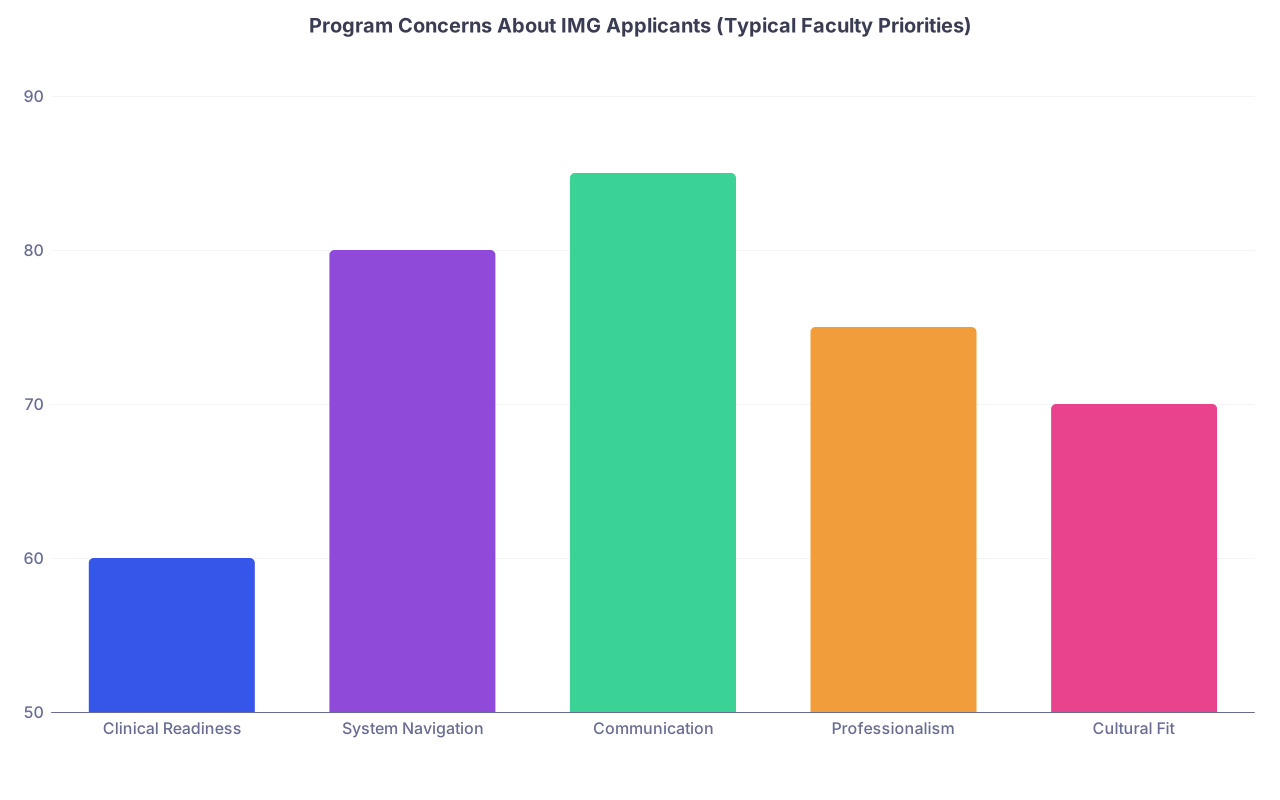
| Category | Value |
|---|---|
| Clinical Readiness | 60 |
| System Navigation | 80 |
| Communication | 85 |
| Professionalism | 75 |
| Cultural Fit | 70 |
You need to understand the subtext. When a U.S. attending asks you about “cultural differences,” they are thinking things like:
- Will this resident argue with nurses?
- Will they accept feedback or become defensive?
- Do they understand patient autonomy and informed consent?
- Will they blow up under ACGME duty‑hour rules and documentation pressure?
- Can they handle conflict without escalation?
So I am structuring this question bank around exactly those pressure points.
Sections:
- Cultural norms and team dynamics
- U.S. healthcare system and practice environment
- Communication, language, and patient‑centered care
- Ethics, autonomy, and professionalism differences
- Systems questions specific to IMGs (gaps, visas, letters, etc.)
- A compact “rapid‑review” mini‑bank
You will see questions, what is really being tested, and outlines of strong responses.
2. Cultural Norms and Team Dynamics
This is where many IMGs quietly fail. Not because they are rude. Because they sound completely unaware of the U.S. team culture.
2.1 Core Cultural‑Behavioral Questions
- “Tell me about a time you worked in a multidisciplinary team.”
- “How is the doctor–nurse relationship different in your home country compared to the U.S.?”
- “Describe a situation where you disagreed with a senior and how you handled it.”
- “How do you handle being corrected in front of others?”
- “Have you experienced hierarchy differently across settings? How did you adapt?”
What programs are actually probing:
- Do you treat nurses and allied health as equal team members or as subordinates.
- Are you overly hierarchical (defer blindly) or overly confrontational.
- Can you accept feedback without ego.
- Do you understand the flatter, team‑based culture that U.S. programs expect, even if reality is messier.
Example: Doctor–Nurse Relationship Question
Weak IMG answer (I have heard this almost verbatim):
“In my country, nurses follow doctors’ orders more closely; here, nurses are more independent, but I think if I explain my reasoning, they will understand.”
Red flags:
Authoritarian framing. Implies nurses “should” follow orders if you “explain well.” No explicit respect for independent judgment. Interviewer hears: “This person will argue when a nurse pages them and questions an order.”
Stronger structure:
- Start by acknowledging the principle in the U.S.: shared responsibility and safety.
- Explicitly value nursing expertise.
- Give a concrete example of collaborative behavior.
- End with how you changed your own default behavior.
Sample outline:
“In my home system, the formal hierarchy was clearer and nurses rarely questioned physician orders. In my U.S. experiences, I have seen nurses as critical safety partners. For example, on a medicine sub‑internship, a nurse questioned a heparin dose I had suggested. We reviewed the weight‑based protocol together and realized the patient’s weight had been documented incorrectly. Since then, I deliberately invite nurses’ input on new orders during rounds. I view disagreement as a safety check, not a challenge to authority.”
You do not have to memorize this wording. But you must hit those beats.
2.2 Conflicts and Feedback
Typical IMG‑targeted questions:
- “Tell me about a time you received critical feedback.”
- “Describe a conflict with a colleague or staff member and how you resolved it.”
- “How would your co‑residents describe your personality on a busy call night?”
They are sniffing for:
- Blame shifting (“The nurse misunderstood me.” → red flag)
- Fragile ego (“I was upset they said this in front of others.”)
- Cultural rigidity (“In my country that would not happen.”)
Good answer pattern:
- Brief, specific scenario
- Own your part
- Show concrete behavior change
- Mention follow‑up outcome
Avoid three things:
- “I cannot think of any serious conflicts.” (No one believes this.)
- Blaming others as the main takeaway.
- Vague “I learned communication is important.”
Be explicit: “I realized my tone sounded abrupt; now I…” etc.
3. U.S. Healthcare System and Practice Environment
This is where IMGs get exposed quickly. If you cannot show basic understanding of how U.S. care is structured, you look unprepared.

| Step | Description |
|---|---|
| Step 1 | Patient with symptoms |
| Step 2 | Primary care visit |
| Step 3 | Follow-up in primary care |
| Step 4 | Referral to specialist |
| Step 5 | Testing / Procedures |
| Step 6 | Insurance authorization |
| Step 7 | Treatment |
| Step 8 | Ongoing chronic care |
| Step 9 | Needs specialist? |
3.1 Typical System‑Knowledge Questions
- “What do you see as key differences between healthcare in the U.S. and your home country?”
- “How do you think lack of insurance affects patient care?”
- “How familiar are you with Medicare and Medicaid?”
- “Have you used an EMR? What systems have you worked with?”
- “How do you manage documentation and billing requirements?”
They are not expecting policy experts. They are screening for:
- Basic awareness of insurance‑driven care
- Realistic view of access and cost issues
- Comfort with EMR, not paper mentality
- Willingness to “play inside the system” instead of complaining
Difference‑Between‑Systems Question
Common weak mistake: turning this into a rant.
“I think the U.S. system is very complicated and expensive. In my country we have universal coverage, and care is free. Here everything is about insurance, which is not good.”
This answer tells them: “I will spend residency annoyed, arguing with case management and complaining about prior auths.”
Better skeleton:
- Identify 2–3 factual differences (financing, access, continuity).
- Name one advantage of the U.S. system you respect.
- Name one challenge you have observed and how you worked within it.
- Conclude with your adaptation, not judgment.
Outline:
“In my home country, care is predominantly government‑financed with universal coverage, so patients rarely delay care due to direct cost. In the U.S., I have seen incredible access to advanced diagnostics and subspecialty care, but also patients delaying visits or prescriptions due to insurance or co‑pays. On my observership at [Hospital], I learned to involve case management early when I suspected cost could be a barrier. I am still learning the details of Medicare and Medicaid, but I understand that planning realistic follow‑up here requires considering insurance and social resources from the start.”
3.2 EMR and Documentation Questions
You will almost certainly get something about EMR or documentation.
Sample questions:
- “What experience do you have with electronic medical records?”
- “How do you balance documentation and patient interaction?”
- “Have you encountered U.S. billing or coding concepts?”
Programs fear IMGs who are slow with EMRs or cling to paper habits.
If you have limited EMR experience, do not panic. Be honest but tactical:
Bad:
“We used only paper charts in my hospital, so I have no experience with EMR.”
Better:
“In my home institution, records were paper‑based, so I did not use a full EMR as in the U.S. During my observerships at [X] and [Y], I observed Epic and Cerner workflows and practiced writing structured notes and orders in parallel on my own using the same templates. I am comfortable with computers and typing; during exam prep I used digital question banks 6–8 hours a day. I know there will be a learning curve with local templates and order sets, but I tend to pick up software quickly.”
Be precise. Mention specific EMR names if you have seen them.
4. Communication, Language, and Patient‑Centered Care
This is your make‑or‑break domain. Accents do not matter nearly as much as clarity, structure, and respect for patient autonomy.

4.1 Patient‑Centered and Cultural Questions
Common ones:
- “Tell me about a time you cared for a patient from a very different background.”
- “How do you handle language barriers with patients?”
- “How would you explain a complex diagnosis to a patient with limited health literacy?”
- “What does patient‑centered care mean to you?”
- “Have you ever had to negotiate with a family that wanted something different than the medical team’s recommendation?”
What they really want:
- You know how to use interpreters properly (not family members as default).
- You can simplify medical language without being patronizing.
- You respect autonomy even when families are very involved.
- You are not rigid about “my way is the only way.”
Language Barrier Question
Bad signs:
- “I ask family members to translate.” as primary strategy.
- “I speak slowly and louder.”
- “I use Google Translate for everything.”
Strong pattern:
- Start with: “Use certified medical interpreters whenever available.”
- Mention modalities: in‑person, phone, video.
- Add a concrete example where using an interpreter changed the plan.
- Show awareness of documentation and consent implications.
Example outline:
“In the U.S., my first step is to request a certified medical interpreter, either in person or via phone/video, rather than relying on family members. During an observership in [city], a Spanish‑speaking patient initially nodded ‘yes’ while I explained a new medication using my basic Spanish. Once we involved a professional interpreter, it became clear she had misunderstood the dosing schedule entirely. That experience reinforced for me that informal language skills are not enough for critical decisions; proper interpreter use is part of patient safety.”
4.2 Explaining Complex Issues and Health Literacy
You will almost certainly be probed on this.
Question:
“How would you explain congestive heart failure to a patient with very limited health literacy?”
They are watching:
- Do you drown them in jargon.
- Or can you use analogies and simple language.
Framework that works:
- One‑sentence diagnosis.
- Simple analogy.
- One or two key actions the patient must remember.
- Check‑back / teach‑back.
Outline:
“I would avoid medical jargon. I might say: ‘Your heart is a pump that sends blood around your body. Right now, the pump is weaker and cannot keep up, so fluid backs up in your lungs and legs, making it hard to breathe and causing swelling.’ Then I would focus on 1–2 key points: taking medications daily and watching weight and swelling. I would ask them to repeat back in their own words what they understood and what they will do at home, so I can correct any misunderstandings.”
5. Ethics, Autonomy, and Professionalism Differences
Ethical questions are a favorite playground for exposing cultural misalignment.

5.1 Classic IMG‑Trap Ethics Questions
- “What would you do if a patient refuses a life‑saving treatment?”
- “How do you feel about DNR and withdrawal of care?”
- “Have you encountered situations where the family wanted to hide a cancer diagnosis from the patient?”
- “Would you ever override a patient’s wishes for their own good?”
- “What does professionalism mean to you in the U.S. context?”
U.S. programs expect you to anchor in:
- Respect for patient autonomy (competent adult makes their own decisions).
- Informed consent as non‑negotiable.
- Transparency about diagnosis unless strongly justified otherwise.
- Recognizing that “family‑centric” cultures do not cancel autonomy.
Family Wants to Hide Diagnosis Question
Common IMG response:
“In my country, we usually talk to the family first and sometimes do not tell the patient if the family requests that.”
That answer, unedited, will cost you.
Smarter approach:
- Acknowledge your prior context.
- State clearly: In U.S. practice, competent patient’s right to know and decide is primary.
- Mention exploring the patient’s own preference for information.
- Show that you are not rigidly family‑first now.
Outline:
“In my home country, it was common for families to request that we not tell an elderly patient about a cancer diagnosis. Early in my training, I accepted that as normal. Through my U.S. clinical experiences and ethics teaching, I have learned that here, a competent adult’s right to know and make decisions about their own health is central. In a U.S. setting, I would first explore with the patient how much information they want about their condition. If they want full information, I would respect that, even if the family is uncomfortable, and then work with the family to support the patient. The family’s role remains important, but not at the expense of the patient’s autonomy.”
This is exactly the kind of reframing that reassures interviewers.
5.2 End‑of‑Life and DNR
Expect some version of:
- “How do you feel about DNR orders?”
- “Would you be comfortable withdrawing life support?”
They want confirmation that:
- You understand DNR ≠ “do not treat.”
- You respect documented wishes, advance directives.
- You have some emotional maturity around death and dying.
Do not get lost in religious or philosophical tangents here. Give a concrete, emotionally grounded but professionally framed answer:
“I have been involved in several end‑of‑life discussions on my U.S. rotations. One case that stayed with me involved an elderly patient with metastatic cancer whose previously expressed wish was to avoid intubation. When she deteriorated, the team clarified code status with the family, who initially wanted ‘everything done.’ The attending modeled how to explain that a DNR order only limits CPR and intubation, not comfort or appropriate treatments. The patient died peacefully with hospice support. That experience taught me that honoring a patient’s values sometimes means not using every possible intervention, but ensuring comfort and dignity.”
6. Systems Questions Specific to IMGs
Program directors hold an unofficial checklist for IMGs:
- Gaps.
- Visas.
- Previous attempts.
- U.S. clinical experience.
- Adaptation to culture and stress.
| Question Focus | Underlying Concern |
|---|---|
| Gaps in training | Clinical rust, lack of recency |
| Visa status | Stability, sponsorship burden |
| Attempts/failures | Resilience, honesty |
| U.S. experience | Adaptation to local system |
| Long-term plans | Retention vs leaving |
6.1 Gaps in Training / Non‑Clinical Time
Typical questions:
- “I see you graduated in 2017. Can you walk me through what you have been doing since?”
- “How have you maintained your clinical skills during this gap?”
Bad move: long, defensive explanations.
Good structure:
- One sentence on why the gap happened.
- Several sentences on productive, clinically relevant activities.
- One sentence on how you refreshed hands‑on skills recently.
- Zero self‑pity.
Example outline:
“After graduating in 2017, I completed a year of mandatory rural service, then spent two years preparing for the USMLE while working part‑time as a clinical tutor and volunteering in an outpatient clinic. During that period, I saw patients under supervision twice a week, focusing on chronic disease management. In the last year, I completed observerships at [Hospitals], where I was on the wards daily, pre‑rounding with the team, presenting patients, and updating notes under supervision. That experience helped me align my clinical reasoning with U.S. standards and regain day‑to‑day clinical rhythm.”
6.2 Visa and Long‑Term Plans
Programs hate surprises. They want to know whether you will stay and whether visa issues will be manageable.
Questions:
- “What is your visa status, and what type of visa will you require?”
- “Where do you see yourself practicing after residency?”
Answer clearly, without drama, and with at least a plausible plan:
“I will require J‑1 sponsorship. I understand the two‑year home country requirement and am prepared to fulfill it through a waiver position in an underserved area if possible. Long term, I aim to practice as a general internist in either a community or academic setting with a significant teaching component.”
Do not sound like you are trying to “game” the system. Show you have at least read the basic rules.
7. Rapid‑Review Question Bank: Cultural & Systems High‑Yield
Here is a compact list you can actually rehearse with a friend or into your phone. Focus your practice on organizing your thoughts into 3–4 clear points, not memorizing scripts.

7.1 Cultural and Team Dynamics
- How would you describe the biggest cultural adjustment you anticipate in a U.S. residency?
- Tell me about a time you received feedback that was hard to hear. What did you do with it?
- Compare the physician–nurse relationship in your home system and in the U.S. as you have seen it.
- Describe a situation where you had to advocate for a patient in the face of resistance from other team members.
- How do you manage stress and maintain professionalism during very busy or understaffed shifts?
7.2 U.S. System and Practicalities
- What do you see as the main strengths and weaknesses of the U.S. healthcare system?
- How familiar are you with U.S. outpatient follow‑up systems (PCP, referrals, insurance approvals)?
- Give an example of how cost or lack of resources affected a patient’s care and what you did.
- What EMR systems have you been exposed to, and how did you adapt?
- How do you prioritize tasks when you have multiple patients with competing needs?
7.3 Communication and Patient‑Centered Care
- Describe a time you had to explain a complex diagnosis to a patient or family. How did you ensure understanding?
- How do you handle language discordance with patients in a U.S. setting?
- What does “shared decision‑making” mean to you?
- Tell me about a time you had to adjust your communication style to fit a patient’s cultural or educational background.
- How would you handle a situation where a patient repeatedly misses follow‑up appointments?
7.4 Ethics, Autonomy, and Professionalism
- Have you encountered a situation where the family wanted you to hide information from the patient? How did you handle it, and how would you handle it in the U.S.?
- What is your perspective on DNR orders and end‑of‑life care?
- Tell me about an ethical dilemma you faced in clinical practice.
- How do you approach errors—either your own or those you have observed?
- What differences have you noticed in professionalism expectations between your home system and the U.S.?
7.5 IMG‑Specific Trajectory and Adaptation
- Walk me through your path since medical school graduation.
- Why did you choose to pursue residency in the U.S. instead of staying in your home country?
- How have you prepared specifically for the cultural and systems differences in U.S. training?
- What has been the most challenging aspect of adapting to U.S. medical culture so far?
- Where do you see yourself five to ten years after completing residency?
Use this list as a daily drill set. Record yourself, listen back, and ask: Do I sound:
- Concrete, not vague?
- Adaptable, not rigid?
- Aware of U.S. norms, not stuck in “how we do it back home”?
8. Putting It All Together on Interview Day
You can do 2000 UWorld questions and still look unprepared if you stumble on cultural and systems questions. This is how you tighten your presentation:
, Mock Interviews & Feedback](https://cdn.residencyadvisor.com/images/articles_svg/chart-suggested-weekly-allocation-of-img-interview-prep--7774.svg "Suggested Weekly Allocation of IMG Interview Prep Time")
| Category | Value |
|---|---|
| Clinical/Traditional Questions | 35 |
| Cultural/Systems Questions | 30 |
| [Program-Specific Research](https://residencyadvisor.com/resources/img-residency-guide/img-strategies-for-program-signaling-prioritization-and-wording) | 15 |
| Mock Interviews & Feedback | 20 |
Practical structure for prep:
- Write short bullet‑point answers to 15–20 of the questions above.
- Practice out loud—timed, 1–2 minutes per answer.
- Get someone who has trained in the U.S. (even one resident) to listen once and point out any “cultural landmines” in your wording.
- Adjust phrases that sound authoritarian, dismissive of nurses, family‑centric to the point of violating autonomy, or overly critical of the U.S. system.
If you do this seriously, you will outperform most IMGs who simply memorize generic behavioral stories and hope no one probes too deeply.
FAQ (5 Questions)
Do I need to explicitly say “In the U.S., I would do X” when describing ethical or cultural scenarios?
For ethically sensitive questions (truth‑telling, autonomy, end‑of‑life), yes, it helps. Briefly acknowledge how things were done in your home context, then clearly state how you understand and accept U.S. norms now. Interviewers want to hear that transition explicitly.Is it bad to criticize aspects of the U.S. healthcare system in my answers?
Mild, balanced critique is fine if you also show respect and willingness to work within the system. Saying “patients sometimes delay care because of cost, which is challenging” is acceptable. Ranting about how “the system is broken and all about money” makes you sound bitter and inflexible.My English is not perfect. Will that kill my chances?
No. Accent or minor grammar issues are not the main problem. Disorganized, overly long, or vague answers are. Speak a bit slower, structure your responses clearly (situation–action–result), and use simpler vocabulary. Show that you recognize when to use interpreters, and programs will accept imperfect English if your content and attitude are strong.What if I have almost no EMR experience? Should I pretend I used EMR?
Do not lie. A lot of IMGs come from paper‑based systems. Emphasize your computer literacy, exposure to EMRs during observerships, and your ability to learn software quickly. Mention any structured note‑writing or template use you practiced. Honest awareness plus a plan beats fake experience every time.How long should my answers be for these complex cultural and systems questions?
Aim for about 60–90 seconds. Under 30 seconds usually means you are being superficial; over 2 minutes and you are probably rambling. Practice with a timer until you can hit a clear structure: brief context, what you did or what you would do in the U.S. system, what you learned, and how you have changed your behavior.
Key takeaways:
- Programs are not just testing your medical knowledge; they are testing whether you understand and accept U.S. cultural, ethical, and systems norms.
- Strong answers are concrete, self‑aware, and explicitly show your adaptation from your home system to the U.S. environment.
- If you systematically rehearse the cultural and systems question bank above, you will avoid the classic IMG pitfalls and present yourself as a low‑risk, high‑value addition to any residency team.