
You are in week three of drafting your ERAS application. Your CV feels thin: a few observerships, some scattered clinical experience, one poster from three years ago. You keep seeing other applicants talk about “case logs” and “audit projects” on forums, and program directors saying they value “evidence of systematic clinical work and QI involvement.” You have cases. You have work you did back home. But right now, it is all in your head, random discharge summaries, and a messy folder of PDFs.
This is exactly where case logs and audit projects can turn you from “generic IMG with experience” into “this applicant clearly operates like a resident already.”
Let me walk through how to do that properly.
1. Why Committees Care About Case Logs and Audits
Program directors, especially in the US and UK-style systems, think in a few core categories:
- Can you function safely on day one?
- Do you understand systems, not just single patients?
- Are you trainable and data‑literate?
- Will you document your work the way their residents must?
Case logs and audits hit all four.
A good case log tells a committee:
- You saw enough volume to justify your claimed competency
- You can categorize and summarize your clinical exposure
- You think in patterns, not anecdotes
A well‑done audit or QI project tells them:
- You understand clinical standards or guidelines
- You can collect data, identify gaps, implement change
- You are not just a passive observer; you try to improve care
If you are an IMG without home‑institution research infrastructure, this is your realistic way to produce something rigorous and impressive.
Where a lot of IMGs screw this up: they just list “Managed 800+ patients” or “Did audit on hypertension control” with zero structure, no outcome, no numbers. That impresses nobody.
We are going to make yours look like something a chief resident or hospital QI lead would respect.
2. Building a Case Log That Actually Impresses
Most IMGs either do no case log, or they do it in the laziest possible way: a chaotic spreadsheet with MRNs and notes. Useless.
You need three levels:
- Raw data (for you; never sent as‑is)
- Clean summary tables (for documents or portfolios)
- Polished, quantified bullets (for ERAS / CV)
2.1 What to Capture in Your Raw Case Log
Open Excel, Google Sheets, or Notion. Columns, not paragraphs. At minimum:
- Date of encounter
- Patient age & sex
- Setting (ward, ICU, clinic, ED, OR)
- Role (primary clerk, assistant, observer, telemedicine, etc.)
- Diagnosis / problem (standard terms: “NSTEMI”, “COPD exacerbation”)
- Type of case (new consult, follow‑up, procedure, admission, surgery)
- Procedures you personally performed or assisted with
- Supervising physician (initials or short code)
- Outcome (discharged, improved, transferred, deceased) – optional but strong
- Notes (1 short line: “managed DKA with insulin infusion protocol”)
No patient identifiers. No MRN, no full dates of birth, no initials that can identify a person. Ever. You are building an educational log, not a PHI dump.
You do not show this raw sheet to programs. You use it to generate the next layer.
2.2 Turning Raw Cases into Structured Experience
Once you have ~50–100 cases from one context (e.g., 3‑month internal medicine rotation), you can generate structure.
Do a simple pivot table or filtered count for:
- Number of total patients
- Split by:
- Inpatient vs outpatient
- Acute vs chronic conditions
- System (cardio, respiratory, endocrine, etc.)
- Level of responsibility (sole clerk vs assistant vs observer)
Now build a concise summary that reads like this:
“During a 12‑week internal medicine rotation at [Hospital], contributed to the care of 126 adult inpatients, including 38 cases of decompensated heart failure, 24 COPD exacerbations, 17 DKA admissions, and 9 sepsis cases. Functioned as primary student provider for initial assessment and daily follow‑up in 72 patients under direct supervision.”
See the difference from “Worked in internal medicine for 3 months”?
You then convert this into manual mini‑tables you can attach as a “Case Log Summary” or “Clinical Exposure Summary” PDF.
| Category | Count |
|---|---|
| Total inpatients | 126 |
| Heart failure admissions | 38 |
| COPD/asthma exacerbations | 24 |
| Diabetic emergencies (DKA/HHS) | 21 |
| Sepsis/Septic shock | 9 |
| Patients followed ≥3 days | 64 |
You do not need huge numbers. Committees are scanning for coherence and credibility, not volume alone.
2.3 Specialty‑Targeted Case Logs
If you are applying to a targeted specialty, your case log should support that story clearly.
For example, an IMG applying to internal medicine with two relevant rotations might frame it like:
- “Cumulative internal medicine experience: 210 inpatients, 160 outpatients across 2 institutions.”
- “Typical week: 25–30 patients on ward rounds, 8–10 new consults, 5–7 follow‑ups in clinic.”
Then in ERAS you pick 3–4 strongest experiences and explicitly tie them to numbers:
- “Internal Medicine Externship – XYZ Hospital (USA)
Rotated on inpatient general medicine service, contributing to care of ~80 hospitalized adults across 4 weeks. Evaluated 2–4 new admissions per day and followed a census of 6–8 patients under direct supervision.”
Concrete. Verifiable. Serious.
2.4 How to Actually Present Case Logs in Your Application
Three channels:
- ERAS / CV bullets
- Supplemental documents (if allowed)
- Interview talking points
Do not upload your 15‑column spreadsheet. You create:
A 1–3 page “Clinical Case Log Summary” with:
- Short paragraph describing setting, dates, role
- 1–2 small tables summarizing counts
- 3–5 bullet points highlighting complexity or autonomy
ERAS / CV bullet examples:
- “Documented case log of 126 inpatient internal medicine cases during 12‑week rotation, including heart failure, COPD, and diabetic emergencies; functioned as primary student provider for 72 patients under supervision.”
- “Maintained prospective case log of 45 pediatric neurology consultations, including seizure disorders, developmental delay, and neuromuscular diseases.”
At interview, you do not say “I saw many patients.” You say:
“I kept a prospective log. Over that 3‑month rotation I followed 120+ inpatients. About a third were decompensated heart failure or COPD. I was responsible for daily notes and presenting 6–8 patients on rounds.”
Now you sound like someone who documents like a resident.
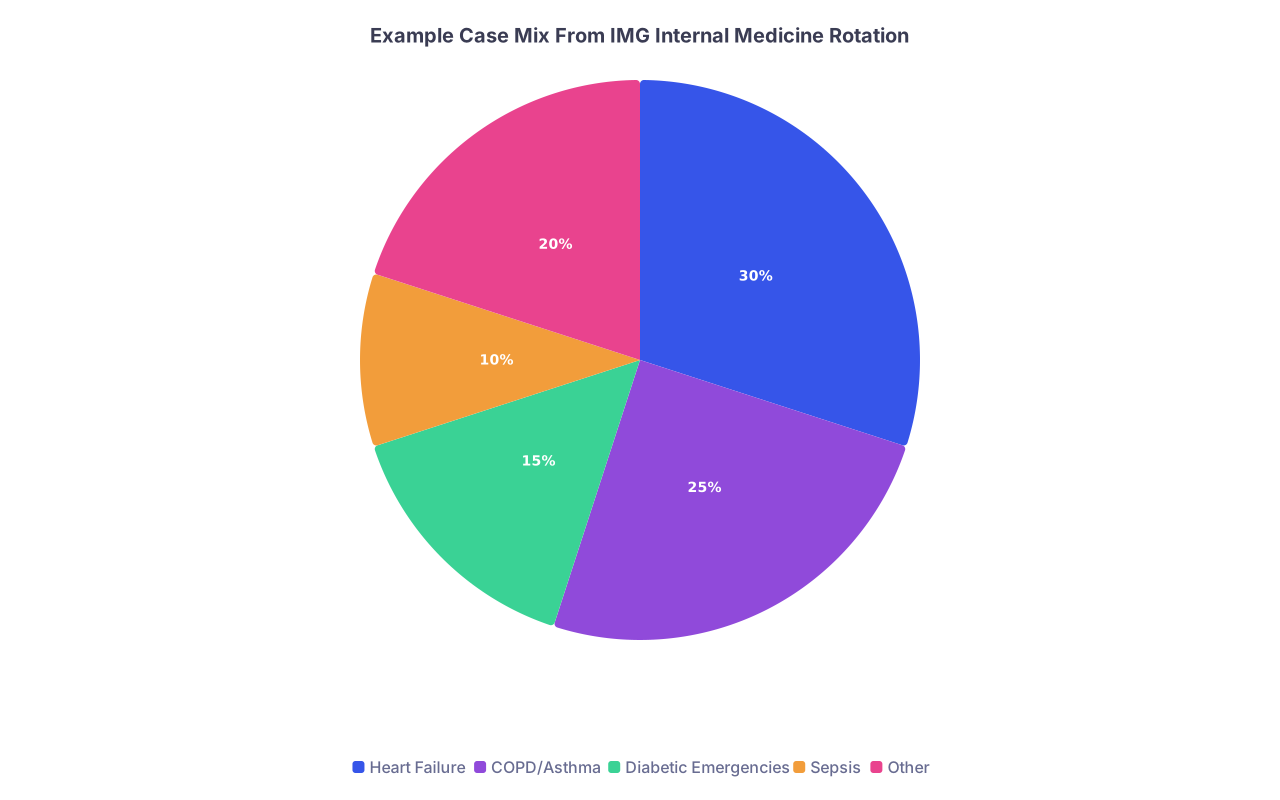
| Category | Value |
|---|---|
| Heart Failure | 30 |
| COPD/Asthma | 25 |
| Diabetic Emergencies | 15 |
| Sepsis | 10 |
| Other | 20 |
3. Audit and QI Projects: The IMG’s Best Friend
If you are outside a major research university, chasing randomized trials is fantasy. But audits and quality improvement (QI)? Absolutely within reach.
And committees love them because audits look like what they actually do in residency: M&M conferences, QI meetings, process reviews.
Let me break the structure down.
3.1 What Counts as an “Audit” or QI Project?
An audit is not: “We saw a lot of diabetics.” That is just observation.
A clinical audit / QI project usually has:
- A standard or guideline (what should be happening)
- Measured current practice (what is actually happening)
- A gap
- An intervention
- Re‑measurement or at least a plan for follow‑up
Classic examples for IMGs:
- “Audit of antibiotic prescribing for community‑acquired pneumonia compared to IDSA guidelines”
- “Improving documentation of VTE prophylaxis risk assessment on medical wards”
- “Screening rates for HbA1c in diabetic patients in primary care clinic”
- “Time from triage to analgesia in ED patients with long bone fractures”
The bar is not “published in NEJM.” The bar is: structured, guideline‑linked, with numbers and at least an attempted change.
3.2 How to Design a Simple but Solid Audit
Step 1 – Pick a narrow, clinically relevant question.
Something that could plausibly matter to patient care and that you can measure from existing charts.
Example: “Are we prescribing appropriate prophylactic anticoagulation for high‑risk medical inpatients according to ACCP guidelines?”
Step 2 – Define standards and targets.
E.g.:
- Standard: ACCP guideline recommends pharmacologic VTE prophylaxis for hospitalized medical patients with Padua score ≥4, absent contraindications.
- Target: ≥90% of high‑risk patients should receive appropriate prophylaxis documented within 24 hours of admission.
Step 3 – Decide data sources and sample.
For a student‑level audit, 50–150 patients is fine.
- Inclusion: adults admitted to general medical ward over 1‑month period.
- Exclusion: patients on full‑dose anticoagulation for other indications, surgical patients, etc.
Step 4 – Collect data into a simple sheet:
- Age, sex
- Diagnosis category
- VTE risk score (or simplified high vs low risk)
- Whether prophylaxis was prescribed
- Timing
- Any clear contraindication documented
Step 5 – Analyze compliance.
“How many high‑risk patients got prophylaxis?”
“How many had explicit reasons documented for not receiving it?”
Step 6 – Propose and/or implement change:
- Present findings at department meeting.
- Suggest admission checklist revision or order set change.
- Create simple reminder on front of admission form.
Step 7 – Re‑audit (if possible).
Even if you move away, you can at least document that a second cycle was “planned and handed over,” though actually participating in re‑measurement is better.

| Step | Description |
|---|---|
| Step 1 | Choose Topic |
| Step 2 | Define Standard |
| Step 3 | Collect Data |
| Step 4 | Compare to Standard |
| Step 5 | Report Compliance |
| Step 6 | Plan Change |
| Step 7 | Implement Change |
| Step 8 | Re-audit |
| Step 9 | Gap Identified? |
3.3 How to Package an Audit for Committees
You must resist the urge to just write “Did an audit on VTE prophylaxis.” That screams “padding.”
For ERAS / CV, use a structured description that sounds like this:
- “Clinical Audit – VTE Prophylaxis in Medical Inpatients, ABC Hospital
Retrospective review of 102 consecutive medical admissions comparing use of pharmacologic VTE prophylaxis against ACCP guidelines. Identified under‑prescription in 28% of high‑risk patients without documented contraindications. Presented findings at departmental meeting; proposed inclusion of VTE risk assessment checkbox in admission proforma.”
No need for paragraphs. One tight bullet like that is enough.
If you produced a poster locally, add:
- “Presented at XYZ Hospital Quality Improvement Day (2023), awarded ‘Best Student QI Project’.”
For personal statement:
“I realized my interest in systems‑based practice while conducting a VTE prophylaxis audit on our general medicine ward, where 28% of high‑risk patients were not receiving anticoagulation despite no documented contraindication. Working with my supervisor, we proposed a simple checklist addition to the admission template. That experience taught me how small process changes can meaningfully reduce preventable harm.”
Now your audit is not just a checkbox. It is a narrative point.
3.4 Good vs Weak Audit Topics for IMGs
You want things that:
- Have clear external guidelines
- Are easily measurable from charts
- Fit the setting you actually worked in
Examples that work well:
- Hypertension control in clinic (BP target attainment)
- Diabetic foot exam documentation rates
- Time to antibiotics in sepsis / suspected sepsis
- Pain assessment documentation on post‑op ward
- Smoking cessation advice in COPD clinic patients
Examples that sound unimpressive or vague:
- “Audit of general ward care quality” (too broad)
- “Audit of patient satisfaction” with 10 patients (subjective and tiny)
- “Audit of adherence to all hospital protocols” (unrealistic)
Keep it sharp and specific.
3.5 Numbers You Should Mention
Audit / QI is one place where data makes or breaks you. Include:
- Sample size (even if modest)
- Baseline compliance rate vs target
- Any measurable change after intervention (even partial)
Example:
“We reviewed 60 ED patients with long‑bone fractures and found only 45% received analgesia within 30 minutes of triage. After introducing a nurse‑driven analgesia protocol, this improved to 70% over the following month.”
Nobody expects a randomized controlled trial. They do expect evidence you know how to count and compare.
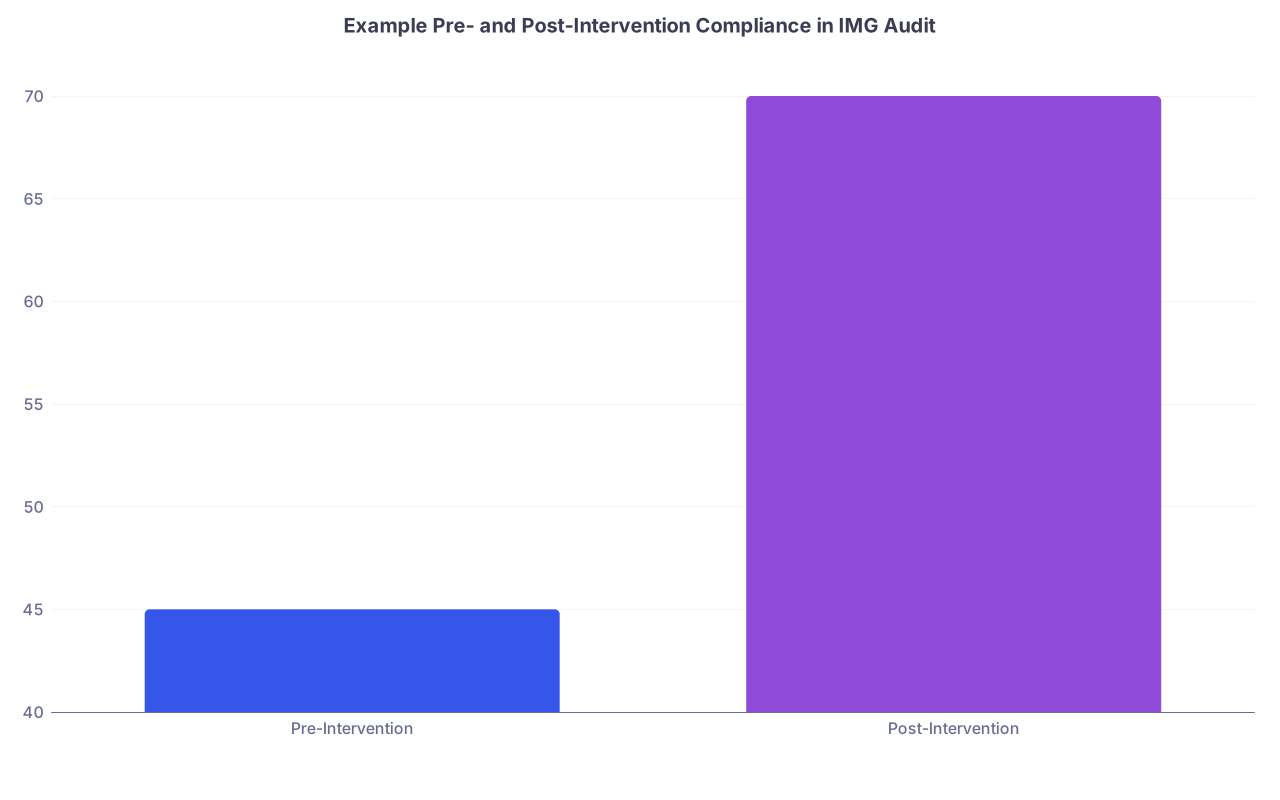
| Category | Value |
|---|---|
| Pre-Intervention | 45 |
| Post-Intervention | 70 |
4. Integrating Case Logs and Audits Across Your Application
These things only really impress when they are integrated, not floating as random bullets.
You want a coherent story where:
- Your case logs show meaningful exposure in your target specialty
- Your audits show you engaging with quality and systems in that same environment
- Your personal statement narrates how those experiences shape your motivation and readiness
- Your letters reinforce: “Yes, this person really did do what they claim”
4.1 In ERAS / CV
Aim to have:
1–2 bullets under each major clinical experience that reference your case log:
- “Maintained prospective case log of 95 internal medicine inpatients over 8 weeks, including sepsis, DKA, and decompensated heart failure.”
1–2 bullets in the “Research / QI” or “Scholarly Activity” section for each audit:
- “Clinical audit on antibiotic prescribing for CAP in accordance with IDSA guidelines (n=80); identified 35% non‑compliance; results presented at departmental grand rounds.”
If you have space for uploaded documents (common in non‑US systems), include:
- “Clinical Exposure Summary – Internal Medicine (Case Log Overview)”
- “Audit Report – VTE Prophylaxis in Medical Inpatients, 2023”
Do not send 40 pages. 2–3 pages each is sufficient.
4.2 In the Personal Statement
Be surgical. A few sentences is enough:
“I learned to treat each patient as part of a broader pattern during my internal medicine rotation at XYZ Hospital, where I maintained a prospective log of 120 inpatients and noticed recurring issues with VTE prophylaxis. This led me to design a small audit comparing our practice to ACCP guidelines, revealing under‑use of prophylactic anticoagulation in high‑risk patients. That project showed me how data and bedside care intersect, and has made me especially drawn to residency programs that emphasize quality improvement.”
You do not need every detail. Just enough to prove you did real work.
4.3 In Interviews: Typical Questions and How to Answer
Expect:
- “Tell me about your QI or research experience.”
- “You mentioned an audit on your CV; what did you find?”
- “How did you ensure your case log was accurate?”
- “What challenges did you face in conducting that project?”
You answer with structure.
For an audit:
- One‑line question: “We wanted to know whether we were prescribing VTE prophylaxis appropriately for high‑risk medical inpatients.”
- Method: “We reviewed 100 consecutive admissions, assessed risk and compared actual prescriptions to ACCP guidelines.”
- Findings: “About 30% of high‑risk patients did not receive prophylaxis without any documented contraindication.”
- Action: “We presented to the department and proposed adding a VTE checklist to the admission form; the team agreed to pilot this over the next month.”
For case logs:
“I kept a prospective log during my internal medicine and ED rotations. After each shift, I entered age, diagnosis, my role, and key interventions. I then summarized the data into counts by diagnosis and setting to understand my own exposure and be transparent in my application.”
If you cannot talk about your project in 60–90 seconds, you either do not understand it or you are overcomplicating it.
5. Common Mistakes IMGs Make — And How to Avoid Them
I have seen the same sloppy errors over and over on IMG applications.
Let me be blunt.
5.1 Inflated Numbers with No Documentation
“Managed over 1000 patients in internal medicine alone.” No dates. No details. No logs.
This smells like exaggeration. Committees are not stupid.
Fix: Use realistic counts backed by logs. If you say 120 inpatients over 12 weeks, that is plausible. If you say 2500 in one year as a student, it is not.
5.2 Vague Audits with No Standard
“Did an audit on diabetes in clinic.” That means nothing.
Fix: Always state the standard. “Compared HbA1c monitoring intervals with ADA guidelines” is already better.
5.3 Patient Identifiers in Case Logs
Including names, MRNs, phone numbers in case logs you share is a fast way to get blacklisted if anyone notices.
Fix: Use only de‑identified data. Diagnosis and age are plenty.
5.4 Calling Routine Student Work an “Audit”
“Checked charts for my attending to help him with his data” is not an audit you led.
Fix: If you just helped with someone else’s project, phrase it accurately: “Assisted in data collection for clinical audit on…” If you designed the question and analysis, say “Led design and data analysis…”
5.5 Over‑focusing on Fancy Statistics
For basic audits, you need counts and simple percentages. Not multivariate regression.
Fix: Keep your language simple: “X out of Y patients (Z%) received…” That is enough.
6. Practical Roadmap: If You Are Starting from Zero
If you are reading this while still abroad or early in rotations, here is how to act this year.
Month 1–2:
- Start a simple, de‑identified case log for every clinical experience.
- Get used to entering data after each shift (takes 5 minutes).
Month 2–3:
- Look around your ward/clinic for obvious process problems: missed prophylaxis, delayed labs, poor documentation.
- Talk to a supportive attending about doing a small audit. Ask: “Is there any small clinical process you think we could measure and try to improve?”
Month 3–5:
- Design and run one focused audit with 50–150 charts.
- Do basic counts and percentages.
- Present locally (department meeting, teaching conference).
Month 5–6:
- Convert case logs into 1–2 page summary tables.
- Polish the audit into a 1–2 page structured report (background, methods, results, conclusion).
- Draft precise bullets for your CV.
If you are closer to application season and cannot do a full audit cycle, you can still:
- Organize your existing scattered clinical exposure into a clear case log summary.
- Write up any past quality-related work as structured audit descriptions, even if small.
7. Example: Putting It All Together For an IMG Applicant
Let me give you a composite example of how this looks on paper.
Say you are an IMG applying to internal medicine. You have:
- 12‑week internal medicine rotation overseas
- 8‑week US inpatient IM observership/externship
- One small audit on diabetic foot exam documentation in clinic
Your ERAS experience entry for the overseas rotation might be:
“Internal Medicine Sub‑Internship – University Hospital, Country X
- Contributed to care of 110 adult inpatients across 12 weeks, including 32 decompensated heart failure, 18 COPD exacerbations, and 14 DKA admissions, documented in a prospective case log.
- Functioned as primary student provider for daily assessment and note‑writing in 60 patients under direct supervision, and presented 4–6 patients on daily ward rounds.”
Under “Research / QI”:
“Clinical Audit – Diabetic Foot Examination Documentation, University Clinic, Country X
- Retrospective review of 80 diabetic patients over 3 months to assess documentation of annual foot examinations compared with ADA recommendations.
- Identified that only 40% had documented foot examinations; findings presented at clinic meeting and a standardized ‘diabetic foot exam’ checkbox was added to the EMR template.”
Then you attach:
- “Internal Medicine Case Log Summary (University Hospital)” – a 2‑page PDF with tables like the sample I showed and a short explanation.
In your personal statement, a short paragraph connects these:
“Maintaining a prospective case log during my internal medicine sub‑internship showed me where our care patterns were strong and where they were inconsistent. I was particularly struck by the variation in how we screened for diabetic complications, which led me to conduct a small audit of foot examination documentation in our clinic. Discovering that only 40% of our patients had a recorded exam, and then helping implement a simple EMR prompt to address that gap, made quality improvement feel concrete and achievable. I hope to expand that skill during internal medicine residency, where I can combine bedside care with systematic improvement.”
This is coherent. Measured. And it makes you look like someone who is already thinking and working at resident level.
FAQ (exactly 6 questions)
1. Do US residency programs actually read attached case logs or audit reports, or is this a waste of time?
They rarely read every line of a 10‑page document, but they absolutely notice when you list a “Clinical Exposure Summary” or “Audit Report” and then back it up in your CV and interviews. The real value is not them reading your spreadsheet; it is how the existence of those logs lets you write and talk in quantified, credible terms. Program directors are used to vague descriptions. When you say, “I kept a prospective log of 100+ internal medicine inpatients and summarized my exposure,” you stand out even if they never open the PDF.
2. How many patients do I need in my case log for it to look serious?
There is no magic number, but patterns matter more than raw volume. For a 4–12 week rotation, something in the 40–150 patient range is realistic and believable. If you only have 20–30, you can still summarize them; just be honest. Extremely large claims (e.g., “500+ patients in 4 weeks”) without structured documentation look inflated. Better to have a smaller, clearly described log than a huge, unbelievable one.
3. Can I create a case log retrospectively from memory or old notes?
You can reconstruct some of it, but retrospective logs are naturally less precise. If you are going to do this, be conservative with numbers and focus on approximate counts and case types instead of pretending you have exact figures. Do not invent data. You can say, “Based on review of my rotation notes and discharge summaries, I estimate I followed approximately 60–70 inpatients over 8 weeks, predominantly with cardiovascular and respiratory diagnoses.” Going forward, keep a prospective log so that you do not have to guess.
4. What if my audit did not show improvement or the intervention was never implemented?
That is not fatal. Committees know real‑world change is messy. You still frame the project around the question, method, and findings. For example: “Identified that only 35% of eligible patients received X according to guideline; proposed changes are under departmental review.” It is more honest and still proves that you can think critically, measure practice against standards, and work within a team. An honest negative or incomplete audit is still better than no structured project at all.
5. How do I avoid violating patient privacy with logs and audits?
You strip all direct identifiers before anything leaves the clinical system. No names, no MRNs, no addresses, no telephone numbers. Age in years and general diagnosis are safe. If you are working with electronic records, you either use hospital‑approved data export tools under supervision or you collect data manually into a de‑identified sheet. If you are unsure, ask a supervising physician explicitly: “I want to keep a de‑identified educational case log for my learning and portfolio; can you review my format to ensure it is compliant?”
6. Does a small, well‑done audit really matter as much as a big research paper for IMGs?
For many IMGs, especially those from schools without research infrastructure, a small but rigorous audit is actually more believable and more closely aligned with residency training than a random “co‑author” position on a distant lab project. Program directors want to see evidence that you can think in terms of guidelines, systems, and quality improvement. A cleanly executed 80‑patient clinical audit that you can explain clearly in 60 seconds often does more for your application than a superficial name on a large paper you barely understand. Ideally, you have both. But if you must choose, a strong audit plus well‑built case logs is a very respectable scholarly foundation.
Key points: Build structured, de‑identified case logs and summarize them into credible numbers. Design at least one focused, guideline‑linked audit with clear methods and findings. Then integrate both across your CV, personal statement, and interviews so that you look less like a drifting IMG and more like a resident who already thinks in data, systems, and responsibility.