The biggest threat to an IMG residency application is not your USMLE score. It is a clerical visa or documentation error that gets you auto‑rejected before a human ever reads your file.
I have watched strong applicants—250+ on Step 2, glowing letters, solid USCE—quietly disappear from interview lists because of one incorrect box on ERAS or one missing visa PDF. No discussion. No appeal. Just filtered out.
If you are an IMG, you cannot afford to be casual about this part of the process.
1. The “Visa? Yes.” Checkbox That Destroys Your Application
Let me start with the most common, quiet killer: lazy or inaccurate visa answers on ERAS.
Programs often use a hard filter on:
- “Requires visa sponsorship: Yes/No”
- “Citizenship”
- “Permanent Resident”
- “Eligible to work without sponsorship”
If your answers do not match their sponsorship policy, your application never reaches a human.
The classic mistakes
Marking “US Citizen/Permanent Resident” when you are not
Some applicants think: “I have an EAD / pending green card / Canadian citizenship / spouse is a US citizen—close enough.”
No. That is misrepresentation. And programs notice when:- Your ERAS says “US Citizen”
- But your passport in the ID upload is clearly foreign
Or - Your CV lists years abroad with no US immigration status
You can be quietly blacklisted by a program (and sometimes by an entire institution) for this.
Checking “No visa sponsorship required” when you are on:
- F‑1 STEM OPT
- J‑2 EAD
- TPS with EAD
- Any temporary work authorization that will expire during residency
Programs know they will need to sponsor you long‑term. If your status will not clearly last through all years of training without new sponsorship, you are effectively “requires sponsorship.”
Checking “Yes—any visa” when you absolutely do not qualify for certain visas
Example:- Claiming you can take H‑1B but you have failed Step 3 or never taken it
- Saying “J‑1 or H‑1B” when your home country or contract obligates you to return or keeps you from J‑1
Some programs screen for “H‑1B eligible only.” If you say “H‑1B” and then later cannot actually get it, they feel deceived.
How to avoid this
Sit down and create a brutally honest status snapshot:
| Item | Your Answer (Yes/No / Details) |
|---|---|
| Current visa type | |
| Expiration date (MM/YYYY) | |
| Requires sponsorship for PGY1 | |
| Requires sponsorship beyond 1 year | |
| Eligible for J-1 | |
| Eligible for H-1B (Step 3 passed, etc.) |
Then put only what survives that reality check into ERAS.
Do not guess. If you are uncertain, you talk to:
- Your current DSO/ISO (if F‑1)
- An actual immigration attorney
- The ECFMG EVSP guidelines (for J‑1)
Today, not in October.
2. The J‑1 vs H‑1B Fantasy Problem
The second category of auto‑rejection errors: not understanding which visas programs actually use and what they require.
Most IMGs overestimate their real H‑1B eligibility and underestimate how rigid J‑1 rules are.
Hard truth: Most programs default to J‑1
Look at any set of program websites for community internal medicine, FM, peds. You’ll see this pattern:
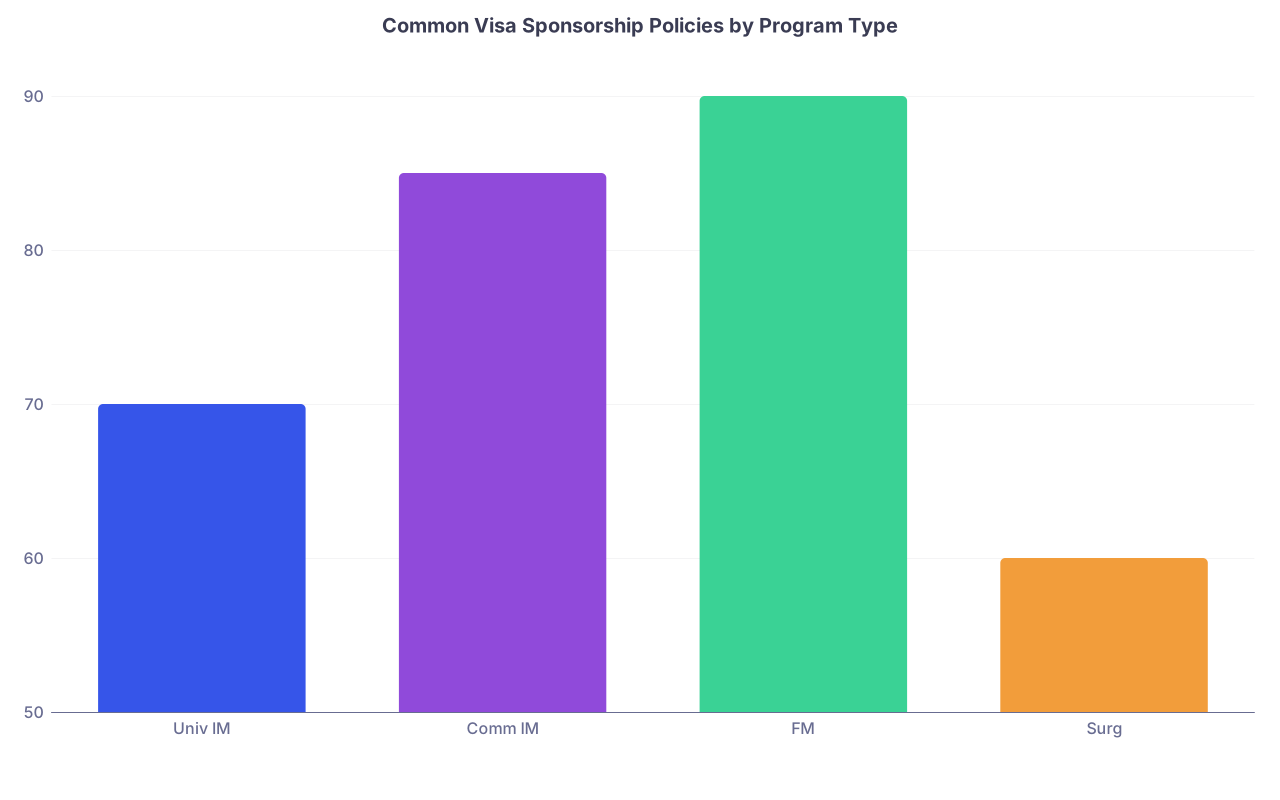
| Category | Value |
|---|---|
| Univ IM | 70 |
| Comm IM | 85 |
| FM | 90 |
| Surg | 60 |
(Think of those numbers as approximate percentage supporting J‑1 among programs that consider IMGs; H‑1B is much lower across the board, especially outside big academic centers.)
So when you put in ERAS “H‑1B only” because you “do not want J‑1,” many otherwise IMG‑friendly programs will simply never see your file. Their filter is set: must accept J‑1.
Common J‑1 documentation errors
These are the things that get you filtered or delayed until every interview slot is gone:
- Listing ECFMG certification as “pending” when you will not have it before the J‑1 deadline
- Inconsistent graduation dates between diploma, transcript, and ERAS (J‑1 requires accurate, verifiable documents)
- Missing or mismatched passport details (name order, spelling, expiration)
You might still be technically eligible, but programs see “documentation headache” and move on. You do not want that label.
Common H‑1B myths that cost you interviews
I see these mistakes almost every year:
Assuming Step 3 can be taken after Match for H‑1B
Many programs require you to have passed Step 3 before they will even consider H‑1B sponsorship. If your ERAS lists “H‑1B” and Step 3: “Planned summer after Match,” they often do not bother.Assuming your school’s start date aligns with H‑1B timing
H‑1B is not flexible like J‑1. There are filing windows, caps, institutional policies. Programs that already struggle with July 1 onboarding will not gamble on a complicated H‑1B case unless they absolutely must.Saying “H‑1B preferred” with a marginal Step 2 score and no Step 3
On paper, you look like a risky, expensive hire. Some programs auto‑filter for J‑1 only just to simplify their lives.
How to avoid this
Ask yourself two blunt questions:
If a program offers me only J‑1, would I accept?
If yes, do not advertise “H‑1B only” anywhere. In ERAS or emails. You are just shrinking your pool.Do I already have Step 3 passed and documented before applications open?
If no, stop fantasizing about broad H‑1B options. Be realistic. Target the few programs that publicly say they sometimes sponsor H‑1B without Step 3 (rare), but assume J‑1 first.
Your application should present you as easy to sponsor, not as a negotiation.
3. Inconsistent Identity: Names, Dates, and “Who Are You, Actually?”
Programs and institutional GME offices are extremely sensitive to identity mismatches. They should be. Fraud exists.
If your ERAS profile, passport, ECFMG certificate, and medical diploma do not match cleanly, you trigger levels of suspicion and delay you really do not want as an IMG.
Where people mess this up
I have seen:
- ERAS name: “Maria Silva”
- Passport: “Maria da Silva Santos”
- Diploma: “Maria D. S. Santos”
- ECFMG: “Maria da Silva-Santos”
And the applicant uploads nothing explaining the variation. No name change documentation. No affidavit. No note.
A tired program coordinator combs through your file at 10 p.m. They see four different versions of your name. They are behind on 500 other applications. Guess what they do? They move on to the next applicant whose identity is simpler to verify.
Common triggers:
- Hyphenated vs non‑hyphenated surnames
- Multiple surnames in Latin American, Spanish, or Portuguese naming systems
- Marriage/divorce name changes
- Transliterations from Cyrillic, Arabic, etc.
- Missing middle name on some documents
Date mistakes that look like fraud
Small date errors cost people big:
- Graduation date on ERAS: June 2022
- Transcript says completed requirements: July 2022
- Diploma date: October 2022
If you then answer “Have you had any gaps?” as “No,” it can look dishonest. Even if it was just confusion about “requirements completed” vs “degree conferred.”
How to avoid this
You create a “documentation harmony” checklist.
Line up these documents on your screen or table:
- Passport
- ECFMG certificate
- Medical diploma
- Transcripts
- Any name change/marriage documents
- ERAS profile
Then check:
- Full legal name: same structure and spelling everywhere?
- Dates: graduation, birth, exams—consistent?
- Country of birth / citizenship: match across documents?
If there are legitimate variations, you pre‑emptively fix the confusion:
- Use your passport name in ERAS, exactly
- Add a short explanation in your CV or personal statement: “I appear as ‘Maria da Silva Santos’ on my passport and as ‘Maria Silva’ in some academic records due to cultural naming conventions. All records refer to the same person.”
- Upload supporting documents if allowed
You want a GME coordinator to glance through your papers and think: “This is clean. Easy file.”
4. Expired, Missing, or Sloppy PDFs That Trigger Instant “No”
Programs are not chasing you for missing or messy documents. They do not have time. If something core is missing or obviously wrong, they skip you.
High‑risk items that must be perfect
Passport
Common deal‑breakers:- Passport expiring during residency period and no plan shown to renew
- Blurry photo page upload
- Cropped scans cutting off MRZ (the barcode at bottom)
- Different passport number in different places
ECFMG certificate
Issues that raise red flags:- “Expected” certificate with unrealistic date
- Old certificate uploaded, missing recent name changes
- Low resolution upload where text is unreadable
US visas / I‑20 / DS‑2019 (if currently in US)
Programs sometimes check these to estimate how much work your onboarding will be. If your upload looks chaotic—multiple overlapping statuses, unorganized pages—they imagine months of headaches.
Technical formats that quietly hurt you
Sloppy uploads scream “unprofessional” and sometimes make your application literally unreadable.
Patterns I see:
- Multiple documents stuffed into one 40‑page PDF out of order
- Sideways scans not rotated
- Phone photos of documents with shadows and fingers visible
- Cropped edge cutting school seals or signatures
When you are competing against thousands of other IMGs, why would you hand a program coordinator any excuse to say “too messy”?
How to avoid this
Set a standard: every document you upload should look like it came from a scanner at a US hospital HR office, not your bedroom floor.
That means:
- Use a real scanner whenever possible (library, office, print shop)
- Filename discipline:
LastName_DocumentType_Year.pdf
Example:Singh_Passport_2024.pdf - One document per file, clearly labeled
- Check every page is upright, not rotated
- Ensure resolution is high enough to zoom in without blurring
Then do a test: open your documents on a phone and a laptop. If you have to pinch‑zoom and squint to read basic text, rescan.
5. Lying About “ECFMG Certified” or “Graduate” Status
Programs are starting to be more aggressive about verifying that what you claim in ERAS matches what ECFMG and your school say.
If you mark:
- “ECFMG Certified: Yes” when it is actually pending
- “Medical School Graduate” when you still have outstanding requirements
You are not just making a “small error.” You are:
- Triggering instant distrust if they cross‑check early
- Risking a Match violation if the truth comes out after rank lists
Some programs simply auto‑filter all applicants whose statuses later change from “yes” to “no” or vice versa because they do not want to revisit old files.
The timing trap
People try to “time” their answers:
- “I will have Step 2 CK score by October, so I will mark it as taken.”
- “My ECFMG certificate will arrive in November, so I will put ‘Yes’ now to avoid looking weak.”
If your score gets delayed or you fail, or your certificate gets held up, you end up with a file that looks dishonest when compared to updated information.
How to avoid this
Use this rule: ERAS answers must reflect your status on the date you submit. Not your best‑case projection.
If something is pending:
- Mark it as pending
- State realistically in your CV or experiences: “Step 2 CK scheduled for August 12, 2025; score anticipated in September 2025.”
- Update programs if you later pass and the result is available
Programs can work with an honest, incomplete profile. They do not bother with a dishonest one.
6. Ignoring Program‑Specific Visa Rules (The Website Problem)
Too many IMGs treat programs as generic: “IMG friendly, accepts visas = good.” That is how you waste money and opportunities.
Programs have wildly different visa and documentation rules. Some examples I have seen:
- “We sponsor J‑1 only. No exceptions.”
- “We accept only graduates from schools listed in the California Medical Board Approved List.”
- “We require proof of Step 3 for all applicants requiring H‑1B by January 15.”
- “We do not sponsor visas for preliminary positions.”
If you ignore these and apply anyway, two bad things happen:
- Your file gets filtered out by automated criteria
- You build a reputation (within that system) as someone who does not read instructions
How to avoid this
You build a small pre‑application table for yourself.
| Program Name | Visas Accepted | Step 3 Required for H-1B | J-1 Only? |
|---|---|---|---|
| Program A | J-1 | N/A | Yes |
| Program B | J-1, H-1B | Yes | No |
| Program C | None | N/A | Yes |
| Program D | H-1B only | Yes | No |
You do this before you spend a single ERAS token.
If the website is unclear, you email the program coordinator with a specific, short question. Not: “Do you sponsor visas?” They hate that.
Ask: “Dear Ms. [Last Name], I am an IMG requiring J‑1 sponsorship through ECFMG. Does your program currently consider applicants requiring J‑1 visas for categorical internal medicine positions?”
If there is no response, you assume the worst (no sponsorship) unless multiple recent residents obviously had visas.
7. Sloppy Timelines and Gaps That Look Like Immigration Issues
Residency offices worry about two things with IMGs:
- Can this person legally be here to start on July 1?
- Are there unexplained time gaps that might hide immigration or professionalism problems?
If your timeline is messy, they often choose not to find out. They skip you.
Where timelines go wrong
Common patterns:
- Six‑month “gap” between graduation and US arrival with no explanation
- Multiple short observerships listed but no clear full‑time activity
- “Studying for exams” for 2+ years with no structured position
- Overlaps that do not make sense (full‑time job in one country while being “full‑time extern” in the US)
This is where coordinators and PDs start asking themselves:
- Were they out of status?
- Were they denied visas before?
- Did they have professional issues they are hiding?
You do not want to invite those questions.
How to avoid this
You make your timeline boringly clear.
Write out, month‑by‑month from graduation to present, what you were doing and where. Then compare that to what you put in ERAS experiences.
Every gap longer than 2–3 months should have:
- A legitimate activity (research, family care, structured prep, job)
- A consistent location
- Honest description
If you had a complicated immigration history (visa denials, changes of status), you do not need to detail everything. But your professional timeline must still make sense and match your documents (entry stamps, I‑94s, etc.).
8. Underestimating How Fast Filters Kill IMG Files
This is the part most IMGs do not emotionally accept: by the time anyone decides if they “like” you, 60–80% of the damage is already done by filters and documentation flags.
Think of a typical large internal medicine program with 4,000+ applications. For IMGs, the path often looks like this:

| Step | Description |
|---|---|
| Step 1 | All Applications |
| Step 2 | Auto-Reject |
| Step 3 | Human Review |
| Step 4 | Meets Score Cutoff? |
| Step 5 | Visa Status Acceptable? |
| Step 6 | ECFMG/Grad Status OK? |
| Step 7 | Docs Clean & Complete? |
Notice where visa and documentation sit: before human review.
You might be the most personable, clinically gifted candidate in the pile. If your documentation causes you to fail node C, D, or E, no one will ever know.
9. The “I’ll Fix It After Match” Delusion
One more dangerous mindset: “I just need to get matched. I can sort out the visa later.”
No. Programs and their GME offices know very well that a visa mess can destroy an entire residency year. They are not gambling on applicants whose paperwork looks shaky from the start.
Patterns that scare them away:
- Very short passport validity with no evidence you understand renewal timelines
- Previous US visa denials with no context
- Multiple previous US statuses (F‑1, then B‑2, then out of status) not cleanly resolved
- Vague or evasive answers about home country return obligations for J‑1
If your situation is complex, you need to demonstrate the opposite of denial: clear understanding and evidence you have competent legal guidance.
That means:
- Not overpromising in ERAS
- Having letters or emails from immigration counsel (for your own planning)
- Being ready with a precise explanation if asked, not a vague story
Programs are much more willing to work with a complicated but transparent case than with a “it will be fine” fantasy.
10. Build a Pre‑ERAS Visa & Docs Audit (Non‑Negotiable)
If you do only one thing after reading this, do this: run a full pre‑ERAS visa and documentation audit before you ever click “Certify and Submit.”
Break it down across a few days. Do not rush this in one late‑night session.
Day 1 – Identity and core documents
- Passport: name, number, expiration, clear scan
- Diploma and transcript: consistent dates, names
- ECFMG: exact name, status, certificate image
Day 2 – Status and eligibility
- Current visa or immigration status summary in writing
- Honest assessment: will I require sponsorship on July 1?
- J‑1 vs H‑1B realistic eligibility checked against ECFMG and exam status
Day 3 – ERAS alignment
- Names match passport
- Dates across ERAS, CV, documents aligned
- Gaps in training/residency-ready timeline explained
- Visa questions answered according to reality, not wishful thinking
Day 4 – Program targeting and documentation polish
- Shortlist programs by visa policy using a simple table
- Review every uploaded PDF for clarity, orientation, and legibility
- Rename files with professional filenames
- Fix any messy scans
You want your future program coordinator to think, “This person’s file was a relief to open,” not “Why is every document a problem?”
Open your ERAS application and your passport right now. Compare every letter of your name and every key date between them. If you spot even one mismatch, start a written list of fixes—and do not submit a single application until every item on that list is resolved.