
Most IMGs waste half their application budget on programs that will never sponsor their visa. That is a fixable problem.
You cannot afford a “spray and pray” strategy. Not with ERAS fees. Not with exam attempts. And definitely not with immigration in the mix. If you are an IMG who needs a visa, your entire match strategy must begin with one question:
Will this program actually sponsor me, this year, for my visa type?
Let me walk you through a structured, repeatable system to get that answer. Not guesses. Not rumors. A real, working pipeline that produces a filtered list of truly visa‑friendly programs you can apply to with intent.
Step 1: Get Brutally Clear On Your Own Visa Reality
You cannot target “visa‑friendly” programs if you are fuzzy about your own situation. Programs are not just “IMG‑friendly” or “visa‑friendly.” They are:
- Visa‑type specific
- Policy‑change prone
- Risk‑averse with prior attempts and gaps
1. Clarify your exact visa need
You are in one of these buckets:
- You need J‑1 sponsorship through ECFMG
- You need H‑1B sponsorship directly from the program
- You are open to either J‑1 or H‑1B
- You already have work authorization (e.g., green card, EAD, Canadian citizen on TN for some roles)
If you:
- Have not taken Step 3 → You are pushed toward J‑1. Most H‑1B‑sponsoring programs require Step 3 passed before they rank you.
- Have multiple attempts → Some H‑1B‑sponsoring programs will hard‑filter you out.
- Have graduation > 5–7 years ago → More programs will already be hesitant; visa sponsorship makes them even more selective.
Write down, explicitly:
- “I will need J‑1” or
- “I will need H‑1B and will take Step 3 by [date]” or
- “I am open to J‑1 or H‑1B, but I prefer [one] because [reason].”
If you cannot say that in one sentence, you are not ready to build your list.
2. Accept the J‑1 vs H‑1B tradeoff
Stop romanticizing H‑1B. It is more restrictive, more expensive for programs, and fewer programs sponsor it. It may be the right choice for you, but you need to be realistic.
Here is the core tradeoff:
| Factor | J-1 (ECFMG Sponsored) | H-1B (Program Sponsored) |
|---|---|---|
| Number of sponsoring programs | High | Much lower |
| Step 3 required before start | No | Usually yes |
| 2-year home residency requirement | Yes | No |
| Program cost/administration | Lower | Higher |
| Flexibility after residency | Lower initially | Higher |
If you are early in the process and do not have Step 3, optimize your target list around J‑1‑friendly programs first, then layer on H‑1B if realistic.
Step 2: Build a Master Program List Before You Filter Anything
You cannot systematically target visa‑friendly programs if you start from a half‑baked, rumors‑based list. Start wide, then cut down.
1. Gather raw program data from multiple sources
Use at least these:
- FREIDA (AMA) – official but often incomplete or outdated on visa details
- Program websites – better for current policy language
- NRMP charting outcomes and results data – for IMG/visa patterns
- Past match lists from IMG‑heavy schools or agencies – for real‑world sponsorship behavior
- Trusted forums and spreadsheets (but never as your only source) – Reddit, SDN, WhatsApp groups, etc.
You are not curating yet. You are collecting.
2. Build a simple tracking spreadsheet
Do not keep this in your head. You will forget. You will mix up programs. Then you will waste money.
Set up a spreadsheet (Excel, Google Sheets, whatever) with at least these columns:
- Program name
- ACGME ID
- Specialty
- State
- City
- University vs community
- Website URL
- FREIDA link
- J‑1 sponsorship (Yes/No/Unclear)
- H‑1B sponsorship (Yes/No/Unclear)
- Step 3 required for H‑1B (Yes/No/N/A)
- Recent IMGs in residents list (Yes/No/Not visible)
- Explicit statement about visas (quote or summary)
- Last confirmed year of visa data (e.g., 2024 website, 2023 FREIDA)
- Red flags / notes
This sounds tedious. It is. Do it anyway. You will reuse this sheet for years and possibly for multiple specialties.
Step 3: Extract Visa Policy from Official Sources First
Now you turn the raw list into a filtered, semi‑reliable picture of visa friendliness. You start with what programs say publicly.
1. FREIDA: Fast but not enough
On FREIDA:
- Filter by specialty and state.
- On each program page, look for “Sponsorship of J‑1” and “Sponsorship of H‑1B.”
- Record in your sheet exactly what you see.
But treat FREIDA as a starting point, not the final word. I have seen programs listed as “H‑1B: Yes” that dropped H‑1B three years ago, and others listed as “No” that quietly sponsor case‑by‑case.
2. Program website: More accurate, still not perfect
Go to each program’s website and hunt, systematically:
Look under:
- “Eligibility”
- “Application Requirements”
- “International Medical Graduates”
- “FAQ”
- “For Applicants”
You are looking for explicit phrases like:
- “We sponsor J‑1 visas only through ECFMG.”
- “We do not sponsor visas of any kind.”
- “We accept J‑1 and H‑1B visas.”
- “We may consider H‑1B visas for highly qualified candidates who have passed USMLE Step 3.”
- “Applicants must have US citizenship, permanent residency, or employment authorization. The program does not sponsor visas.”
Copy‑paste that exact text (with date) into your notes. It is evidence.
Then categorize:
- J‑1 only
- J‑1 + H‑1B
- H‑1B selectively
- No sponsorship
- Ambiguous / not mentioned
3. Spotting coded language
Programs sometimes try to be polite instead of straightforward. Learn to read between the lines:
- “Due to institutional policies, we are unable to sponsor visas at this time.” → They do not sponsor. Move on.
- “International graduates must be eligible for ECFMG sponsorship.” → J‑1 only.
- “We do not accept H‑1B transfer applicants.” → Might still sponsor H‑1B for new residents; needs clarification.
- “We prioritize applicants with US citizenship or permanent residency.” → They might still sponsor, but will be very selective.
If the website is vague or silent about visas, mark the program as “Unclear – needs direct confirmation.”
Step 4: Verify Visa Sponsorship with Real‑World Behavior (Not Just Words)
Programs lie? Not exactly. But their websites lag behind reality. Funding changes. GME office changes. Chair changes. Suddenly a “J‑1 + H‑1B” program quietly stops H‑1B.
So you cross‑check with what they have done, not just what they say.
1. Review current residents
Go to the “Current Residents” or “Our Residents” page:
- Look at names, medical schools, sometimes countries.
- Confirm: Are there recent IMGs (last 1–3 years)?
- Are those IMGs from non‑US/Canadian medical schools?
- For those with LinkedIn or Doximity profiles (quick search by name + specialty + hospital), you can sometimes see their visa type.
If you see:
- Resident bio: “Originally from India, completed medical school at XYZ, currently on J‑1 visa” → Strong J‑1 evidence.
- Many non‑US grads in recent classes → Likely comfortable with visas.
- Only US/Caribbean grads for the past 5 years → Lower visa probability, even if policy says “we accept IMGs.”
2. Use match lists and crowdsourced data carefully
IMGs obsessively document where visa candidates match. Use that.
Use:
- Public “Match lists” from Caribbean schools and big IMG feeders (e.g., St. George’s, AUC, Ross, some Eastern European schools).
- Shared Google Sheets in forums listing “H‑1B IMG matches 2023” or similar.
- Reddit / SDN match threads where people mention “matched on H‑1B at [Program].”
What to do with this:
- Add a column “Recent visa match confirmed” and mark programs where you see an IMG explicitly stating J‑1 or H‑1B sponsorship in 1–2 recent years.
- Give those programs more weight than ones with only vague old website statements.
Do not trust anonymous comments that say “they never sponsor visas” with no specifics. Look for:
- Screenshots
- Name + year + visa type
- Consistent confirmations from different cycles
Step 5: Contact Programs Correctly (Without Burning Bridges)
Now you narrow your “Unclear” and “Maybe” programs with direct communication. This is where most IMGs mess up. They send essays. They ask for exceptions. They overshare.
Your goal is not to convince them to sponsor you. Your goal is to get binary information: Do you currently sponsor [my visa type] for incoming PGY‑1 [specialty] residents?
1. Who to contact
Order of priority:
- Program Coordinator – usually the right first contact.
- Program Administrator / GME Office – especially for institution‑wide visa policies.
- Program Director – only if the website or coordinator cannot answer, or if the program itself suggests contacting the PD.
Use the contact emails listed on:
- The program’s official site
- FREIDA
- Institution GME office pages
2. How to write the email (keep it surgical)
You are asking a yes/no policy question, not sending a mini‑personal statement. Something like this:
Subject: Quick Question on Visa Sponsorship – [Specialty] Residency
Dear [Mr./Ms. LastName],
I am an international medical graduate planning to apply to the [Program Name] [Specialty] residency for the [2025] cycle.
Could you please confirm your current policy on visa sponsorship for incoming PGY‑1 residents?
Specifically:
- Do you sponsor J‑1 visas through ECFMG?
- Do you sponsor H‑1B visas for applicants who have passed USMLE Step 3?
Thank you very much for your time.
Best regards,
[Your Name], MD
[Medical School], [Graduation Year]
[ERAS ID – if you already have it]
That is it. Short. Respectful. Easy to answer.
Do not:
- Attach your CV.
- Explain your entire immigration history.
- Beg for exceptions.
- Ask “what are my chances?”
You are a data‑gathering operation, not a supplicant.
3. How to record and use responses
In your spreadsheet, add:
- “Direct confirmation” (Yes/No)
- Date of response
- Exact wording (copy‑paste key sentence)
- Contact name
If they say:
- “We only sponsor J‑1 visas.” → Mark H‑1B as No; J‑1 as Yes.
- “We do not sponsor any visas.” → Remove from your visa‑needed list.
- “We consider H‑1B on a case‑by‑case basis for highly qualified applicants with Step 3.” → Mark as “H‑1B: selective – Step 3 required.”
If they never reply after 2 weeks and one short follow‑up, assume the website/FREIDA info is the best you will get. If both are silent or inconsistent, downgrade that program’s priority.
Step 6: Classify Programs into Practical Tiers
Once you have website, FREIDA, real‑world, and (some) email data, stop treating all “visa‑friendly” programs equally. They are not.
I use a simple 4‑tier system for IMGs needing visas.
Tier 1 – Confirmed, Consistent Visa Sponsors for IMGs
Characteristics:
- Clear written policy: “We sponsor J‑1 visas.”
- Multiple recent IMGs in current residents.
- Recent matches or public statements showing J‑1 / H‑1B sponsorship.
- Direct email confirmation this year or last year.
These are your highest‑priority applications.
Tier 2 – Likely Sponsors, Slightly Less Clear
Characteristics:
- Policy text exists but is a year or two old.
- Residents include some IMGs, but not many.
- Some indirect evidence from match lists, but not rock‑solid.
- Email response is generic but not negative.
These are reasonable targets, but not your core safety net.
Tier 3 – Ambiguous / “Case‑by‑Case” / No Recent Visa Track Record
Characteristics:
- Website is vague or silent.
- Little or no clear IMG presence recently.
- Response like “we do not typically sponsor visas” or “case‑by‑case.”
You apply here only if you have an otherwise strong alignment (regional ties, research, very high scores, etc.).
Tier 4 – Visa‑Negative or “No Sponsorship”
Characteristics:
- Explicit “We do not sponsor visas.”
- Explicit “US citizens/permanent residents only.”
- No IMGs for years, and nothing to suggest a change.
You do not apply. Stop trying to “beat the odds” here. That is application money you will never see again.
Step 7: Align Your Program List With Your Profile and Budget
A “visa‑friendly” program that is impossibly out of reach for your profile is not friendly to you. You need alignment on three things:
- Visa feasibility
- Academic competitiveness
- Application budget
1. Estimate how many programs you realistically need
IMGs who need visas usually have to apply broadly. But “broad” must still be targeted.
As a rough guideline (varies by specialty, scores, and attempts):
- High‑scoring IMG (Step 2 CK ≥ 245, no attempts, recent grad, USCE)
- 60–100 programs in Internal Medicine, 80–120 in FM/IM combined, 30–60 in less competitive specialties (Psych, Peds, etc. depending on year).
- Moderate profile (Step 2 CK 230–244, some gaps or older grad, limited USCE)
- 100–150 programs in IM/FM, more if no Step 3 and needing H‑1B.
- Lower profile / multiple attempts
- You either need extremely carefully chosen lists and likely 150+ applications, or you need to fix your profile before applying.
You then split that total across tiers:
- 40–60% Tier 1
- 30–40% Tier 2
- 10–20% Tier 3
- 0% Tier 4
2. Build a specialty‑specific targeting strategy
Certain specialties are more likely to sponsor visas. You already know the broad trends: IM, FM, Peds, Psych tend to be more visa‑friendly than Derm, Ortho, ENT.
To keep this grounded, here is a simplified example for Internal Medicine:
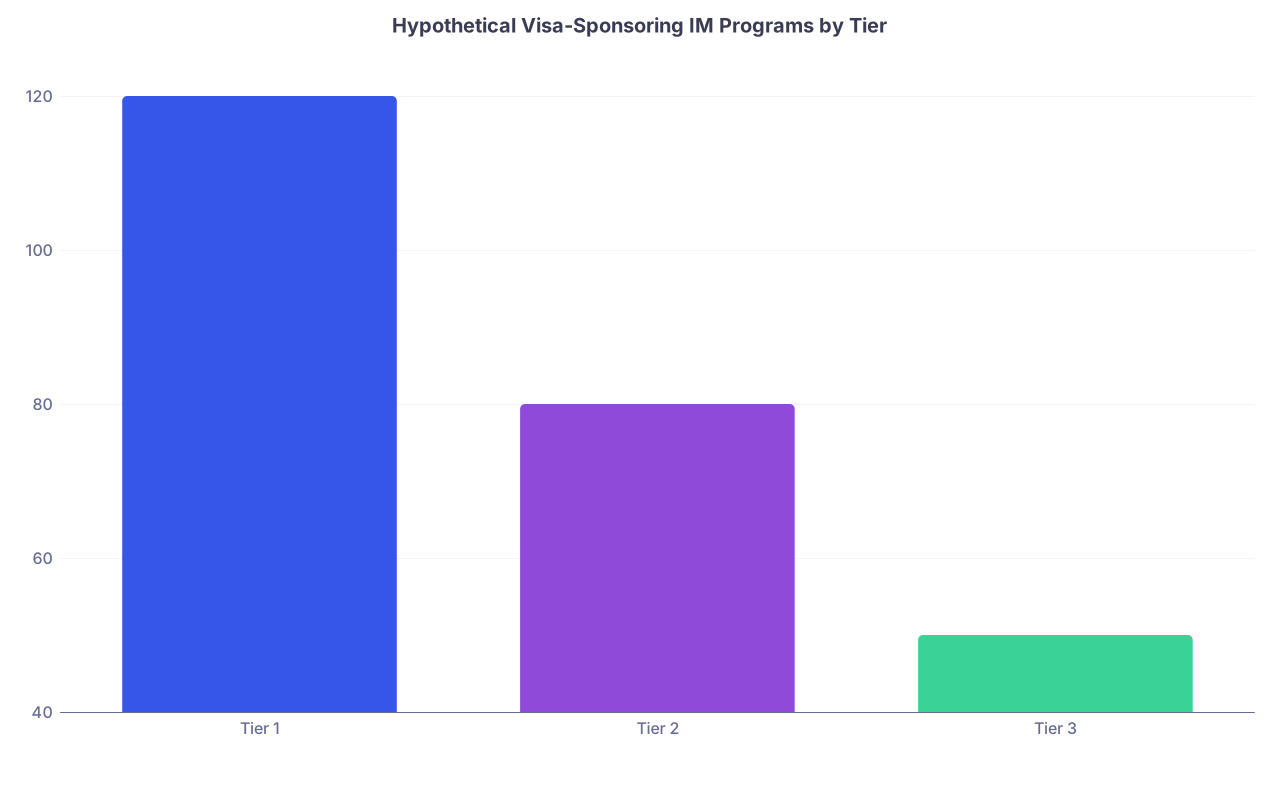
| Category | Value |
|---|---|
| Tier 1 | 120 |
| Tier 2 | 80 |
| Tier 3 | 50 |
Your goal:
- Capture as many Tier 1 IM programs that fit your basic cutoffs (YOG, attempts, Step 2 CK) as your budget allows.
- Then pad with Tier 2 for volume and diversity (geography, program type).
Step 8: Use Geography and Institutional Patterns to Your Advantage
Visa‑friendly clusters exist. Pretending all regions are equal is naive.
1. Know the friendlier regions
Historically more visa/IMG‑friendly (not universal, but patterns):
- New York, New Jersey
- Michigan
- Illinois
- Texas (especially for J‑1)
- Some parts of Florida
- Parts of Pennsylvania, Ohio
Relatively tougher on visas/IMGs overall:
- Many West Coast academic centers (California can be rough for H‑1B)
- Some New England states (highly competitive academic programs)
- Wealthy suburban programs with deep USMD applicant pools
You are not boycotting regions. You are weighting them.
2. Follow institutional policies
Major hospital systems and universities often have system‑wide visa policies that affect multiple departments:
- If one residency at Hospital X clearly sponsors J‑1, chances are others do too.
- If the institution GME page says “we only support J‑1,” assume that applies across specialties unless contradicted.
Check the institution’s GME office website directly:
- They usually state: “Residents are sponsored in J‑1 category only.”
- Or: “The institution sponsors J‑1 visas and, in limited cases, H‑1B visas.”
Mark this in your spreadsheet as an “institutional visa environment” column (e.g., “J‑1 strong,” “H‑1B rare,” “unknown”).
Step 9: Leverage Your Strengths to Prioritize Within Visa‑Friendly Programs
Visa friendliness is necessary, not sufficient. Among the programs that will sponsor your visa, you still need to pick the ones that will actually like your file.
1. Match your strengths to program preferences
Examples:
- You have strong research → Target university‑affiliated programs with active research, even if slightly more competitive.
- You have heavy clinical experience and letters from community attendings → Community and hybrid programs become prime targets.
- You are a recent grad with high scores but little USCE → Programs that advertise “score‑driven selection” or “USMLE cutoff 230+” may offset your weaker USCE.
2. Watch for explicit IMG language
Programs that make life easier for IMGs often say so:
- “We welcome applications from international medical graduates.”
- “We sponsor J‑1 visas and have a diverse resident cohort, including IMGs.”
- “ECFMG certification required prior to ranking.”
These places have already done the work to integrate IMGs. You will not be their first visa experiment.
Step 10: Turn Your System into a Timeline (So You Do Not Scramble in September)
If you wait until ERAS opens to start this research, you will either:
- Apply blindly, or
- Apply late
Both are bad for you.
Use a structured timeline.
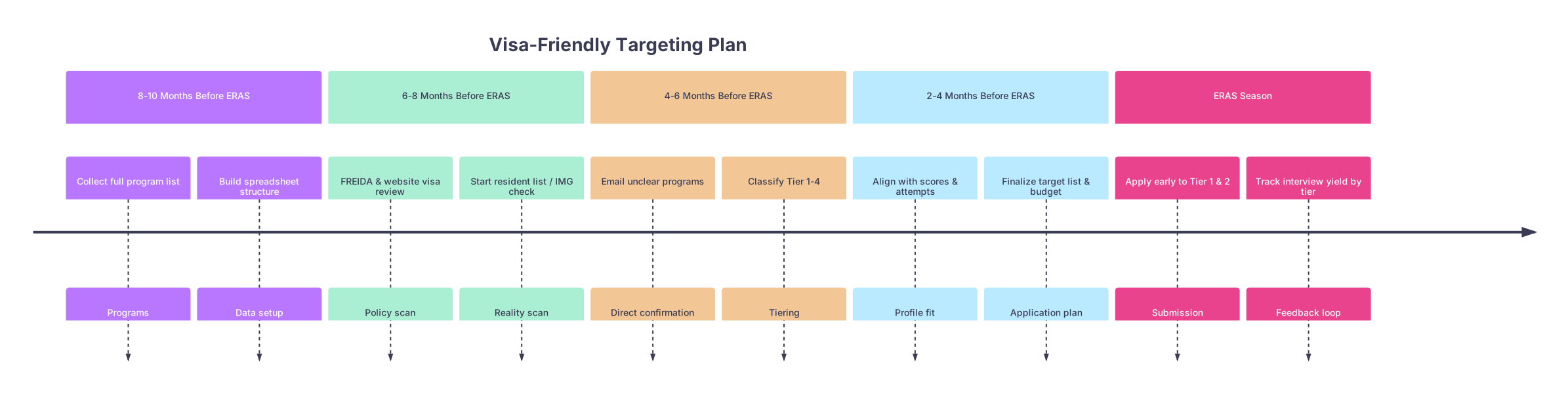
| Period | Event |
|---|---|
| 8-10 Months Before ERAS - Collect full program list | Programs |
| 8-10 Months Before ERAS - Build spreadsheet structure | Data setup |
| 6-8 Months Before ERAS - FREIDA & website visa review | Policy scan |
| 6-8 Months Before ERAS - Start resident list / IMG check | Reality scan |
| 4-6 Months Before ERAS - Email unclear programs | Direct confirmation |
| 4-6 Months Before ERAS - Classify Tier 1-4 | Tiering |
| 2-4 Months Before ERAS - Align with scores & attempts | Profile fit |
| 2-4 Months Before ERAS - Finalize target list & budget | Application plan |
| ERAS Season - Apply early to Tier 1 & 2 | Submission |
| ERAS Season - Track interview yield by tier | Feedback loop |
You want your visa‑friendly tiering done at least 2–3 months before ERAS submission. Then you spend the last weeks refining based on your final scores, Step 3, and any new info.
Step 11: Track Interview Yield by Visa Tier (So You Get Smarter Each Year)
One last thing that almost no one does: treat this like an experiment. Because it is.
During interview season:
- Add columns to your spreadsheet:
- “Interview offered (Y/N)”
- “Interview date”
- “Outcome (waitlisted, ranked, matched, rejected)”
- Later, sort by:
- Tier
- Visa type
- Program type (university vs community)
Then produce your own mini‑analysis. For example:
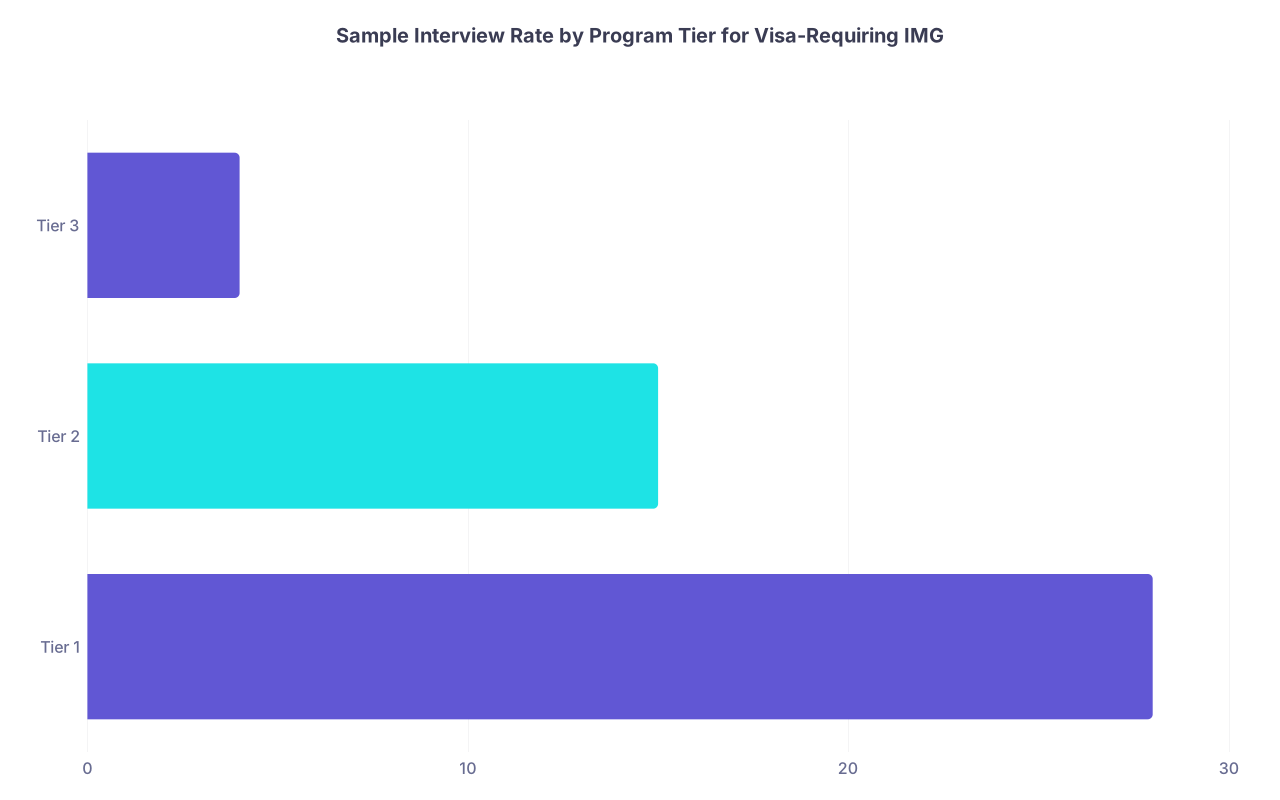
| Category | Value |
|---|---|
| Tier 1 | 28 |
| Tier 2 | 15 |
| Tier 3 | 4 |
If you see that Tier 1 programs gave you 28% interview rate and Tier 3 only 4%, you know where to pour your money and effort next time or when advising juniors.
You are building your own visa‑friendly map, not relying on outdated internet lore.
A Quick, Concrete Example Walkthrough
Let me show you what this looks like in practice for a hypothetical IMG.
Profile:
- Step 2 CK: 239, first attempt
- No Step 3 yet
- YOG: 2022
- 3 months USCE in Internal Medicine
- Needs a J‑1 (no H‑1B requirement right now)
Goal: Internal Medicine, 120 applications maximum.
Process:
Master list from FREIDA: 550 IM programs.
Spreadsheet built with all columns listed earlier.
FREIDA + website review:
- 330 programs clearly state J‑1 sponsorship.
- 70 state “no visa sponsorship.”
- 150 ambiguous.
Remove 70 clear “no sponsorship” programs. Now 480.
Resident roster review:
- Among the 330 J‑1‑declared, 260 show IMGs in last 3 classes → mark as likely real sponsors.
- Among the 150 ambiguous, 50 show clear IMGs → move to “likely J‑1 friendly,” 100 remain uncertain.
Emails to 100 ambiguous programs:
- 35 reply “J‑1 only.”
- 10 reply “no visas.”
- 55 no response.
After this:
- Tier 1: 260 + 35 = 295 programs (clear J‑1, recent IMGs, or direct confirmation).
- Tier 2: 50 with some IMG history but weaker confirmation.
- Tier 3: 55 no response, weak or unclear IMG evidence.
- Tier 4: 80 total “no visa” (70 original + 10 new).
Now apply reality filters:
- Remove programs with “YOG ≤ 3 years” if you are beyond that.
- Remove obvious hyper‑competitive academic outliers if your profile is not close.
Let us say this trims Tier 1 down to 210, Tier 2 to 40, Tier 3 to 30.
You need 120 applications:
- 75 from Tier 1
- 35 from Tier 2
- 10 from Tier 3 (only where you have some hook: geography, contacts, language, etc.)
Final step: sanity check geography, spread across academic/community, avoid heavy clustering in one state (visa policies can change regionally).
This is how you go from 550 programs and guesswork to 120 targeted, visa‑compatible applications with a clear rationale.
Visual Recap of the System
To make this even clearer, think of your process as a filter sequence.

| Step | Description |
|---|---|
| Step 1 | All Programs in Specialty |
| Step 2 | FREIDA & Website Visa Scan |
| Step 3 | Discard - Tier 4 |
| Step 4 | Resident & IMG Check |
| Step 5 | Tier 1 or 2 |
| Step 6 | Contact Program |
| Step 7 | Tier 3 - Low Priority |
| Step 8 | Any Visa Sponsorship? |
| Step 9 | Recent IMGs or Clear Policy? |
| Step 10 | Response? |
You keep pushing programs through this pipeline until you end up with a refined, rational list.
Final Takeaways
Visa strategy is not an afterthought. For IMGs, it is the backbone of your entire residency application plan. Start by defining your own visa reality and then build everything around it.
Stop guessing which programs sponsor visas. Use a structured system: FREIDA + websites + resident rosters + direct emails + real‑world match evidence. Put it all in a spreadsheet and tier programs based on verified behavior.
Treat this like data science, not superstition. Track your interview yield by tier and by program type. Refine your approach each year, and you will waste less money, avoid dead‑end programs, and give yourself a real shot at matching where your visa is actually welcome.