
The residency system is brutally unforgiving to “older grads” who have been out of medical school for 5+ years. It is not fair. But it is predictable. Which means you can engineer your way back in.
You are not “done” because you graduated in 2015 or 2010. You are done only if you treat your application like a generic IMG and hope programs will ignore the gap. They will not.
This is a re‑entry problem. And re‑entry problems need a structured roadmap, not wishful thinking.
1. Reset Your Mindset: You Are a Re‑Entry Applicant, Not a Regular IMG
Let me be blunt. Most programs see:
- Graduation year: 2017
- No US clinical in last 3–5 years
- Marginal or no ongoing clinical work
- Old scores
and they quietly screen you out. No drama. Just “no.”
You cannot afford to think like:
- “I will just apply broadly and see what happens.”
- “My old experience should speak for itself.”
- “I will tell them in the personal statement that I am motivated.”
That approach kills older grads every single cycle.
You need to think like this:
- I have a deficit (time since graduation) that must be overcompensated.
- I must prove two things relentlessly:
- I am clinically current and safe.
- I am committed to the U.S. system now, not in theory.
Everything you do for the next 12–24 months should be built around those two goals.
2. Understand How Programs See “Years Since Graduation”
Most IMGs never actually see the numbers. So they underestimate the problem.
Many internal medicine, family medicine, pediatrics, and even some psychiatry programs have unofficial filters:
- “Prefer within 3–5 years of graduation”
- “No more than 5 years out”
- “No cut‑off, but recent grads are more competitive” (translation: they still care)
Some programs publish it. Many do not, but follow it internally.
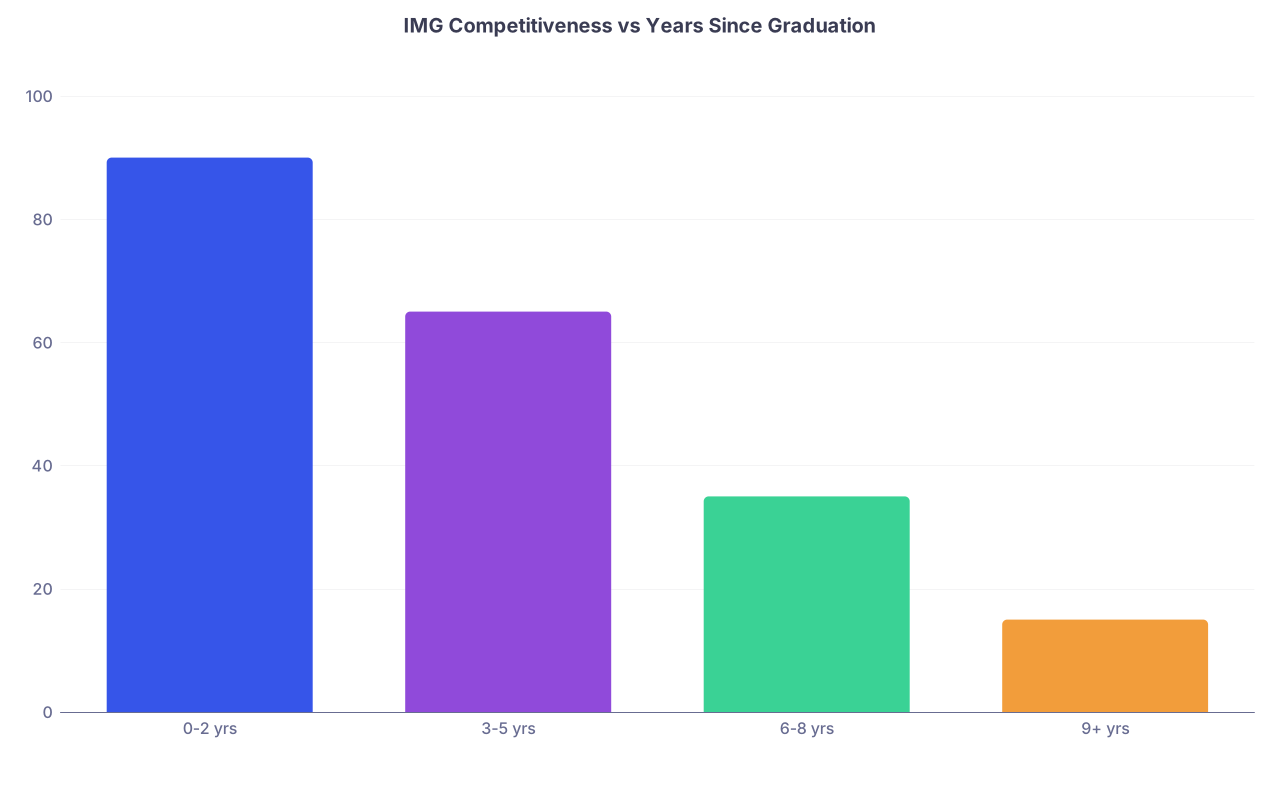
Here is how your “years since graduation” competes against other IMGs:
| Category | Value |
|---|---|
| 0-2 yrs | 90 |
| 3-5 yrs | 65 |
| 6-8 yrs | 35 |
| 9+ yrs | 15 |
Think of that bar chart as “relative chance if everything else is equal (scores, USCE, etc.).” Past 5 years, your baseline odds drop hard.
So your strategy cannot be “equal.” You must be better in other dimensions to offset the age of your degree.
Key implications:
- You cannot rely on “average” scores or “okay” letters.
- You cannot send a generic application to 200 programs and expect magic.
- You must target the subset of programs that actually take older grads and then hit them with a surgically strong file.
3. Clarify Your Starting Point: Brutal Self‑Audit
Before you touch ERAS, you need honest data on yourself. Not vibes.
Write this down in a table. Do not guess. Find the exact numbers.
| Category | Your Status (Example) |
|---|---|
| Year of graduation | 2014 |
| Step 1 | 226 (first attempt) |
| Step 2 CK | 238 (first attempt) |
| Step 3 | Not taken |
| USCE | 2 months observership (2016) |
| Research | 1 publication (2013) |
| Current clinical | GP in home country, full-time |
Now ask:
Scores
- Step 1 is pass/fail now; older numeric score matters less but still appears.
- Step 2 CK is the main academic filter.
- If:
- Step 2 CK < 230 → you have work to do compensating elsewhere.
- Step 2 CK 230–245 → workable, but not a strength.
- Step 2 CK > 245 → can be leveraged as an asset.
Step 3
- For older grads, Step 3 is not optional. It is a signal: “I can pass U.S. board‑style exams now.”
- If you have any Step failures, Step 3 with a solid score is critical damage control.
US Clinical Experience (USCE)
- Anything older than 3–4 years is basically sentimental value. Programs want recent.
- Hands‑on (sub‑internships, externships) > observerships > remote research with no clinical exposure.
Current clinical work
- If you have been clinically inactive, that is a red flag you must fix.
- If you have been active (even outside the U.S.), that is leverage with the right framing.
Outcome of this audit: you know if you are:
- High‑risk but salvageable
- Very high‑risk (multiple fails, old grad, no recent work)
- Or reasonably strong but disorganized
Different profile, different roadmap intensity. But the structure is the same.
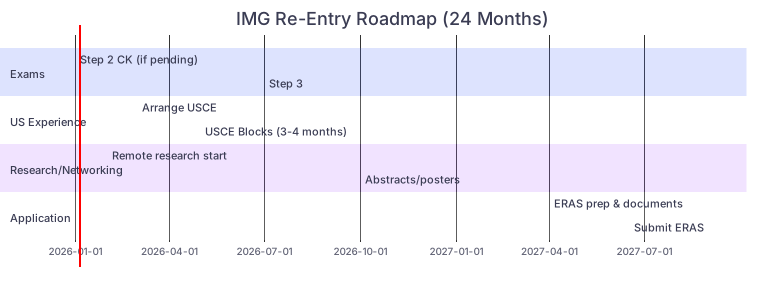
4. The 12–24 Month Re‑Entry Roadmap
You are not doing a one‑month “application prep.” You are running a re‑entry project.
Think in phases, not chaos.
| Task | Details |
|---|---|
| Exams: Step 2 CK (if pending) | a1, 2026-01, 6m |
| Exams: Step 3 | a2, 2026-07, 4m |
| US Experience: Arrange USCE | b1, 2026-03, 2m |
| US Experience: USCE Blocks (3-4 months) | b2, 2026-05, 4m |
| Research/Networking: Remote research start | c1, 2026-02, 10m |
| Research/Networking: Abstracts/posters | c2, 2026-10, 6m |
| Application: ERAS prep & documents | d1, 2027-04, 4m |
| Application: Submit ERAS | d2, 2027-09, 1m |
You can compress this to 12–18 months if Step 2 is already done and you are efficient. But do not kid yourself. This takes time.
Phase 1: Academic Revalidation (0–6 months)
Goal: demonstrate you can still pass American exams now.
If Step 2 CK is not done or weak:
- Schedule Step 2 CK within 4–6 months.
- Commit to a real study schedule:
- UWorld full pass (not random dipping in and out).
- NBME practice exams every 3–4 weeks, data‑driven review.
- Anki or similar spaced repetition, daily.
- Aim for meaningful improvement if you already passed long ago.
Step 3 plan (for older grads, this matters):
- Target to take Step 3 before ERAS opens or at least before ranking.
- Use:
- UWorld Step 3 Qbank
- CCS cases (do not skip these; programs know when you fake it)
For older grads, Step 3 acts as “recent proof of brain function” in the U.S. exam format. It also helps with visas for some programs (H‑1B friendliness).
5. Rebuild Clinical Currency: USCE That Actually Helps
This is the part most older IMGs get wrong. They do:
- One month of observership at a random clinic
- A generic letter: “Dr. X is nice and punctual.”
- And think: “Done, I have USCE.”
No. You are competing with people who have 3–6 months of structured clinical work this year and letters that say, “I would rank this applicant in the top 10% of students I have supervised.”
You want 3–4 months of recent clinical experience that creates real letters.
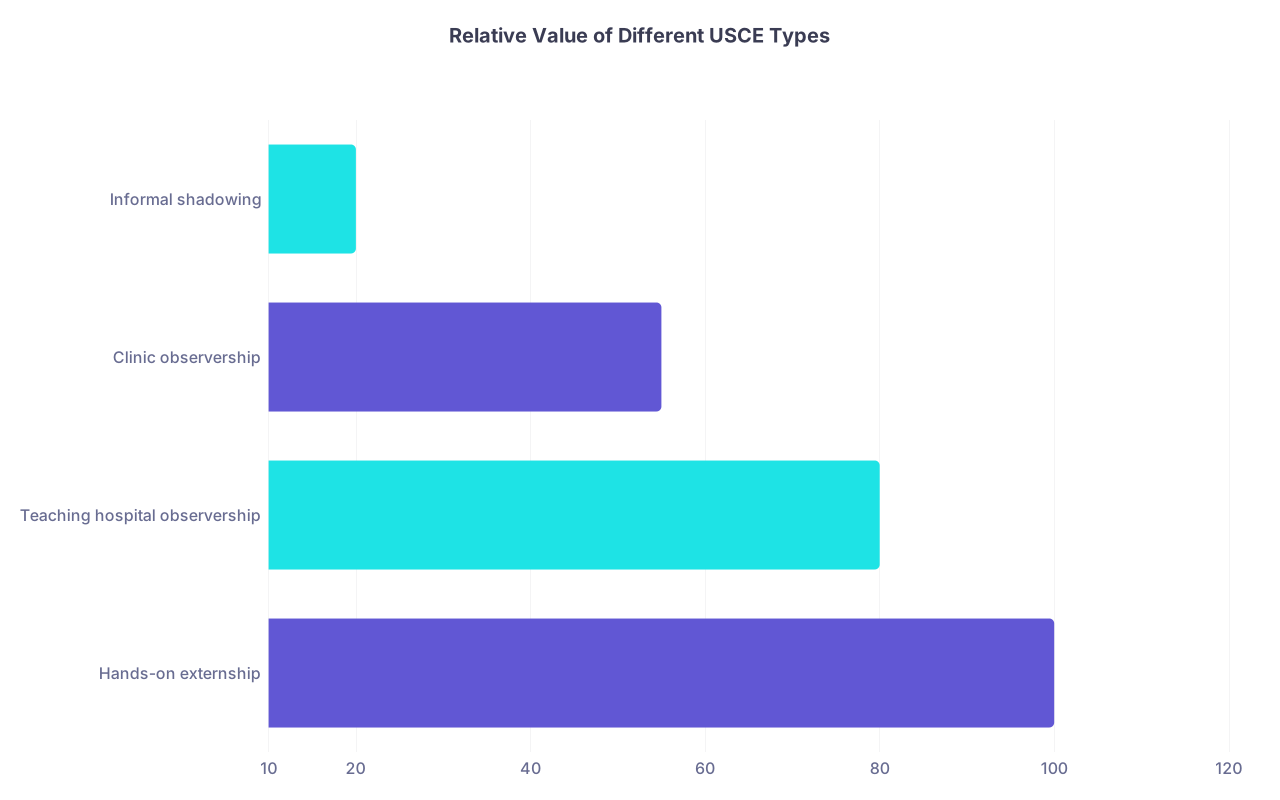
Best to worst:
- Hands‑on externships (where allowed)
- Structured observerships at teaching hospitals
- Private clinic observerships with active teaching + EMR exposure
- Random “shadowing” with no notes, no discussions (barely counts)
| Category | Value |
|---|---|
| Hands-on externship | 100 |
| Teaching hospital observership | 80 |
| Clinic observership | 55 |
| Informal shadowing | 20 |
How to structure USCE for maximum impact
You want:
- Continuity: 2–3 months in one place > 1 month each at three random clinics.
- Clear role: following patients, attending rounds, writing mock notes, discussing plans.
- Letter potential: attending who actually sees you work and is residency‑involved.
Concrete steps:
Start by targeting smaller teaching hospitals and community programs
- They are more likely to accept IMGs.
- Many have affiliated observership/externship programs hidden on their websites.
Parallel track: paid externship companies
- Yes, some are expensive and mediocre. Some are actually structured and productive.
- Criteria to avoid scams:
- They specify site details and supervising physicians.
- Prior participants matched (ask for examples).
- You can see sample schedules.
Define your goals before you start:
- Get at least 2 strong U.S. letters, dated within 12 months of application.
- Be able to describe real clinical tasks in your ERAS experiences.
- Learn EMR language, note structures, and team dynamics.
During the USCE:
- Arrive early, stay a bit late.
- Ask intelligently for feedback.
- Keep a logbook of patient cases, tasks you did, skills you practiced.
- Two weeks before leaving, ask for a LOR while your work is fresh in their mind.
6. Fill the “Gap” with Real, Defensible Activity
The years since graduation are not automatically fatal. What kills you is unexplained or clinically irrelevant gaps.
Acceptable storylines:
- Practicing physician in home country (with evidence).
- Ongoing research or academic roles.
- Non‑US clinical fellowships, hospitalist roles, etc.
Red‑flag storylines:
- Nothing clinical for 2–5+ years.
- “Studying for exams” as the only activity over multiple years.
- Unclear employment, patchy work history.
If you have empty years, you need to fix from now on. You cannot rewrite the past, but you can make the last 12–18 months look coherent and serious.
What to plug in:
Clinical continuity back home
- Work in a hospital or clinic.
- Document it. Get a supervisor LOR.
- Mention scope of practice: inpatient vs outpatient, volume, responsibilities.
Research that connects to your target specialty
- Remote research with U.S. faculty (common now).
- Case reports, retrospective chart reviews, QI projects.
- Aim to produce at least:
- 1–2 abstracts/posters,
- or 1 solid publication,
- or meaningful QI participation.
Teaching / academic roles
- Tutor medical students, teach OSCEs, examiner roles.
- Programs like seeing “academic citizenship,” especially in IM and Peds.

Do not list fluff like “reading NEJM daily” as a formal activity. If you did self‑study, combine it with something tangible: case logs, mock presentations, or participation in journal clubs.
7. Letters of Recommendation: Your Most Underrated Weapon
Older grads often lean heavily on old professors:
- “She taught me in 2011, she knows me well.”
- That letter is effectively dead. It proves nothing about your current ability.
You want:
- Three to four letters.
- At least two from U.S. physicians, dated within the last 12 months.
- At least two from your target specialty (IM letters for IM, FM letters for FM, etc.).
How to get strong letters, not just letters:
- Tell your attendings upfront you are aiming for residency re‑entry.
- Ask if they are comfortable evaluating you in that context.
- Perform like a junior resident, not a passive observer.
- Present patients coherently.
- Volunteer to draft notes (for teaching, not billing).
- Read around your patients and bring something new to rounds.
- Provide a letter packet when they agree to write:
- Your CV
- Personal statement draft
- List of concrete things you did with them
If an attending does not seem enthusiastic, do not rely on that letter as one of your core three. Better to have one fewer U.S. letter than a generic “I barely know this person” line.
8. Target the Right Specialties and Programs
Some roads are simply closed or nearly closed to older IMGs unless you are exceptional (top 1–2%). You can fight that reality, or you can optimize around it.
More realistic for older IMGs:
- Internal Medicine (community and some university‑affiliated)
- Family Medicine
- Psychiatry (still competitive, but some programs flexible)
- Pediatrics (selectively)
- Transitional Year + later specialty (rare but possible)
Very tough unless you have outstanding credentials:
- Radiology, Dermatology, Ophthalmology, Ortho, ENT, Neurosurgery
- Competitive fellow‑driven fields from the start
Your decision should be anchored in a basic competitiveness view:
| Specialty | Feasibility | Needs for Older Grads |
|---|---|---|
| Internal Med | Moderate | Strong USCE, Step 3, recent LORs |
| Family Med | Higher | Community focus, broad applications |
| Psychiatry | Variable | Great fit narrative, strong LORs |
| Pediatrics | Moderate | Peds-specific exposure |
| Radiology | Very low | Exceptional scores + research |
Program targeting
You are not applying “everywhere.” You are creating a curated list:
- Programs that have historically taken:
- IMGs
- Older grads
- Visa‑requiring applicants (if that applies to you)
How to find them:
- Use program websites (look at current residents – graduation years, countries).
- Filter FREIDA or program lists for “IMG friendly” and cross‑check with current resident data.
- Talk to recent matched IMGs a few years older than average. They know the programs that actually walk the talk.
9. Build an Application That Explains, Not Hides, Your Path
The worst mistake: trying to pretend the gap is not there and hoping the personal statement “sounds passionate.”
You must control the narrative.
Personal statement for re‑entry IMGs
Core elements:
- Direct acknowledgement of the time since graduation.
- One clear paragraph: what you did, what you learned, why now.
- Evidence of continuity with medicine.
- Clinical roles, teaching, research, QI, U.S. exposure.
- Specific reasons for your specialty.
- Not generic “I like to help people” nonsense.
- Link your post‑grad years to your specialty choice.
Bad version:
After medical school I had some personal issues and then was preparing for exams.
Better version:
Since graduating in 2014, I have worked as a general practitioner in a high‑volume urban clinic, managing chronic disease and acute presentations for a panel of approximately 1,500 patients. Over the past five years I have supervised medical students, led a weekly hypertension clinic, and collaborated on a quality improvement project reducing unnecessary antibiotic prescriptions. These experiences solidified my commitment to internal medicine and pushed me to pursue formal training in the United States, where I can combine direct patient care with teaching and systems‑level improvement.
You do not need to confess every life detail. But you cannot leave a 5‑year hole.
ERAS experiences
Each experience must prove recency and role. For each:
- Use dates that show continuity.
- Describe:
- What you did
- How often
- Who supervised you
- Concrete outcomes (projects, teaching sessions, QI metrics)
Avoid vague lines like “participated in patient care.” Instead:
- “Conducted daily pre‑round patient reviews and presented 3–5 cases per day on the internal medicine service under direct attending supervision.”
10. Strategy for Applications and Interviews
Older grads usually under‑ or over‑apply. You want strategic breadth, not blind volume.
How many programs?
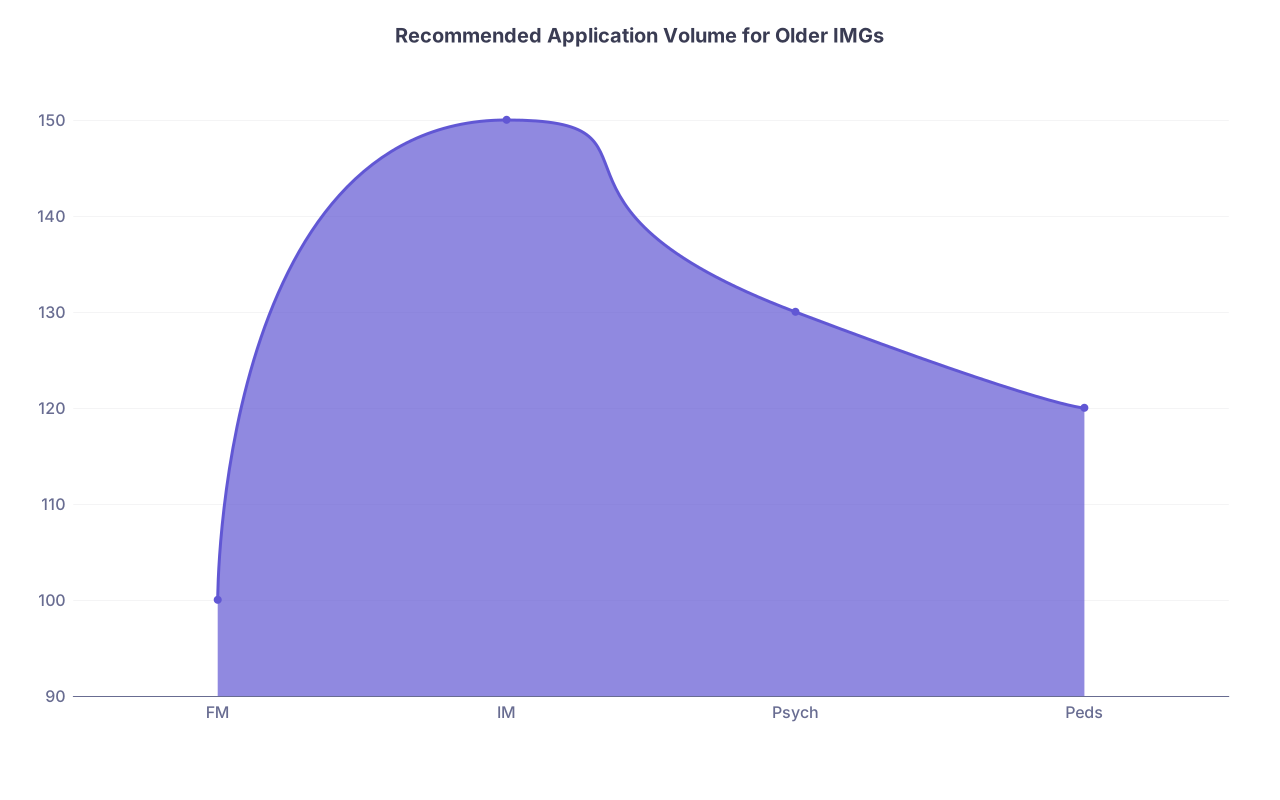
This varies, but a rough range for older IMGs:
- FM: 80–120 programs
- IM: 120–180 programs
- Psych/Peds: 100–150, depending on profile
If you have:
- multiple exam attempts
10 years since graduation
- limited USCE
you are on the higher end of those ranges and may still need 2 cycles of grinding and improvement.
| Category | Value |
|---|---|
| FM | 100 |
| IM | 150 |
| Psych | 130 |
| Peds | 120 |
Interview preparation: different for older grads
Program directors will test:
- Are you clinically rusty?
- Are you flexible enough to be an intern again?
- Are you going to struggle with hierarchy after being an attending back home?
Anticipate and rehearse:
- “You graduated in 2013. Why residency now?”
- Concise, non‑defensive, specific.
- “How have you maintained your clinical skills?”
- Mention recent USCE, current practice, recent exams.
- “You were a practicing doctor. How will you handle taking orders from younger seniors?”
- Emphasize learning mindset, respect for system, experience teaching others.
If you sound defensive or bitter about not being accepted earlier, that kills offers. Programs want persistence, not resentment.

Mock interviews with someone who knows the U.S. system will save you. They hear the small cultural or attitudinal red flags you do not hear in your own voice.
11. When to Pivot: Knowing If You Need Plan B or C
I have to say this clearly: not everyone will match into residency, no matter how hard they try. Especially older grads with major academic issues and no resources for USCE.
You need decision checkpoints.
Set these markers:
- After 1st serious cycle (post‑rebuild):
- If you get 0–2 interviews despite strong USCE, Step 3, and targeted applications, you must reassess.
- Ask:
- Is my specialty too competitive for my profile?
- Are there serious red flags I cannot fix (multiple failed attempts, legal issues, >15 years out)?
Potential pivots:
- Shift specialty (e.g., from IM to FM, or from Psych to FM/IM).
- Focus on non‑ACGME clinical roles (hospitalist roles abroad with U.S. connections).
- Transition to research‑heavy or academic careers (PhD, public health, clinical research).
Plan B is not a failure. It is an intelligent response to reality. The failure is spending 6–8 years applying with the same weak profile and no real improvement.

FAQ (Exactly 4 Questions)
1. I graduated more than 10 years ago. Is it still realistic to match into a U.S. residency?
Yes, but only with a very disciplined plan and usually in the less competitive primary care specialties (IM/FM) or occasionally psychiatry. You will likely need:
- Solid Step 2 CK and Step 3 scores
- 3–4 months of recent, strong USCE with excellent letters
- A coherent recent clinical history (not multi‑year inactivity)
- A carefully selected, IMG‑friendly program list
If you have multiple exam failures and a very old graduation year and limited recent clinical work, matching becomes low probability and you should actively develop a parallel Plan B.
2. Do programs really care that much about Step 3 for older IMGs?
For you, yes. Step 3 is one of the few ways you can show: “I can still handle U.S. board‑style exams today.” It reduces anxiety about your academic decay over time. It also:
- Makes some H‑1B‑sponsoring programs more willing to consider you
- Offsets older Step 2 CK scores, especially if you improved
- Signals serious commitment, not casual interest
If you are an older grad without significant clinical or research prestige, skipping Step 3 is usually a mistake.
3. My only recent experience is non‑US clinical work. Does that still help?
It helps, but it is not enough by itself. Non‑US clinical work shows continuity and skill, which is better than a blank gap. But programs still worry about your ability to adapt to U.S. systems, EMRs, and culture. The best approach:
- Continue your current clinical work (do not stop and “just study”).
- Add 3–4 months of targeted USCE before application.
- Use letters from both settings: one or two strong home-country clinical letters plus two recent U.S. letters.
So yes, it helps, but you still must add U.S. touchpoints.
4. If I can afford only 1–2 months of USCE, how should I prioritize them?
Then you must optimize brutally:
- Choose 1–2 high‑yield sites where:
- There is actual teaching
- The supervising physicians write detailed letters
- Residents and PDs know IMGs frequently
- Stay in one place long enough (at least 4–6 weeks) to allow them to really observe you.
- Focus your energy on performing at near‑resident level: show up early, volunteer presentations, read around patients, ask to participate in QI or teaching.
One excellent month with a powerful letter beats three random, shallow months with generic letters.
Key takeaways:
- Treat yourself as a re‑entry applicant with a deficit to actively overcompensate, not as a regular IMG.
- Build a 12–24 month plan around three pillars: recent exams (including Step 3), substantial recent USCE with strong LORs, and a coherent, clinically active story.
- Target realistic specialties and program types, control your narrative directly, and be willing to pivot if the data after a full, serious cycle say the road is closing.