Most IMG personal statements do not get taken seriously—because they sound like they were written by the same person.
If your personal statement reads like a generic “hard-working, compassionate future physician” essay, you are handing the program director a reason to skim, yawn, and move on. I have watched faculty look at a PS, say “template,” and immediately lower their expectations for that applicant.
Let me be blunt: template-sounding personal statements hurt IMGs more than they hurt anyone else. You are already fighting skepticism. You cannot afford to sound replaceable.
This is the guide to stop you from doing exactly that.
Why “Template Vibes” Are Deadly For IMGs
Program directors can smell a template from the first paragraph. They read hundreds of statements in a few days. Their brain auto-flags patterns:
- Same openings
- Same clichés
- Same “ever since I was a child” nonsense
Once they detect that pattern, they make a quick, silent judgment: “This applicant is not reflective. They did not think deeply. Probably similar in other areas.”
For IMGs, that snap judgment is lethal. You are already:
- Outside the U.S. system initially
- Often dealing with visa concerns
- Competing with U.S. grads for fewer interview spots
You do not just need to be “good.” You need to sound unmistakably individual. A template personal statement tells them the opposite: “There is nothing unique here.”
Let us go through the common mistakes that scream “template” and how to avoid them—specifically as an IMG.
Mistake #1: The Generic “Origin Story” Opening
The worst offenders all start the same way. Variations of:
- “I have wanted to be a doctor since I was a child…”
- “Medicine has always been my passion…”
- “Growing up in [country], I witnessed suffering…”
I have seen entire piles of IMG statements from very different countries that are indistinguishable for the first three paragraphs. Different names. Same story.
The problem is not that your childhood did not influence you. The problem is that everyone uses the same vague, sentimental framing. It tells the reader precisely nothing about:
- How you think
- How you work
- How you solve problems
- How you behave on a bad call night
It just says: “I know the expected script, and I am sticking to it.”
How to avoid this:
Start with a moment, not a lifetime. A specific clinical encounter, a mistake you made and learned from, a concrete turning point during internship, a particular day on your U.S. rotation.
Bad, templated opening:
“Since childhood, I have been fascinated by the human body and driven by a deep desire to help others.”
Better, grounded opening:
“On my first overnight call as an intern, I froze. The nurse handed me the chart, alarms were sounding, and I realized I had no idea how to prioritize the four new admissions in front of me.”
One sounds like ChatGPT. The other sounds like a real human being who has actually practiced medicine.
If your first sentence could be used, unchanged, by 50 other IMGs in different countries and specialties, delete it.
Mistake #2: Copy-Pasted “Traits List” Without Proof
Another template giveaway: a paragraph that reads like a LinkedIn endorsement.
“I am hard-working, compassionate, dedicated, and a strong team player. I have excellent communication skills and always put my patients first.”
Every word there is empty. Anyone can write it. Many do. Faculty eyes glaze over when they see that laundry list.
Programs care far less about what you claim to be and far more about the evidence that you act that way when stressed, tired, or uncertain.
How to avoid this:
Show, do not announce. Pick 2–3 core traits and demonstrate them with specific stories.
Template-style sentence:
“I am a team player and always communicate well with my colleagues.”
Better approach:
“During my internal medicine rotation at [Hospital Name], we admitted a patient with severe DKA and limited English proficiency. While the resident managed the insulin drip, I coordinated with the translator phone, updated the family every hour, and kept a running problem list on the whiteboard so the night team could take over smoothly.”
Same trait. Very different credibility.
If you see a string of adjectives in your draft, assume it sounds templated unless each one is backed by a concrete example.
Mistake #3: “Passion for Medicine” Without Specialty-Specific Thinking
IMGs often write a “generic medicine” statement and then slap a specialty name on top. I have seen almost identical PSs used for internal medicine, family medicine, and pediatrics with one or two words changed.
Programs notice.
If your internal medicine PS would still mostly make sense if I changed “internal medicine” to “family medicine,” your statement is not actually about internal medicine. It is a template.
Program directors read for:
- Do you understand the real work of their specialty?
- Do you know what challenges you are signing up for?
- Do you reflect on how your skills fit that specific field?
Vague specialty paragraph:
“Internal medicine will allow me to form long-term relationships while continuing to learn throughout my career.”
This could be lifted from any brochure.
Sharper, specialty-aware paragraph:
“What draws me to internal medicine is the constant need to think in systems. Managing our patients with decompensated cirrhosis on my hepatology rotation forced me to hold fifteen problems in my mind at once—ascites, variceal bleeding risk, infection, renal function—while still talking to them as human beings, not just complex puzzles. I enjoy that level of cognitive load.”
You do not have to sound like a textbook. But you must sound like someone who has actually spent time on that service and noticed the reality, not just the marketing.
Mistake #4: Forced, Overcomplicated English That Sounds “Coached”
This one is especially common among IMGs who worked with aggressive editing services or overconfident friends.
When the language shifts from normal, clear English to something that reads like a thesaurus exploded, program directors get suspicious. They know how applicants from your medical school usually write. If your PS suddenly sounds like a philosophy professor, they assume heavy outside authorship.
Overedited sentence:
“My odyssey through the labyrinth of medical training has galvanized an unwavering ardor for the noble calling of internal medicine.”
You think this sounds impressive. It sounds fake.
Clear, authentic sentence:
“My clinical training has shown me that I enjoy the kind of complex decision-making that internal medicine demands.”
You are not applying for a creative writing degree. They want to hear your thinking, not your dictionary.
Practical rule:
If you would not say a word or phrase out loud on rounds, do not use it in your personal statement.
Mistake #5: The Overused “Global Health / Poor Country” Narrative
If you trained in a resource-limited setting, that experience is real and valuable. The problem is not the context. The problem is the same framing used by thousands of IMGs:
“Growing up in [developing country], I saw many patients without access to healthcare. This inspired me to become a doctor so I could help underserved populations.”
It is not offensive. It is just generic. U.S. programs have read that paragraph five hundred times.
Worse, some applicants lean into a trauma-or-poverty narrative because they think U.S. reviewers expect a “heartbreaking” story from IMGs. It starts to feel exploitative and staged.
How to avoid this:
Frame your context with specificity and reflection, not clichés.
Template-style paragraph:
“In my country, many patients cannot afford healthcare, and hospitals are overcrowded. This taught me the importance of compassion and empathy.”
Stronger use of the same reality:
“During my internship in [city], our government hospital regularly had more patients than beds. On nights when there were six patients in the corridor on oxygen, I learned to triage fast, make decisions with incomplete data, and communicate honestly when we simply could not do more. That pressure forced me to become more organized and more transparent with families. It also made me appreciate the systems-level resources available in U.S. teaching hospitals during my rotations there.”
You are still mentioning limited resources, but it now shows clinical judgment, ethical thinking, and contrast—not just “I saw suffering.”
Mistake #6: Templated “U.S. System Worship” Paragraph
Another red flag: a suspiciously generic paragraph praising the U.S. healthcare system.
I have seen almost the exact same paragraph in dozens of IMG statements, usually somewhere in the middle:
“The U.S. healthcare system, with its advanced technology and focus on evidence-based medicine, will allow me to grow as a physician and provide the best care for my patients.”
It is vague, generic, and sounds like it came from a consultant’s brochure.
Programs are not looking for flattery. They are looking for understanding.
Better approach:
Be specific about what you noticed and how it changed your practice.
Template-style “praise” paragraph:
“In the U.S., I was impressed by the multidisciplinary team approach and advanced technology.”
Better, grounded version:
“On my internal medicine observership at [Hospital], I was struck by how routinely the team used risk calculators and guideline-based order sets. At home, decisions like starting anticoagulation for atrial fibrillation often depended mostly on the senior physician’s preference. Seeing the structured use of evidence in daily practice pushed me to review tools like CHA₂DS₂‑VASc and HAS‑BLED and start incorporating them into my own thinking, even when I returned to my institution.”
You do not need dramatic comparisons. Just concrete observations and how they changed you.
Mistake #7: Ignoring Red Flags or Gaps With Silence Or Excuses
IMG files often contain:
- Graduation more than 5 years ago
- Failed attempts at USMLE
- Long gaps without clinical work
- Specialty switches (e.g., prior surgical training, now applying to IM)
Template personal statements pretend none of this exists. They read as if the applicant had a perfectly linear path. Program directors do not buy it. They see the timeline in ERAS.
Silence around red flags feels evasive.
On the other side, some applicants over-explain and slip into self-pity or blame: attacks on their school, the exam, the system, or the pandemic.
How to avoid this:
Address the issue briefly, factually, and with ownership. Then move on to how you corrected course.
Bad handling:
“Unfortunately, due to personal reasons and the unfair difficulty of the exam, I did not pass Step 1 on my first attempt, but this does not reflect my true abilities.”
Better handling:
“I did not pass Step 1 on my first attempt. I underestimated the need for question-based practice and relied too heavily on passive reading. For my second attempt, I changed my approach completely—using UWorld daily, tracking my weak areas, and studying in timed blocks. The improvement in my Step 2 CK score reflects the more disciplined, active learning style I now use in all my clinical preparation.”
No drama. No excuses. Clear responsibility and growth.
Mistake #8: Ending With a Meaningless, Generic Conclusion
If your last paragraph looks like one of these, you have a problem:
- “In conclusion, I am confident that my skills and experiences have prepared me well for residency.”
- “I am excited to bring my dedication, compassion, and work ethic to your program.”
- “Thank you for considering my application.”
This kind of conclusion tells the reader nothing new. It confirms that your statement was, in fact, a template.
Your final lines are prime real estate. They are what stay in the interviewer’s mind. Use them to reinforce one clear, distinctive message about who you are as a resident.
Better closing flavor:
“What I bring to residency is a calm, methodical approach on busy nights, a willingness to say ‘I don’t know’ and look things up, and a track record of showing up on time and staying late when the work is not done. I am looking forward to training in a program where that consistency matters more than a perfect CV.”
Specific. Grounded. Human.
If your last paragraph could end any applicant’s statement, rewrite it.
A Quick Self-Check: Does Your Statement Scream “Template”?
Use this as a rough gut-check.
| Area | Red Flag Example |
|---|---|
| Opening line | Childhood dream / lifelong passion |
| Traits section | Long list of adjectives, no examples |
| Specialty explanation | Could fit 2–3 different specialties |
| Language level | Unnaturally flowery, overformal |
| Context description | Vague “poor country” narrative |
| U.S. exposure description | Generic praise of “advanced system” |
If you see 3 or more of these in your current draft, you are very likely in “template” territory.
Mistake #9: Overusing Buzzwords Without Substance
Some applicants think they can impress by cramming in a checklist of trendy terms:
- “Evidence-based medicine”
- “Multidisciplinary team”
- “Cultural competence”
- “Holistic care”
- “Life-long learning”
On their own, none of these are bad. The problem is when they appear with zero demonstration. They read like someone copied phrases from program websites.
Template-style buzzword salad:
“I am passionate about evidence-based medicine, working with multidisciplinary teams, and providing holistic, patient-centered care while being a life-long learner.”
There is no real content there. Just marketing.
The fix is always the same: attach a concrete moment.
“During my cardiology rotation, I watched how the attending would stop after rounds, open the most recent guideline on his phone, and review it with us when there was disagreement on management. That practice normalized questioning habits and reinforced for me that being ‘evidence-based’ means actually looking up the data, not only relying on memory.”
If you cannot attach at least one scene, decision, or practice change to a buzzword, remove it.
Mistake #10: Letting Others Rewrite Your Voice Out Of Existence
A quiet but very common problem: the over-edited IMG statement.
You start with a decent, honest draft. Then:
- One friend “fixes” the English
- Another adds big vocabulary
- A paid editor restructures everything
- You paste sections from a “sample” PS they sent you
By the end, you are left with a polished, generic essay that does not sound like you, and 30 other clients have a similar one.
Programs pick up on this. They speak with you at the interview and compare how you talk to how you “write.” When there is a huge mismatch, doubts creep in.
I am not telling you to avoid help. I am telling you to guard your voice.
Use feedback for:
- Clarity
- Grammar
- Structure
- Eliminating clichés
Do not let anyone:
- Insert their personal stories
- Add dramatic lines you would never say
- Turn your simple story into a soap opera
Your statement should sound like a more polished version of how you speak thoughtfully in English. Nothing more theatrical than that.
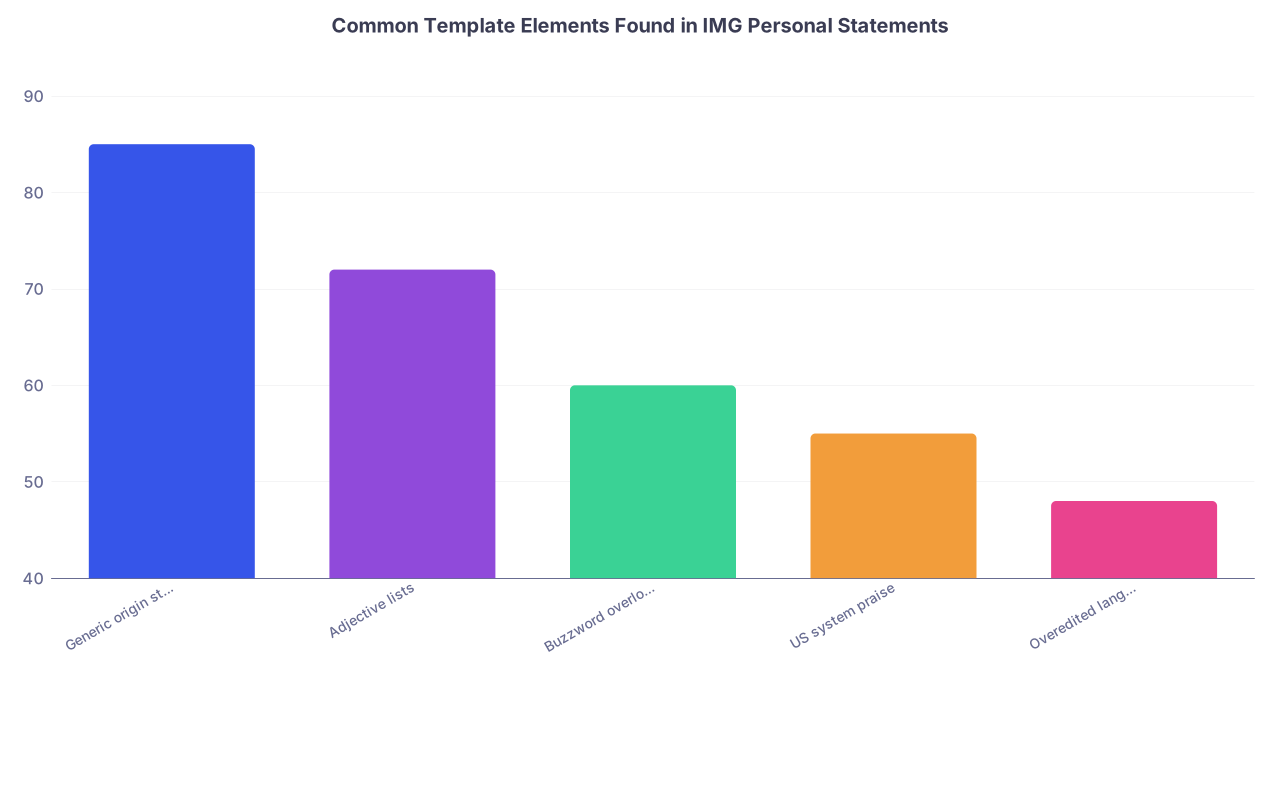
| Category | Value |
|---|---|
| Generic origin story | 85 |
| Adjective lists | 72 |
| Buzzword overload | 60 |
| US system praise | 55 |
| Overedited language | 48 |
How To De-Template Your Existing Draft Today
If you already have a draft (you probably do), do not start from scratch. Strip the template out of it. Here is a process that actually works.
Highlight all generic sentences.
Anything that:- Could apply to dozens of applicants
- Has no specific person, place, or action
- Is just adjectives or abstract claims
These are your “template hotspots.”
Replace at least half of them with moments.
For every highlighted line, ask: When did I actually learn this? When did I actually show this?
Then write 2–3 sentences about that situation.Normalize your language.
Do a pass where your only goal is to make the English sound like something you would say on rounds:- Shorten long, clunky sentences
- Replace rare words with normal ones
- Remove decorative filler phrases (“noble calling,” “ardent passion,” etc.)
Make the specialty paragraph bulletproof.
Ask yourself:- Could this paragraph be moved into a PS for a different specialty with minimal changes?
- If yes, it is too generic.
Add details about the actual day-to-day work of that specialty that you like and have experienced.
Add one honest weakness or growth point.
Show that you are capable of self-assessment. Something like:- A mistake you corrected
- A limitation you are working on
- A system you had to change
This separates you from the “perfect, plastic” template applicants.

| Step | Description |
|---|---|
| Step 1 | Start with current draft |
| Step 2 | Highlight generic sentences |
| Step 3 | Replace with specific moments |
| Step 4 | Normalize language to your voice |
| Step 5 | Strengthen specialty-specific content |
| Step 6 | Briefly address gaps/red flags if needed |
| Step 7 | Get light editing, not rewriting |
| Step 8 | Final read aloud check |
Read that last box again. The “read aloud check” is underrated. If you feel ridiculous saying a line out loud, it probably does not belong.
One Thing Program Directors Actually Want To Hear From IMGs
Program directors reading IMG statements are asking themselves a short list of questions:
- Will this person show up, do the work, and not melt down?
- Can I trust them with patients when it is busy and imperfect?
- Are they realistic about what residency in the U.S. is like?
- Do they understand why they are choosing this specialty in this country?
A templated statement answers none of that. It just signals, “I know the expected format.”
A strong IMG personal statement does something much simpler:
- Shows you have done actual clinical work, not just observed
- Demonstrates one or two patterns: reliability, teachability, calm in chaos
- Reflects honestly on a few specific moments
You do not need drama. You do not need a tragic backstory. You need to stop sounding like everyone else.
FAQs
1. Is it okay to use sample IMG personal statements as a reference?
Use them very cautiously. Looking at one or two samples for structure is fine. The mistake is copying their style, metaphors, or story beats. If you catch yourself thinking, “I like this line, I will just adjust it a little,” stop. That is how template language creeps in. Use samples only to understand rough length and general flow, then close them and write your own content from scratch.
2. How much should I mention my home country and healthcare system?
You should mention it enough to give context to your training, challenges, and strengths, but not turn your PS into a tourism or tragedy essay. One or two well-written paragraphs are plenty. Focus on what you did and learned in that environment, not just describing how poor or overburdened the system is. Avoid broad, dramatic statements that sound like every other IMG essay about “limited resources.”
3. Can I reuse the same personal statement for multiple specialties?
You should not. That is one of the clearest “template” signals programs see. Each specialty has a different daily reality and different types of residents who tend to thrive. If you are applying to two specialties, each one deserves its own statement that addresses specific experiences and reasoning for that choice. Reusing 80% of one PS and just changing the specialty name is a red flag.
4. How long should my personal statement be as an IMG?
Typical length is about 650–800 words. Going a little over is not fatal, but long, wordy essays increase the risk of generic filler and “template-speak.” If you need more than a page to make your point, you are probably including clichés, repetition, or unnecessary life story. A tighter, specific, honest 700-word statement almost always beats a 1,200-word saga.
Open your current personal statement draft right now and do one thing: highlight the first paragraph and the last paragraph. Ask yourself, honestly—could another IMG applicant swap in their name and use those exact lines? If the answer is yes, those are the first sections you must rewrite.