
Most IMGs sabotage their letters of recommendation before the attending ever starts typing.
Not with bad performance. With badly written requests.
I’ve watched this play out over and over: an IMG with solid scores, real clinical experience, and a decent personal statement… and then I see the email they sent to their potential letter writer. Vague. Awkward. Sometimes borderline demanding. And suddenly I understand why their “strong” letters sound lukewarm or generic.
If you’re an IMG, you do not have the margin for these mistakes. You’re already fighting an uphill battle in the residency match. A sloppy or tone-deaf LOR request makes you look less mature, less professional, and less trustworthy. Program directors are allergic to that.
Let’s walk through the traps that hurt your credibility—and how to avoid stepping in them.
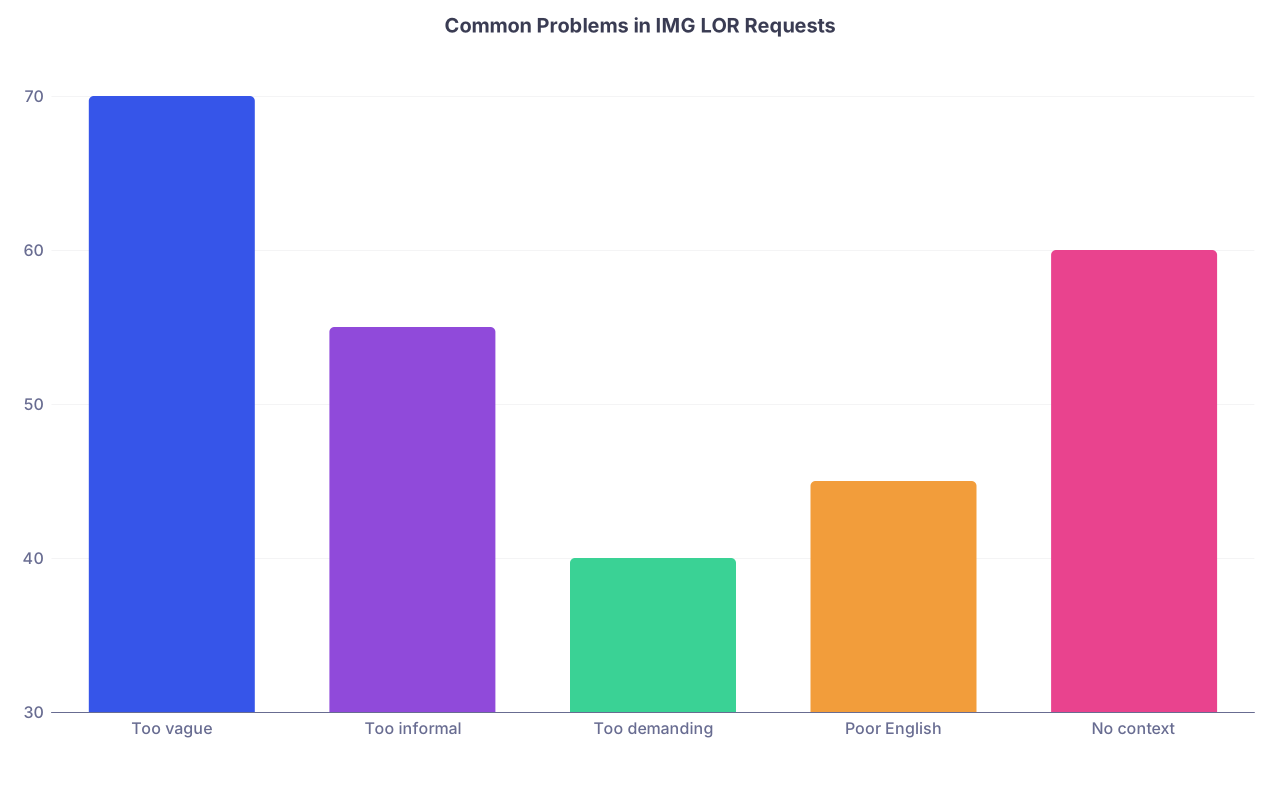
| Category | Value |
|---|---|
| Too vague | 70 |
| Too informal | 55 |
| Too demanding | 40 |
| Poor English | 45 |
| No context | 60 |
The Biggest Mistake: Making Your LOR Request About You, Not The Letter Writer
The worst-written IMG LOR requests have the same core flaw: they treat the letter writer like a formality, not a human with a reputation to protect.
Here’s how that shows up in real emails I’ve seen:
- “Dear Sir, I need a strong LOR for residency. Please help me and write good things because it is very important for my future.”
- “Dear Dr., I am applying this year and require 4 letters of recommendation. Can you provide one? It must be strong and uploaded before Sept 1.”
- “Respected Professor, I request you to kindly give me a good LOR for internal medicine residency.”
Read those again from the attending’s perspective. You’re being told:
- I “need” this.
- It must be “strong” and “good”.
- I’m framing it as your obligation.
Attendings don’t like being cornered. They really don’t like being told what to write. And they definitely don’t like their name attached to a letter for someone who sounds desperate and self-focused.
The right mindset:
You’re asking a busy physician to stake their reputation on you. Your phrasing needs to show awareness of that. Respect. Maturity. And the emotional intelligence to let them say no.
Bad: “I need a strong LOR.”
Better: “Would you feel comfortable writing me a strong and supportive letter of recommendation for residency?”
Key difference: You’re asking if they feel comfortable, not ordering the strength level.
If that wording feels too humble to you, that’s exactly your problem.
Mistake #2: Vague, Generic Requests That Make You Look Forgettable
Another recurring disaster: IMGs send LOR requests that are so generic the attending has no idea who they are, what they did, or why they’re even asking them.
Example versions I’ve seen:
- “Dear Dr. Smith, I hope you are well. I am applying this year and would like to ask if you might write a letter of recommendation for me.”
- “I was a student in your department. Please write me a letter of recommendation for internal medicine residency.”
No context. No reminder of when you worked together. No hint of what you did or what you’re applying for. You’re forcing a busy physician to do memory excavation just to decide if they can help you.
That laziness costs you. A letter writer who’s not reminded of your strengths will write vague, boilerplate nonsense:
“Ms. X was a student with us and showed interest in medicine. She was punctual and professional.”
Translation: I barely remember this person.
Your request email should do some of the cognitive work for them. Not by sending them your life story, but by jogging their memory surgically.
You need at least these concrete details:
- When and where you worked with them: “I worked with you on the inpatient cardiology service at [Hospital] in March 2024.”
- Your role: “I was an observership student” / “extern” / “research assistant.”
- What specialties you’re targeting.
- A couple of specific reminders of what you did well.
A competent attending can build an actual letter off that. A generic ask just screams, “I want a letter, but I don’t really care if it’s any good.”

Mistake #3: Sounding Like a Template, Not a Professional
Program directors can tell when an IMG has coached themselves into robotic English. Guess who else can? Your letter writer.
I see a lot of emails that sound like this:
“Respected Sir, I hope this email finds you in good health and high spirits. It was a great privilege and honour to rotate under your esteemed guidance. I humbly request you to kindly consider giving me a LOR.”
This sounds exactly like what it is: copied from someone’s WhatsApp group or Telegram channel.
Three problems here:
- The tone doesn’t match U.S. clinical culture. It’s over-flattering, formal to the point of sounding strange, and feels inauthentic.
- It makes you sound like you can’t switch registers between cultures and professional norms.
- It often comes with grammar issues that make it worse.
You’re not writing to a distant monarch. You’re emailing a colleague who’s senior to you but still a doctor in a modern workplace.
Aim for:
- Polite, not groveling
- Professional, not stiff
- Respectful, but not “Respected Sir, Honoured Madam” level
Bad: “Most humble request to kindly consider giving me a good LOR under your able guidance.”
Better: “I really appreciated the opportunity to work with you on the [service]. I’m reaching out to ask if you’d be willing to write a strong letter of recommendation on my behalf.”
You’re still being respectful. You just don’t sound like ChatGPT wrote your email in “Victorian Royal Court” mode.
Mistake #4: Letting Poor English Bleed Into Your Professional Image
This one is tough but unavoidable:
If your LOR request email is full of grammar errors, wrong prepositions, and bizarre phrasing, you damage your credibility in two ways.
- The attending doubts your communication skills.
- They become more cautious about how strongly they can recommend you.
I’ve seen:
- Wrong tense everywhere: “I was doing observership and seeing patient and present to you.”
- Misused words: “You gave me many enormous chances of exposure.”
- Broken sentences: “Also I attached my CV and personal statement for your review, I am very hardworking and punctual, I do everything correctly.”
Nobody expects IMGs to sound like native novelists. But they do expect you to manage clear, clean professional English in an email that you had time to edit.
And here’s the brutal part: if your email sounds confused, an attending may think twice before putting their name above a letter that claims you’re an “excellent communicator.”
What to do instead:
- Draft your email.
- Run it past someone fluent—ideally someone already in U.S. training.
- Or at minimum, use a writing tool and then re-read it out loud to catch weird phrasing.
- Keep sentences short to reduce mistakes.
There’s no prize for complex, long, “fancy” sentences in your request email. I’d rather see simple and correct than ambitious and broken.
| Situation | Bad Phrasing | Better Phrasing |
|---|---|---|
| Asking for letter | “I need a strong LOR. Please write good things about me.” | “Would you feel comfortable writing a strong, supportive letter of recommendation for my residency applications?” |
| Reminding who you are | “I was your student last year.” | “I worked with you on the inpatient internal medicine service at County Hospital in Feb–Mar 2024 as an observership student.” |
| Mentioning specialty | “I am applying in all specialties.” | “I’m applying mainly to Internal Medicine programs this cycle.” |
| Providing context | “Attached is my CV, please see.” | “I’ve attached my CV and personal statement in case they’re helpful as you prepare the letter.” |
| Deadline | “Upload ASAP, ERAS is closing.” | “If you’re able to support me, ERAS recommends letters be uploaded by September 15.” |
Mistake #5: Being Vague or Dishonest About Your Performance
There’s a quiet, dangerous habit I see: IMGs trying to “pad” their perceived performance in the LOR request itself.
Things like:
- “You were very impressed with my work on the rotation.”
- “As you know, I was one of your top students.”
- “Because I always did very excellent presentations and you praised my knowledge.”
Sometimes that’s not entirely accurate. Sometimes it’s wildly exaggerated.
Here’s the problem:
If you’re rewriting history in the email, you immediately raise suspicion. And if the attending doesn’t remember you as “top,” your message now feels manipulative.
Do not tell them what they thought. Remind them what you did.
Ground-level specifics:
- “I presented 2–3 new admissions daily and followed my patients closely.”
- “You gave me feedback that you appreciated my thorough pre-rounding and organization.”
- “We worked together especially closely on [specific patient/scenario].”
Attending brains latch onto specific patients and concrete moments. Use that. But don’t put words in their mouth like “you said I was your top student,” unless they actually said that.
Your credibility is on the line. Once you look slippery in a simple email, no one will assume the best about your ERAS application.

| Step | Description |
|---|---|
| Step 1 | Finish Rotation/Work |
| Step 2 | Self-assess performance |
| Step 3 | Identify best potential letter writer |
| Step 4 | Draft professional email |
| Step 5 | Customize with specifics |
| Step 6 | Attach CV & PS |
| Step 7 | Send 4-8 weeks before deadline |
| Step 8 | Polite reminder if needed |
Mistake #6: Zero Structure, No Attachments, and Making Them Chase You
A surprisingly common rookie move: sending a vague, unstructured ask with no supporting documents and then waiting for magic to happen.
Like this:
- No CV attached.
- No personal statement.
- No ERAS ID.
- No clear deadline.
- No mention of what you’re applying to.
You’re basically asking: “Can you please open ERAS, search for my name, recall what I’m doing with my life, and build a letter from scratch out of thin air?”
Busy attendings will do the minimum in response to that. Which usually means generic letters that say very little.
A credible IMG looks organized. Prepared. Easy to help.
Your request should include:
- One to two short paragraphs of context (who you are, when you worked together, what you’re applying for).
- A short, explicit ask: “Would you feel comfortable writing a strong letter…”
- Attachments: CV, personal statement (or a brief summary of your goals).
- ERAS details if applicable (ERAS ID, how they’ll receive the request).
- A reasonable timeline: not “today,” not “sometime this year.”
You’re not burdening them by including attachments. You’re making it easier to write something meaningful.
Mistake #7: Awkward Timing That Makes You Look Inconsiderate
You damage your perceived professionalism when you:
- Ask for a letter months after the rotation ended, with no prior contact.
- Ask three days before ERAS deadlines.
- Ask during a known crunch period (July, major holidays, right before big conferences) with no flexibility in your wording.
“Please upload by September 1st” when you’re emailing on August 28th simply screams poor planning.
Attending takeaway: If you can’t manage simple deadlines for your own application, how will you manage patient care?
Better timing:
- Ask near the end of a rotation or research period, while they remember you.
- If it’s long after, acknowledge the gap: “I know some time has passed since we worked together in 2022, but…”
- Give at least 3–4 weeks, ideally more.
- Phrase the deadline as guidance, not an order.
Something like: “I’m aiming to have my letters uploaded by September 15 if possible, since many programs begin reviewing applications around then.”
You’re explaining the timeline, not bossing them around.
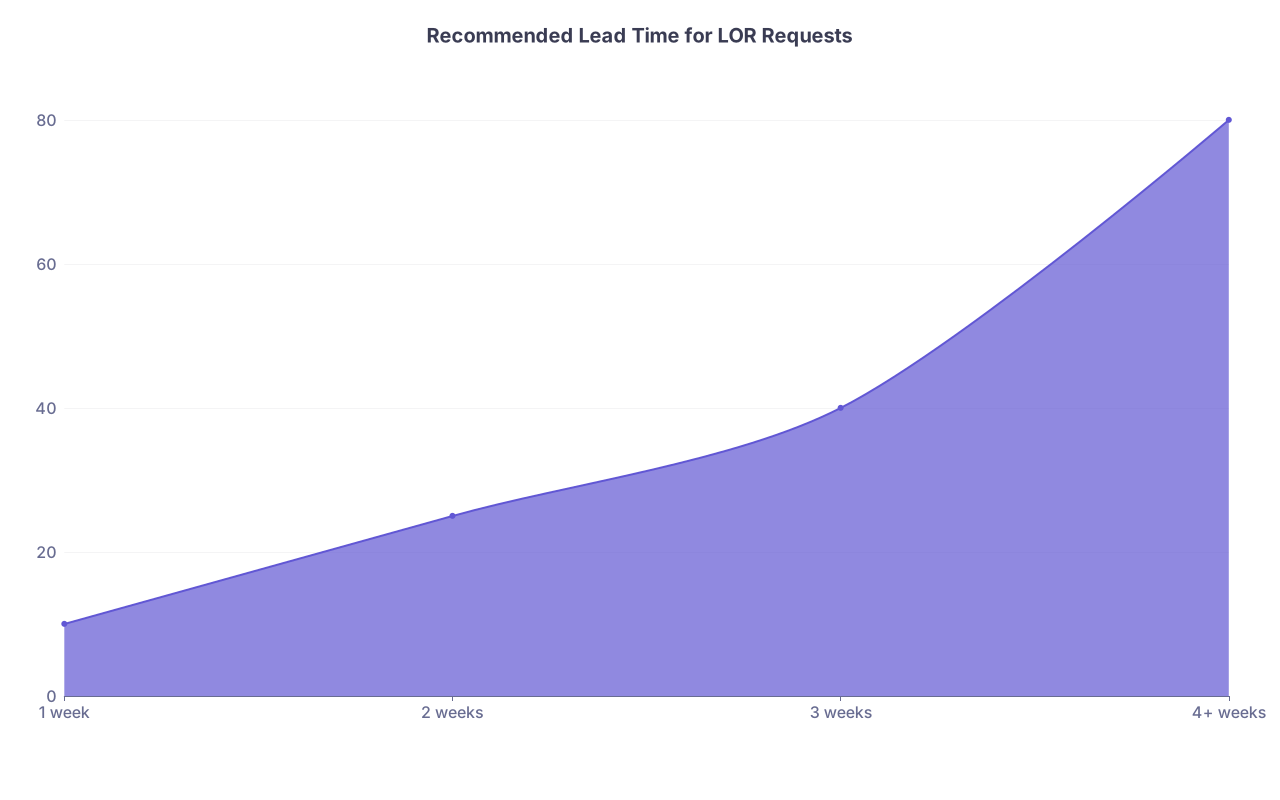
| Category | Value |
|---|---|
| 1 week | 10 |
| 2 weeks | 25 |
| 3 weeks | 40 |
| 4+ weeks | 80 |
Mistake #8: Not Protecting Yourself From Weak or Negative Letters
This might be the most serious danger:
IMGs often ask the wrong people for letters—or fail to screen whether the letter will actually be strong.
Then they get something lukewarm that quietly kills their application.
Red flags you ignore at your own risk:
- The attending barely interacted with you.
- They clearly don’t remember you.
- They hesitate when you ask: “Uh… sure, I can write something.”
- They say: “I can write you a letter” but never say “strong” or “positive” or “supportive.”
- They delegate fully to a resident you barely know.
You have to phrase your ask to give them an easy exit if they can’t write a strong letter. That’s not weakness. That’s self-preservation.
Use a line like: “Would you feel comfortable writing a strong and supportive letter of recommendation for my residency applications?”
If they say no, or they waffle, believe them. That’s your warning that this letter may be generic—or worse, subtly negative.
And no, you will not see it if it’s waived. But program directors will. You don’t want question marks or faint praise.
Strong letter request = strong response or polite decline. Both are good outcomes for you.
Mistake #9: Following Up in Clumsy, Pestering, or Passive-Aggressive Ways
You’re terrified about timelines. I get it. But panic-follow-ups can damage your relationship and your professionalism in seconds.
Disasters I’ve seen:
- “Dear Dr., ERAS is closing and you still did not upload. Kindly do the needful urgently.”
- Sending reminders every 3 days.
- CC’ing multiple people to “pressure” the attending.
- Complaining that other letter writers finished faster.
This makes you look entitled and immature.
A decent pattern:
- Initial request with clear timeline.
- One polite follow-up 10–14 days before your hoped-for deadline if they haven’t confirmed or uploaded.
- One last reminder a few days before, framed as checking-in, not accusing.
Sample tone: “I know you’re very busy, so I just wanted to gently check in about the letter of recommendation. I’m very grateful for your support, and ERAS suggests letters be submitted by [date] for best consideration.”
You’re allowed to care about your future. You’re not allowed to treat letter writers like an ERAS concierge desk.
Mistake #10: Forgetting That Every LOR Request Is Part Of Your Professional Brand
Too many IMGs treat LOR requests like a one-off administrative task. They’re not. They’re a test.
Your email, your timing, your follow-up, your tone—this is exactly the same professional behavior you’ll bring to:
- Requesting consults
- Communicating with colleagues
- Asking for urgent help on a patient
- Negotiating schedules and coverage
Attending physicians know this. Whether consciously or not, they’re evaluating you based on how you handle this ask.
If you:
- Are clear
- Are respectful
- Are organized
- Don’t over-flatter or beg
- Provide helpful information without dumping everything
…you look like someone they’d be fine working with again. That makes them more invested in writing you a letter that actually helps.
If you:
- Sound desperate
- Are sloppy with language
- Are demanding about deadlines
- Or copy-paste weird, culturally mismatched templates
…you look like a risk. And nobody wants to put their name on a risk.
Pulling It All Together (Without Sounding Like a Robot)
I’m not going to give you a full template to blindly copy; that’s half the problem. But here’s the structure of a credible IMG LOR request:
- Clear subject line with context.
- Short reminder of who you are and when you worked together.
- Direct but respectful ask for a strong letter, giving them a safe way to decline.
- One or two sentences about what you’re applying for and your goals.
- Attachments (CV, personal statement) mentioned briefly.
- Gentle mention of your ideal timeline.
- Gratitude without flattery overload.
If your email hits those beats, without the common mistakes above, you’re already ahead of a painful number of IMG applicants.
Bottom Line: What You Cannot Afford To Get Wrong
You’re not competing only on scores and externships. You’re competing on how professional you look at every single contact point.
Three things to remember:
- A poorly phrased LOR request makes you look pushy, unprepared, or fake—and that bleeds directly into how confidently someone will recommend you.
- You must ask for a strong letter while giving the writer permission to say no; anything else is gambling your match on a blind, possibly weak letter.
- Every email you send to a potential letter writer is part of your professional reputation—treat it with the same care you want them to put into your letter.