
The most dangerous myth for IMGs is that “more applications = more interviews.” The data shows that after a certain point, you are mostly buying stress and debt, not interviews.
The Core Metric: Interview Yield per Application
You are not really asking “How many programs should I apply to?”
You are asking a better, colder question:
What is my interview yield per application, and at what point do diminishing returns make extra applications a bad investment?
Let us define it precisely.
Interview Yield per Application (IY/A) =
Number of Interview Invites ÷ Number of Programs Applied To
If you apply to 120 programs and get 6 interviews:
- IY/A = 6 ÷ 120 = 0.05
- That is 5 interviews per 100 applications
- Or 1 interview per 20 applications
Most IMGs never calculate this. They just throw more money and more clicks at ERAS and hope something sticks.
The pattern I keep seeing in real applicant spreadsheets is consistent:
- Yield is highest in the first 40–60 applications
- Yield drops sharply by 80–100
- Beyond ~120–150, for most IMGs, yield is almost flat
You are fighting three things:
- Program volume limits (many programs auto-screen you out)
- Competition clustering (everyone applies to the same “IMG-friendly” places)
- Application fatigue (your application quality, targeting, and supporting materials do not scale linearly when you are sending to 200+ programs)
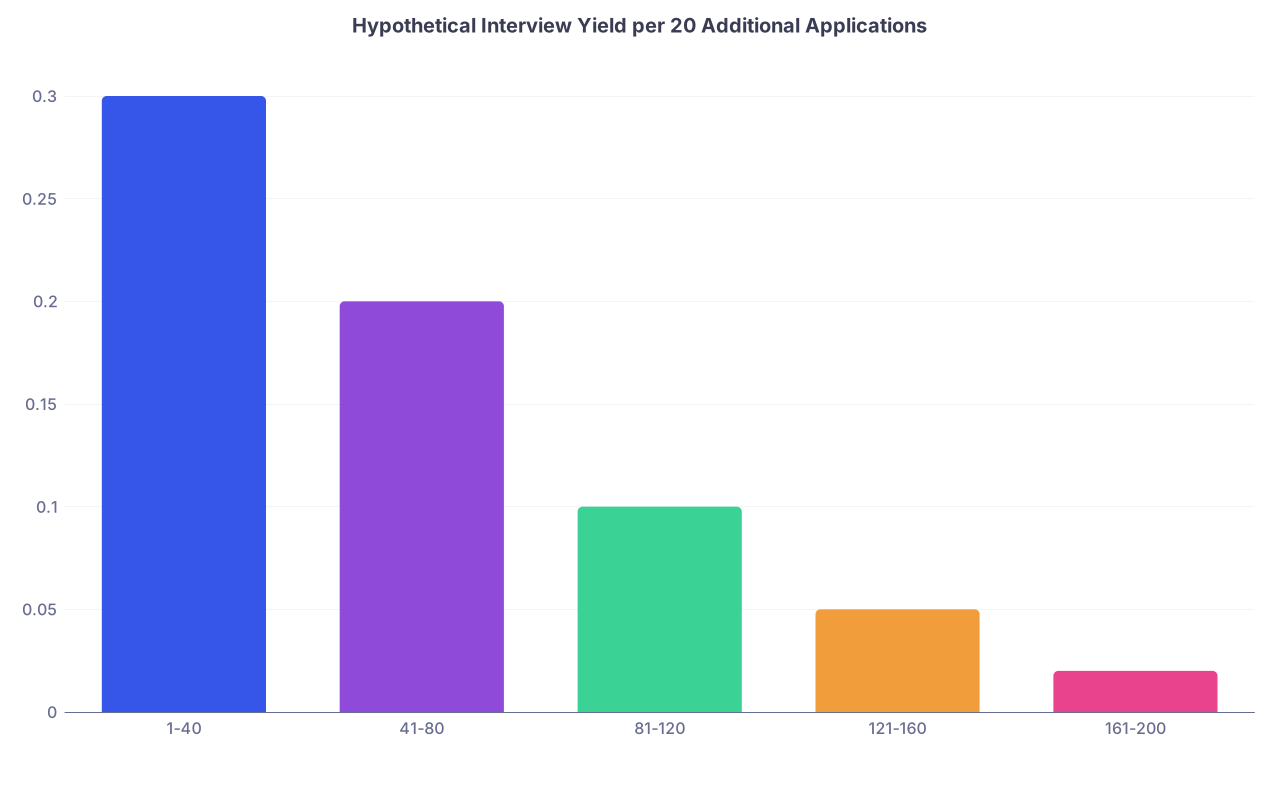
Let us quantify this.
| Category | Value |
|---|---|
| 1-40 | 0.3 |
| 41-80 | 0.2 |
| 81-120 | 0.1 |
| 121-160 | 0.05 |
| 161-200 | 0.02 |
Interpretation:
- First 40 applications might produce ~0.30 interviews per application (12 interviews per 40 if you are a strong candidate)
- By 121–160, you are at 0.05 (1 interview per 20 applications)
- By 161–200, 0.02 (1 interview per 50 applications)
No one should be paying ERAS fees for 1%–2% marginal yield unless they are already at very high risk and understand they are buying lottery tickets.
What Real Data Says for IMGs
Let me anchor this in actual numbers from NRMP, ECFMG reports, and what I see in applicant tracking spreadsheets.
Baseline: How Many Interviews Do You Actually Need?
For IMGs, the Match curve is brutal but clear:
- For Internal Medicine, IMGs who match typically have 5–7+ interviews
- For Family Medicine, about 4–6+ interviews
- For Pediatrics, often 5–7+
- For competitive specialties (Radiology, Derm, Ortho), IMGs are statistical outliers; you usually see 10+ interviews for those who match at all
A reasonable working target for a typical IMG in a core specialty (IM, FM, Peds, Psych):
- Minimum survival zone: 4–5 interviews
- Safer zone: 7–10 interviews
Now the question becomes: how far in application volume do you usually need to go to statistically reach that range?
Typical Interview Yields by Profile
These are approximate ranges I see when you combine published match outcomes with real-world spreadsheets from IMGs:
| Profile Type | USMLE / OET / Gaps | Typical Apps | Typical Interviews | Approx Yield (IY/A) |
|---|---|---|---|---|
| Strong IMG | 250+ / good OET / no gap | 80–120 | 10–20 | 0.10–0.17 |
| Average IMG | 230–245 / decent English / ≤2 year gap | 120–180 | 5–10 | 0.04–0.07 |
| Weak IMG | <225 or significant issues | 150–220 | 1–5 | 0.01–0.03 |
Look at the pattern:
- Strong IMGs do not need 200+ applications; their yield collapses in the second hundred.
- Average IMGs hit diminishing returns hard after ~140–160.
- Weak profiles have such low underlying yield that even 250 applications do not solve the problem; you are stretching a broken signal.
You do not fix a low-yield profile by doubling the number of programs. You fix it by raising the underlying probability that any single program will consider you.
Where Diminishing Returns Really Start
Let me be direct: There is no single magic number that fits every IMG. But the range where the curve bends is surprisingly consistent.
The Three Phases of Application Yield
Think of your applications in bands of 40–50 programs. The yield curve, for most IMGs, has three phases:
Phase 1: High-yield core (0–60 programs)
These are:- Your home state or region
- Clearly IMG-friendly programs by history
- Programs where you have real connections, observerships, or alumni presence
Yield is relatively high. You are a real candidate.
Phase 2: Reasonable extension (60–120 programs)
Still mostly rational choices:- Broader geographic spread
- Mix of IMG-neutral and some aspirational programs
Yield drops compared with Phase 1, but you still see a decent return.
Phase 3: Diminishing returns (120+ programs)
This is where:- You apply to every program that has ever taken one IMG in the last decade
- You include places where your metrics are far below their typical matched class
- You chase high-cost, low-probability options
Yield per extra 20–40 applications becomes very low.
A realistic “inflection point” for many IMGs is between 120 and 160 programs. Beyond that, interviews per additional 20 apps often drop into “0 or 1 if you are lucky” territory.
Example: Average IMG in Internal Medicine
Let us make up a typical profile:
- USMLE Step 2 CK: 235
- 1–2 years since graduation
- 1 US observership, one US letter
- Applying Internal Medicine
A pretty common, middle-of-the-road IMG.
Plausible scenario:
- First 60 applications (strongly IMG-friendly + regional targets):
- Yield: 8 interviews → IY/A = 0.133
- Next 60 applications (more mixed range):
- Yield: +4 interviews (total 12) → incremental IY/A = 4/60 = 0.067
- Next 40 applications (120 → 160, weaker fit / more competitive):
- Yield: +1 interview (total 13) → incremental IY/A = 1/40 = 0.025
- Next 40 (160 → 200):
- Yield: 0 extra interviews. IY/A = 0.
That last block of 40 cost you hundreds of dollars and added zero interviews.
That pattern is not rare. I have seen dozens of spreadsheets that look almost exactly like this.
Cost vs Yield: The Financial Reality
You are not just trading time. You are trading money that you probably do not have.
ERAS fees climb steeply with program count, and IMGs routinely underestimate how punishing the marginal cost per extra interview becomes after diminishing returns kick in.
Let me approximate the marginal cost per extra likely interview as volume increases. Say you are that average IMG in IM:
- Applications 1–60:
- 8 interviews → 7.5 applications per interview
- If your average ERAS fee per program is about $26–$30, you are paying ~$200–$225 per interview in this range.
- Applications 61–120:
- 4 more interviews → 15 applications per interview
- Now you are paying
2x per interview compared with the first block ($400–$450 each).
- Applications 121–160:
- 1 more interview → 40 applications per interview
- You are at ~$1,000+ per marginal interview.
Past that, the price can easily go to $2,000+ for a single extra interview, when you factor program fees + time + secondary costs.
At some point, that money would be better spent on:
- A proper US clinical experience with strong letters
- A step retake or Step 3 (where allowed) to raise your underlying chance
- A second application cycle with a stronger profile
The data is harsh: throwing more money at a weak marginal yield usually just creates an expensive first failure, not a successful match.
IMG vs AMG: Why Your Yield Curve Is Different
U.S. MD and DO seniors see a very different curve:
- They often get most of their interviews from 20–40 applications
- Yield stays decent through 50–60
- Many AMGs waitlist programs by October, while IMGs are still sending desperate emails in December
For IMGs, three structural problems flatten your curve earlier:
Hard filters
Programs use:- USMLE cutoffs (often ≥ 230 or ≥ 240)
- Year of graduation cutoffs
- “US graduate only” policies (sometimes unofficial)
You are rejected by algorithm long before a human sees your CV.
Sponsorship limitations
Visa policy alone wipes out a large fraction of potential programs for non–green card IMGs. You can spend money applying, but your yield is mathematically near-zero.Perception and risk tolerance
Many programs still prefer a “average” US graduate to a “strong” IMG. You are fighting selection bias with every application.
So your yield curve starts lower, rises slower, and flattens sooner.
This is why “I will just apply to 250+ programs” is usually a symptom of panic, not strategy.
Where Different IMG Profiles Should Consider Stopping
Let me break this down by profile, focusing on core specialties (IM, FM, Peds, Psych). Competitive fields are a different universe.
Strong IMG (e.g., 250+ step score, recent grad, good USCE)
The data from real cycles shows:
- Many strong IMGs in IM / FM match with 8–15 interviews
- They frequently obtain that with 80–130 well-chosen applications
For this group:
- Strong core list: 60–80 programs
- Reasonable extension: up to 120–140 programs
- Diminishing returns: after ~140–160, yield usually collapses
If you are still below 5 interviews at 120 apps with a strong profile, the problem is almost never just “not enough programs.” It is usually:
- Very poor targeting
- Weak personal statement or letters
- Red flag that is not being addressed
Just scaling from 150 to 220 programs does not fix those.
Average IMG (230–245, small gap, some USCE)
This is the bulk of the IMG pool.
Observed patterns:
- Most who match secure interviews in the 5–10 range
- Many end up applying to 140–200 programs, but the tail > 160 has very low marginal yield
For this group:
- Rational band: about 120–160 programs if your budget allows
- Past ~180, the expected gain per extra 20–30 applications is very small
If you are at 160 programs and have 0–2 interviews, more applications are not going to magically fix the underlying signal. You need to rethink strategy: emails, networking, later SOAP, or preparing for a stronger next cycle.
Weak IMG (sub-225, older YOG, or major gaps)
This is the hardest conversation.
The data is unforgiving:
- Even at 200+ applications, many in this segment end with 0–3 interviews
- Yield can be 0.005–0.02 (1 interview per 50–200 applications)
For this group, applying to 220–260 programs is common, but the real question is: Is the money buying meaningful probability?
Often it is not. You might be better off:
- Strengthening your CV: research, USCE, Step 3
- Targeting a different specialty (FM, Psych) if realistic
- Planning for a two-cycle strategy instead of a one-and-done blast
Diminishing returns start early here, because your base probability is so low at each program. You can spend thousands chasing fractions of a percent.
Specialty Differences: IM vs FM vs Psych vs Others
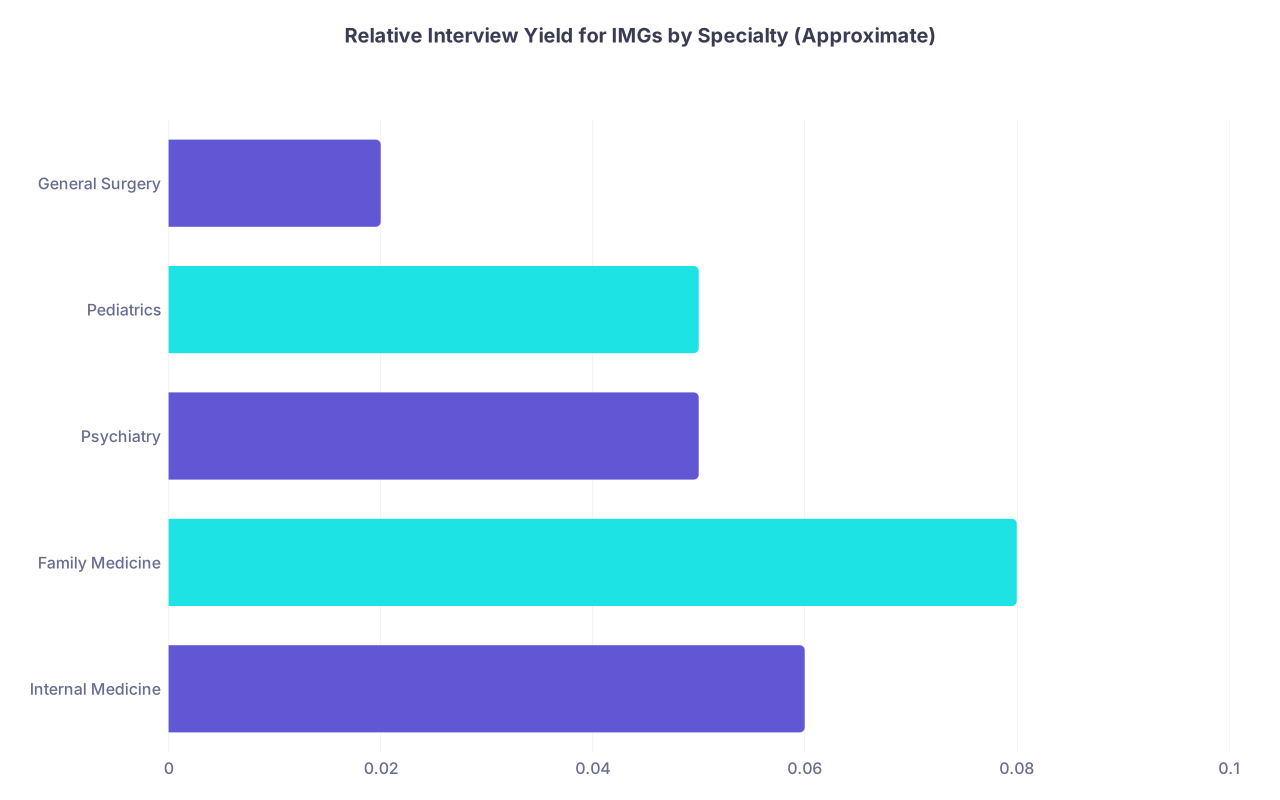
Interview yield is not uniform by specialty.
| Category | Value |
|---|---|
| Internal Medicine | 0.06 |
| Family Medicine | 0.08 |
| Psychiatry | 0.05 |
| Pediatrics | 0.05 |
| General Surgery | 0.02 |
Rough interpretation (for average IMGs):
- FM tends to have slightly higher yield per application
- IM and Psych are moderate, but highly variable by program and region
- General Surgery and other procedural fields are extremely low-yield
So:
- In FM, diminishing returns might start earlier in application count, because the baseline yield per program is a bit higher. You might reasonably stop around 120–160.
- In General Surgery, the yield is so low that even 200+ might not generate >3 interviews for many IMGs. This is not an application volume problem; it is a structural competitiveness problem.
Using Data to Decide When to Stop
Here is a practical, data-based way to handle your own curve rather than chasing someone else’s number.
Step 1: Track Yield in Real Time
You should track every block of, say, 30–40 applications:
- Block 1 (Programs 1–40):
- Sent date
- Interview invites from this block
- Block 2 (41–80)
- Block 3 (81–120)
- Block 4 (121–160), etc.
Compute incremental IY/A for each block:
Incremental IY/A for Block n =
Invites from Programs in that block ÷ Number of Programs in that block
If:
- Block 1: 6 invites from 40 → 0.15
- Block 2: 3 invites from 40 → 0.075
- Block 3: 1 invite from 40 → 0.025
- Block 4: 0 invites from 40 → 0
You already know where diminishing returns kicked in: between Block 2 and 3. Block 4 was pure waste.
Step 2: Define a Cutoff Threshold
Set a minimum acceptable incremental yield. For example:
- “If my incremental IY/A in a new 40-program block is <0.03 (1/33), I stop.”
- Or financially: “If the marginal cost per extra interview is trending above $1,000, I stop.”
Do not wait to hit 220 applications “because others on Reddit did it.” That is not analysis. That is herd behavior.
Step 3: Reallocate Instead of Blindly Expanding
Once your yield drops below your threshold:
- Reallocate time to:
- Targeted emails to PDs and PCs
- Networking with alumni, faculty, and attendings
- Strengthening Plan B (SOAP, next cycle, Step 3, USCE)
At some point, more applications are lower ROI than a single strong letter or one rotated month in the U.S. The math makes that obvious once you track it.
Summary: Where Diminishing Returns Start for IMGs
I will put concrete numbers to it, since that is what you actually need:
- For strong IMGs in core specialties:
- Serious diminishing returns often start after 140–160 programs
- For average IMGs:
- You probably need 120–180 programs, but most of the added value is in the 120–160 range
- Beyond 180–200, marginal yield is usually extremely low
- For weak IMGs:
- Diminishing returns start early because base probability is tiny
- You should question whether 200+ applications are better than structural improvement and a second cycle
The exact inflection point is personal. But the principle is not:
Once your incremental interviews per additional 20–40 applications approach zero, you have reached the flat part of the curve. At that point, more clicks are just more debt.
FAQ (5 Questions)
1. Is there ever a justification for an IMG to apply to 250+ programs?
Rarely. The data shows that for almost all IMGs in core specialties, the incremental yield past ~180–200 programs is extremely low. The only semi-rational case is a very high-risk candidate who understands they are buying lottery tickets for a near-failed cycle and is fully prepared to go through a second cycle anyway. Even then, I would usually recommend investing that money in USCE or exam improvement instead.
2. How many interviews should I aim for as an IMG to feel reasonably safe?
For Internal Medicine, Family Medicine, Pediatrics, and Psychiatry, most matched IMGs are sitting in the 7–10+ interview range. You can sometimes match with 4–5, but probabilities drop noticeably below that. Think of 7+ as a solid target, not a guarantee.
3. If I have 0 interviews by late October, should I keep adding programs?
If you already applied broadly (e.g., >120 programs) and have 0 interviews by late October, the problem is not just volume. More applications might add 1–2 interviews at best and often none. At that point you should prioritize targeted outreach, preparing for SOAP, and planning how to strengthen your profile for next year (USCE, Step 3, research, or addressing red flags).
4. Do IMG-friendly lists actually improve interview yield?
Used intelligently, yes. If you build your first 60–80 programs mainly from historically IMG-friendly programs that match people with stats like yours, your initial yield per application is usually significantly higher. The mistake is when applicants exhaust that list and then keep adding programs that are neither IMG-friendly nor aligned with their profile, which drives the incremental yield toward zero.
5. How does visa status affect my interview yield per application?
It lowers it, sometimes dramatically. Many programs categorically do not sponsor visas, or they limit sponsorship to exceptional candidates. If you need a visa, you must filter aggressively to visa-sponsoring programs. Applying broadly to non-sponsoring programs just drags your average interview yield down and burns money on programs where your true probability is effectively zero.