
The usual “just get the highest Step score you can” advice is lazy. For IMGs, the data show a very different reality: Step score bands and thresholds matter more than single‑point differences.
You are not competing on whether you scored 235 vs 238. You are competing on whether programs see you as “sub‑220 risk,” “230+ safe,” or “250+ outlier.” And those bands heavily shift your odds.
Let’s quantify that.
1. The data reality: IMGs play by harsher Step rules
I am going to be blunt: an IMG with a 230 is not viewed the same as a US MD with a 230. NRMP and ECFMG data consistently show this.
We will focus on Step 2 CK, because:
- Step 1 is pass/fail now (though older cohorts still have numeric scores in the data).
- Many programs use Step 2 CK as a hard filter for IMGs.
- NRMP’s “Charting Outcomes in the Match” provides usable IM/IMG‑specific statistics.
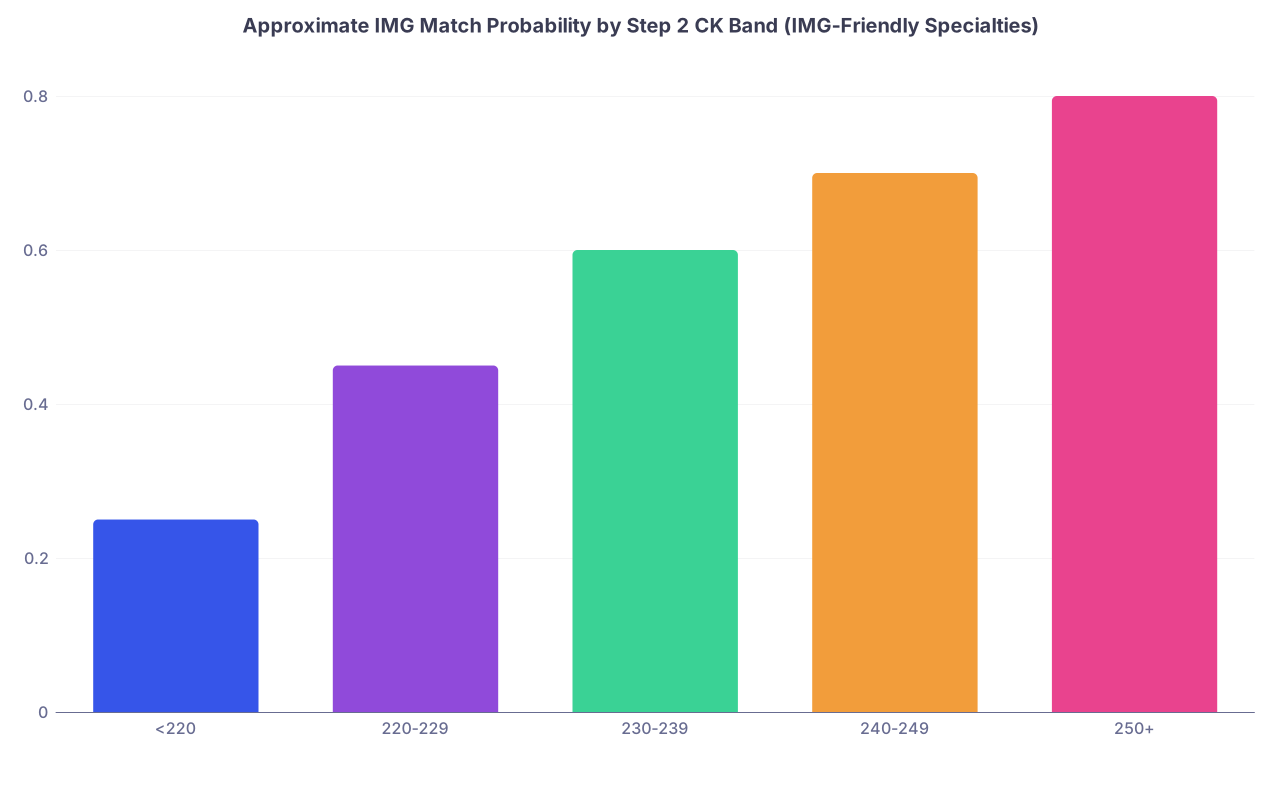
To ground this, here is a simplified set of approximate probability bands for IMGs in relatively IMG‑friendly fields like Internal Medicine and Family Medicine, derived from public NRMP data patterns and typical program filters.
| Category | Value |
|---|---|
| <220 | 0.25 |
| 220-229 | 0.45 |
| 230-239 | 0.6 |
| 240-249 | 0.7 |
| 250+ | 0.8 |
Read that carefully:
- Moving from <220 to low‑220s: roughly doubles your odds.
- Going from 225 to 235: large bump, because you cross several program cutoffs.
- Going from 242 to 248: helps, but the marginal gain is smaller; you are already “above most cutoffs.”
For more competitive specialties (radiology, anesthesia, EM, etc.), shift those bars downward by 20–40 percentage points. Same bands, much worse odds.
2. Score bands that matter for IMGs
Programs do not sit around arguing 233 vs 235. They set filters like “220+” or “230+” and then move on. You need to think in those discrete steps.
Here is a practical way to think about Step 2 CK bands as an IMG:
Sub‑210: Red zone
Data reality:
- For most IMGs with <210, match odds in any specialty are extremely low.
- Many programs auto‑filter you out entirely.
- Even in IMG‑heavy community IM, you are below most cutoffs.
What this usually means:
- You almost certainly need a strong compensating narrative (second attempt with massive improvement, significant US clinical experience, meaningful research, or non‑traditional background).
- Even then, you are in the “long‑shot” category.
210–219: Severe risk band
You are still below the majority of program thresholds for IMGs:
- A decent number of community IM/FM programs start filters at 220.
- Competitive specialties are essentially off the table, barring rare connections.
Realistically:
- You will need:
- A very targeted application strategy.
- High volume of applications.
- Strong US letters and clinical experience.
- Even then, the aggregate data show low overall match probability for IMGs in this band.
220–229: Viable but fragile
This is where outcomes start to diverge hugely based on everything besides your score.
The numbers pattern for relatively IMG‑friendly specialties (IM, FM, Peds):
- You move from “nearly impossible” into “plausible” match probability.
- Many community and some mid‑tier university programs will at least see your application.
But:
- You are still below the mean for matched IMGs in most specialties.
- For competitive fields, this is simply not enough without exceptional other factors.
230–239: The workhorse band for many successful IMGs
Most of the IMG success stories in IM/FM/Peds I see live here.
Data patterns:
- Your odds of matching in IM/IMG‑friendly specialties climb into the 50–60% range if the rest of your application is average.
- Many filters (220, 225, 230) stop being a barrier. You comfortably clear them.
- You are around or slightly below the mean for matched IMGs in several specialties.
This band is what I would call “statistically safe enough” for reasonable targets.
240–249: Strong performance, leverageable
Now you start to separate:
- You beat the mean of many matched US MDs in primary care fields.
- You are competitive for a significant number of mid‑tier university IM programs, provided your other metrics are acceptable.
- For more competitive specialties, you become “worth a look” but not a lock.
The data show diminishing returns: going from 235 to 245 is a big image boost, but not double the match rate. You move up in queue; you do not change the laws of gravity.
250+: Outlier advantage
For IMGs, 250+ is signal. Programs notice because:
- You now exceed average matched scores in most specialties.
- Even competitive programs may look at your file despite being an IMG.
- Some PDs explicitly scan for 250+ as a sign of high test‑taking ceiling.
But this does not erase IMG bias, visa headaches, or lack of US experience. It simply puts you into a much smaller group where your file actually gets read.
3. Specialty competitiveness vs. IMG score bands
You cannot interpret a 235 in a vacuum. A 235 in Family Medicine is not the same thing as a 235 in Dermatology.
Here is a simple comparative view. These numbers are approximate bands where an IMG starts becoming “meaningfully competitive” if other aspects are solid.
| Specialty Tier | Example Specialties | Rough IMG 'Competitive Starting Band' |
|---|---|---|
| Very IMG-Friendly | Family Med, Psych, Peds | 220–225+ |
| Moderately IMG-Friendly | Internal Med (community + some univ) | 225–230+ |
| Selectively IMG-Receptive | Anesthesia, Pathology, Neurology | 235–240+ |
| Highly Competitive | Radiology, EM, Gen Surg | 240–245+ |
| Ultra-Competitive | Derm, Ortho, Plastics, ENT | 250+ and even that is often not enough |
Data translation:
- 230 that looks “good” for IM might be functionally non‑competitive for radiology as an IMG.
- 220 is extremely risky in radiology but viable in FM/Psych with the right portfolio.
- In ultra‑competitive fields, Step scores function more as screen‑in rather than a predictor of actual match odds; the real constraint is the number of IMG‑friendly programs (which is very small).
4. US MD vs DO vs IMG: same score, different odds
The most misunderstood part of all this: a 235 is not the same asset for everyone.
NRMP “Charting Outcomes” data consistently show:
- At similar Step scores and other metrics, US MDs have the highest match rates.
- US DOs fall somewhat lower but still significantly above IMGs in most specialties.
- IMGs trail both groups, sometimes by a wide margin, even at the same score band.
So if you as an IMG think “The mean matched score in Internal Medicine is around 240, I have a 240, so I am average,” you are misreading the context. That mean is driven heavily by US MDs and DOs.
For IMGs, you want to think like this:
- If the overall matched average in a field is 240, a safer IMG target is 245+.
- Being below the overall mean puts you at more risk than an equivalent US MD.
Not fair. But the numbers do not care whether you like them.
5. How programs actually use Step bands on IMGs
Forget the fantasy that programs lovingly evaluate each application holistically from the start. The first pass is mechanical. Especially for IMGs.
The typical flow looks roughly like this:

| Step | Description |
|---|---|
| Step 1 | All IMG Applications |
| Step 2 | Auto-Reject or Do Not Rank |
| Step 3 | Scored on CV, USCE, Letters, Research |
| Step 4 | Ranked for Interview Offers |
| Step 5 | Interviews Offered |
| Step 6 | Pass Minimum Step Cutoffs? |
| Step 7 | Meets Visa/Graduation Year Criteria? |
| Step 8 | Any Red Flags? |
Notice:
- Step scores are often the first filter, especially for IMGs.
- Cutoffs are not constant. Some examples from real program websites and anecdotal PD quotes:
- “We consider IMGs with Step 2 CK ≥ 230.”
- “We rarely interview IMGs with Step 2 CK below 240.”
- “Our minimum for IMGs is 220 on first attempt.”
- Once you pass the filter, your exact value is less important than:
- US clinical experience.
- Strength of letters (especially from US faculty).
- Graduation year (YOG).
- Research and publications.
- Communication and interview performance.
So the key is: score enough to clear the filters reliably, then maximize the variables that actually predict ranking and match.
6. Using your Step band strategically as an IMG
Let us translate all this into decisions.
Case 1: Step 2 CK 218 IMG, recent graduate, no strong red flags
Data perspective:
- You are in the “severe risk band” but not hopeless if YOG is recent and you can add USCE.
- Many programs will filter you out at 220+ or 225+.
Practical strategy:
- Target very IMG‑friendly specialties (FM, Psych, Peds; maybe community IM).
- Apply heavily to community programs, especially those with a track record of IMGs with mid‑220s or below.
- Maximize:
- US clinical experience at community programs.
- Honest, detailed letters from US attendings.
- Consider boosting with research or a strong home‑country record, but understand the data: the Step band still heavily constrains you.
Case 2: Step 2 CK 233 IMG, 2 years since graduation, some USCE
You are in the “viable” zone for IM/IMG‑friendly fields.
Data interpretation:
- You likely clear the 220 and 225 filters, and many 230 filters.
- In Internal Medicine, this is in the main cluster of successful IMGs.
Strategy:
- Prioritize IM/FM/Psych/Peds and community‑heavy lists.
- Include a reasonable number of university‑affiliated IM programs that are known to match IMGs.
- You need:
- No red flags.
- Documented US clinical experience.
- Clear explanation if there is any gap since graduation.
This is the zone where thoughtful program selection and high‑quality applications make a huge difference in your realized match odds.
Case 3: Step 2 CK 247 IMG, recent grad, solid USCE, minimal research
You are finally playing offense.
Data translation:
- Well above many IMG filters.
- Strong for IM, Psych, Peds, FM. Reasonable for Anesthesia, Path, Neuro in some settings.
- Still swimming upstream for radiology, EM, surgery, but no longer invisible.
Strategy:
- For IM: mix of university and community, with some realistic reach programs.
- For more competitive fields: either
- Accept statistically lower odds and apply broadly (with a realistic backup), or
- Use this score to secure a strong IM spot and consider future fellowships (cards, GI, etc.).
The key with 245–255 scores: do not squander them by only applying to low‑tier programs because someone scared you. The data justify some ambition—so long as you remain realistic about being an IMG.
7. When a “re-take” or additional exam makes sense
With Step 1 now pass/fail, IMGs have fewer levers to move test‑based perception. But there are still decisions.
If you have only a Step 2 CK score in the low 210s
Data view:
- You are below many common IMG cutoffs (220+ or 225+).
- Your odds improve significantly if you can show a strong later performance on another standardized exam (e.g., Step 3).
But this is nuanced:
- Retaking Step 2 CK is generally not an option (aside from fails or specific cases), so your “second shot” tends to be:
- Step 3, if allowed by your licensing pathway.
- High‑level in‑training or specialty exams later, but that does not help with the first Match.
If you can sit Step 3 before applying and you are confident you can score very well (say, equivalent of 230+), that can partially offset a weaker Step 2 CK in some programs’ eyes. But it will not override hard filters.
If you already have 240+
The marginal benefit of another test is limited.
- Your score band already clears almost every IMG filter outside ultra‑competitive specialties.
- Spending additional months chasing 2–3 perceived “score points of prestige” is poor ROI compared to gaining:
- Stronger USCE.
- Publishing a paper or case report.
- Improving your communication and interview skills.
The data favor investing in the weakest part of your profile once your score clears the main thresholds.
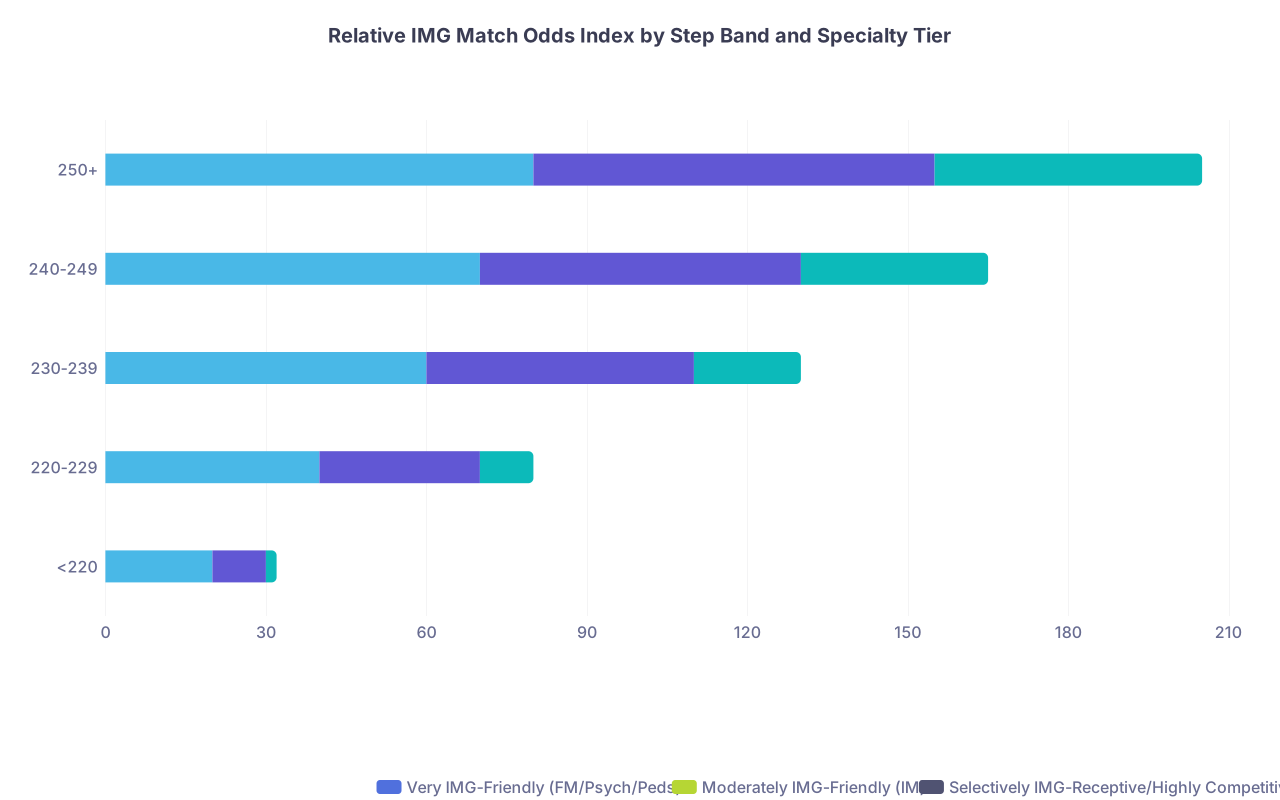
8. Putting it together: an IMG match probability matrix
To make this more concrete, here is a conceptual matrix showing how Step 2 CK bands, specialty competitiveness, and overall application strength interact for IMGs. These are not exact NRMP probabilities, but a realistic directional model built from data patterns.
Assumptions:
- “Strong” profile: recent grad, good USCE, good letters, no red flags.
- “Average” profile: mild gaps or weaker USCE/letters.
- Specialty tiers as before.
| Category | Very IMG-Friendly (FM/Psych/Peds) | Moderately IMG-Friendly (IM) | Selectively IMG-Receptive/Highly Competitive |
|---|---|---|---|
| <220 | 20 | 10 | 2 |
| 220-229 | 40 | 30 | 10 |
| 230-239 | 60 | 50 | 20 |
| 240-249 | 70 | 60 | 35 |
| 250+ | 80 | 75 | 50 |
Think of those numbers as a “match odds index” out of 100, not precise probabilities. They show the curve:
- Major jump from <220 to 230s in friendly specialties.
- Much flatter growth in more competitive specialties.
- Even at 250+, competitive specialties are still far from “high” odds for IMGs.
The brutal but honest conclusion: for IMGs, score bands mostly determine which fight you are allowed to be in, not whether you will win it.
9. Actionable rules if you are an IMG planning or entering the Match
Condensing the analytics into decisions:
- Treat 220, 230, 240, and 250 as critical bands, not arbitrary numbers.
- For IMG‑friendly specialties:
- <220: consider delaying, strengthening, or reassessing your plan.
- 220–229: apply, but aggressively optimize every other factor.
- 230–239: solid; choose realistic programs and apply broadly.
- 240–249: strong; you gain leverage with university‑affiliated and stronger programs.
- 250+: use that outlier status with some ambition, but keep backup plans.
- For competitive specialties:
- Under 240: you are fighting statistics and program culture, not just numbers.
- 240–249: targeted, strategic applications plus backup in a more IMG‑friendly specialty.
- 250+: possible, not probable. Research, connections, and USCE become decisive.
- Once you clear your target band, stop obsessing over points and reallocate effort to:
- US clinical experience.
- Relationships with US faculty (for strong, specific letters).
- Cleaning your narrative: gaps, failures, career switches explained coherently.
- Interview skills; this is where many IMGs quietly lose ground.
FAQ (exactly 3 questions)
1. I am an IMG with Step 2 CK 236 and strong US clinical experience. Should I attempt a competitive specialty like radiology or anesthesia?
The data say you are below the effective competitive starting band (roughly 240–245+ for IMGs) for those specialties. You can still try, but you will be fishing in a very small pond of IMG‑receptive programs and facing long odds. A rational strategy would be: apply primarily to IM/IMG‑friendly fields where your 236 plus strong USCE gives you a real shot, and, if you insist, allocate a small fraction of applications (10–20%) to your dream competitive specialty with full awareness of the risk.
2. Does a very high Step 2 CK (250+) erase the disadvantage of being an IMG?
No. It significantly improves your likelihood of being screened in and taken seriously by more programs, including some competitive ones, but it does not put you on equal footing with US MDs at the same score. Factors like visa status, program culture, historical IMG acceptance, and your USCE and letters still heavily influence outcomes. Think of 250+ as “elite signal” that opens doors, not a magic equalizer.
3. If my Step 2 CK is below 220, is it pointless to apply as an IMG?
Not automatically pointless, but statistically very unfavorable. Your best odds would be in the most IMG‑friendly, lower‑cutoff specialties (FM, some Psych/Peds, a subset of community IM) and programs that explicitly accept lower scores or prioritize non‑test metrics. You would need a compelling combination of recent graduation, strong USCE, strong letters, and possibly a later high Step 3 to offset the weak band. Even then, the probability curve is steeply against you, so you should plan contingencies rather than assuming a standard Match outcome.
Key takeaways: Step scores for IMGs are about bands and thresholds, not tiny differences. For most IMG‑friendly paths, 230–240 is the crucial inflection zone; below that, odds drop fast, above that, returns diminish. Use your band to choose the right specialty tier and program list, then put your energy into the non‑score variables that actually decide who gets ranked.