
The biggest myth in the IMG world is that “IMG‑friendly” equals “they took an IMG once.” That’s wrong. One IMG resident does not make a program IMG‑friendly.
If you’re an IMG, you can’t afford to guess. You need a systematic way to judge how IMG‑friendly a residency program really is before you spend money on ERAS fees.
Here’s the framework I’d actually use with my own spreadsheet.
The Core Formula: IMG‑Friendliness = Data + Policy + Culture
You’re trying to answer three questions for every program:
- Do they actually take IMGs regularly? (data)
- Do they make it administratively possible for you? (policy)
- Will you be treated like a real colleague, not a “backup choice”? (culture)
If a program doesn’t check at least two of these boxes strongly, it’s not “IMG‑friendly.” It’s “IMG‑possible.” Very different.
Let’s break those down into concrete filters you can use.
Step 1: Hard Numbers – Look at Who They Actually Match
Ignore the marketing language first. Look at the residents.
A. Resident roster: count the IMGs
Go to the program’s website → “Current Residents” or “Our People.”
You’re looking for:
- Medical schools obviously outside the US/Canada
- Names you can’t easily place? Google them. The school is usually listed on LinkedIn, Doximity, or their old med school websites.
Then assess:
- IMG‑heavy: >40–50% of current residents are IMGs
- IMG‑mixed: 10–40% IMGs
- IMG‑rare: <10% IMGs or “token” IMG every 2–3 years
- IMG‑invisible: Website only shows MD/DO schools or hides med schools entirely
If you see no IMGs in PGY‑1 and PGY‑2, don’t kid yourself. That’s not suddenly changing this year.
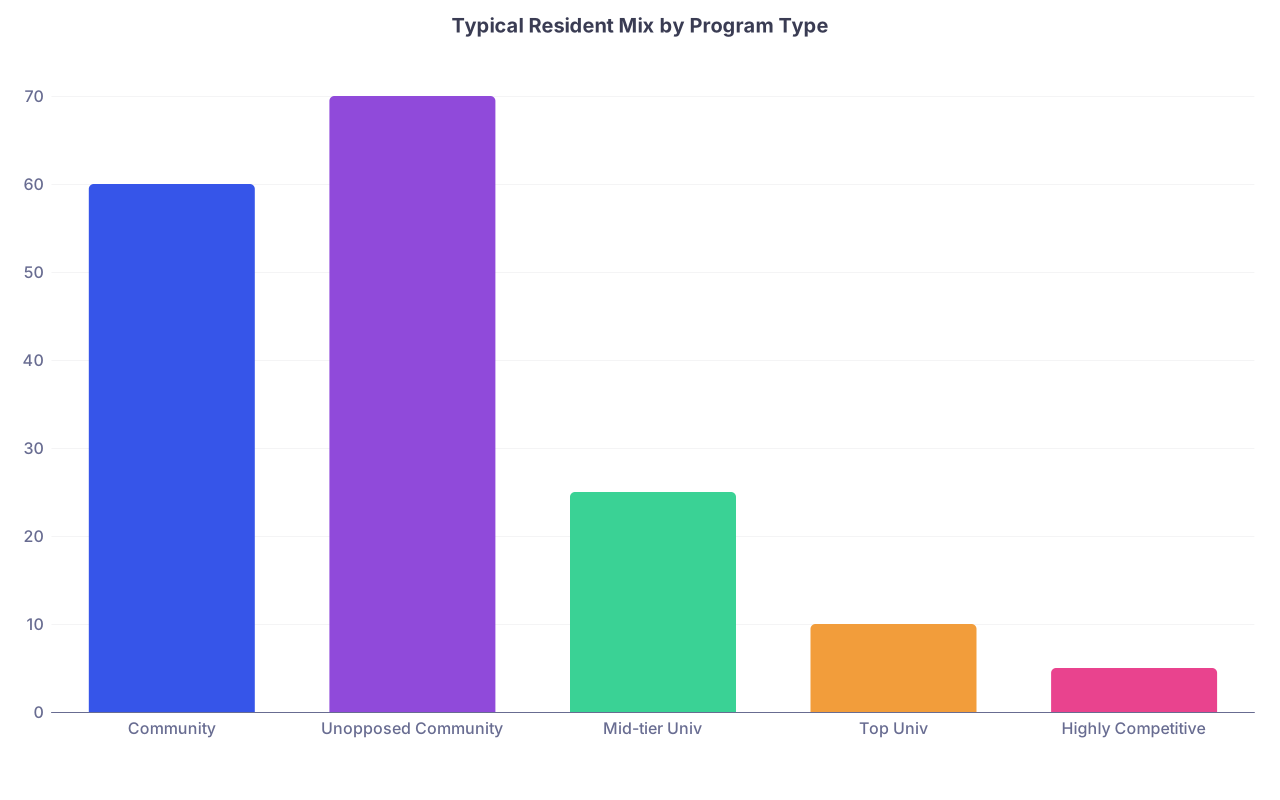
| Category | Value |
|---|---|
| Community | 60 |
| Unopposed Community | 70 |
| Mid-tier Univ | 25 |
| Top Univ | 10 |
| Highly Competitive | 5 |
(Values above = rough % of programs where IMGs make up a significant share of residents.)
B. NRMP and program‑level match data
Check two layers:
- Specialty‑wide IMG statistics (NRMP “Charting Outcomes in the Match” and “Results and Data”):
- Some specialties are naturally more open: Internal Medicine, Family Medicine, Pediatrics, Psychiatry, Pathology.
- Others are brutally tough: Dermatology, Plastic Surgery, Ortho, Neurosurgery, ENT, Ophtho, EM.
If you’re an IMG applying to a specialty where <10% of matched applicants are IMGs, you must be extremely selective and realistic.
- Program‑level trends
- FRIEDA (AMA), Doximity, or program’s own pages sometimes show:
- % of IMGs matched
- How many positions total
- If they sponsor visas
- FRIEDA (AMA), Doximity, or program’s own pages sometimes show:
If you can’t find data, email the coordinator with one line:
“Hi [Name], quick question: how many of your current residents are international medical graduates?”
If they dodge the question or give a vague answer (“We consider all strong applicants equally!”), that’s a red flag.
Step 2: Visa Reality – No Visa = Not IMG‑Friendly
Programs that won’t handle visas are not IMG‑friendly, full stop.
You need to know two things for every program:
- Do they sponsor visas at all?
- Which visa type(s) do they actually use in practice?
A. Where to find visa info
Check:
- Program website → usually under “Eligibility,” “International Medical Graduates,” or “FAQ”
- FREIDA → filters for J‑1 and H‑1B sponsorship
- GME Office page for that hospital/university
You want specific language like:
“We sponsor J‑1 visas through ECFMG. We do not sponsor H‑1B visas.”
“We sponsor both J‑1 and H‑1B visas. H‑1B applicants must have passed Step 3 before starting.”
Vague or missing info? Assume J‑1 only at best, unless confirmed.
B. J‑1 vs H‑1B: why it matters
- J‑1 only: Very common. Good enough for many IMGs. But you’ll probably face a home‑country return requirement or need a waiver.
- H‑1B:
- Usually needs Step 3 done before residency.
- Often signals a program that’s used to working with IMGs long‑term.
- More paperwork, more cost for them. Programs that still do it are typically more invested in IMGs.
If you absolutely need H‑1B and the website doesn’t spell it out, email:
“Do your current residents include H‑1B visa holders? If yes, roughly how many per year?”
No clear yes? Don’t waste an application.
Step 3: Application Filters – Are They Even Willing to Look at You?
IMG‑friendly programs don’t make you decode hidden rules. They spell out their criteria.
A. USMLE / COMLEX cutoffs
Scan their eligibility section for:
- Stated cutoffs (e.g., “We prefer Step 1 > 220, Step 2 CK > 230”)
- Attempts allowed (e.g., “No failures” vs “We consider applicants with a single failure”)
If you see:
- “Applicants must have passed all exams on the first attempt” and you have a fail → move on.
- “We prefer scores above [X] but review applications holistically” and you’re close → maybe.
And brutal truth:
If you’re significantly below their posted cutoffs, “holistic review” will not save you.
B. Graduation year limits
Look for lines like:
- “Graduated within the last 3–5 years”
- “We do not consider applicants who graduated more than 7 years ago”
If:
- You’re outside that window and
- They don’t mention exceptions for advanced degrees or substantial clinical work
…you’re probably dead on arrival there. Focus somewhere else.
C. US clinical experience (USCE) requirements
IMG‑friendly programs understand that USCE is harder and more expensive for you. So they’ll define what actually counts.
You’ll see levels like:
- Flexible: “US clinical experience preferred but not required.”
- Moderate: “At least 1–2 months US clinical experience required.”
- Strict: “We require hands‑on US clinical experience in an ACGME‑accredited setting.”
Observerships? Some count them. Some explicitly don’t.
If you have only observerships and they say “hands‑on only,” skip.
Step 4: Website and Communication Clues – Who Are They Actually Talking To?
This is softer, but it’s real. The tone of their communication tells you a lot.
Strong signs a program is truly IMG‑friendly
- They have a separate section: “Information for International Medical Graduates.”
- They explicitly list:
- Visa types with clear policies
- Step requirements
- Types of USCE accepted
- Time since graduation limits
- They highlight resident diversity, show photos with names and med schools from multiple countries.
- They show success stories of IMGs matching into fellowships or becoming chiefs.
Another major green flag: when multiple faculty bios openly list non‑US medical schools. That tells you IMGs don’t just get in; they grow there.
Red flags that it’s just “IMG‑possible”
- They say “we welcome diverse applicants” but:
- No visa info
- No IMG section
- No IMGs visibly listed among residents
- Coordinator replies with generic lines:
- “We are unable to answer questions about applicant competitiveness.”
- “Please see our website” when your question isn’t actually answered there.
- They highlight 100% board pass rate, 100% fellowship placement, but no diversity stories.
If they’re not proud to show their IMGs, they’re probably not prioritizing IMGs.
Step 5: Use a Scoring System, Not Vibes
You’re going to look at dozens of programs. If you rely on gut feeling, you’ll miss patterns.
Make a simple spreadsheet and score each program on 5 axes from 0–2:
0 = bad / missing
1 = mixed / unclear
2 = strong / IMG‑friendly
Here’s a sample structure.
| Factor | 0 (Weak) | 1 (Mixed) | 2 (Strong) |
|---|---|---|---|
| IMG Residents | 0–1 IMG total | 10–30% IMG | >30–40% IMG |
| Visa Policy | No sponsorship | J-1 only, vague details | Clear J-1 and/or H-1B policy |
| Requirements Clarity | No info for IMGs | Some info, but incomplete | Dedicated, detailed IMG section |
| USCE Expectations | “USCE required” but vague | Strict but clear | Reasonable, flexible or defined |
| Communication / Tone | Generic, dismissive | Neutral, slow replies | Responsive, specific, welcoming |
Total score out of 10. Then categorize:
- 8–10: High priority IMG‑friendly → worth the ERAS fee
- 5–7: Selective → apply only if you’re a strong applicant for that specialty
- 0–4: Low yield → only if you have a very broad, well‑funded application strategy
Step 6: Reality Check – Specialty + Your Profile
Here’s the uncomfortable part. “IMG‑friendly” is relative to your numbers and your specialty, not just the program.
You need to line up three things:
- Specialty competitiveness
- Your stats (scores, attempts, YOG, USCE)
- Program’s baseline IMG‑friendliness
| Specialty | IMG Opportunity Level | Notes |
|---|---|---|
| Internal Medicine | High | Many community/university IMGs |
| Family Medicine | High | Very IMG-friendly overall |
| Pediatrics | Moderate–High | Many mixed programs |
| Psychiatry | Moderate–High | Growing IMG presence |
| Neurology | Moderate | Selectively IMG-friendly |
| Surgery (Gen) | Low–Moderate | A few IMG-heavy community |
If you’re:
- 5+ years out from graduation
- Have a Step failure
- Minimal USCE
…you don’t just need “IMG‑friendly.” You need very IMG‑heavy community or unopposed programs, often in less popular locations.
Step 7: Use Networks and Social Media Smartly (Not Desperately)
Don’t spam every resident on LinkedIn. But you can absolutely gather high‑value intel with a few targeted moves.
How to ask residents for honest info
Message 1–2 residents per program (ideally IMGs) with something like:
“Hi Dr. [Name], I’m an IMG from [Country] applying to [Specialty]. I’m researching programs that are truly supportive of IMGs.
Would you say your program regularly takes IMGs and supports visas, or is it more of a rare exception? Totally fine if you don’t have time to reply – I appreciate any insight.”
You’re looking for answers like:
- “Yes, we have several IMGs per class.”
- “We mostly take US grads, I’m one of the few IMGs.”
- “They just started accepting IMGs again.”
Pay attention to the vibe. If they warn you indirectly (“It’s competitive for IMGs here”), believe them.
Use X (Twitter), Reddit, and forums wisely
Search:
"[Program Name] IMG""[Program Name] H1B""[Program Name] J1 visa"
You’ll find old threads where people:
- List which programs interviewed them as IMGs
- Talk about changed visa policies
- Mention hidden cutoffs (“Coordinator told me they don’t consider Step attempts”)
This isn’t perfect data. But it helps you decide where to dig deeper vs where to move on.
Putting It Together: A 30‑Minute Per Program Checklist
Here’s a quick flow you can literally follow:

| Step | Description |
|---|---|
| Step 1 | Program Website |
| Step 2 | Check Visa Policy |
| Step 3 | Low Priority |
| Step 4 | Check Requirements |
| Step 5 | USCE Requirements |
| Step 6 | Score on Spreadsheet |
| Step 7 | High Priority Apply |
| Step 8 | Maybe, If Budget Allows |
| Step 9 | Resident List |
| Step 10 | Visa Supported? |
| Step 11 | Cutoffs & YOG OK? |
| Step 12 | Score >= 8? |
| Step 13 | Score 5-7? |
If you stick to this process, you’ll stop wasting time on programs that were never going to touch your application.
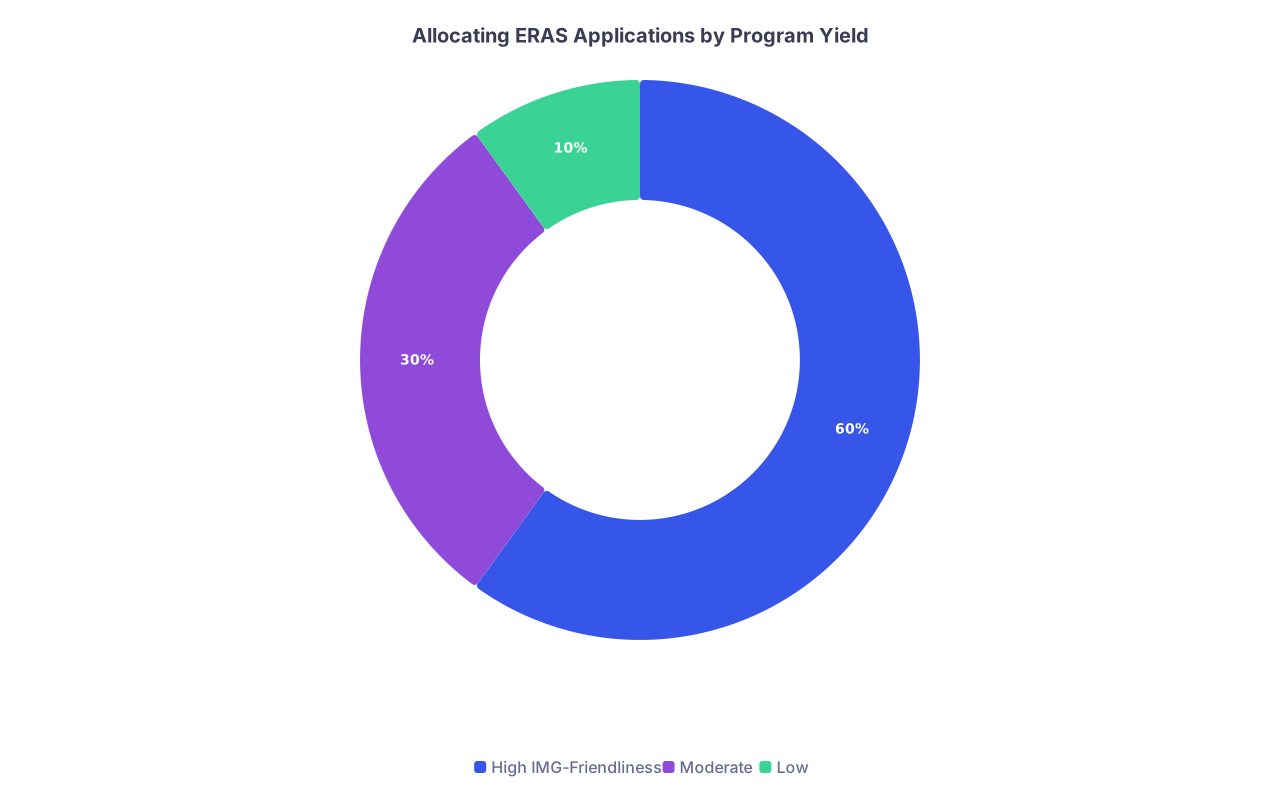
Visual: Your Application Budget vs Program Yield
To drive the point home: your budget should follow program yield, not hope.
| Category | Value |
|---|---|
| High IMG-Friendliness | 60 |
| Moderate | 30 |
| Low | 10 |
Rough rule of thumb: 60%+ of your applications should go to programs you’ve scored as truly IMG‑friendly.
FAQ: IMG‑Friendly Residency Programs (7 Questions)
1. Is any program that lists “IMGs welcome” automatically IMG‑friendly?
No. That line is often just legal/PR language. IMG‑friendly means they consistently match IMGs, have clear visa policies, and don’t hide their international grads. If the resident list is 95% US MD/DO and there’s no visa info, they’re not truly IMG‑friendly.
2. What’s the quickest way to filter out non‑IMG‑friendly programs?
Three fast cuts:
- No IMGs visible on the resident roster.
- No visa sponsorship mentioned anywhere.
- Strict criteria that kill most IMGs (recent grad only, all first attempts, mandatory US clinical experience with no flexibility).
If a program fails any two of those, move on.
3. Should I email programs to ask if they accept IMGs before applying?
You can, but don’t expect miracles. The better question is:
“Do you sponsor J‑1 and/or H‑1B visas?” or “How many current residents are IMGs?”
Avoid asking “Will I be competitive?” They won’t answer that honestly. Use their policies + your stats instead.
4. The program has only 1–2 IMGs but they’re on H‑1B. Is that good or bad?
Mixed. Good: they clearly know how to handle visas and the system. Bad: if there are only 1–2 IMGs total, it suggests they’re exceptions, not the norm. I’d count that as “moderate” IMG‑friendliness at best unless other factors are very strong.
5. Do community programs automatically mean more IMG‑friendly?
Not automatically, but often yes. Community and unopposed programs, especially outside big coastal cities, tend to have higher IMG percentages. Still, don’t assume—check the resident roster and visa policy. There are community programs that quietly prefer US grads only.
6. If my scores are low or I have a fail, should I still apply to university programs?
Sometimes, but only to explicitly IMG‑heavy university‑affiliated programs (often “university‑community hybrids”). Flagship academic programs with top‑tier reputations rarely go for IMGs with weak scores. Your money is almost always better spent on IMG‑heavy community programs unless you have strong compensating strengths (research, US grad degree, strong US letters).
7. What’s one red flag that a program looks IMG‑friendly but actually isn’t?
When they proudly say “We welcome IMGs!” but:
- Current PGY‑1 and PGY‑2 classes have zero IMGs
- Website has no details about visas or international grads
- All residents’ med schools are US/Canadian
That usually means they had one IMG five years ago and never updated their phrasing.
Open your program list right now and pick three programs. For each one, check the resident roster and visa page, and give it a 0–10 IMG‑friendliness score. If more than half your list ends up below 5, you’re aiming at the wrong targets—and you’ve just saved yourself a lot of wasted ERAS fees.