
You’re staring at your score report. That ugly word “Fail” is sitting where you thought your passing score would be. Your stomach drops, your mind jumps ahead to ERAS, and the question hits you hard:
“Am I done? Is this match over before it starts?”
Let me be blunt: a USMLE fail hurts, especially for IMGs. Programs notice. Some will screen you out automatically. But no, it does not automatically end your career. I’ve seen IMGs with a fail on Step 1 or Step 2 CK still match into solid internal medicine, FM, peds, psych. Even some prelim surgery. It’s possible.
The real question isn’t “Is it forgivable?” It’s:
- When is it forgivable?
- What makes it less forgivable?
- How do you frame it so programs don’t toss your file in 5 seconds?
That’s what we’re going to walk through.
1. How Bad Is A USMLE Fail For An IMG… Really?
For an IMG, a USMLE fail is a big red flag. Not career-ending by default, but you’re now in the “explain yourself” category.
Here’s how program directors generally think about it:
- One fail, then solid pass(es), strong application otherwise → “Hmm, okay, what happened?” (Yellow flag, not automatic rejection in many places.)
- Multiple fails, low passes, weak other metrics → “Nope.” (Red flag, often auto-filtered.)
- Fail with long gap before retake or low improvement → “Risky. Probably not.”
Most PDs aren’t looking for perfection. They’re looking for reliability. They want to know: if they invest in you, will you pass boards and function safely?
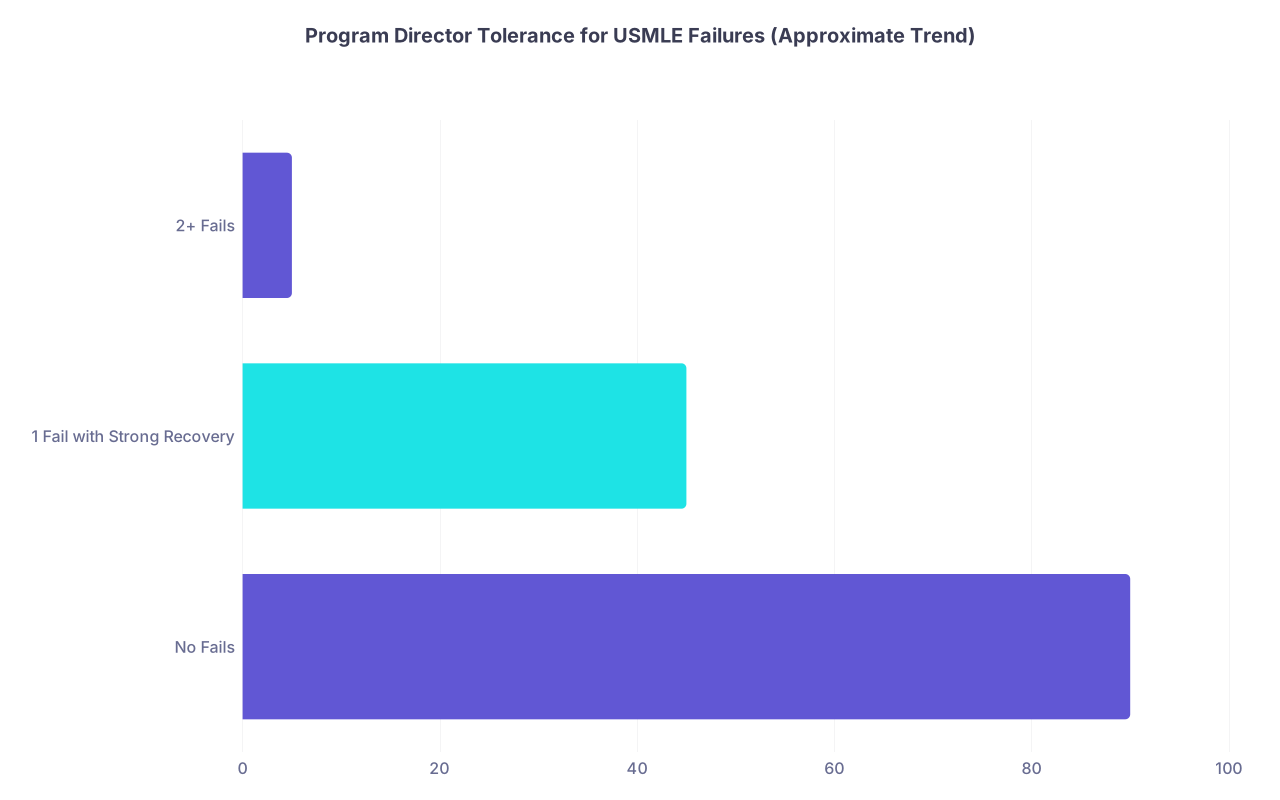
| Category | Value |
|---|---|
| No Fails | 90 |
| 1 Fail with Strong Recovery | 45 |
| 2+ Fails | 5 |
These aren’t exact numbers, but they match what I’ve heard over and over in PD panels and from faculty:
- No fails: You’re judged on the usual stuff: scores, YOG, research, letters, communication.
- One fail: Some doors close. Others stay open if the rest of your file is strong.
- Two or more fails: Only a small group of programs will still seriously consider you, often community or less competitive programs, and even then you need something clearly exceptional.
So yes, a fail is forgivable in some contexts. The context is everything.
2. When Is A USMLE Fail Most (And Least) Forgivable?
Let’s sort scenarios from “most salvageable” to “you need a miracle or a different plan.”
Most forgivable situations
Early exam, clear recovery
- Fail Step 1 (especially back when it was scored), then:
- Pass on first retake
- Strong Step 2 CK score (well above minimums)
- Story: “I under-estimated the exam, corrected fast, and now I’m clearly competent.”
- Fail Step 1 (especially back when it was scored), then:
Borderline fail + big jump
- Example: Step 2 CK 208 (fail), then 241 retake.
- That jump shows you can perform at residency level. PDs like trajectories that go up.
Legitimate, time-limited, documented cause
- Serious illness, family emergency, major tech issue.
- You don’t want to sound like you’re making excuses, but a real event that explains a sudden drop can soften the blow—if your retake performance is strong.
More concerning but still possible
Fail on Step 1 and mediocre Step 2 CK
- Fail Step 1, then Step 2 CK just barely passes.
- You’ve passed, but you haven’t convincingly shown “this was a fluke.” You’re in a much smaller pool of programs.
Step 2 CK fail after passing Step 1
- PDs worry more because Step 2 CK is closer to day-to-day residency work.
- Still salvageable if the retake is strong and your clinical record is great, but this carries more weight.
Hardest to overcome
Multiple attempts on the same exam
- Two or more fails on Step 1 or Step 2 CK.
- This screams “board risk” to PDs, which is poison because board pass rates affect accreditation.
Fails + older YOG + no US experience
- If you’re 5–10 years out of graduation, have no USCE, and multiple USMLE issues, almost all realistic doors in the US close. That’s just the truth.

3. Decide: Do You Address The Fail Or Not In Your Application?
This is where people overthink and under-strategize.
There are three main places your fail might come up:
- Your ERAS application (exam attempt history is automatically visible)
- Your personal statement
- Interviews (if they ask)
Reality check: PDs see your attempts whether you talk about them or not. You’re not hiding anything. The only real decision is: do you proactively explain it, or wait to respond if asked?
Here’s the framework I use.
You SHOULD address it briefly in your personal statement if:
- You have one fail and:
- You made a big improvement on retake or
- There is a clear, discrete, non-recurring reason (illness, death in family, major disruption) and
- The rest of your profile is competitive (good YOG, some USCE, decent scores).
Why? Because you control the narrative. You say, in effect, “Yes, this happened. Here’s why it doesn’t define me or predict my performance now.”
You should PROBABLY NOT highlight it in the personal statement if:
- You have multiple fails and no strong redemption (scores still low, nothing exceptional elsewhere).
- Or the “reason” is weak and sounds like making excuses:
- “I was anxious.”
- “I was under a lot of stress.”
- “I didn’t study properly.”
In those cases, mentioning it in the PS just shines a spotlight on your weakest point without a real upside. The PD will see it anyway. Don’t start your story there unless you can flip it into a clear strength now.
Non-negotiable
If they ask in an interview, you answer directly. Dodging, minimizing, or blaming others is the fastest way to confirm their worst fears about you.
4. How To Talk About A USMLE Fail (Without Shooting Yourself In The Foot)
The structure I push people to use is simple:
- Own it.
- Explain it briefly.
- Show what changed.
- Point to objective evidence you’ve improved.
Let me show you what that looks like in practice.
Example: One fail, then strong retake
“On my first attempt at Step 2 CK, I failed by a small margin. I scheduled the exam during an intense clinical period and didn’t give it the dedicated time it required. I took full responsibility, adjusted my schedule, and completely overhauled my study plan. On my second attempt, I scored a 244, and since then I’ve passed all subsequent standardized exams comfortably. That experience taught me to be very intentional about preparation and time management, which I now apply routinely in my clinical work.”
Notice what’s happening:
- No blaming.
- No long drama.
- Clear mistake identified.
- Concrete corrective action.
- Objective improvement.
What not to do
Here’s the type of answer that kills chances:
“I failed because I was very stressed and had a lot going on personally. The exam was very hard and there were also some issues at the testing center. I do think the result didn’t reflect my true knowledge.”
That sounds like someone who’ll struggle and blame the environment again. PDs run away from this.

| Step | Description |
|---|---|
| Step 1 | USMLE Fail |
| Step 2 | Own it briefly |
| Step 3 | State specific cause |
| Step 4 | Explain what you changed |
| Step 5 | Point to improved result |
| Step 6 | Connect to residency readiness |
5. Where Exactly Do You Address It In ERAS?
Let’s break it down.
1. ERAS application itself
You don’t “address” it here. Your attempts and scores are just recorded facts. No commentary.
2. Personal statement
Use the PS to address it if you can frame it as:
- A turning point, and
- A source of specific growth, and
- Backed by better future performance.
Keep it to 2–4 sentences. Don’t anchor your whole statement around the fail.
Something like:
“While preparing for Step 1, I underestimated the exam and failed my first attempt. That was a humbling wake-up call. I sought structured guidance, rebuilt my study habits, and on my second attempt passed comfortably. The disciplined, systematic approach I developed then is the same approach I bring to managing complex patients and learning new clinical skills.”
That’s enough. You don’t need a full page of self-flagellation.
3. MSPE / Dean’s letter
As an IMG, your school’s format may vary, and you often don’t control this text. If your school mentions it, fine. Your job is to make sure the rest of your application shows a pattern of reliability after that point.
4. Interviews
Treat it like any other tough but predictable question. Practice it out loud, not just in your head. You want it to come out calm, rehearsed, and short.
I would literally script and rehearse:
- A 30-second version (for quick questions)
- A 60–90 second version (if they dig deeper)
6. What You MUST Do After A Fail (If You Still Want A Real Shot)
You can’t change the fail. You can change everything after it. And that’s exactly what PDs look at.
Here’s what helps your case, ranked from “bare minimum” to “this actually impresses them”:
| Priority Level | Action | Impact on Forgivability |
|---|---|---|
| Mandatory | Pass retake on first try | Baseline requirement |
| High | Raise score meaningfully on retake | Shows growth and capacity |
| High | Gain US clinical experience with strong letters | Offsets concern about real-world performance |
| Medium | Recent graduation or active clinical work | Reduces worry about being ‘rusty’ |
| Bonus | Research, QI, extra certifications (BLS/ACLS, etc.) | Shows work ethic and commitment |
And clearly:
- If your retake score is just barely passing, you must be strong in USCE, letters, communication, professionalism.
- If your retake score is significantly higher, you get more leeway on everything else.
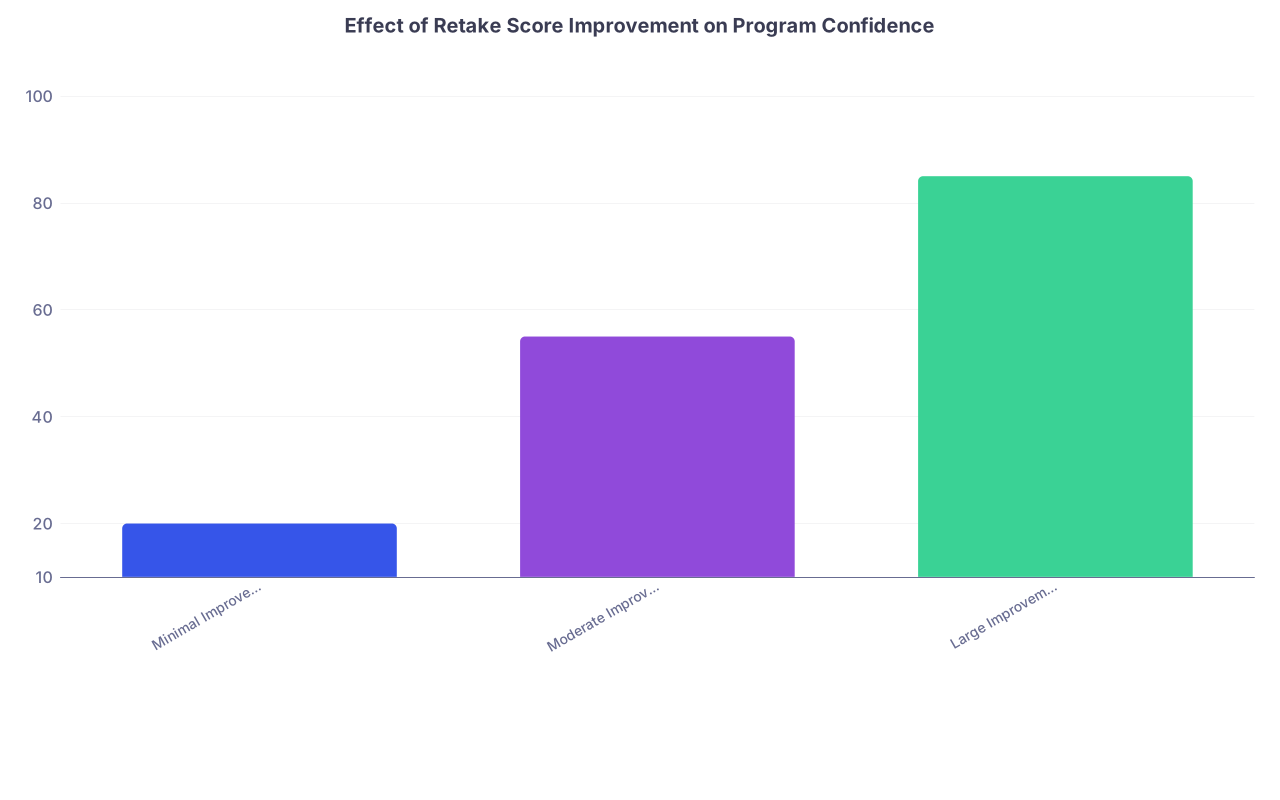
| Category | Value |
|---|---|
| Minimal Improvement | 20 |
| Moderate Improvement | 55 |
| Large Improvement | 85 |
Again, these numbers are illustrative, but you get the point: PDs trust big upward trajectories.
7. How Program Type Changes Your Odds
Not all programs think about a USMLE fail the same way.
Broadly:
University programs / highly competitive locations
- Often use strict filters.
- Even one fail = instant rejection in many systems.
- You might still get interviews at a few if the rest of your file is outstanding, but don’t bank your entire strategy on them.
Community programs, especially in less competitive regions
- Filters vary wildly. Some are just “must have passed by X date.”
- A single fail can be forgiven if:
- You have USCE, especially at community hospitals.
- You show you’re mature, dependable, and teachable.
Smaller or newer programs
- Sometimes more flexible.
- Often care more about “will this person show up, work hard, and pass boards eventually?” than about having perfect exam history.
Don’t guess. Email or call a reasonable number of programs once you have all your scores:
“Hi, I’m an IMG who completed Step 2 CK with one prior failed attempt. My current score is 238. Do you accept applications from IMGs with a single USMLE fail if the rest of the application is strong?”
You’ll get a mix of:
- “No, unfortunately we require first-time passes.”
- “Yes, we review all applications holistically.”
That’s actionable data.

8. When You Should Consider A Plan B
Sometimes the answer is: it’s not forgivable enough for what you’re trying to do.
Strong signs you need to seriously consider alternate paths:
- Multiple USMLE fails, and:
- Old YOG (>5–7 years),
- Little or no USCE,
- No standout element (research, niche expertise, advanced degree).
At that point, your chances in competitive specialties and locations drop close to zero. You might still have a shot at:
- Family medicine in certain regions,
- Prelim or transitional year in rare cases (but prelim with multiple fails is still tough),
- Or you look at:
- Other countries,
- Non-clinical roles (research, industry, public health),
- Or going back to a clinical path in your home country.
That’s not failure. That’s adjusting to reality.
9. The Bottom Line: Are USMLE Fails Ever Forgivable For IMGs?
Yes—sometimes. Here’s the clean summary:
One fail with a strong comeback is often forgivable. Especially if you:
- Pass the retake on the next attempt,
- Show clear score improvement,
- Build a strong, recent, clinically active profile with solid USCE and letters.
How you explain it matters almost as much as the fail itself. Own it briefly, show what you changed, and point to objective proof that you’re now reliable. No excuses, no long stories.
Multiple fails or weak recovery sharply limit options. At that point, you focus on the smallest number of realistic programs or start seriously building Plan B.
You can’t erase that “Fail” from the report. But you can decide whether it’s the headline of your story—or just one rough chapter that you’ve clearly moved past.