Community programs are not automatically easier for IMGs. That belief is lazy, outdated, and in a lot of specialties, objectively wrong.
The “just apply to community programs, they take IMGs” cliché is one of the most persistent and most dangerous pieces of folklore in the IMG world. I have watched people cling to it, build their entire strategy on it, and then sit with 0 interviews wondering what happened.
Let’s tear it apart properly.
The Origin of the Myth: What Used To Be True
This myth didn’t come from nowhere.
Twenty years ago, many university-based programs were heavily US‑grad focused, some explicitly. At the same time, a good number of community internal medicine and family medicine programs had trouble filling. They turned to IMGs—often very strong ones—to keep their services running. Word spread fast in the IMG grapevine:
“University won’t touch you. Apply community. They take us.”
I’ve literally heard that sentence, word-for-word, in advising sessions.
That story persisted while the landscape changed underneath it.
Several quiet shifts:
- The number of US MD and DO graduates increased.
- Some community programs became extremely competitive because they funneled residents into hospitalist jobs or subspecialty fellowships.
- More programs—community and university—started using Step 1/2 filters and ECFMG status as blunt weapons.
- Some “university-affiliated community” programs started behaving like mini-universities in selectivity, while maintaining the “community” label on ERAS.
So yes, there was a time when “community = more IMG-friendly” was a decent heuristic. It’s now a half-truth at best, and in some fields, a total lie.
What the Data Actually Shows About IMGs and Program Type
Let’s talk numbers instead of nostalgia.
The NRMP, ECFMG, and individual program websites collectively tell a straightforward story: competitiveness and IMG-friendliness track more with specialty, geography, and program-specific culture than with “community vs university.”
Look at broad-level patterns:
- Internal Medicine: Many community programs remain very IMG-friendly. But the most competitive community IM programs (high fellowship placement, desirable cities) are not easier for IMGs than mid‑tier university programs in less sexy locations.
- Family Medicine: Lots of IMG presence, both community and university-affiliated. But some small community programs in suburban areas now fill easily with US grads.
- Psychiatry: Used to be a fallback. Not anymore. Many community psych programs are now US‑grad heavy and quite picky.
- Surgery, Ortho, Derm, ENT: “Community” does not magically open doors. Most of these program types—regardless of label—take very few IMGs, if any.
- Geography: Community program in New York or New Jersey with visa sponsorship? Expect 5,000–8,000 applications. That’s not “easy.”
To make this less abstract, think about how different program types actually look in terms of IMG intake:
| Program Type | Typical % IMGs in Categorical Spots |
|---|---|
| Community IM (visa-friendly, urban) | 40–80% |
| University-affiliated Community IM | 20–50% |
| University IM, mid-tier | 10–30% |
| Competitive Community Psych | 0–20% |
| Community General Surgery | 0–10% |
Are these exact numbers from one database? No. They’re in line with what you see if you actually click through 100+ program websites and look at resident lists in 2023–2024.
The takeaway: “community” is not a free pass. It’s a label on a website. IMG‑friendliness lives in the resident roster, not in the name.
Here’s what that looks like in aggregate when you separate programs by whether they currently have IMGs or not:
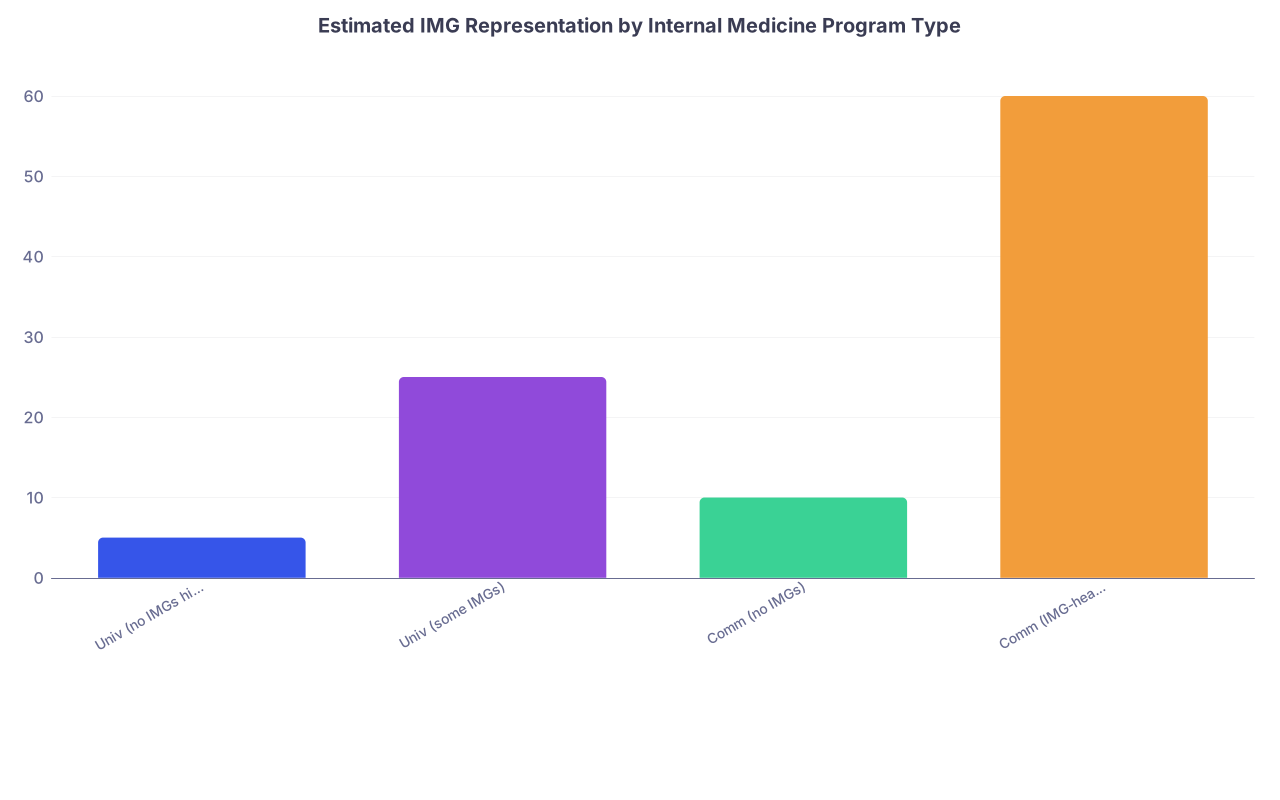
| Category | Value |
|---|---|
| Univ (no IMGs historically) | 5 |
| Univ (some IMGs) | 25 |
| Comm (no IMGs) | 10 |
| Comm (IMG-heavy) | 60 |
Again: representative, not exact. But it matches what you see when you stop listening to rumors and actually count faces and schools.
The Real Drivers: What Makes a Program “Easier” for IMGs
Program type is a lazy proxy. These matter more:
1. Historical IMG intake
Most IMGs skip the most important data source: the program’s own resident list.
If the last 3 years of residents are 80–90% US MD/DO, your odds as an IMG are low unless you are exceptional or have a hook (insider connection, home rotation, unique skills). That’s true whether the logo says “University Medical Center” or “Community Hospital.”
On the other hand, a “university-affiliated” program where half the residents are from Pakistan, India, Nigeria, Eastern Europe, and the Caribbean? That’s an IMG program dressed in academic clothes.
You should be asking: “Do they take IMGs every year, in real numbers?” Not: “Is this community?”
2. Visa policy and behavior
Sponsoring a visa on paper is not the same as actively ranking visa‑needing IMGs.
There are community programs that list “J‑1 visas sponsored” on their website but have not had a single J‑1 resident in 5 years. Shows up in the resident photos. Dead giveaway.
Then there are mid‑tier university programs with 20–40% of their residents on J‑1s, year after year. Which one is “easier” for IMGs? The label doesn’t help you here.
I’ve seen this pattern dozens of times: IMGs flood every community program that says “J‑1 OK” in New York or Michigan. Meanwhile, a university program in the Midwest quietly sponsors multiple J‑1s every cycle with far fewer total applications.
3. Location and desirability
This one hurts people who only think in labels.
A glamorous community program in a coastal city with strong fellowship ties is frequently harder for IMGs than a low‑profile university program in a midwestern town where winter lasts 7 months.
American grads care about location. A lot. That means:
- Desirable cities: more US interest → higher scores → more competition → fewer IMGs.
- Less popular cities: fewer US grads chasing them → slightly more room for strong IMGs who are actually willing to live there.
Again: has nothing to do with “community vs university” and everything to do with “Would a US grad want to live here?”
4. Specialty culture
If you’re IMG and thinking surgery, ortho, derm, ENT, plastics, radiology, or ophtho, the label “community” will not rescue you.
Most community general surgery programs still lean heavily US‑grad, or take a tiny number of IMGs with extremely strong profiles (high Step 2, significant US research, home‑grown from their prelim years). Many take no IMGs at all in categorical spots.
So when I hear “I’ll just go for a community surgery program, they’re easier,” I know that person has not looked at a single resident roster.
How to Actually Judge If a Program Is IMG-Friendly
Ditch the label. Use data. Here’s the process I wish more IMGs followed.

| Step | Description |
|---|---|
| Step 1 | Find Program |
| Step 2 | Check Resident List |
| Step 3 | Deprioritize Program |
| Step 4 | Check Visa & Policies |
| Step 5 | Apply Only If Strong Fit |
| Step 6 | Review Scores & Background |
| Step 7 | Compare With Your Profile |
| Step 8 | Decide Priority Level |
| Step 9 | Recent IMGs Present? |
| Step 10 | Active Visa Residents? |
The steps, in plain language:
Look at PGY‑1 to PGY‑3 resident lists for the last 3 years.
If you see several IMGs from a range of schools and countries, the program is at least open to IMGs.Identify whether any residents are on visas.
Often you can infer from country of medical school and occasional “J‑1” notes. If you see multiple J‑1/IMG residents currently training, that’s real.Look at what kind of IMGs they take.
Are they all US‑IMGs from the same Caribbean school with links to that hospital? Are they mostly non‑US IMGs with very strong research backgrounds? Pattern matters.Check their stated minimums and filters (if any).
Many community programs now have a Step 2 threshold (e.g., 220+ or 230+) and a graduation cut‑off (≤ 5 years since graduation). Some university programs quietly accept older grads if they’re strong.Cross-check with NRMP / FREIDA data if available.
FREIDA often lists % of IMGs and visa types (J‑1, H‑1B). It’s not perfect, but it’s far superior to gossip.
You end up with an actually useful classification:
- IMG-heavy, visa-friendly (high yield if you meet their profile).
- IMG-light but open (reasonable reach if you’re strong).
- IMG-hostile or IMG-empty (do not waste your hopes on them unless you’re extremely competitive and have a real angle).
None of that requires knowing whether they call themselves “community” or “university.”
Where the “Community = Easier” Rule Still Has Some Truth
I’m not going to pretend the myth is 100% rubbish. There are narrow situations where “community” does align with “more realistic for IMGs.”
Typically:
Internal Medicine and Family Medicine
A big chunk of IMG‑heavy programs here are community or community‑affiliated.Certain regions (NY/NJ, parts of Michigan, parts of the South and Midwest)
Some community programs in these regions have long-standing IMG pipelines. They exist because they’ve historically struggled to recruit enough US grads or they serve large underserved populations where resident labor is in high demand.Transitional Year and prelim spots
Some community hospitals use IMGs (often very sharp ones) as a workhorse layer in TY or prelim IM. Different game than categorical, but again, you see “community = more IMGs” in those buckets.
To visualize it roughly for Internal Medicine:
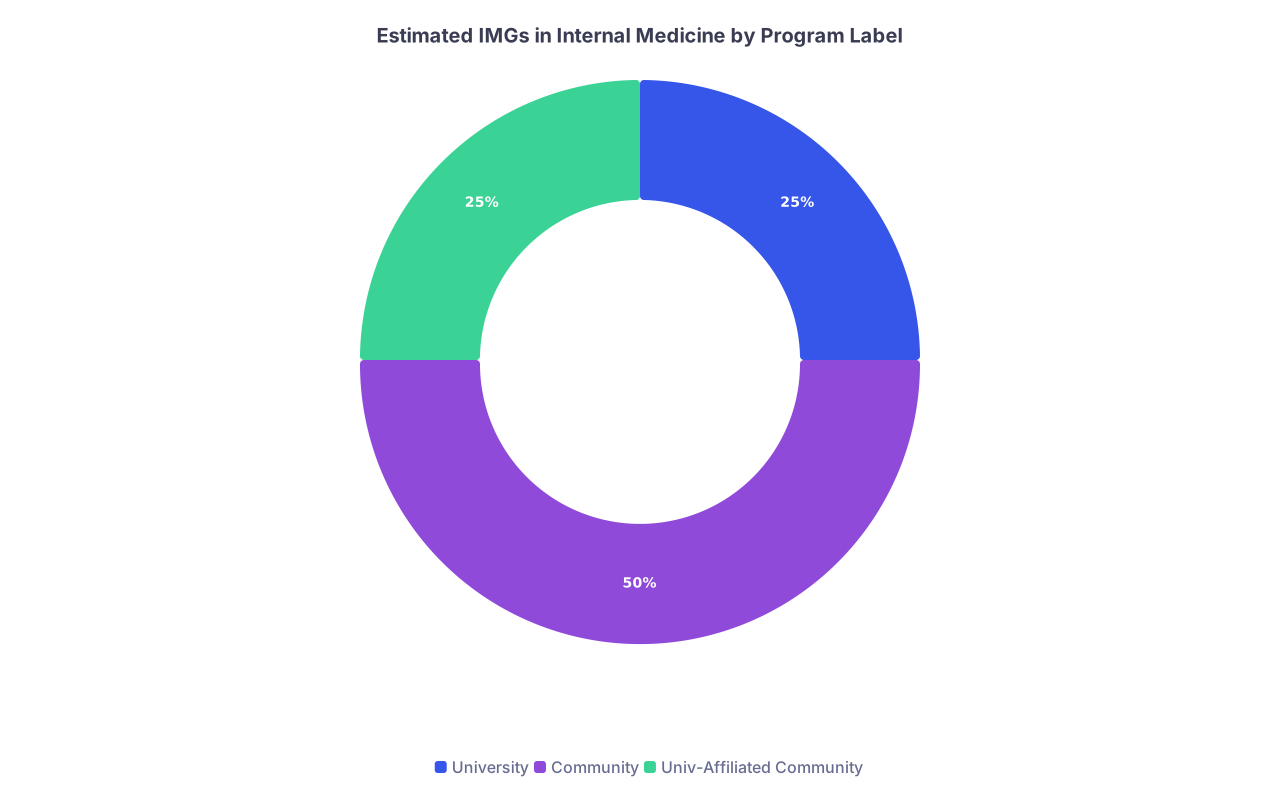
| Category | Value |
|---|---|
| University | 25 |
| Community | 50 |
| Univ-Affiliated Community | 25 |
So no, the rule isn’t pure fantasy. It’s just way too crude, and people treat it like a law of nature instead of a weak correlation with massive exceptions.
The Traps IMGs Fall Into When They Worship the Label
I’ve seen three recurring disasters.
1. Over-applying to over-saturated “IMG magnets”
Programs that are known in every IMG WhatsApp group as “friendly” get absolutely flooded. I’ve seen single community IM programs with 6–8k applications, mostly IMGs, fighting for a handful of interview slots.
These programs become harder to match than some lesser-known university programs simply because the applicant pool is insane.
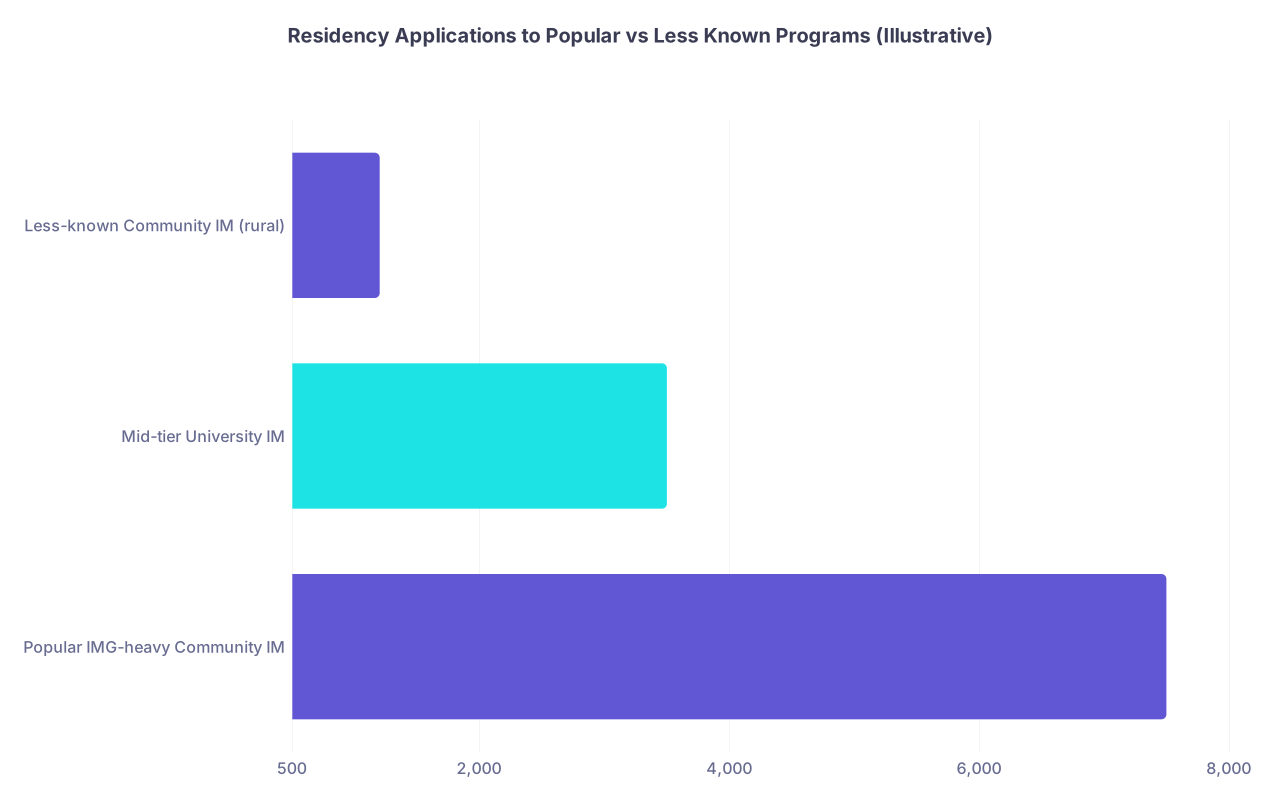
| Category | Value |
|---|---|
| Popular IMG-heavy Community IM | 7500 |
| Mid-tier University IM | 3500 |
| Less-known Community IM (rural) | 1200 |
Which one gives you a better shot per application? Not the one everybody in your alumni group is obsessed with.
2. Ignoring viable university or hybrid programs
Plenty of IMGs leave interviews on the table because they never even consider:
- University‑affiliated community programs in smaller cities
- Mid‑tier university programs with moderate IMG presence
- Programs that are not famous on social media but consistently take 2–6 IMGs a year
They look at the “University” label, assume rejection, and never apply. Meanwhile, those exact programs match IMGs every cycle.
3. Applying blindly to any program called “community”
Some community programs:
- Have never taken an IMG in their history.
- Explicitly prefer US grads only (sometimes unofficially, but effectively true).
- Do not sponsor any visas, ever.
- Are unbelievably competitive because of location or specialty.
But they’re called “community,” so people burn fees on them. That’s not strategy. That’s superstition.
Building a Smarter IMG Application Strategy
If you want a serious shot at matching, you need to stop asking “community or university?” and start asking better questions:
- Do they consistently take IMGs in my specialty?
- Do they sponsor my visa type, and do they have current residents on that visa?
- Do my Step 2, attempts history, YOG, and clinical experience match what their current IMGs look like?
- Is this program in a location US grads compete heavily for, or somewhere they overlook?
Then you allocate applications based on probability, not folklore. For many IMGs in medicine/psych/FM:
- A meaningful chunk of your list will still be community.
- Some of your highest‑yield places will be unglamorous, midwestern/southern, or in smaller cities.
- You’ll probably have a minority of university and university‑affiliated programs that actually make sense based on their historical IMG intake.
Add in something most IMGs still ignore: contact. Away rotations (if you can get them). Observerships that actually connect you with a PD or faculty. Targeted emails that demonstrate you know something real about the program beyond its ZIP code.
All of that moves the needle more than whether the ERAS page says “community.”
The Bottom Line
Three things to walk away with:
“Community = easier for IMGs” is a weak, outdated shortcut. Some community programs are very IMG‑friendly; some are basically closed. The label tells you almost nothing by itself.
Program behavior matters far more than program type. Look at resident rosters, visa patterns, and historical intake. If they do not have IMGs now, they are unlikely to start with you.
Smart IMGs optimize for probability, not stories. They don’t just throw apps at every “community” program. They identify IMG-heavy, visa‑friendly, realistically aligned programs—community and university—and build a list around that.
Stop asking, “Are community programs easier?”
Start asking, “Where do people like me actually match?”