
Most of what you’ve heard about IMG year-of-graduation (YOG) cutoffs is either outdated, exaggerated, or flat-out wrong.
“Programs won’t touch you if you graduated more than 5 years ago.”
“You must have graduated within 3 years or it’s over.”
“If you’re an old graduate, you need a 270 or forget it.”
I hear this from IMGs constantly. And I watch people sabotage their own chances because they’re planning around myths, not data.
Let’s rip this apart and rebuild it using what actually happens in residency selection.
The Myth: “If Your YOG Is >5 Years, You’re Done”
This is the big one. The absolute rule people swear by. And it’s lazy.
Here’s the truth:
YOG is a filter, not a death sentence. Programs don’t all treat it the same way. Some do hard-cut. Many don’t. And even among those that do, the “rule” is often softer than what you see posted online.
There are three different things people lump together when they talk about cutoffs:
- Official ERAS / website cutoffs
“We prefer graduates within 5 years of graduation.” - Hidden practical filters inside the program’s selection spreadsheet
“We usually don’t interview >7 years out unless something is special.” - Applicant folklore
“My friend said nobody >3 YOG matched IM, so it must be impossible.”
Those are not the same. At all.
Let’s separate them.
What Programs Actually Do With YOG
I’ve seen this up close: program coordinators dumping ERAS exports into Excel, sorting on Step scores, YOG, visa status, and USCE. You are not being judged by one number. You’re being triaged.
YOG is used in three main ways:
Hard exclusion – some programs do set a strict maximum YOG
Example: “No applicants >5 years from graduation are considered.” These are usually:- Very competitive community programs with tons of applicants
- Some academic places that are swamped and lazy with screening
- Institutions with HR or hospital rules around “recent training”
Soft preference – they’ll consider older grads if other things are strong
Example: “We prefer graduates within 5 years, but exceptions may be made.” Translation in practice:- If you’re 8 years out but working clinically, with recent USCE and good scores, you can still get looked at.
- If you’re 8 years out, no clinical activity, average scores… you’ll lose to someone who is more recent.
Context variable – they notice YOG but don’t use a rigid cutoff
- They look at what you did since graduation, not just when you graduated.
So instead of one big “YOG rule,” you’re dealing with a mixture of policies.
What the Data and Match Outcomes Actually Suggest
Obviously there’s no public spreadsheet of “program YOG rules,” but we can triangulate:
NRMP’s Charting Outcomes has consistently shown:
- Older graduates match less often than fresh grads, especially among IMGs.
- But you still see meaningful numbers of IMGs matching with YOG 5+, 7+, even 10+.
- Internal medicine, family medicine, psych, peds, and pathology all have older graduates matching every year.
Multiple program directors (PDs) have said the quiet part out loud in talks and podcasts:
- “I care much more about what they’ve been doing since graduation.”
- “If they’ve been clinically active, I don’t care that much if they’re 7 or 8 years out.”
- “The problem is the applicant who’s 9 years out with a 6-year gap and no explanation.”
So YOG is correlated with lower match rates, but it’s not causal on its own. It’s a proxy:
- Longer time since school → more likely:
- You’re rusty on basic science and exam style
- There are gaps, immigration issues, or failed attempts hiding in that time
- You never transitioned into a stable clinical role
Programs know this. They’re using YOG to estimate risk. You’re not disqualified by a year. You’re judged by your story.
Four Common YOG “Rules” – And What’s Actually True
Let’s go straight at the clichés.

Myth 1: “>5 Years Since Graduation = No Chance in the US”
Wrong. What actually happens:
- A chunk of programs won’t touch you.
- A chunk will, if:
- You’ve got recent clinical work (ideally hands-on, even if not in the US).
- You’ve done recent exams (Step 3 or 2 CK within the last few years).
- Your application has a coherent narrative (not 7 unexplained gap years).
Older grads do match:
- The ones I see match in IM/FM with YOG 8–12 years typically:
- Have 1–5 years of solid clinical activity (hospitalist, GP, MO in home country).
- Take and crush Step exams more recently, not 9 years ago.
- Stack US letters from recent observerships / externships.
- Target 80–120 programs that don’t explicitly ban older grads.
The ones who don’t match often:
- Apply like fresh grads.
- No explanation of gaps, no work continuity, USCE from 7 years ago, and a personal statement that reads like “I always dreamed of being a doctor.” Programs see that and move on.
Myth 2: “Academic Programs Don’t Take Older Grads, Only Community Does”
Mostly wrong, partially true.
Some academic IM and FM programs absolutely take older grads—especially those who:
- Bring research, publications, or teaching experience
- Have strong US-based clinical exposure
- Are academically solid with current exam scores
Some community programs are actually more rigid:
- They’re oversubscribed with IMGs.
- They want low-risk, fresh grads to keep board pass rates high.
- Their “5 years or less” rule is very real.
So it’s not:
- Academic = no older grads
- Community = yes older grads
It’s more:
- Program-by-program variation, with a tendency for ultra-competitive places (academic or community) to be picky.
Myth 3: “If You’re 10+ Years Out, Only Pathology or Psych Will Take You”
Not accurate. Path and psych are more IMG-friendly in some ways, but you still see older grads matched in:
- Internal Medicine
- Family Medicine
- Pediatrics
- Neurology (sometimes)
- Pathology, yes
- Psychiatry, yes—but more competitive now than a decade ago
You know what is true?
- Highly competitive specialties:
- Derm, ortho, ENT, urology, ophtho, plastics, neurosurgery: essentially zero realistic chance for an older non-US IMG. That’s not a YOG problem. That’s a market problem.
- Moderately competitive ones:
- EM, radiology, anesthesia: older IMGs do match, but they’re rare and very strong.
If you’re 10+ years out and non-US IMG, you should see IM/FM/psych/path/peds as your core realistic lane, not because of some written YOG rule, but because these fields have more positions, more IMG presence, and more PDs willing to look at atypical paths.
Myth 4: “You Need a USMLE Score in the 260s to ‘Offset’ an Old YOG”
This one is fantasy created by forums and WhatsApp groups.
Here’s the pattern I see in real matched older grads:
- IM / FM older grads often match with:
- Step 2 CK scores in the 230s–240s, sometimes a bit lower if everything else is strong.
- Step 3 done and passed, often mid-220s to 230s.
Do 260s help? Sure. But that’s like saying a Lamborghini helps you get to work. Most people don’t need, or get, that.
What matters more than an insane score:
- Recency: exam taken within the last 3–4 years.
- Clean record: limited or no failures.
- Pattern: if you took Step 1 eight years ago and Step 2 CK two years ago and did better, that actually reassures PDs you’re still sharp.
The “Invisible” Part: What You Did Between Graduation and Application
The biggest misunderstanding: people act like YOG is independent of everything else. Programs don’t see “YOG = 2013” and stop there. They immediately ask:
“So what were you doing from 2013 to 2024?”
That answer matters more than the raw number.
| Scenario | Program Reaction (Typical) |
|---|---|
| 3 years out, continuous clinical work, recent exams | Comfortable; low-risk candidate |
| 7 years out, continuous clinical work, recent exams | Considerable; wants explanation but open |
| 7 years out, 3–4 years unexplained gap, old exams | High risk; often screened out |
| 10+ years out, active physician, recent USCE & exams | Niche but viable; needs strong application |
| 10+ years out, no current clinical activity | Essentially non-competitive for most programs |
This is where older grads either sink or swim:
Strong story:
“Graduated in 2014, practiced internal medicine in Pakistan for 7 years, did research with X group, came to the US in 2022, completed 3 observerships, took Step 3 in 2023, and now applying to IM with specific interest in hospital medicine.”Weak story:
“Graduated 2013. Worked a little. Family business. Some personal reasons. Now I realized I want to do residency.”
Guess which one survives the YOG question.
USCE, Gaps, and “Staleness” – The Real Landmines
Programs are not just looking at when you finished school. They’re looking at how stale you are.
Stale means:
- No recent patient care
- No recent exams
- No recent US exposure
Three big truths for older grads:
USCE older than 3–4 years loses a lot of value.
That observership from 2015 isn’t buying you much in 2026. You need something more recent to show you understand current US systems and EMR culture.Unexplained gaps are worse than old graduation.
A PD can live with “I was a practicing physician for 7 years.”
They hate “I was preparing for exams” for 6 years straight. That screams low productivity and poor time management.Recent exam activity buys you credibility.
If your YOG is 2012 but you passed Step 3 in 2024 with a decent score, that’s a loud signal: “I can still study. I can still pass standardized tests. I’m not mentally retired.”
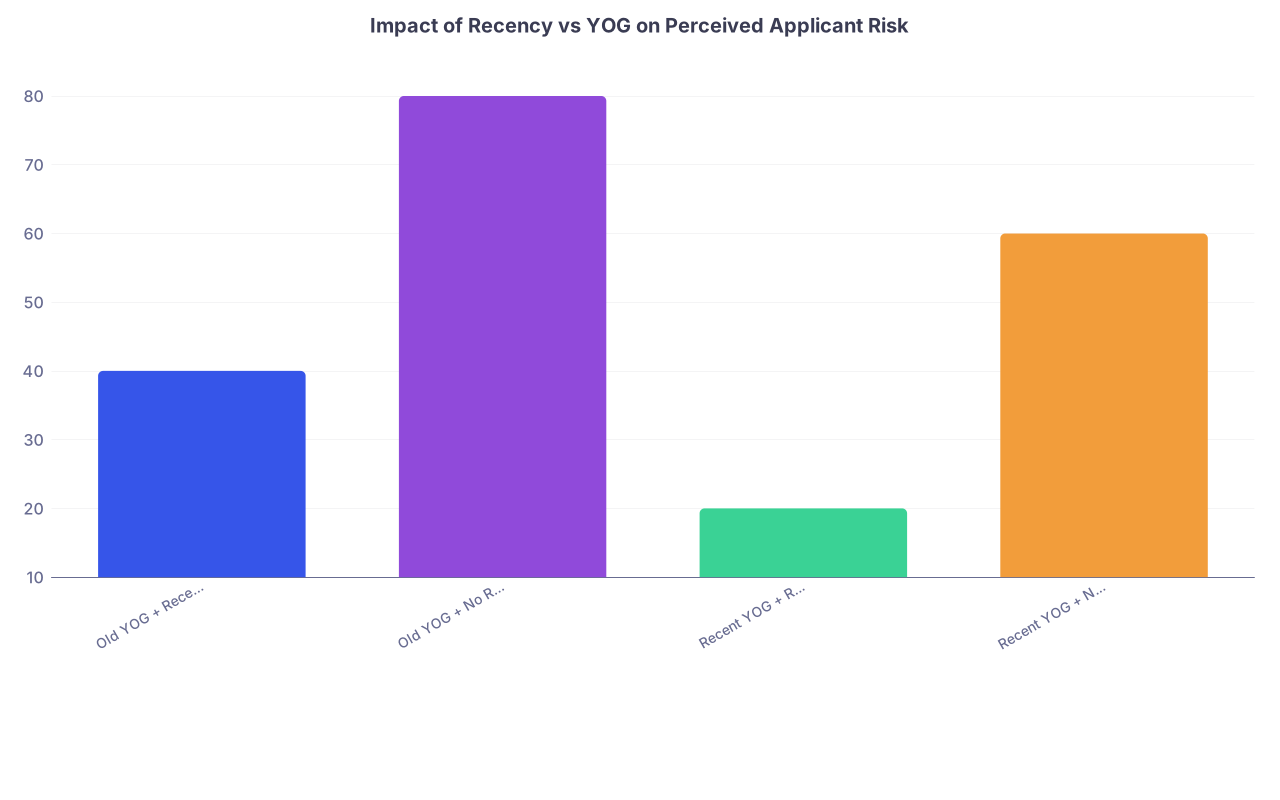
| Category | Value |
|---|---|
| Old YOG + Recent Activity | 40 |
| Old YOG + No Recent Activity | 80 |
| Recent YOG + Recent Activity | 20 |
| Recent YOG + No Recent Activity | 60 |
(Interpretation: lower number = lower perceived risk. The worst group isn’t “old YOG” alone—it’s old YOG plus inactivity.)
Strategy: How Older IMGs Should Actually Adapt
Let me be direct: you don’t beat YOG by praying. You beat it by packaging yourself so YOG becomes just one small line, not the headline.
1. Choose Your Specialty Like an Adult, Not a Dreamer
If you’re:
- 0–3 years out: you can aim wider, but still be realistic.
- 5–10+ years out: you’re in pragmatic territory.
For older grads, your safest realistic core in the US:
- Internal Medicine
- Family Medicine
- Pediatrics
- Psychiatry
- Pathology
EM, anesthesia, radiology, etc. are possible but you’re playing on “hard mode” as an older non-US IMG.
2. Target Programs Rationally, Not Randomly
You should:
Filter out:
- Programs that explicitly say “we only consider graduates within 3–5 years”
- Extremely competitive university programs with tiny IMG numbers
Focus on:
- Community and university-affiliated programs that:
- List IMGs in their current residents
- Don’t state strict YOG bans
- Have taken “non-traditional” paths before (look at resident bios when websites list them)
- Community and university-affiliated programs that:
Do not waste 40 of your 120 applications on places that openly exclude your YOG. That is denial, not strategy.
3. Build Recency: Exams, USCE, and Clinical Work
Your anti-staleness toolkit:
- Recent Step 2 CK or Step 3 (or OET for those who still need it).
- USCE in the last 1–3 years:
- Observerships at least; externships or hands-on roles are better if your immigration status allows it.
- Ongoing clinical role in your home country if you’re not in the US:
- Hospital-based work beats clinic-only in many PDs’ minds, but any real practice is better than sitting idle.
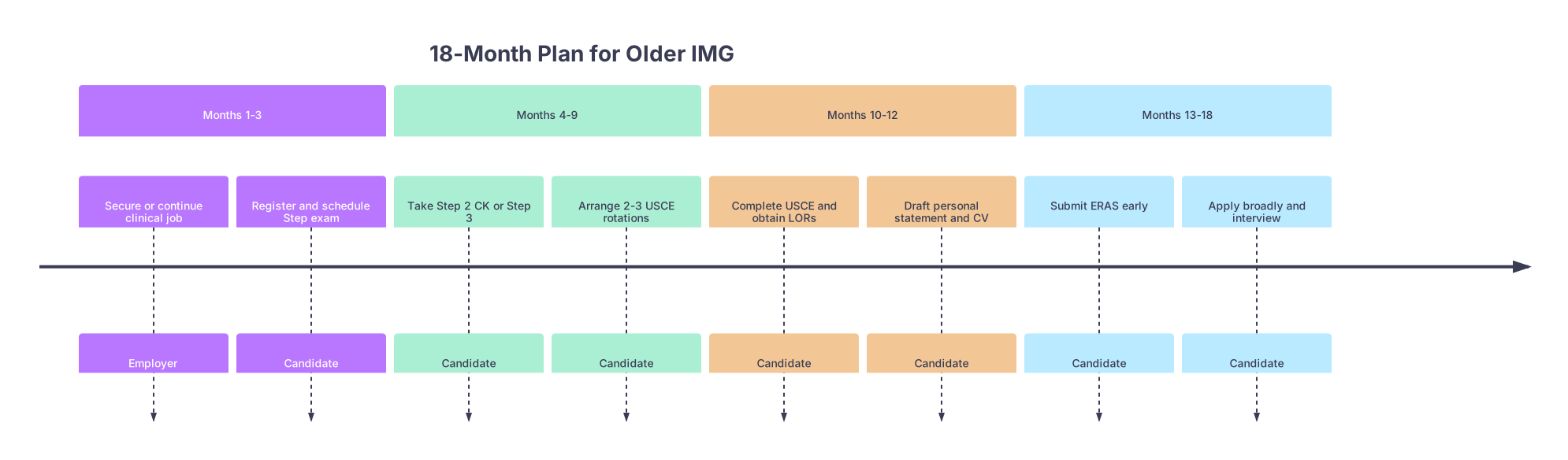
| Period | Event |
|---|---|
| Months 1-3 - Secure or continue clinical job | Employer |
| Months 1-3 - Register and schedule Step exam | Candidate |
| Months 4-9 - Take Step 2 CK or Step 3 | Candidate |
| Months 4-9 - Arrange 2-3 USCE rotations | Candidate |
| Months 10-12 - Complete USCE and obtain LORs | Candidate |
| Months 10-12 - Draft personal statement and CV | Candidate |
| Months 13-18 - Submit ERAS early | Candidate |
| Months 13-18 - Apply broadly and interview | Candidate |
Hard Truth: When YOG Does Become Nearly Disqualifying
I’m not going to sugarcoat this. There are scenarios where YOG plus other factors makes a US match almost fantasy-level:
- YOG >10 years
- No recent exams
- No clinical activity for years
- Weak English or communication
- No USCE, and no feasible way to get it
That combination is practically fatal for US residency chances. Not because of one rule, but because:
- You look unreliable.
- You look out of sync with current medicine and systems.
- You’re a huge board-risk gamble for a PD who has hundreds of safer applicants.
Sometimes the honest advice is:
- Consider other roles: research, MPH + related careers, non-US training, or clinical practice where you’re already licensed.
But do not jump to that conclusion just because you’re 7 or 8 years out. That’s where people give up too early.
Quick Reality Check: US vs Canada vs UK on YOG
The US is not uniquely evil on YOG. Other systems just hide it differently.
| Country | How YOG/Recency Shows Up |
|---|---|
| USA | Explicit or implicit YOG filters; focus on recent exams & USCE |
| Canada | Strong emphasis on recency and Canadian experience; very IMG-tight |
| UK (NHS) | More open to older grads but screens hard on recency and GMC rules |
So if you’re thinking of “escaping” YOG by jumping systems, you’re mostly swapping one version of the same issue for another: recency and continuity of practice.
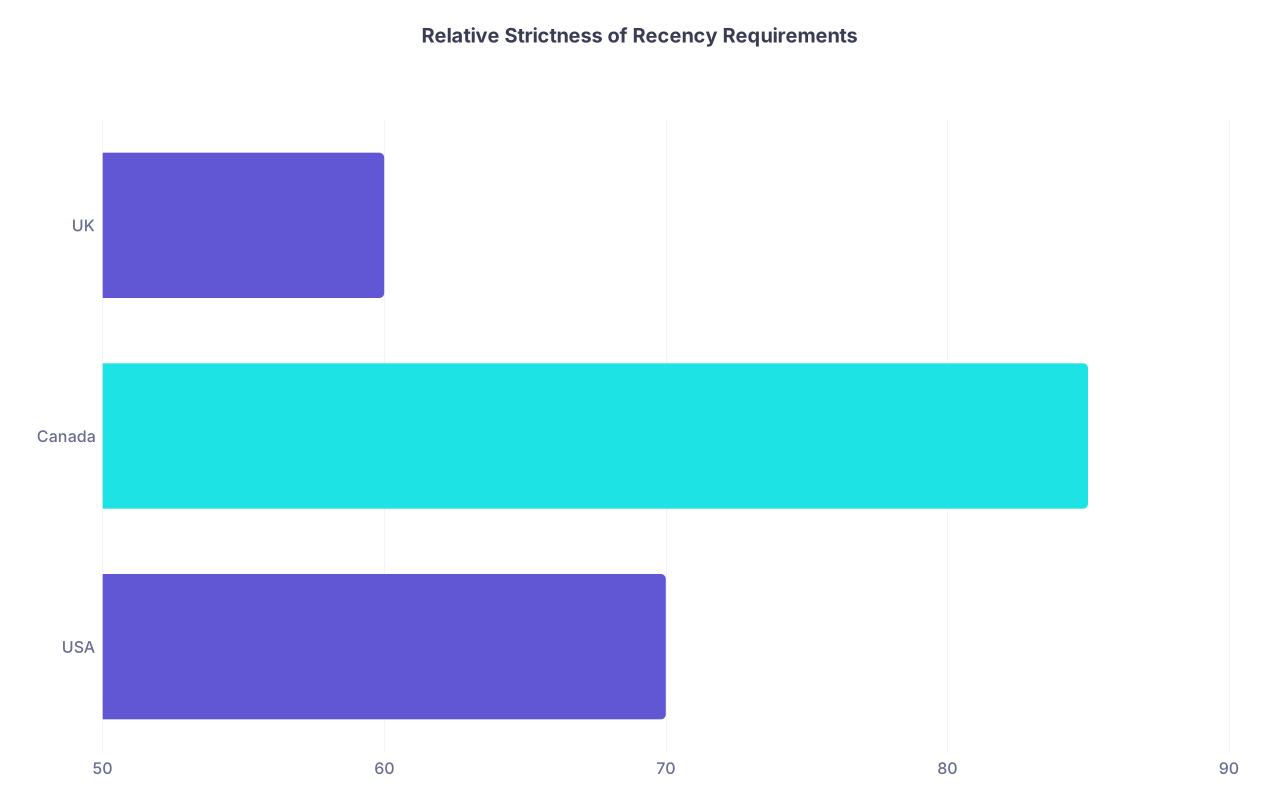
| Category | Value |
|---|---|
| USA | 70 |
| Canada | 85 |
| UK | 60 |
(Again, lower is easier, higher is stricter. Canada is brutal for IMGs overall.)
Final Word: Which “Rules” Actually Matter?
Strip away the noise, and three things emerge:
YOG is a flag, not a verdict.
Programs use it to ask: “Is this person still clinically and academically alive?” If you can prove you are, YOG loses a lot of its power. If you cannot, no trick will save you.Recency beats raw year.
Recent exams, recent clinical work, and recent USCE matter more than whether you graduated 4 or 8 years ago. “Old grad, current doctor” beats “fresh grad, 5-year gap.”Program choice and story matter as much as stats.
If you apply smartly (avoiding clear hard cutoffs), build a coherent narrative of continuous medical engagement, and back it with objective recency (tests, USCE, work), you’re in the game—even as an older IMG.
Ignore the lazy folklore. YOG isn’t the wall people say it is. It’s a hurdle. Some jump it. Some don’t even try.