
Do IMGs Really Need ‘Perfect’ Scores to Match? What Outcomes Show
What do you actually get for killing yourself over a 265+ Step score as an IMG? A guaranteed match… or just bragging rights in WhatsApp groups?
Let me be blunt: the “you need a near-perfect score or you’re dead” mantra for IMGs is lazy advice. It’s based on anxiety, not on data.
Are high scores helpful? Obviously. Are they the gate, the door, and the entire building? No. And I have seen more than a few IMGs with monster scores sitting unmatched while lower‑scoring colleagues start internship.
Let’s walk through what the numbers really say, where the obsession with perfection comes from, and what actually moves the needle for an IMG trying to match in the U.S.
What the Match Data Actually Shows (Not the WhatsApp Version)
Step 1 is now pass/fail, so the old “you need a 250+ Step 1” script is dead. People just haven’t updated their mental software yet.
For IMGs today, Step 2 CK is the main standardized metric. So look at outcomes by Step 2 range and specialty.
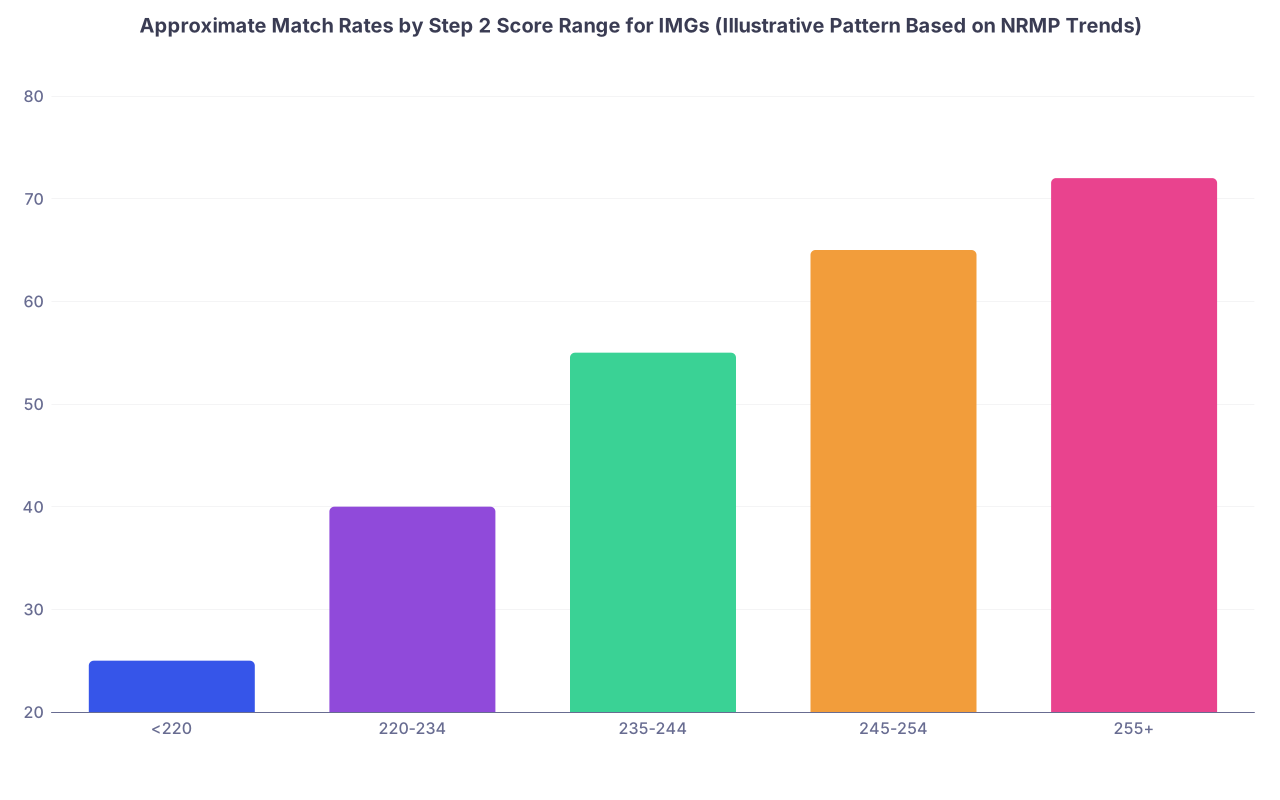
| Category | Value |
|---|---|
| <220 | 25 |
| 220-234 | 40 |
| 235-244 | 55 |
| 245-254 | 65 |
| 255+ | 72 |
These numbers are approximate, but they mirror the pattern from recent NRMP Charting Outcomes and IMG-focused reports:
- Below ~220 as an IMG, your odds are poor for most core specialties unless something else about your file is outstanding or you’re very strategic.
- Around 230–240, you’re in the competitive, realistic range for Internal Medicine, Family Medicine, Pediatrics, Psych, Neurology at many community and some mid‑tier university programs.
- 245+ gets you more interviews and a wider spread of programs, but it still doesn’t guarantee anything, especially for the more competitive fields.
- 255+ is not a golden ticket. It’s more like TSA PreCheck: your line is shorter; you still can’t bring explosives.
Here’s the part people conveniently ignore: match probability curves flatten at the top. Going from 210 to 235 matters a lot. Going from 245 to 260? Much less.
Programs don’t sit there debating 248 vs 257. They ask:
- Can this person function clinically?
- Do they know how U.S. hospitals work?
- Will we actually enjoy working with them at 3 a.m.?
- Can they communicate with patients and staff without chaos?
Scores answer none of that.
Specialty Reality Check: Where “Perfect” Is Oversold
The myth that IMGs “need perfect scores” usually comes from people conflating one specialty with all of residency.
Let’s separate reality from fantasy:
| Specialty | Need Near-Perfect Scores? | What Actually Matters More Once You Clear a Threshold |
|---|---|---|
| Dermatology | Yes, and even then thin | U.S. research, connections, publications, home ties |
| Plastic Surgery | Yes | Research years, mentors, U.S. training track |
| Neurosurgery | Yes | Strong U.S. research, letters from big names |
| Internal Medicine | No | U.S. clinical experience, letters, consistency |
| Family Medicine | Definitely no | Communication, fit, primary care interest |
| Psychiatry | No | Personality, psych‑relevant experience, visas |
If your dream is dermatology as an IMG, yes, you are playing on “hard mode.” Monster scores are basically table stakes, and you still need serious research and connections.
But most IMGs are not going into derm or plastics. They’re looking at internal medicine, family, psych, peds, neuro, anesthesia, maybe community general surgery.
In those fields, the difference between a 240 and a 260 is not what people think. An IMG with 240, solid U.S. letters, real hands-on experience, and a coherent story will beat a 260 who has never set foot in a U.S. hospital and writes robotic personal statements.
And I’ve watched that exact scenario play out.
The IMG Trap: Worshipping Scores and Ignoring Everything Else
Here’s the common pattern I see:
- IMG hears: “You must have 250+ to even be looked at.”
- They delay exams, delay applications, spend 2–3 extra years chasing some magical number.
- Meanwhile:
- No fresh U.S. clinical experience
- No relationships with U.S. faculty
- No recent letters
- CV gaps getting longer and uglier
- They finally get 250+.
- The application still looks weak. Or worse: stale.
Programs notice gaps. They notice if your last real patient contact was three years ago. A 258 does not erase that.
If you want to know what program directors think, read the NRMP Program Director Survey. IMGs like to screenshot the “USMLE score” bar and ignore the rest. But for many core specialties, PDs also list these near the top:
- Evidence of professionalism and ethics
- Consistency and lack of red flags
- U.S. clinical experience in the specialty
- Strong letters of recommendation from U.S. faculty
- Ability to work well in a team
Nobody writes “we only rank people with 260+.” That kind of rigid filter is what anxious applicants imagine, not what most programs actually do.
What Program Directors Actually Do With Your Score
Here’s how your Step 2 CK tends to function in the real world for IMGs:
As a filter
Programs with 1,500+ applications will use Step 2 as a first-pass screen. Maybe 220 for FM, 230–235 for IM/psych, higher for gas or surg. This is where “higher is safer” is true. But there is no universal “perfect” threshold.As a flag, not a tie-breaker
Once you’re over their internal cutoff, a 240 vs 260 mostly just moves you into the “academically strong” pile. They don’t have the time or interest to stratify within that pile by tiny differences.As a risk assessment
Really low or barely passing scores raise concern: Will this person pass boards? Will they need remediation? Programs don’t want headaches with failing residents.As context
IMG with 237 + extensive U.S. hands-on experience + strong letters >>> IMG with 260 + no U.S. exposure + questionable communication.
I remember a community IM program director summarizing it during a Q&A:
“After 235–240, your score matters less than your letters and our gut feeling that we can trust you on the wards.”
That line should be painted on the wall of every IMG prep center.
Data That Really Predicts Match Success for IMGs
Let’s be concrete. The NRMP’s reports on IMGs and Charting Outcomes make the same points over and over, but nobody reads the tables that don’t have “Step” in the title.
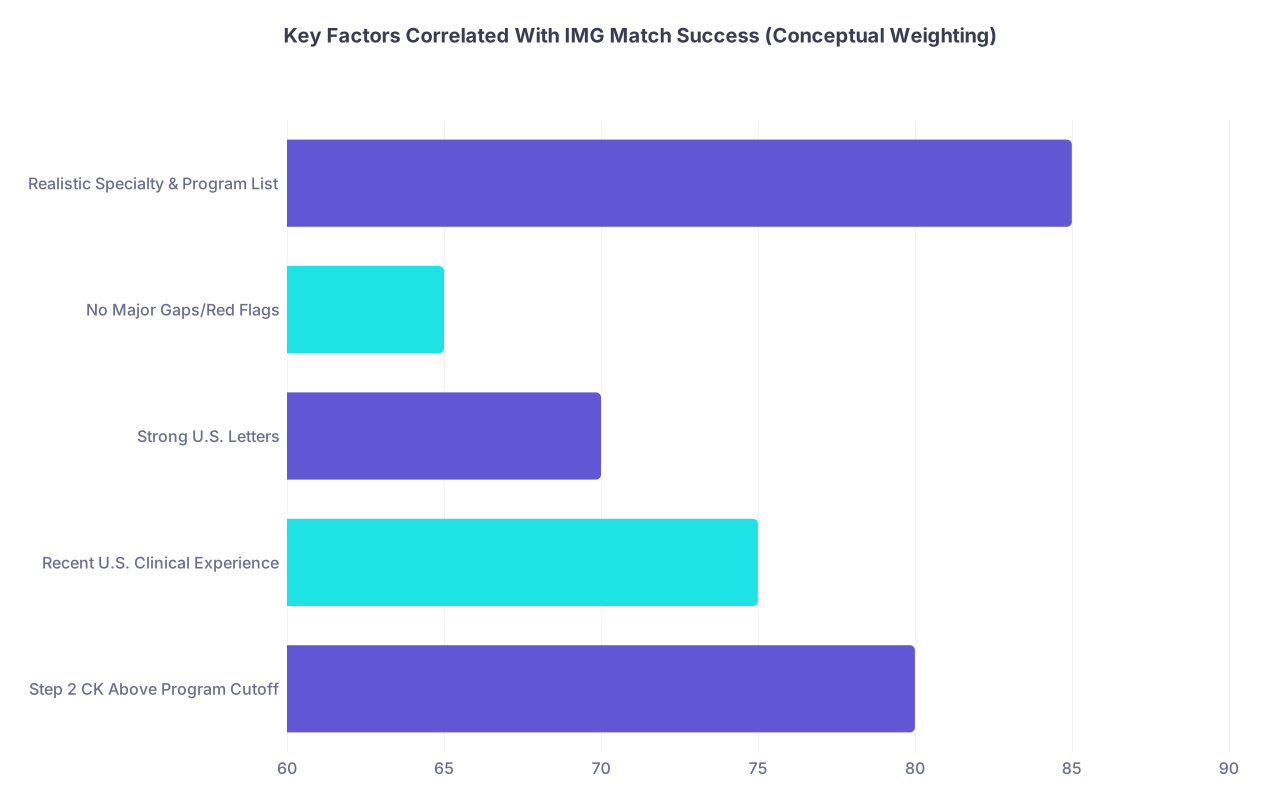
| Category | Value |
|---|---|
| Step 2 CK Above Program Cutoff | 80 |
| Recent U.S. Clinical Experience | 75 |
| Strong U.S. Letters | 70 |
| No Major Gaps/Red Flags | 65 |
| Realistic Specialty & Program List | 85 |
What tends to matter in practice:
- You’re above each program’s practical Step 2 cutoff (this is often ~225–235 for many IM/FM/psych programs, higher for others, but it’s not “255 or die”).
- You have recent U.S. clinical experience in the specialty you’re applying to. Not just observer-only shadowing from five years ago.
- You have letters from U.S. attendings who can vouch for your reliability, communication, and clinical reasoning.
- Your timeline doesn’t scream “I’ve been drifting and hiding from exams for six years.”
- Your application list is not delusional. Community programs, smaller cities, newer residencies are on there, not just top‑20 names you saw on TikTok.
Every time I look at a strong IMG who failed to match, I can almost always spot at least one of these:
- Excellent scores but no U.S. experience.
- Excellent scores but massive unexplained gaps.
- Excellent scores but applied to 40 insanely competitive university programs and virtually no community ones.
- Excellent scores but clearly weak English and poor interviews.
The obsession with “perfect” numbers lets people avoid these harder, messier problems.
How to Think About Scores as an IMG (Like an Adult, Not a Forum Thread)
You do not need “perfect” scores.
You do need scores that support your story, clear basic risk thresholds, and don’t create extra questions.
Here’s the more honest framing:
Below ~220 Step 2 as an IMG
You’re in a tough spot for many specialties. You’ll need:- Very thoughtful school and specialty targeting
- Strong, recent U.S. hands-on experience
- Honest Plan B/C thinking Retaking (if allowed and if you can realistically improve) may be worth discussing.
Roughly 225–240
This is workable for many IM, FM, psych, peds, neurology programs, especially community-based, if everything else is strong and fresh. You don’t need another 2 years chasing a 250 unless your entire profile is weak.Around 240–255
This is more than adequate for most core specialties if the rest of your application is good. Your priority should shift to letters, U.S. experience, and a sane application list.255+
Great. You’ve cleared every meaningful test-score bar for non-insanely-competitive fields. If you still don’t match, it will almost certainly not be because your score “wasn’t perfect.”
And no, Step 3 will not magically fix a weak Step 2 if you are trying to use it as a band-aid. Programs do not say, “Well the Step 2 is 218 but Step 3 is 245, so all good.” Step 3 is a nice bonus once you’ve already shown you can pass Step 2 solidly and are otherwise competitive.
The Psychology Behind the “Perfect Score” Myth
Why does this myth survive, even when the data screams against it?
Because numbers feel controllable. You can sit with UWorld and feel like you’re doing something. You can’t control whether an attending likes you or whether a program has silent internal politics.
So people double down on the one metric that feels objective. They study another 6 months. They push exams back. They create gaps that are harder to explain than a 235 would have been.
And some prep companies and “consultants” are happy to feed that fear. If they convince you that you must be superhuman to match as an IMG, you’ll pay more for another course, another “extension,” another year.
You need to see that for what it is. A business model, not a career path.
How to Actually Use This Information
If you’re an IMG planning or in the middle of the process, here’s the responsible way to act on this:

| Step | Description |
|---|---|
| Step 1 | Take Step 2 CK |
| Step 2 | Reassess specialty & schools |
| Step 3 | Prioritize USCE & letters |
| Step 4 | Target realistic programs |
| Step 5 | Consider retake or FM/psych focus |
| Step 6 | Interview prep & communication |
| Step 7 | Score >= ~230? |
Stop asking, “Is my score perfect?” Ask:
- Is my score above the likely cutoffs for the kinds of programs I’m targeting?
- Is my U.S. clinical experience recent, hands-on, and in the right field?
- Do I have at least 2–3 genuinely strong U.S. letters from people who know me?
- Does my CV tell a coherent story without unexplained black holes?
- Is my school list built for my actual profile, not my ego?
If the answer to those is “yes,” then throwing another year of your life away for an extra 10–15 points is usually a bad trade.

The Real Bottom Line for IMGs
Strip away the fear, the group chats, and the test-prep marketing, and you’re left with this:
- You do not need “perfect” scores as an IMG; you need good-enough scores plus a complete, recent, coherent application.
- Scores open doors; once you’re past a program’s cutoffs, U.S. clinical experience, letters, and realistic targeting decide whether you actually walk through them.
- Chasing marginal score gains while neglecting U.S. experience, letters, and timeline usually hurts your match chances more than a “non-perfect” but solid score ever will.
Stop worshipping the number. Start building the profile.