
Blanket applying to 300+ programs is not strategy. It is a tax on fear.
Let me be blunt: for most IMGs, mass‑applying is an expensive security blanket that does a lot more for ERAS’s revenue than for your interview tally. The “just apply to everything” advice gets repeated in WhatsApp groups, Telegram channels, and Facebook forums like gospel—usually by people who have never seen the actual numbers and rarely by program directors.
You want to know what actually moves your match odds. Not what people feel is safer.
Let’s break the myth.
The IMG Application Myth: “More Programs = More Interviews”
The story you’ve been sold goes something like this:
“As an IMG, you’re at a disadvantage. To compensate, you must apply very broadly—250, 300, 400 programs. That’s how you get enough interviews.”
Sounds logical. Also wrong in the way that matters: the numbers.
ERAS and NRMP release data every year. People just do not read it—then panic, then swipe the credit card.
Here’s what the data consistently shows across recent cycles:
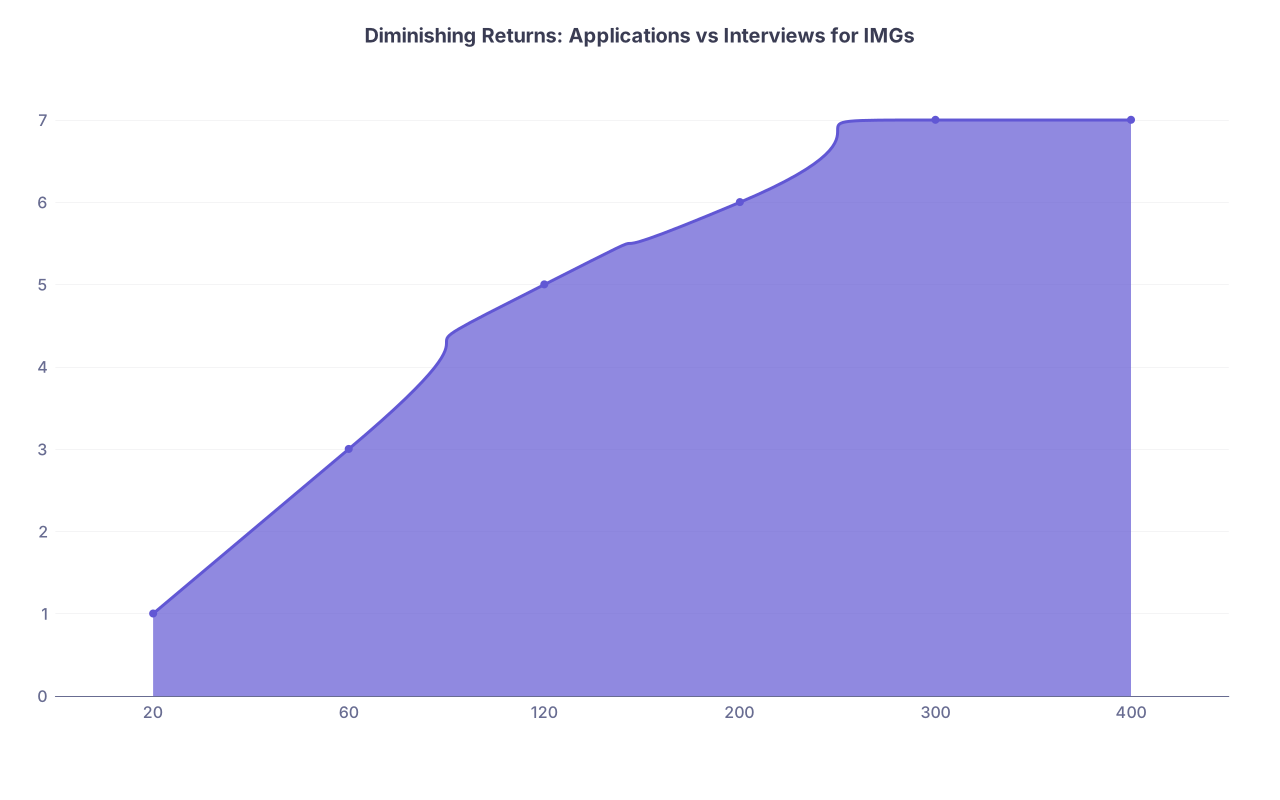
- Match probability increases with number of interviews, not raw number of applications.
- The relationship between applications and interviews is non‑linear. You get diminishing returns—fast.
- IMGs who match almost never “need” 300+ applications to get those interviews; they need realistic targeting and enough interviews (≈7–10).
| Category | Value |
|---|---|
| 20 | 1 |
| 60 | 3 |
| 120 | 5 |
| 200 | 6 |
| 300 | 7 |
| 400 | 7 |
Look at that curve. Doubling from 20 to 40 apps might help. Going from 120 to 300? You’re mostly just buying anxiety and transaction fees.
What the Numbers Actually Say
Let’s ground this in the data pattern we see over and over (US and non‑US IMGs, internal medicine as the classic example).
1. It’s about interviews, not app volume
NRMP Program Director Surveys and Charting Outcomes show roughly:
- About 6–7 interviews → match probability climbs sharply.
- Around 10–12 interviews → you’re in strong territory, even as an IMG, if your list is not delusional.
- Beyond that, each extra interview helps, but the big risk (complete shutout) is already dramatically reduced.
The brutal part: most IMGs who apply to 300+ programs do not end up with 20 interviews. Often they end with 2–5. Why? Because…
2. Most programs will screen you out long before they “see” you
Programs use filters. Hard. Especially on IMGs.
Common filters:
- USMLE Step 1/2 cutoffs (e.g., 220, 230, sometimes 240+)
- Graduation year cutoffs (5 years, sometimes 3 years)
- Visa status (J‑1 only, or no visas at all)
- “US grads only” or “No IMGs” unofficial policies
- Prior attempts or failures = automatic screen-out
If you do not meet those criteria, your application is not “weak.” It is invisible.
You can send 500 applications. If 350 of those programs have a Step 2 cutoff of 230 and you’re at 216, those 350 are fantasy applications. You’re just sponsoring ERAS’s next server upgrade.

The Real Cost of 300+ Applications
People like to talk about the emotional “peace of mind.” Let’s talk about the bill.
Money
Let’s approximate ERAS fees for one specialty:
- First 10 programs: base fee
- Then each additional chunk costs more per program
- By the time you’re at 200–300 programs, you are well into four‑figure territory
For IMGs I’ve worked with:
- 80–120 programs: often around $1,000–$1,400
- 250–300 programs: more like $2,500–$3,500
And this is just ERAS. You still have:
- NRMP registration
- USMLE transcript fees
- Potential extra Step 3 if aiming to boost your file
- Interview travel if any in‑person visits pop up again
- Visas, document translations, notarizations
Now realize this: if half those programs would never have considered you due to hard filters, a big chunk of that money was literally unmatchable from the start.
Time and cognitive overload
Nobody talks enough about time cost:
- Tailoring personal statements? You won’t. At 300+, you just copy‑paste.
- Contextualizing experiences to community vs academic vs safety‑net programs? You won’t. Too many.
- Tracking requirements, supplemental questions, token “why us” fields? Nightmare.
What actually happens at 250–300+:
- Your PS becomes generic and forgettable.
- Your program research is shallow, so your list is full of poor‑fit or IMG‑unfriendly choices.
- You burn hours tracking programs you never had a shot with.

| Step | Description |
|---|---|
| Step 1 | Fewer than 100 apps |
| Step 2 | Time to research programs |
| Step 3 | Can tailor PS a bit |
| Step 4 | Track requirements sanely |
| Step 5 | 250+ apps |
| Step 6 | No time for real research |
| Step 7 | Generic PS for almost all |
| Step 8 | High stress & confusion |
Where “Apply to Everything” Comes From (and Why It’s Flawed)
I’ve heard the same lines over and over from IMGs:
- “My senior applied to 280 and matched, so I will too.”
- “Consultant told me to apply to 300 ‘to be safe’.”
- “As an IMG, more is always better. You never know who’ll pick you.”
Let’s dismantle that.
Survivor bias is lying to you
You only hear from the IMGs who matched after applying to 300.
You very rarely hear:
“I applied to 320 programs, got 1 interview, and didn’t match. Now I’m reapplying and broke.”
Those people don’t make YouTube videos or Telegram guides. They lick their wounds quietly. So you build your strategy on survivor stories and ignore the graveyard.
Consultants and agencies are not neutral
There are agencies that literally bill you more as you apply to more programs, or they sell “Platinum Full Coverage – 300+ Programs Strategized” packages. Do you really think they’re going to say:
“Actually, based on your profile, 110 targeted programs makes more sense than 300.”
Of course not. Volume is revenue. For them, not for you.
So How Many Programs Should an IMG Apply To?
There is no single magic number. But there are ranges that actually reflect the data and real‑world outcomes.
Let’s assume we’re talking about a single specialty (say Internal Medicine) and a typical non‑US IMG.
| Profile Type | Rough Program Range | Comment |
|---|---|---|
| Strong IMG (solid scores, recent YOG, USCE, visa OK) | 80–140 | Upper end if very competitive region-preferences |
| Average IMG (OK scores, mild red flags, older YOG) | 120–180 | Needs broader net but still targeted |
| High‑risk IMG (low scores, big gaps, repeated failures) | 150–220 | More apps, but ONLY if filters allow |
Going beyond ~200–220 in a single specialty?
- Usually means your list includes a ton of programs that:
- Don’t take your visa
- Have score cutoffs above you
- Prefer US grads only
- Or have almost zero IMG presence historically
In other words: you’re paying to apply to programs that were never part of your universe.
How to Replace Volume With Strategy
Here’s the part nobody glamorizes because it’s not dramatic. It’s just work.
1. Map your filters brutally honestly
Before you generate a single token in ERAS:
- Step 1/2 (and Step 3 if taken): Where do you actually sit? 205? 220? 240+?
- Attempts: Any failures? Any gaps?
- Year of graduation: Are you 2 years out or 12?
- Visa: Do you need J‑1/H‑1B or are you green card/US citizen?
- Specialty realism: Are you applying to derm with a 215? Then the number of programs is not the problem.
Create a simple spreadsheet. Hard columns like:
- Minimum Step 2
- Accepts IMGs?
- Accepts J‑1 / H‑1B?
- Maximum YOG
If you don’t meet these columns, that program is dead to you. Stop romanticizing it.
2. Use actual IMG‑friendliness data
You want programs that:
- Have taken IMGs in the last 2–3 cycles
- Have more than one token IMG over a decade
- Show up in IMG‑oriented lists as consistently receptive
Do not confuse:
“We welcome diverse applicants”
with
“We consistently rank and match IMGs.”
Look at current residents. Program websites often conveniently show faces and medical schools. If it’s 100% US MD/DO, you’re not “casting a wide net.” You’re applying to a wall.
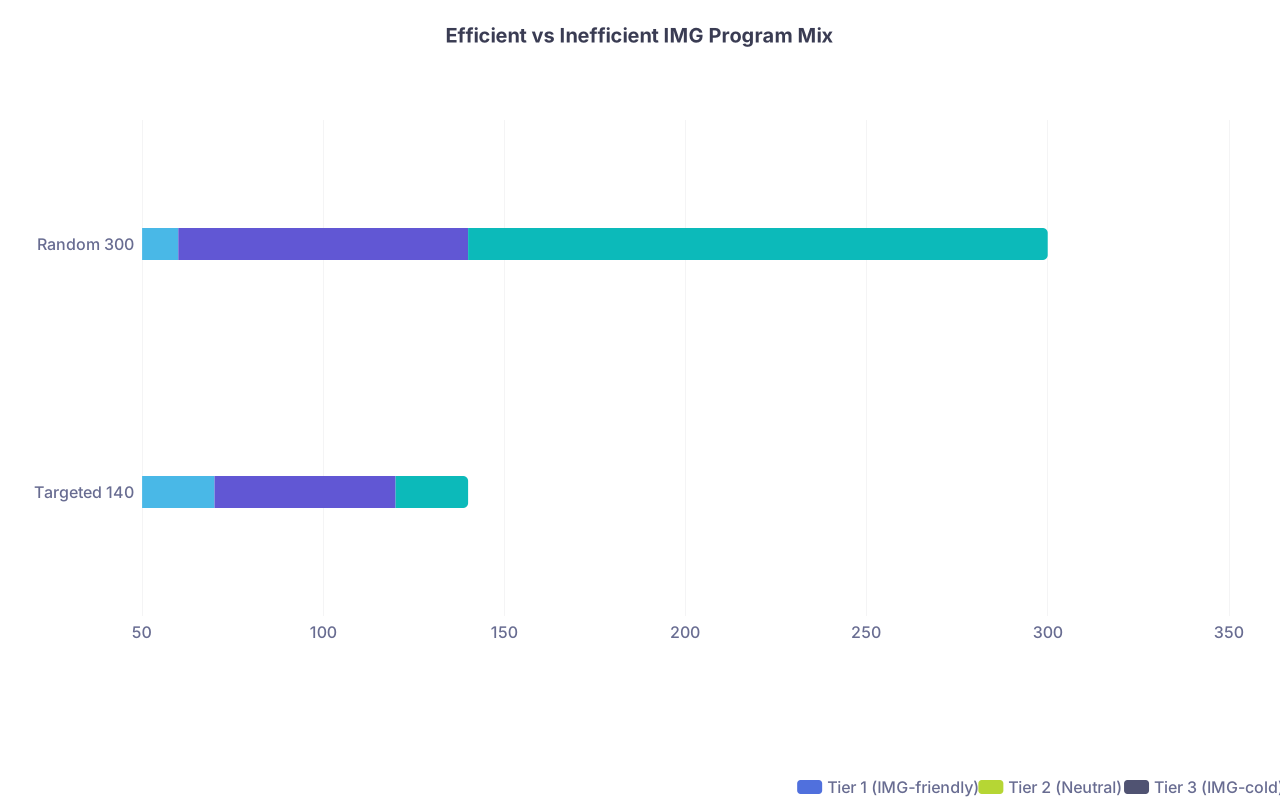
3. Prioritize program tiers, not raw counts
For IM in the US, I often tell IMGs to think roughly like this:
- Tier 1: High‑yield IMG‑friendly programs (strong history of IMGs, good visa support)
- Tier 2: Neutral programs (occasional IMG, not closed but not thrilled)
- Tier 3: Long‑shot academic or IMG‑cold programs
Then aim for a composition like:
- 40–60% Tier 1
- 30–40% Tier 2
- 10–20% Tier 3 (if you really want some “reach” shots)
If your 300‑program list is 70% Tier 3, you do not have a wide net. You have a fantasy roster.
| Category | Tier 1 (IMG-friendly) | Tier 2 (Neutral) | Tier 3 (IMG-cold) |
|---|---|---|---|
| Targeted 140 | 70 | 50 | 20 |
| Random 300 | 60 | 80 | 160 |
The Hidden Problem: Psychology of Panic Applying
Let’s talk about the mental side. Because this is what really drives “300+ or bust” behavior.
When you feel powerless, you do what’s visible and countable:
- Number of programs
- Number of documents uploaded
- Number of dollars spent
It feels like action. Like control. But if that action isn’t targeted, it’s emotional busywork.
I’ve seen IMGs who:
- Refused to cut their list below 300
- Stayed up nights editing spreadsheets instead of improving their Step 2 CK retake or getting higher‑quality USCE
- Felt intense guilt not applying to a program—“But what if this was the one that would have interviewed me?”
Here’s the hard truth: one more cold‑to‑IMG academic center with a 240 cutoff is not “the one that got away” from your 218.
On the other hand, I’ve watched IMGs:
- Apply to ~120 well‑chosen programs
- Spend the saved money on an extra USCE month or an observership that actually led to a strong letter
- Match, with 7–9 interviews, and then look back and laugh at the 300‑program panic they almost fell for.
More apps does not fix an uncompetitive profile. It just hides from you the work you really need to do: strengthen the profile or change the target specialty.
When High Volume Does Make Sense
Let me not oversimplify: there are scenarios where 200+ is rational.
- You’re a non‑US IMG with:
- borderline scores but no failures
- older YOG (6–10 years)
- visa need
- some USCE but not stellar letters
In that situation, your realistically possible universe of IMG‑friendly, visa‑accepting, filter‑compatible programs might be 180–230. Fine. Then your list will be large.
But here’s the key difference:
- You’re applying to 200+ because the filtered pool is that big.
- Not because you panicked and added every program with “Internal Medicine” in its name.
If you can only find 130 programs that:
- Take IMGs,
- Accept your visa,
- Have step cutoffs below or near your score,
- And have some record of IMG residents…
…then applying to 280 just to “hit a big number” is self‑sabotage dressed up as diligence.

How to Use Your Money Smarter Than ERAS Wants You To
If you’re tempted to go past ~180–200 apps, ask this:
“Would the money I’m about to burn on 50–100 extra programs be better spent on something else that actually improves my odds?”
Often the honest answers:
- A USCE rotation with a potential strong letter
- An extra month dedicated to a Step 2 or Step 3 score boost
- A statistically stronger second specialty application (e.g., IM + Family), instead of throwing more darts at the same wall
You don’t win by spraying applications. You win by making it very hard for reasonable programs to say no to you.
The Bottom Line
For IMGs, applying to 300+ programs is usually not a sign of strategy. It’s a sign of fear, bad advice, or both.
The evidence and real‑world outcomes point to something far less dramatic:
- Identify programs where you actually meet filters and they actually take IMGs.
- Build a list in the ~80–180 range (up to ~200–220 in high‑risk profiles) that is truly targeted.
- Use your saved money, time, and mental bandwidth to strengthen what programs care about: exams, recency, USCE, letters, and a believable story of who you are.
Years from now, you will not measure your application season by how many programs you clicked in ERAS. You’ll remember whether you acted out of strategy or out of panic—and whether you were honest enough with yourself to know the difference.