
32% of program directors admit they “rarely or never” consider applicants from at least one major IMG region.
Let’s stop pretending this is a level playing field.
If you’re an IMG, you’ve probably heard every version of the rumor mill: “They hate Caribbean grads.” “Eastern European schools go straight to the recycle bin.” “South Asian schools? Forget it unless you have 260+.”
Some of that is exaggerated. Some of it is flat-out true.
The problem is people talk about this like superstition, not like data. You deserve better than hallway gossip and Telegram group panic.
So let’s strip it down: what program directors actually say (in surveys and off-the-record), what the match data actually shows, and what you can realistically do if you’re from a “disfavored” region.
What PDs Actually Report About IMGs (Not What You Heard)
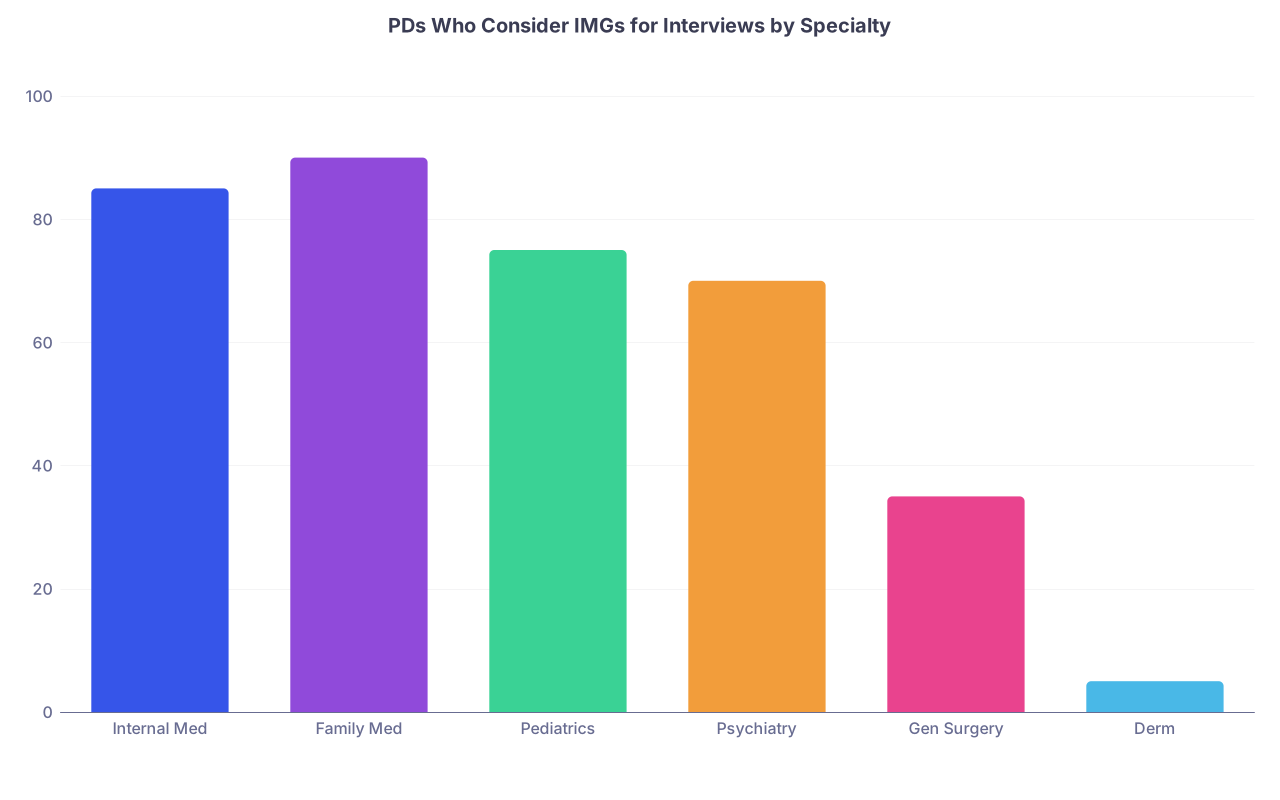
| Category | Value |
|---|---|
| Internal Med | 85 |
| Family Med | 90 |
| Pediatrics | 75 |
| Psychiatry | 70 |
| Gen Surgery | 35 |
| Derm | 5 |
The best hard data on PD attitudes comes from the NRMP Program Director Survey, published every two years. It is not perfect, but it’s the closest you’ll ever get to “here’s what PDs admit to on paper.”
The survey shows three big things that get conveniently ignored on Reddit:
- Most core specialties do routinely interview IMGs. Internal medicine, family medicine, pediatrics, psych — over two-thirds of PDs in these fields say they consider IMGs regularly.
- Some specialties are borderline closed. General surgery, ortho, ENT, derm, plastics? In many of these, a majority of programs either “seldom” or “never” consider IMGs. They’re not subtle about it.
- Region and school reputation matter, but they’re proxies. PDs rarely say “we dislike X country.” They say “school reputation,” “prior experience with grads from that school,” “clinical preparedness,” and “communication skills.” Region is the lazy shorthand.
On the record, PDs talk about “patterns.” Off the record, the language gets blunter:
- “We got burned by a couple of grads from [region/school], so now we’re careful.”
- “Some Caribbean schools just push people through who shouldn’t be near patients.”
- “I know nothing about that school, so I default to what I do know.”
Is that “bias”? Yes. It’s also how humans manage uncertainty when they have too many applications and limited time.
But here’s the thing no one tells you loudly enough: the “region bias” problem is real, but it’s narrower and more nuanced than the horror stories make it sound.
The Myth of “All IMGs From X Region Are Treated the Same”
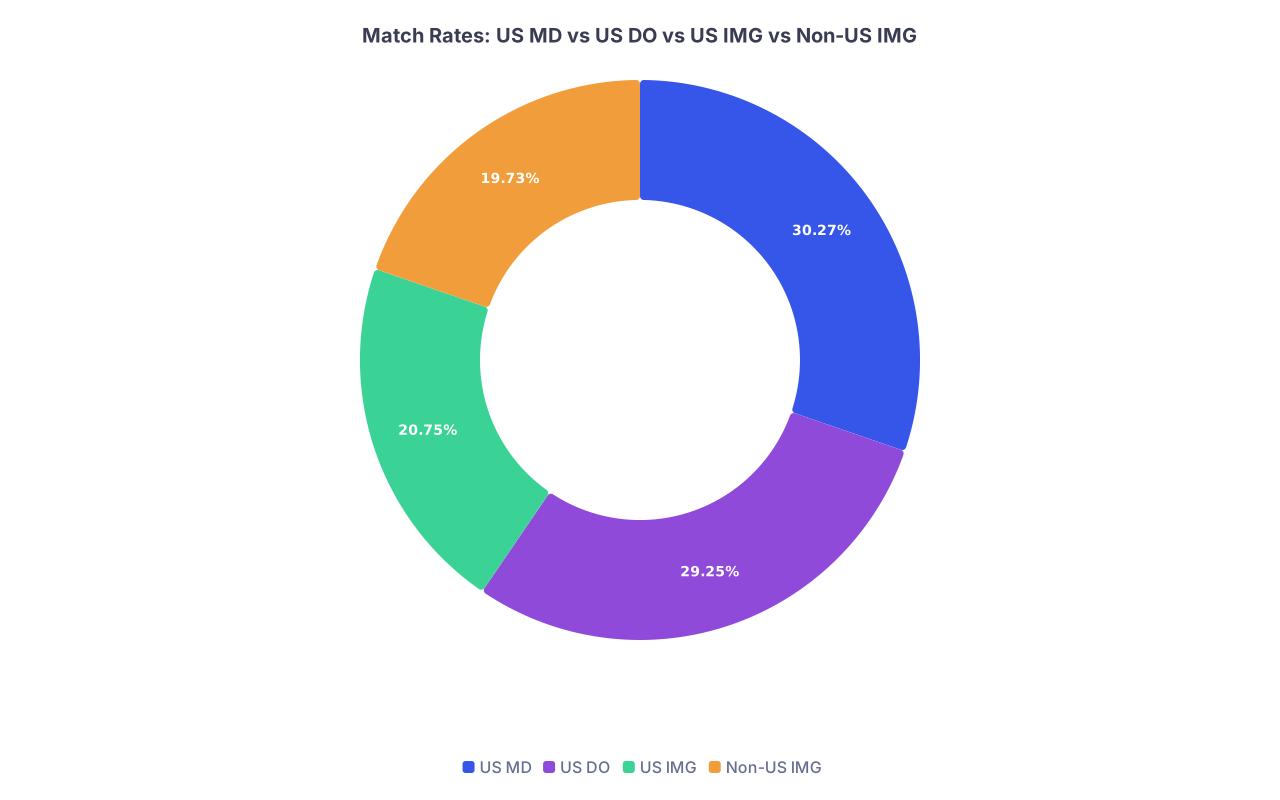
| Category | Value |
|---|---|
| US MD | 89 |
| US DO | 86 |
| US IMG | 61 |
| Non-US IMG | 58 |
People love clean villains. “They hate Caribbean grads.” “They love Indian grads.” “They don’t trust Eastern European schools.”
Reality is messier.
You’re not competing as “a Caribbean grad.” You’re competing as “a grad from this specific school with this specific record applying to this specific specialty.”
Here’s what the data and PD comments actually support:
- Caribbean is not one category. AUC, SGU, Ross, Saba sit in a different mental bucket than obscure, tiny offshore schools with USMLE pass rates nobody can verify. PDs absolutely differentiate.
- South Asian / Middle Eastern grads are not one category. Major Indian schools with long histories and big alumni footprints in the US read very differently from a private, low-clinical-exposure college that sends one student to the US every 3 years.
- Eastern Europe / Latin America are not one category. Programs that have hosted grads from a particular school — and liked them — will keep pulling from that school. They will ignore another school two miles away in the same country.
The pattern that really drives decision-making is this:
“Have we had people from that school or region before? Were they good? Did they pass their boards? Did they function on the wards without hand-holding?”
If the answer is yes, your “region disadvantage” shrinks fast.
If the answer is no, or worse, “we had a disaster from there,” then yes — your file is starting from behind, before you even upload your CV.
That is not fair. It is how it is.
Where Region Actually Shows Up in the Data
We do not have perfect school-by-school public numbers, but we do have some strong patterns from NRMP, ECFMG, and big specialty reports.
| Applicant Type | Approximate Match Rate |
|---|---|
| US MD Seniors | 88–92% |
| US DO Seniors | 85–89% |
| US IMGs | 55–65% |
| Non-US IMGs | 55–60% |
| Caribbean Big 4 (US citizens) | ~60–70% (core fields) |
The conventional myth is: “US IMGs (especially Caribbean) are doomed; non-US IMGs from big overseas schools are safe.”
The data does not support that clean divide.
US IMGs and non-US IMGs have similar overall match rates when you control for:
- Step scores
- Number of applications
- Target specialty
- Whether they’re willing to go anywhere geographically
Within that, the differences are more like this:
- Some Caribbean schools have very high match rates for students who actually pass USMLE — because those schools weed aggressively. The weak students never make it to the match.
- Some foreign schools send hundreds of grads to the US, but only the self-selected top of the class takes USMLE, so their apparent “match rate” looks great. That’s survivorship bias.
In other words: you’re looking at curated subsets in every direction.
The actual penalty tends to come from three things PDs associate with some regions:
- Spotty or opaque clinical training (very lecture-heavy, minimal supervised patient care)
- Weak clinical documentation (terrible Dean’s letters, vague MSPEs, inflated grades)
- Poor prior outcomes from that pipeline (failures to pass Step 3, performance concerns, professionalism complaints)
Once those boxes are checked in PD’s mind, they use region as a heuristic. Not because they care about your passport; because they don’t have time to investigate every unknown school.
Is that lazy? Yes. Is it going away? No.
What PDs Actually Say When You Push Them on “Region Bias”
I’ve heard these lines — or close relatives — in conference rooms, selection committee meetings, and hallway conversations.
They’re ugly, but they’re real:
- “We don’t officially screen out Caribbean, but we know which ones have sent us good residents and which ones haven’t.”
- “We had three residents from [specific country] in a row who struggled with communication and documentation. After that, the committee got gun-shy.”
- “If the clinical exposure was all observerships and no hands-on responsibility, I’m worried, regardless of country.”
- “Some Eastern European transcripts might as well be in code. I don’t know what ‘excellent’ means there.”
Notice something: they’re not saying “we dislike this ethnicity or nationality.” They’re saying, “we had bad prior experiences from this pipeline” or “we don’t understand this school.”
PDs are obsessed with one question: “Will this person function safely and independently by PGY-2?” Everything else is noise.
Region becomes a crude risk flag. It shouldn’t. But it does.
So Are PDs “Biased” Against Certain Regions? Yes — But Not the Way People Think

Let me put it plainly.
Yes, there is region-based bias. But it’s usually:
- School-specific, not whole-continent-specific. “We like grads from XYZ University in India; we’re wary of smaller private colleges we don’t know.”
- Specialty-dependent. Family med in the Midwest is not thinking like derm in Manhattan.
- Experience-driven. One problematic resident from your school 7 years ago can quietly poison the well for the next decade.
What it is not:
- A uniform, nationwide blacklist of “all Caribbean,” “all Eastern Europe,” or “all Latin America.”
- A death sentence for every grad from those regions.
- Fully irrational. Flawed, yes. But anchored in PDs trying to manage risk with imperfect information.
The people who insist “none of that matters, just be a strong applicant” are lying to you by omission. The people who say “you’re doomed because you’re from X region” are also wrong.
You’re not starting at the same line. But you’re not disqualified either.
How IMGs From “Disfavored” Regions Actually Get In
Here’s the part most IMG forums underplay: PDs change their minds when they see evidence that overrides their mental shortcut.
They’re not immovable. They’re just busy and defensive.

| Step | Description |
|---|---|
| Step 1 | Unknown/Disfavored Region |
| Step 2 | Strong USMLE Scores |
| Step 3 | US Clinical Experience with Graded Performance |
| Step 4 | Strong Letters from US Attendings |
| Step 5 | Program Has Positive Experience |
| Step 6 | Pipeline Established |
The IMGs I’ve seen crack “hostile” programs from questionable pipelines usually have some or all of the following:
- Overcompensation on objective metrics. If your region or school carries baggage, “good enough” scores are not enough. 250+ Step 2. Multiple strong shelf scores. No failures. No marginal passes.
- Real US clinical work with graded responsibility. Not just shadowing or “observerships.” Substantial hands-on electives, sub-internships, or legitimate research positions with patient contact where someone can credibly say, “This person functioned at the level of our US seniors.”
- Letters that directly address bias. The best letters explicitly say things like, “I’ve worked with many US MD students — this IMG performed at or above their level in clinical reasoning, documentation, and teamwork.”
- Visible integration into US academic culture. Posters at national conferences. Co-authorship on a paper. Quality-improvement projects. Anything that makes you look less like a random foreign applicant dropping a PDF into ERAS and more like a known quantity.
Once those pieces are in place, PDs start to treat you less as “candidate from suspect region” and more as “very strong outlier I’d be stupid to ignore.”
They may still be nervous. But their selection committee will have ammunition to push back against lazy “we don’t take people from there” comments.
The Ugly Part Nobody Puts in Brochures: Some Doors Will Stay Shut
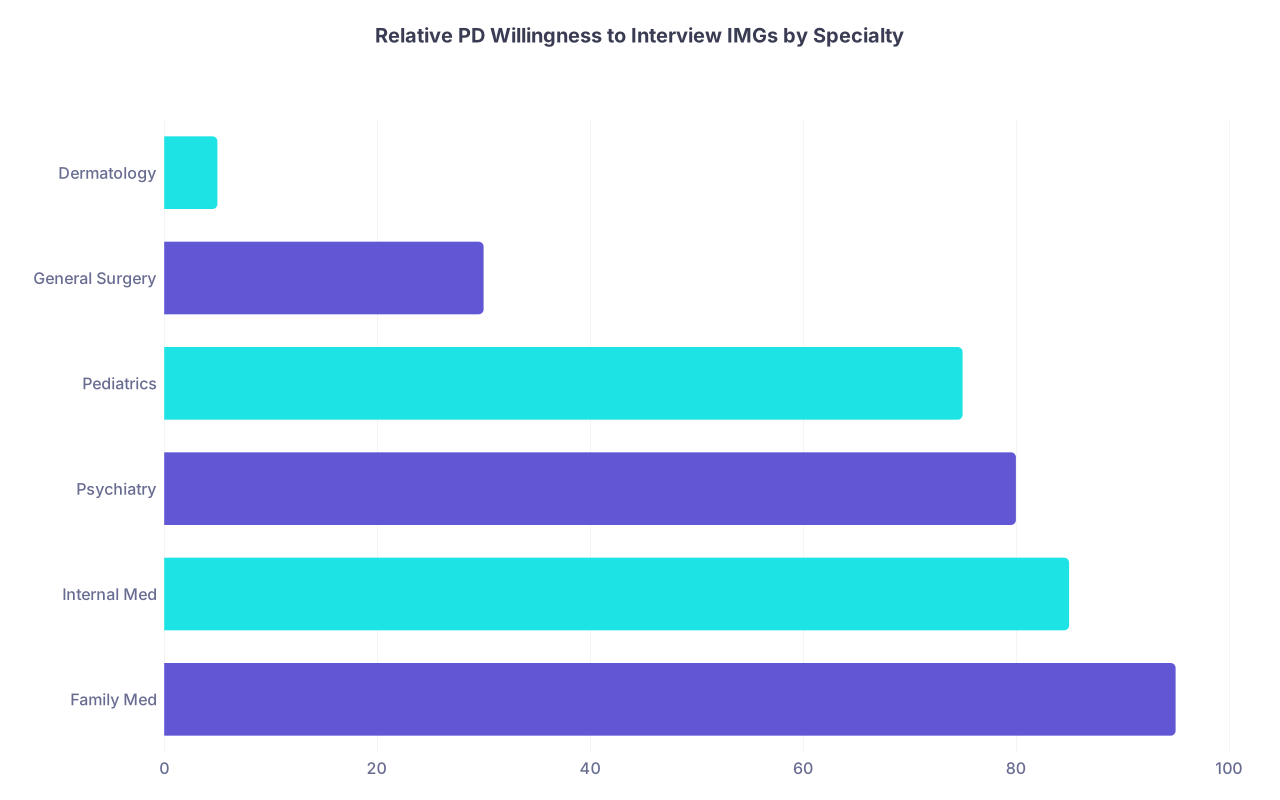
| Category | Value |
|---|---|
| Family Med | 95 |
| Internal Med | 85 |
| Psychiatry | 80 |
| Pediatrics | 75 |
| General Surgery | 30 |
| Dermatology | 5 |
Here’s where I’m not going to sugarcoat it.
If you are from:
- A low-profile or controversial offshore school
- A region your target specialty historically avoids
- A school with a bad internal reputation among PDs
…then there are entire specialties and geographic pockets where your application will never get a genuine look. No matter what you do.
I’ve sat in meetings where an application is opened, someone sees the school name, and the silent eye-roll goes around the table. Nobody says “we’re blacklisting,” but they do not spend time debating the file either.
You cannot fix that. You cannot charm your way past a program-wide “we do not rank from that pipeline anymore.”
What you can do is stop wasting time on fantasy and aim where the door is at least cracked open:
- Programs that already have residents from your region/school
- Community-based and lower-name-recognition university programs
- Specialties that still actively recruit IMGs: internal medicine, family medicine, psych, peds, neurology, pathology
You are not just applying “to the match.” You are applying to human committees with long memories.
Study their current resident list more than you study anonymous Reddit opinions.
How to Minimize the Region Penalty in Your Application

If you’re stuck with a school or region that’s carrying baggage, you have two jobs: reduce uncertainty and overpower the heuristic.
A few concrete levers that actually move PDs:
Objective overperformance.
Not “above average.” Uncomfortable excellence. A 262 forces a different conversation than a 234 for a candidate from a risky pipeline. Harsh but true.US-based validation.
Rotate — seriously rotate — where people know what they’re doing with IMGs. If you can get letter writers who are already trusted by PDs, their endorsement carries more weight than your transcript.Signal you’re realistic.
Your rank list and application choices should reflect you understand your position. A Caribbean IMG applying only to California EM and NYC neurosurgery screams “poor judgment.” PDs hate poor judgment more than they hate any region.Own your story in your personal statement and interviews.
No whining. No defensiveness. Calm, clear explanation of your path, what you actually did clinically, and how you’ve already functioned in US systems. You’re not there to convince them your region is great. You’re there to convince them you are safe and high-yield.Beware of empty credentials.
Ten online “observership” PDFs from random clinics do not offset a region penalty. One serious, real elective at a solid US academic center with a strong letter does.
What This All Means If You’re Choosing an IMG Path Now

If you’re not yet committed to a particular IMG route and you’re reading this, good. You’re already ahead of most people who sign promissory notes first and ask questions later.
Here’s the brutally honest version:
- Some schools and regions do saddle you with a measurable penalty that you’ll be paying back for years.
- That penalty is much worse if you want a competitive specialty or a competitive location.
- The school’s opaque marketing is not your friend. Alumni match lists, ECFMG performance data, and actual resident rosters at US programs are.
If your dream specialty is something like derm, ortho, neurosurgery, plastics, or ENT, and your only options are low-tier offshore schools with poor track records, you are not being “negative” by reconsidering. You’re being rational.
And if you are already in that situation? Then you stop pretending the playing field is fair, pick a strategy that fits reality, and make yourself the kind of undeniable outlier PDs argue for instead of against.
The Bottom Line
Program directors do carry region and school biases. They’re not imaginary, and they’re not going away. But they are narrower, more school-specific, and more specialty-dependent than the internet dramas suggest.
Three key truths to keep straight:
- You’re not competing as “a Caribbean” or “an Eastern European” or “a South Asian” — you’re competing as a graduate of a specific school with a specific track record in a specific specialty.
- Region-based bias is mostly a risk-avoidance shortcut. Strong scores, serious US clinical performance, and trusted letter writers can override that — sometimes.
- Some doors are truly closed to certain pipelines. The smart move is not to bang your head on them; it’s to find the doors that are open a crack and build such a strong case that PDs would be embarrassed to ignore you.