IMGs Must Do Research to Match Academic Programs: True or False?
Are you actually doomed as an IMG if you do not have U.S. research on your CV for academic programs—especially university programs and big-name hospitals?
Let me be blunt: the way people talk about “needing research” for IMGs is lazy, half-true, and often flat-out wrong.
The myth isn’t “research helps” (it does).
The myth is this absolute, repeated like scripture:
“If you’re an IMG and want an academic residency, you must have research. No research, no shot.”
False. But not comfortably false. More like: true for some programs, exaggerated for most, completely misused by people selling ‘research fellowships’ to desperate IMGs.
Let’s dismantle this properly.
What Academic Programs Actually Select For (Not What Reddit Says)
Academic = university-based, large teaching hospitals, research-heavy departments, sometimes “top 20” name brands.
People assume “academic program” = “must be a mini-PhD student.”
Reality: academic programs still need residents who show up at 5:30 a.m., manage five cross-covers, call consults without collapsing, and pass their boards. The research machine runs on fellows and a few residents with protected time, not every categorical resident.
So what do they actually screen for first?
Look at the NRMP Program Director Survey. Year after year, research is not the top filter. It’s in the pack, but not leading it.
Typical ranking of importance (for many academic IM specialties) looks more like:
- Step/USMLE performance
- Failed attempts
- Visa status / citizenship
- Recency of graduation
- U.S. clinical experience (USCE)
- Letters of recommendation
- Medical school reputation / country
Research output? Often sits in the secondary tier:
- “Nice to have, especially for a subset of applicants”
- Rarely the first reason you’re filtered out
For very research-heavy programs—think Harvard-Partners, UCSF, Hopkins, Mayo, Penn in IM, or similar in neurology, psych, etc.—published research starts acting more like a soft requirement for the people who match there. But that’s a specific slice of “academic,” not every university affiliate in the country.
So the better question isn’t “Do IMGs need research for academic programs?”
It’s: “For which academic programs does no research basically kill your chances?”
Different answer.
What the Data Actually Shows for IMGs and Research
Research is measurable. So let’s do that instead of vibes.
NRMP Charting Outcomes for IMGs (2018/2022 editions) gives patterns by specialty: number of abstracts/pubs/presentations vs match rates.
You see this repeatedly:
- Matched IMGs in competitive specialties and strong academic programs tend to have more research items than unmatched IMGs
- But there’s huge overlap. Some matched IMGs have zero. Some unmatched have 15+
For example (pattern, not exact current numbers):
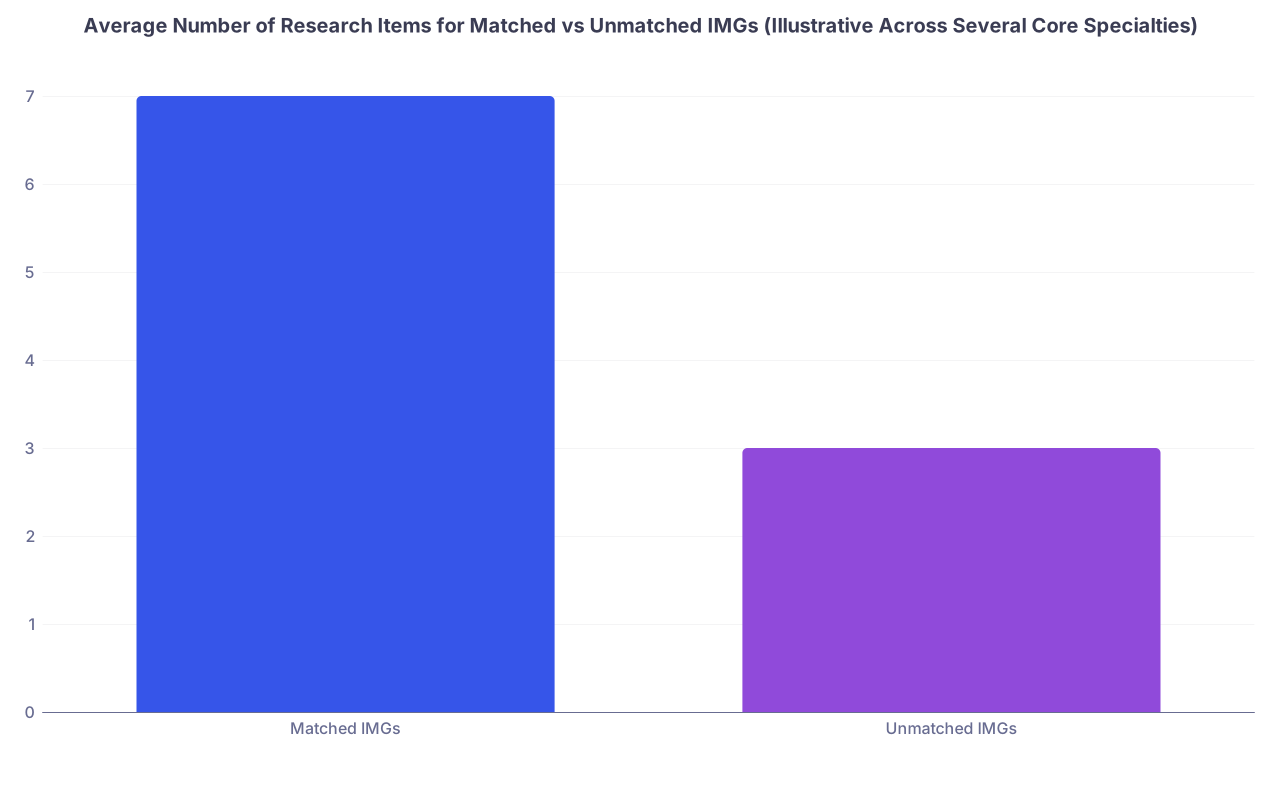
| Category | Value |
|---|---|
| Matched IMGs | 7 |
| Unmatched IMGs | 3 |
Does that mean you must hit “7 or more” to be taken seriously? No. That’s not how selection works. It means:
- Research boosts odds, especially in more academic or competitive environments
- It almost never compensates for bad exams or ancient year of graduation
- It’s one of several signals of “this person is academically inclined and productive”
Also important: U.S. research vs home-country research. Many programs quietly prioritize U.S.-based, recent, and specialty-aligned research over “10 posters from 7 years ago in a non-related field.”
So when you see an IMG with 20 pubs get into a top university IM program, you’re seeing a signal for academic orientation—not a law of the universe.
Types of Academic Programs: Where Research Matters A Lot vs A Little
Lumping everything as “academic” is sloppy. A university-affiliated community program in Ohio is not the same as a flagship department at Columbia.
Let’s break it into rough buckets.
| Program Type | Research Weight for IMGs |
|---|---|
| Elite research powerhouses (top 10–20 nationally) | Very high – often functionally required for IMGs |
| Mid-tier university, strong fellowship pipelines | Moderate–high – helps a lot, sometimes decisive |
| University-affiliated community programs | Low–moderate – bonus, not a gatekeeper |
| Pure community, non-academic hospitals | Low – often barely matters unless CV is otherwise superb |
If your target list is:
- Mass General, Brigham, UCSF, Hopkins, Mayo, Penn, Duke, Stanford, Columbia, NYU, Michigan, etc.
Then yeah. As an IMG, no real research (especially U.S.-based, specialty-relevant, with some productivity) often means your application never gets past “interesting story” into “serious contender.”
But if you mean:
- State university programs
- Regional academic centers
- University-affiliated community tracks
Then this “no research = no chance” mantra is just wrong. I’ve seen plenty of IMGs match those with:
- Strong Steps
- Good letters from U.S. rotations
- Clean attempts
- Decent recency of graduation
…and zero actual publications. Maybe a poster or two at most.
Where the Myth Comes From (And Who Sells It to You)
You hear three groups repeat this “must do research” line aggressively:
Other IMGs who did massive research fellowships
They suffered through 2–3 years of unpaid or underpaid bench work, got a good match, and then retrofit the story:
“Without research, impossible.”
No. Without research, impossible at their specific target tier. Big difference.Research “fellowship” mills
You know the ones.
Unpaid “research fellow” positions where your job is data entry and chart reviews for a PI who barely knows your name. These places survive on fear—specifically your fear that you’ll never match without them.Residents and fellows at high-status programs
They look around, see that “everyone has publications,” and conclude that’s a requirement for all academic programs, for all IMGs, all the time. Survivorship bias at its cleanest.
The common logic error: taking a pattern from the top ~10–15% of academic programs and applying it to every program with a university logo.
When Research Is Functionally Required for IMGs
Let’s be harshly honest: there are situations where, as an IMG, no research usually means no real shot at certain programs.
Here’s where research is close to mandatory:
- You’re aiming for the most research-driven places in IM, neurology, psych, anesthesia, EM, etc. (top “name brands”)
- You’re trying to jump into highly competitive specialties where even AMGs have serious research: dermatology, plastics, ENT, radiation oncology, neurosurgery, ophthalmology
- You’re applying as a relatively old graduate (5–10+ years out) and need a narrative of ongoing academic activity, not just “I worked as a GP”
In those contexts, research is not optional. It is often:
- The way you get strong letters from a known U.S. academic
- The way you show recent engagement with your specialty
- A sorting mechanism: “Who here can actually function in a research environment?”
But that’s not every “academic program.” It’s a thin, elite slice.
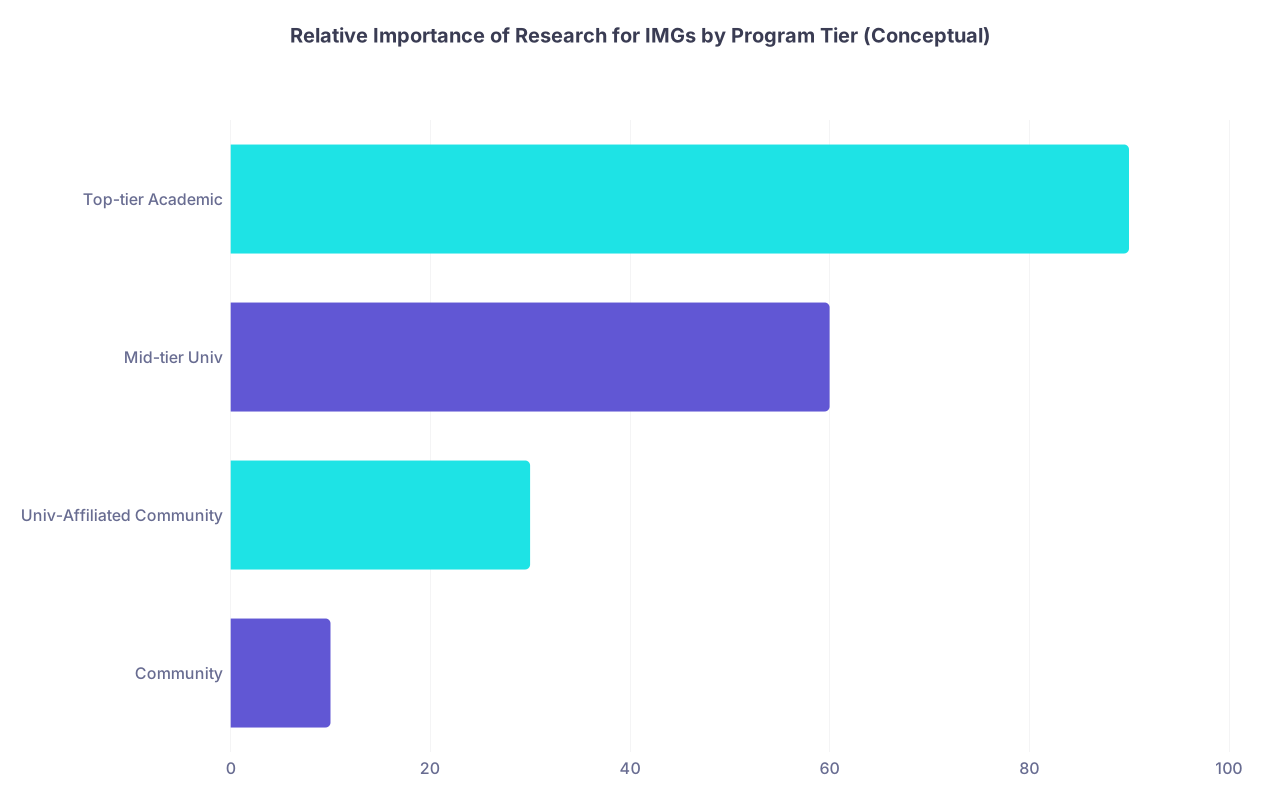
| Category | Value |
|---|---|
| Community | 10 |
| Univ-Affiliated Community | 30 |
| Mid-tier Univ | 60 |
| Top-tier Academic | 90 |
(Values are conceptual “importance scores,” not real percentages, but they track what program directors will quietly admit.)
When Research Is Helpful But Not Required
Most IMGs land in this middle ground. They’re applying to:
- Mid-tier academic programs
- University-affiliated community programs
- Some stronger name-brand places but not “top 10” world-famous research factories
Here, research acts like a tiebreaker and signal, not a hard filter.
Helpful scenarios:
- Two IMGs, similar Step scores, same graduation year. One has three U.S. specialty-relevant abstracts/posters with a letter from the PI saying “they were the most productive member of my team.” Guess who gets the interview first.
- Your Step 1/2 are solid but not exceptional. A track record of research says: “This person can certainly handle the in-service exams and maybe help our publications spreadsheet grow.”
- You want a fellowship-heavy field later (cards, GI, heme-onc). Research as a resident is easier to pull off if you’ve already learned the basics as a student or researcher.
But these are edge and enhancement effects, not “no research = auto-reject.”
I’ve seen IMGs match mid-tier university IM with:
- Step 1: 235–245 (when scored) / strong pass
- Step 2: 240–255+
- No publications
- 1–2 U.S. letters from inpatient rotations
- Clean attempts, recent grad
And I’ve seen IMGs with 10+ publications and mediocre Steps get screened out at the same programs. Because research doesn’t erase weak foundations.
When Research Is Overrated, Misused, or Totally Fake
Here’s the part IMG applicants don’t like hearing: a lot of “research” on CVs is low-yield or obviously padded.
Examples I’ve seen on ERAS:
- 8 “publications” that are all predatory journals, same template, same group of authors, all from the same month
- “Co-author” on 5 systematic reviews, where the actual role was: added three references and name to the author list
- Endless “submitted” manuscripts that have been “under review” for 18 months at journals nobody respects
Program directors aren’t dumb. They read between the lines:
- A couple of decent posters/abstracts from a U.S. institution, with detail and a letter? That’s worth something.
- A wall of obviously fabricated or low-quality stuff? That’s noise. Sometimes worse than nothing.
So if you’re asking, “Should I pay 10k for a guaranteed authorship package to show research?” my answer is simple: terrible idea. It won’t fool programs that matter, and it can backfire if they sense you’re gaming the system.
Alternative “Academic Signals” for IMGs Without Research
If you realistically can’t do a full research year, you’re not automatically out of the academic race. You just need to stop thinking research is the only academic signal.
Other things programs actually care about:
- Exceptional exam performance – Step 2 in the very strong range; that alone gets attention at many academic programs
- Honest, detailed U.S. letters – especially from faculty with academic roles: clerkship directors, division chiefs, program leadership
- Teaching and academic engagement – tutoring, leading small groups, organizing journal clubs (real ones, not fake bullet points)
- Quality of your personal statement and experiences – serious, reflective, specialty-aware, coherent with your CV
You know what screams “this person will be a good academic resident” more than a fake authorship?
A letter that says: “She prepared and delivered three teaching sessions for our students that were better organized than many of our junior faculty.”
So, Should You Chase Research as an IMG? A Sane Framework
Here’s a practical way to decide. Not social media logic. Actual logic.

| Step | Description |
|---|---|
| Step 1 | IMG considering research |
| Step 2 | Prioritize real, U.S.-based research with potential output |
| Step 3 | Fix exams/clinical gaps first |
| Step 4 | Do focused, specialty-aligned projects |
| Step 5 | Skip low-quality/predatory research offers |
| Step 6 | Targeting top-tier research-heavy programs? |
| Step 7 | Have solid Steps and recent graduation? |
| Step 8 | Access to legitimate research with real mentorship? |
Key idea: research is a multiplier, not a band-aid. Do not use it to avoid the harder work of fixing the core weaknesses: exams, USCE, time since graduation.
Realistic Scenarios
Let me give you a few honest composites I’ve seen play out:
IMG A – No research, strong exams
- Step 2: 252
- 2 U.S. inpatient IM rotations, strong letters
- YOG: 2 years ago
- Matches: University-affiliated IM in the Midwest, academic but not famous. No research needed.
IMG B – Heavy research, mediocre exams
- 12 publications (mostly low-impact, middle authorships)
- Step 2: 223, 2nd attempt
- Limited U.S. clinical
- Matches: Struggles. Gets a categorical spot eventually, but at a smaller community program, not academic IM. Research did not erase core weaknesses.
IMG C – Targeting MGH/Brigham-type places
- 1.5 years U.S. cardiology outcomes research
- 3 abstracts, 1 pub, strong letter from a well-known PI
- Step 2: 255+
- Solid U.S. rotations
- Matches: Academic IM at a high-tier university, maybe not the absolute top 3, but in that neighborhood. Here, research was absolutely part of the ticket.
You’ll notice: the research matters most when you’re already competitive.
The Bottom Line: True or False?
“IMGs must do research to match academic programs.”
- False as an absolute rule. Plenty of IMGs have matched university programs with little or no formal research.
- Partly true for top-tier, research-obsessed programs and highly competitive specialties, where as an IMG you’re essentially invisible without real academic output.
- Dangerous when used to justify low-quality, exploitative “research fellowships” that waste your time and don’t actually improve your odds.
If you remember nothing else:
- Research is a multiplier, not a substitute for strong exams, recent training, and real U.S. clinical experience.
- The higher you climb in academic prestige, the closer research gets to an unspoken requirement—especially for IMGs.
- Fake, low-quality, or bought “research” won’t save you. Solid letters, strong performance, and honest productivity beat inflated CVs every time.