
Most International Medical Graduates handle telemedicine U.S. Clinical Experience entirely wrong. They treat it as an inferior substitute for in-person observerships, slap a generic title on their Electronic Residency Application Service (ERAS) entry, and hope program directors do not notice.
That is a tactical mistake.
Unfiltered observation behind a masked attending in a crowded clinic rarely yields real clinical responsibility. A structured telemedicine rotation, if documented and framed with precision, proves direct competency in modern health systems delivery, patient communication, and digital diagnostics. Program directors do not automatically dismiss telehealth. They dismiss vague, unquantified experiences.
Let us break down specifically how to convert virtual USCE from a perceived compromise into a high-yield asset on your residency application.
This article is for educational purposes only. It is not financial advice, not legal advice, and not tax advice. Figures vary by individual circumstances, so consult a qualified professional before acting.
1. Systematic Documentation: From Tele-Encounters to ERAS-Ready Case Logs
You cannot claim clinical competence without granular documentation. If you cannot prove the specific clinical scenarios you encountered, program selection committees will assume you sat passively behind a dark Zoom screen.
Telemedicine documentation must mirror the rigor of a formal hospital electronic health record (EHR) audit. Track every encounter in real time. For every virtual interaction, record:
- Encounter Type: Synchronous video consultation, asynchronous store-and-forward review, or remote patient monitoring (RPM) follow-up.
- Patient Demographics: Age group, geographic context (e.g., rural health professional shortage area, urban safety-net clinic), and language barriers requiring interpreter integration.
- Clinical Detail: Chief complaint, primary working diagnosis, secondary comorbidities, and differential diagnoses considered.
- Procedural and Assessment Components: Virtual physical exam maneuvers performed (e.g., camera-guided rashes inspection, passive range-of-motion evaluation, visual work-of-breathing assessment), medication reconciliation, and patient safety escalation plans.
Use a structured case log spreadsheet. Record the metrics meticulously:
| Field | Example Entry |
|---|---|
| Date & Duration | October 14, 2024 |
| Encounter Category | Synchronous Video Visit (Outpatient Internal Medicine) |
| Chief Complaint | Uncontrolled Type 2 Diabetes & Chronic Neuropathic Pain |
| Differentials Formulated | Poor medication adherence vs. progressive diabetic neuropathy vs. radiculopathy |
| Virtual Exam & Plan | Inspected foot ulcer via high-definition camera feed; adjusted basal insulin; ordered HbA1c and lab panel |
| Attending Verification | Verified & Signed by Dr. J. Miller, MD |
To build a competitive entry, aim for at least 50 distinct patient interactions across a 4-week full-time block (or a minimum of 80 dedicated clinical exposure hours). At the conclusion of each week, export your log into a PDF summary and request your supervising attending's physical or electronic signature. Having a signed, verified log instantly elevates your rotation above generic observerships.
2. Securing Telemedicine-Specific Letters of Recommendation (LORs)
A generic LOR stating that you were "punctual, polite, and logged on regularly" guarantees a rejection at top-tier programs. You need an LOR that explicitly details your clinical decision-making, history-taking speed, and mastery of digital healthcare interfaces.
Target attendings who directly observed you leading patient encounters. Avoid distant course directors who merely hosted morning check-ins.
Two weeks before the rotation ends, schedule a 15-minute briefing session with your attending. Do not ask for an LOR casually over chat. Send a professional prep packet 48 hours prior to your meeting containing:
- Your verified case log summary (highlighting patient volume and primary diagnoses).
- Your updated CV.
- Your draft ERAS Personal Statement (or key specialty themes).
- A concise "Summary of Contributions" document outlining specific cases where you identified critical diagnostic details or facilitated complex patient education.
Brief your attending on the exact competencies you want emphasized. Request that they address your ability to build clinical rapport through a screen, your efficiency in navigating digital EHR systems, and your skill in guiding patients through remote physical examinations.
DEDICATED TELEMEDICINE LOR vs. INTEGRATED CLINICAL LOR

[Dedicated Telemedicine LOR]
• Ideal for: Applicants applying to primary care (FM, IM, Med-Peds) or programs with explicit Digital Health tracks.
• Core Focus: Advanced telehealth logistics, virtual patient rapport, remote monitoring management, population health metrics.

[Integrated Clinical LOR]
• Ideal for: Applicants using telemedicine as part of a broader clinical block (e.g., hybrid outpatient rotation).
• Core Focus: Broad clinical diagnostic skills, history taking, differential diagnostic depth, with telehealth noted as a core modern delivery tool.
If your rotation was hybrid, ensure the letter highlights both modalities. A letter that explicitly states, "Dr. Candidate managed complex outpatient panels both in-person and via our telehealth platform, demonstrating rare adaptability across delivery care models," carries immense weight.
3. Crafting a Compelling 'Telehealth Experience' Section in Your ERAS Application
How you translate your rotation into the ERAS Experience section determines whether an evaluator reads your profile or skips it.
Never list telemedicine under "Research" or vague "Volunteering" categories if it involved real-time clinical care and diagnostic management. Place it under Medical/Clinical Experience.
Structure your bullet points using the Action Verb + Context + Quantified Impact framework. Avoid passive language like "Observed telemedicine clinic." Use direct clinical language.
Weak vs. Strong ERAS Bullet Examples
Poor Entry:
- Participated in virtual visits with Dr. Smith.
- Took patient histories over Zoom and learned about outpatient medicine.
- Watched management of diabetes and hypertension.
Competitive Entry:
- Conducted real-time virtual clinical assessments for 60+ medically underserved outpatient panels across a 4-week clinical block under direct MD supervision.
- Formulated initial differential diagnoses and management plans for complex chronic conditions, including uncontrolled Type 2 Diabetes, hypertension, and COPD.
- Instructed patients on standardized remote physical exam protocols (e.g., home blood pressure monitoring, visual edema scale) to optimize remote clinical decision-making.
- Executed systematic medication reconciliations, identifying adherence barriers and coordinating virtual pharmacy consultations to improve patient follow-up metrics.
Align your description with health system values: health equity, patient accessibility, efficiency, and continuity of care. Explicitly mention the setting: "Remote outpatient clinical rotation serving rural federally qualified health center (FQHC) populations." Specificity commands respect.
4. Showcasing Telemedicine Skills During Virtual Interviews and Sub-Is
When interview season arrives, your telemedicine experience will be tested. Interviewers want to know if you actually learned medicine or simply logged hours from home.
Prepare three structured clinical stories derived directly from your telemedicine log. Use the STARR method (Situation, Task, Action, Result, Reflection):
- Situation: A 62-year-old remote patient presenting via video with vague shortness of breath.
- Task: Perform a rapid remote triage to determine if the patient required immediate emergency department transfer versus routine outpatient management.
- Action: Guided the family member through evaluating respiratory rate, checking fingernail capillary refill on camera, and testing verbal sentence capacity.
- Result: Identified signs of acute distress, coordinated direct emergency services transfer, and provided the receiving team with a pre-arrival virtual summary.
- Reflection: Modern clinical care requires rapid assessment even when direct physical contact is unavailable.
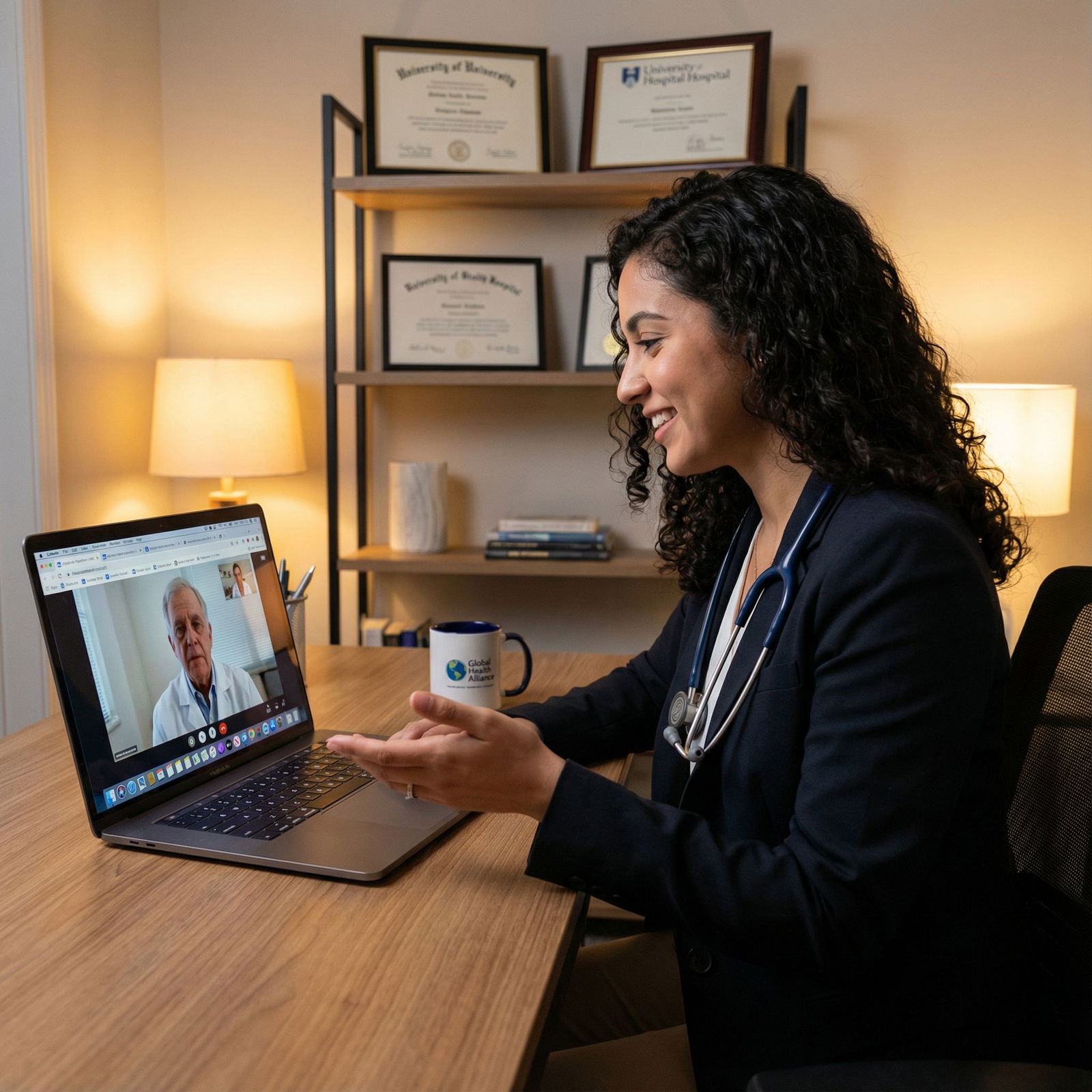
Prepare a single-page Clinical Summary Portfolio. If questioned during informal discussions or sub-internships about your clinical preparation, you can reference this document. It should include total patient volume, top 10 conditions managed, and verified procedural competencies.
When asked the inevitable question, "Why did you opt for a telemedicine rotation instead of traditional in-person USCE?" never offer excuses.
Do not cite visa issues, financial constraints, or travel hassles. Own the choice strategically:
"I intentionally chose this telemedicine rotation because digital health adoption is reshaping outpatient specialty care in the United States. I wanted to master remote patient triage, digital clinical communications, and chronic disease management across diverse geographies before entering residency. It forced me to sharpen my clinical communication and history-taking skills, which directly translates to bedside efficiency."
5. Leveraging Telemedicine to Build Networking Connections That Boost Your Rank List
The biggest mistake IMGs make during virtual rotations is remaining silent. Sitting off-camera with your microphone muted ensures you will be forgotten the moment the call ends.
To convert a remote rotation into long-term advocacy, implement a systematic virtual presence strategy:
- Arrive Early and Stay Visible: Log into virtual pre-clinic huddles 5 minutes early. Keep your professional camera on, maintain lighting that exposes your faces clearly, and sit in a professional environment.
- The Active Chat Technique: Use the chat feature responsibly to drop relevant, high-yield literature or guidelines when complex cases are discussed (e.g., "Here is the 2024 ADA guideline update regarding SGLT2 inhibitors for this patient's chronic kidney disease profile").
- The Post-Clinic Debrief: Ask for 3 minutes at the conclusion of clinic to ask one focused, high-level management question based on a patient seen that day.
Mentorship Follow-Up Strategy
On the final day of your rotation, send a tailored email to your supervising attending.
SUBJECT: Rotation Reflection & Thank You - Dr. [Your Last Name]

Dear Dr. [Attending Last Name],

Thank you for your supervision over the past four weeks during the [Name of Rotation/Clinic] telemedicine rotation.

Assisting with complex management decisions—such as our work adjusting remote insulin regimens for our rural patient panel—substantially strengthened my clinical reasoning.

As I prepare my application for the upcoming Match cycle in [Specialty Name], I would deeply value staying in touch. If your schedule allows, I would welcome 10 minutes in the coming weeks for a brief video call to seek your advice on identifying residency programs that value strong primary care and digital health integration.

I have attached my finalized, signed case log for your records.

Sincerely,

[Your Name], MD
[Contact Information] | [LinkedIn Profile Link]
Maintain this connection. Send short, professional updates every 8-12 weeks regarding your Step 3 progress, application submissions, or interview milestones. When rank list discussions occur, an attending who remembers your proactive work ethic in a virtual clinic can pick up the phone and advocate directly for your file.
Key Takeaways
- Document Everything Rigorously: Maintain a verified, signed case log detailing patient volume, primary diagnoses, virtual exam maneuvers, and direct exposure hours.
- Engineered Recommendations: Secure letters of recommendation from direct clinical supervisors who can explicitly attest to your digital communication, diagnostic efficiency, and virtual rapport.
- Quantify ERAS Entries: Frame your telemedicine entries using strong clinical action verbs and concrete metrics. Never leave descriptions vague or passive.
- Own the Narrative in Interviews: Present your telemedicine USCE as a deliberate strategy to master modern digital care delivery, supported by concrete clinical stories using the STARR framework.
- Maintain Active Longitudinal Professional Networks: Use post-clinic debriefs, precise chat contributions, and structured email updates to convert virtual attendings into active program advocates.