
That’s the part nobody really explains on interview day. They’ll talk about wellness, call structure, supervision, meal cards. Fine. What they won’t say clearly is this: after call, the real shift can keep going inside the inbox. Orders sitting in limbo. Results that hit after rounds. med recs half-done. Consult recommendations that changed the plan but never made it into a signed note. Discharge paperwork hanging around like a curse.
I’ve seen interns think this means they’re slow. Or disorganized. Or just not built for residency. Wrong. Post-call EMR backlogs happen because the system is built to generate tasks faster than a tired human can close them when the unit is busy. Workflow design is messy. Handoffs split responsibility. Staffing gaps dump “temporary” work onto whoever is still logged in. Documentation trails behind real-time care. Order verification can lag just enough to create a second wave of cleanup later.
So if you’re post-call and staring at a ridiculous task list, don’t make the rookie mistake of treating it like a moral failing. It’s an operations problem first. Your job is not to heroically click harder until you pass out. Your job is to sort risk, close the dangerous gaps, communicate clearly, and stop the backlog from turning into patient harm or your personal collapse.
That’s the game. Not perfection. Control.
The ugly version usually looks like this: your overnight was heavy, two admits came in at 5 a.m., one patient boarded in the ED forever and then hit the floor all at once, morning sign-out got rushed, and now you’re technically done but your task list says otherwise. Fifty alerts. Maybe more. Half of them vague. A few of them absolutely real.
This backlog builds for predictable reasons:
- Workflow design is clunky. Tasks are generated by actions, not by common sense.
- Handoffs create debris. Work starts on one shift and lands unfinished on the next.
- Staffing gaps matter. When pharmacy, transport, consultants, or cross-cover are delayed, your “simple follow-up” task multiplies.
- Documentation lags care. The patient has a plan, but the chart doesn’t yet.
- Order verification delays create rework. You thought it was done. It wasn’t.
And yes, some programs normalize this too much. “That’s just residency” is lazy leadership when what they really mean is, “We never fixed the workflow.”
Still, this is manageable if you stop reacting emotionally to the list. The list is designed to provoke panic scrolling. Don’t give it that power. You need a method. A boring, repeatable, sharp-edged method that separates true patient-care risk from administrative noise.
Because that’s the real secret: the backlog is common, but drowning in it is not inevitable.
Name the backlog: what tasks actually pile up after call?
Not all EMR tasks are equal, and lumping them together is how interns waste an hour on the wrong five clicks.
The usual post-call pile includes:
Pending orders
- meds needing cosign or verification
- held orders that need clarification
- duplicate or conflicting orders after transfer
Labs and imaging pending review
- overnight CBC/BMP trends
- culture results
- radiology final reads that differ from prelims
Medication reconciliation
- admission med rec still incomplete
- discharge med rec needing final cleanup
- substitutions that need confirmation
Consult follow-ups
- “see note” with no actual note yet
- recommendation changed verbally but not documented
- consult affects disposition or procedure timing
Discharge paperwork
- instructions
- med list accuracy
- follow-up appointments
- summary/sign-off issues
Daily documentation
- progress notes unsigned
- attestation issues
- addenda after plan changes
Medication changes requiring confirmation
- anticoagulation adjustments
- insulin changes
- antibiotics pending culture review
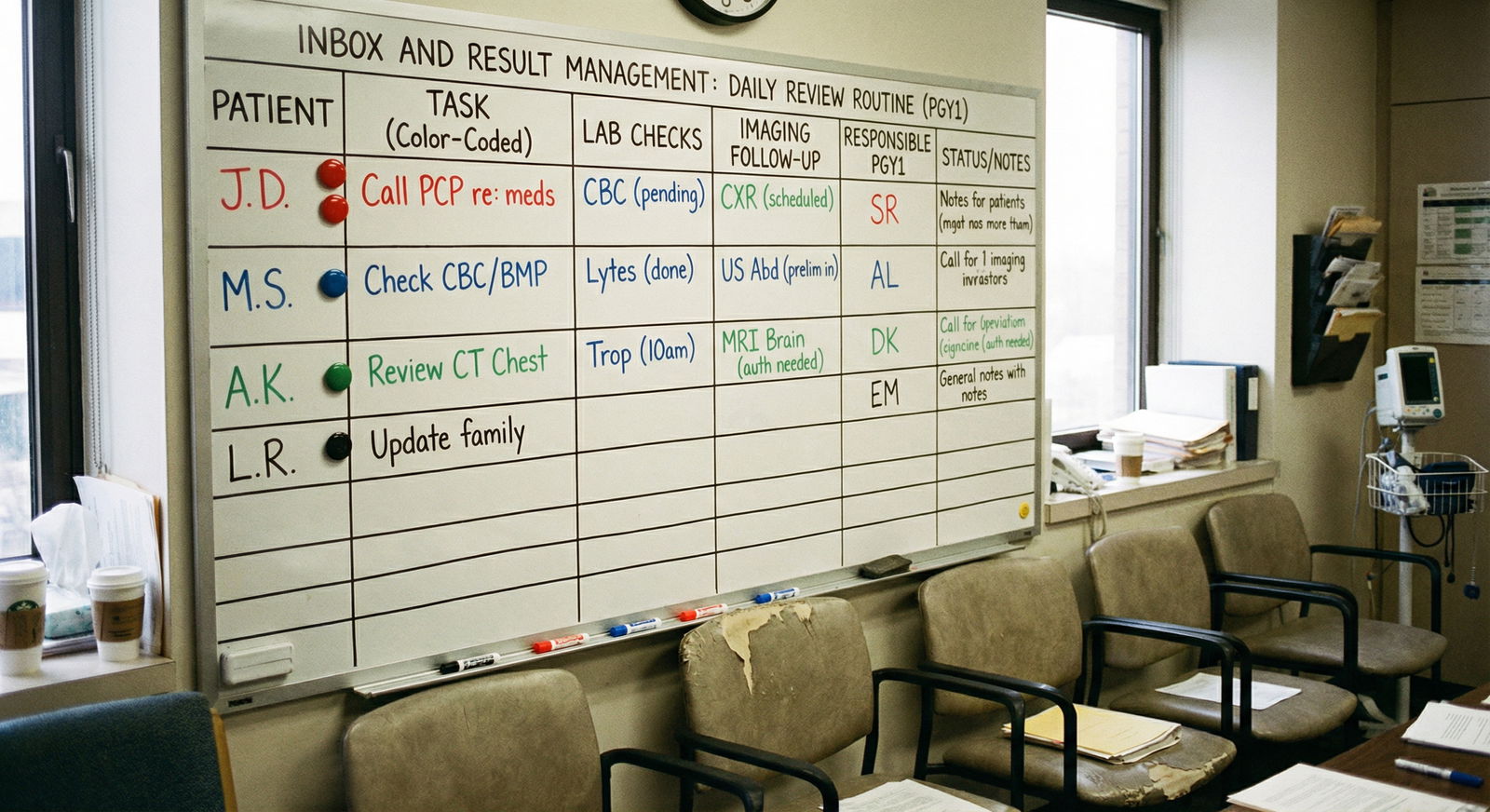
Here’s the distinction that matters: some tasks are must do now, and others are can wait if they’re closed properly.
Must do now usually means:
- a result changes management
- a medication needs immediate action
- a discharge is blocked
- a legal or time-bound requirement expires today
- lack of action could harm a patient before the next team reliably sees it
Can wait with closure means:
- documentation is incomplete but the care plan is already safely executed
- a note needs polishing, not rescuing
- a non-urgent follow-up can be handed off with a clear owner and deadline
Backlogs also cluster after specific operational messes:
- admit overload
- transfer chains
- ED boarding
- night-float handoffs
- discharge surges around late morning
That pattern matters. If your task list explodes after the same kind of shift every time, it’s not random. It’s a workflow fingerprint.
If you’re staring at a 50+ task list right now: triage like a clinician, not like a clerk
First rule: don’t work top to bottom.
That’s clerk behavior. The EMR loves it because the software doesn’t care what matters. You should.
Start like this:
Pause for thirty seconds
- Not meditation. Just orientation.
- Ask: How many actual patients on this list could be harmed by delay today?
Sort by patient, then urgency
- Group tasks by patient if your EMR allows it.
- One patient with six related tasks is not six separate emergencies.
Look for safety threats first
- critical lab trend
- final imaging read that changes the plan
- medication verification issue
- pending order blocking treatment
- consult recommendation affecting escalation, procedure, or level of care
Check deadlines and time windows
- discharge timing
- pre-op requirements
- time-sensitive meds
- required documentation tied to transfer or billing cutoff
- anything that expires before the next team can reasonably act
Then handle blockers
- discharge held up by paperwork
- med rec preventing clean transition
- unsigned or incomplete items preventing downstream staff from moving
Documentation comes after safety and flow
- yes, it matters
- no, it is not more urgent than a potassium of 2.8 nobody addressed
Use one question over and over:
What could happen if this isn’t done today?
That question cuts through nonsense fast.
- If the answer is patient harm, do it now.
- If the answer is disposition delay, do it soon.
- If the answer is mild chart untidiness, don’t let it hijack your morning.
- If the answer is I’ll annoy someone but nothing unsafe happens, that’s a handoff or scheduling problem, not a drop-everything problem.
A few prioritization heuristics I trust:
Review trends, not isolated noise
A mildly abnormal lab that’s improving is different from a “normal-ish” lab drifting the wrong way for 12 hours.
Meds beat paperwork
If a med requires verification, reconciliation, dose confirmation, or discontinuation to avoid harm, that jumps the line. Always.
Consults matter when they change disposition
A consult note that says “outpatient follow-up” can wait a bit. A consult note that determines ICU vs floor, surgery today vs tomorrow, discharge vs stay? That’s not optional.
Legally or operationally time-bound tasks are landmines
Discharge orders, transfer documentation, attestation/sign-off requirements tied to same-day flow—these create downstream chaos if ignored.
Don’t overread every chart from scratch
This is where tired interns lose the day. You are not doing a full rediscovery of medicine at 9 a.m. post-call. You are answering the task in front of you with enough chart review to act safely.
And here’s the blunt truth: if the list is over 50, there is zero chance every item deserves equal attention. Pretending otherwise is how you stay three extra hours and still miss the one thing that mattered.
The hidden reason it piles up: handoffs and “ownership gaps”
Most EMR backlogs aren’t caused by laziness. They’re caused by orphaned work.
A patient gets admitted by one person, rounded on by another, cross-covered by a third, and discharged by whoever drew the shortest straw. In that mess, tasks get created during transitions and then sit there because nobody explicitly owns them.
Classic ownership gaps:
- verbal plan changed, chart not updated
- resident relieved before closing the loop
- task assigned to whoever was logged in
- “day team will handle it” with no actual handoff line
- consult recommendation received but not tied to a named next step
This is where interns get burned. The EMR often assigns work mechanically, not intelligently. If your name is attached, it can look like your problem even when the responsibility was never clearly handed to you.
The corrective move is simple and underused: write the working plan and confirm ownership before time runs out.
Try:
- “Cardiology recommended X; I placed Y; pending final note; day team to confirm Z.”
- “Discharge meds reviewed, instructions drafted, final attending sign-off pending.”
- “CT final read pending; no prelim concern; covering resident aware to review by noon.”
That’s not defensive charting. That’s functional charting. It prevents ghost tasks from becoming your private nightmare later.
What to do when you can’t finish: delegation, escalation, and audit-proof communication
You will not always finish. That’s reality. The mistake is leaving a vague mess behind.
When you need help, use a clean escalation script:
“Here’s what’s done, here’s what’s pending, here’s the risk, here’s my recommendation.”
Example:
- “I reviewed the overnight labs and reconciled meds on rooms 12, 14, and 18. Room 21 still has a final CT read pending and the discharge on room 16 is blocked by the updated med list. If room 21’s read confirms obstruction, that changes disposition. My recommendation is that the covering senior review room 21 by 11 and I can finish room 16’s paperwork in the next 20 minutes if that’s the priority.”
That script works because it answers the questions your senior actually cares about:
- What did you already do?
- What still matters?
- Is anyone unsafe?
- What do you want me to do?

Delegation also has rules. Good delegation is not dumping. It includes:
the right person
- senior resident for clinical judgment
- covering resident for active patient issues
- charge nurse/unit staff for operational barriers
- pharmacist for med clarification when appropriate
what you already checked
- “K was 3.1, replacement ordered, repeat pending”
- “final note still not posted, only verbal rec received”
the deadline
- “needs review before discharge”
- “must be addressed before noon meds”
- “can wait until next shift if no new symptoms”
the reason it matters
- patient safety
- disposition
- compliance/required sign-off
Make your communication audit-proof. Not bloated. Just traceable.
A short message or note should answer:
- what was reviewed
- what remains
- who was notified
- what the agreed plan is
Example:
- “Reviewed final BMP and imaging updates through 0930. No critical action needed except pending med rec for discharge on Pt A and final consult documentation for Pt B. Senior resident notified; plan for covering team to finalize before discharge decision.”
That’s enough. Don’t write a novel. Don’t include extra sensitive detail in insecure channels. Just create a reliable trail.
And if someone pressures you to silently absorb unsafe overflow because “it’ll only take a minute,” be careful. That’s how hours disappear and errors happen. A backlog needs ownership, not magical thinking.
Protect your time without risking patient care: build a post-call ‘containment plan’
If you don’t set a plan, the backlog will consume whatever time you have. Unlimited work expands beautifully into exhausted, unpaid, error-prone limbo. Don’t let it.
Use a three-phase containment model:
Safety sweep — 30 minutes
- critical labs
- final reads
- med issues
- discharge blockers
- active consult items affecting care today
High-impact tasks — 60 minutes
- complete things that move patients
- close tasks blocking discharge, transfer, orders, or treatment
Documentation/residual — 30 minutes
- sign notes
- tidy low-risk admin work
- hand off the leftovers with a concrete plan
Set boundaries like this:
- “I’m doing all safety-critical and discharge-blocking items now.”
- “The remaining documentation is low-risk and will be handed off with status.”
- “I need confirmation on who owns these two pending consult follow-ups after noon.”
That is responsible. Not lazy.
Before you leave, do a next-shift readiness check:
- critical pending tasks identified?
- discharges have a sign-off trail?
- handoff note updated?
- ownership assigned for anything unresolved?
- any result likely to land today flagged to the right person?
That last step saves people. And saves you tomorrow.
When the backlog is a system problem: how to advocate without burning bridges
Sometimes the issue isn’t your efficiency. It’s the system repeatedly generating garbage.
Signs it’s bigger than you:
- same end-of-shift task surge every call day
- same category of orphaned tasks every week
- consult and discharge loops never closing
- cross-cover repeatedly inheriting unclear work
- residents staying late for chart cleanup with no patient-care gain
That’s not grit-building. That’s bad process.
Bring data, not vibes.
Track for two weeks:
- number of post-call tasks
- category of tasks
- how many were true safety issues
- average time to closure
- which tasks lacked clear ownership
Then propose a small fix:
- clearer task routing rules
- a handoff template with “owner/deadline/risk”
- protected post-call documentation block
- standard discharge checklist
- explicit coverage for results that return after sign-out
Keep the tone specific:
- “We’re seeing 20 to 30 post-call tasks recur after night-float handoff, mostly unowned consult follow-ups.”
- “A pilot handoff field for owner plus deadline might reduce unsafe ambiguity.”
- “Protected 20-minute note-finalization time after call may prevent delayed discharge paperwork.”
Don’t make it personal unless it actually is. Blame is cheap. Process fixes are useful.
And yes, be politically smart. Residency is still a hierarchy. But you can absolutely say, “This workflow is creating repeated unowned tasks that affect patient care,” without sounding dramatic. That’s not complaining. That’s doing your job.
Summary: your goal isn’t to clear every task—it’s to close the right ones
Here’s the rule I want you to keep.
If a task can harm a patient or block disposition, act now. If it’s documentation without immediate safety risk, delegate it or schedule it with a clear plan.
That’s the whole framework:
- prioritize patient safety
- close loops
- confirm ownership
- time-box your work
- document the handoff trail
The post-call backlog is common. Annoyingly common. But competence as an intern is not measured by whether you can clear every blinking box before going home. It’s measured by whether you can see through the noise, protect patients, and keep the work from becoming dangerous chaos.
That’s what good residents do. Not everything. The right things.