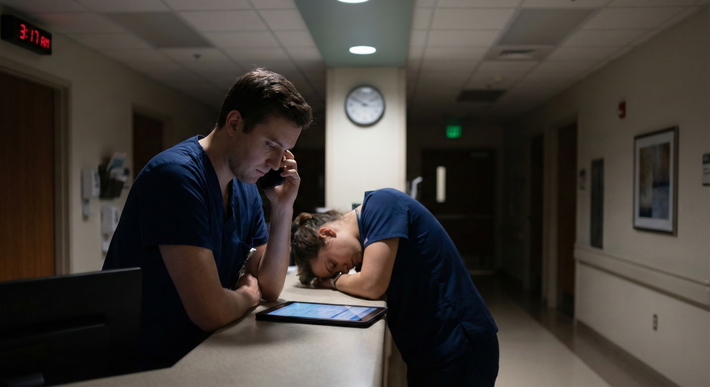
Admission bottlenecks do not mean you are slow. They usually mean the system is badly designed and you are the one paying for it at 2 a.m.
Let me break this down specifically: your first year as an intern, the single biggest time sink on a busy inpatient service is front-loaded into one process—admissions. Not rounding. Not discharges. Admissions. The work expands in every direction: calls, orders, documentation, handoffs, family questions, nursing messages. If you do not build a ruthless, efficient admission workflow early, you will drown.
You are not going to fix hospital throughput as a PGY-1. But you can absolutely stop adding friction. The goal is not “do more work faster”; the goal is “cut every pointless repetition and delay that does not change patient care.”
This is how you do that.
The Real Problem: Why Admissions Bottleneck So Badly
On paper, an admission is simple: accept patient → evaluate → order → document. In real life, the steps look more like this:
- ED calls you with half the story and a guessed diagnosis.
- You are already in another room.
- Bed is not ready yet.
- Old records are in three different systems.
- You see the patient, realize the diagnosis is wrong.
- You rewrite orders.
- You document once for the note, again in handoff, again to answer a nurse’s message.
Every step leaks time. But the leaks cluster around three choke points:
Information chaos
Fragmented data, bad handoffs, missing outside records.Decision paralysis
Unclear diagnosis, too many “just in case” orders, over-documentation.Task switching
Constantly bouncing between patients, phone calls, orders, and notes.
If you want to save time, you attack those three. Not by working faster in general, but by building a tight, repeatable admission pattern that you barely have to think about on your fourth patient of the night.
Build a Standard Admission Workflow (Then Stop Deviating)
Most interns “wing it” for months. They do every admission slightly differently, depending on mood, attending preferences, and how chaotic the ED call was. That is a mistake. You want a default pattern—like a personal protocol—that you follow 90% of the time.

| Step | Description |
|---|---|
| Step 1 | ED/PACU Call |
| Step 2 | Quick phone triage |
| Step 3 | Pre-chart and checklist |
| Step 4 | Bed assigned or virtual hold |
| Step 5 | Focused bedside eval |
| Step 6 | Initial orders set |
| Step 7 | Short problem list |
| Step 8 | Admission note skeleton |
| Step 9 | Refine note and orders |
| Step 10 | Handoff update |
Use this skeleton; adapt it to your hospital, but do not abandon the structure:
1. Phone Call Triage: Decide Depth Up Front
When ED, PACU, or a transfer calls, you do not need a five-minute story each time. You need classification.
Ask these same questions, in this order, every time:
- “What is the working diagnosis and reason for admission?”
- “How sick is this patient right now—pressors, BiPAP, unstable vitals, concerning chest pain, altered?”
- “Do they have a bed assignment on our service yet?”
- “What are the immediate active issues or pending tasks—antibiotics hanging, troponin trend, imaging pending, high oxygen needs?”
You mentally drop them into one of three buckets:
- Bucket A: Sick/unstable – go now, see first, orders now, note later.
- Bucket B: Stable but complex – needs careful problem list and med rec; still reasonably urgent.
- Bucket C: Rock-stable / social admit / low acuity – can wait until you clear higher-risk patients.
That triage alone prevents you from spending 30 minutes deeply charting a stable cellulitis admit while your borderline septic shock patient waits upstairs.
2. Pre-Charting: 5–7 Minutes, Not 25
Pre-charting saves time when done ruthlessly short. Done badly, it eats your night.
Before you walk into the room, pull up:
- ED note summary: chief complaint, HPI, ED impression.
- Vital trends: last 12–24 hours, especially BP, HR, RR, O2.
- Key labs: CBC, BMP, LFTs, lactate, troponin, BNP, cultures if done.
- Imaging: skim impressions, not every word.
- Med list: especially anticoagulants, insulin, immunosuppressants.
You are not writing the note yet. You are forming three things:
- Initial one-liner: “67-year-old with CHF, CKD, now with acute hypoxic respiratory failure likely from volume overload.”
- Safety questions: “Am I missing a stroke? ACS? PE? Sepsis?”
- Immediate orders you probably will place: oxygen, diuretics, antibiotics, insulin adjustments, NPO, telemetry, etc.
Limit yourself. If you are pre-charting a routine admit for more than 10 minutes, you are probably overdoing it.
3. Bedside Evaluation: Targeted, Not Encyclopedic
This is where interns burn enormous time. You do not need to reproduce a Step 2 CS exam for every admit.
You want:
- Focused HPI that explains why today.
- Quick but targeted ROS: chest pain, dyspnea, neuro changes, fevers, GI, GU, bleeding, pain.
- Focused PE with special attention to: mental status, lungs, heart, volume status, any surgical site, lines/tubes, skin.
- Quick review of meds, allergies, and code status in front of the patient or caregiver.
You can always come back for tiny details. What you must not miss: things that would immediately change management. That is the standard.
Time-Saving Shortcuts That Do Not Compromise Care
Let us talk shortcuts. Not cutting corners that make care worse—cutting duplicate work that adds nothing.
Shortcut 1: Standard Admission Order Sets – Used Properly
Order sets are a double-edged sword. Used blindly, they fill your list with garbage labs and unnecessary tests that you will be paged about all night. Used correctly, they are gold.
What to do in your first 1–2 weeks:
- Open each admission order set for your main services (medicine, surgery, neurology, etc.).
- Sit with a senior resident for 15 minutes and have them tell you which items are:
- “Always check these for most admits”
- “Almost never useful—uncheck by default”
- “Only for specific scenarios”
Then, make yourself a personal mental template. Example for a standard medicine admit:
Always:
- CBC, BMP, magnesium, phosphorus
- Baseline LFTs once
- VTE prophylaxis (heparin or enoxaparin, unless bleeding or procedural risk)
- Nursing: vitals q4h, strict I/O on CHF/AKI patients
- Diet appropriate to condition, bowel regimen if opioids
Never on autopilot:
- Daily LFTs for no reason
- Routine coagulation labs without indication
- Multiple redundant imaging orders
- “Daily labs” on dying comfort-care patients
The shortcut is not “use order sets.” The shortcut is “having pre-decided how you will trim them aggressively.”

Shortcut 2: Problem-Oriented Notes With a Rigid Skeleton
Most intern notes are chaotic. Big blobs of HPI, ROS, PE, labs, then a rambling assessment.
Build a rigid skeleton and use it every single time:
Opening one-liner
“54-year-old with poorly controlled type 2 diabetes and CAD presenting with fever and confusion, found to have sepsis likely from pyelonephritis.”Numbered problem list (3–7 problems usually)
- Sepsis from likely pyelonephritis
- Acute kidney injury on CKD3
- Uncontrolled diabetes mellitus
- CAD with stable angina
Under each problem, 3 lines:
- Summary of evidence: “T 38.9, HR 115, leukocytosis 18, UA with nitrites and leuk esterase, CVA tenderness.”
- Assessment: “Most consistent with upper urinary tract infection; no shock, no obstruction known.”
- Plan: bullet out specific actions and follow-up tests.
You are aiming for clarity, not literature review. If you catch yourself writing a paragraph that looks like an UpToDate page, you are wasting your time and everyone else’s.
Copy your skeleton forward for similar patients. Reusing structure is not laziness; it is consistency.
Shortcut 3: Smart Phrases / Macros That Actually Save Time
If your EHR allows smart phrases or dot phrases, build a small library of 5–10 high-yield macros. Not 60. Not “all the things.”
High-yield examples:
.hpi_chfpulm– baseline for dyspnea/CHF/COPD/asthma..hpi_infection– for pneumonia, UTI, sepsis, osteomyelitis..exam_med– your standard complete but concise medicine exam..plan_dka,.plan_nstemi,.plan_pna– skeleton plans for common conditions.
You fill in the details; the macro gives you the scaffolding and ensures you do not forget key elements.
The trap is over-templating: if your note looks the same for every patient, including obviously false statements, you will lose credibility quickly. Templates are a starting point, not a final product.
Controlling the Queue: Handling Multiple Admissions Without Melting Down
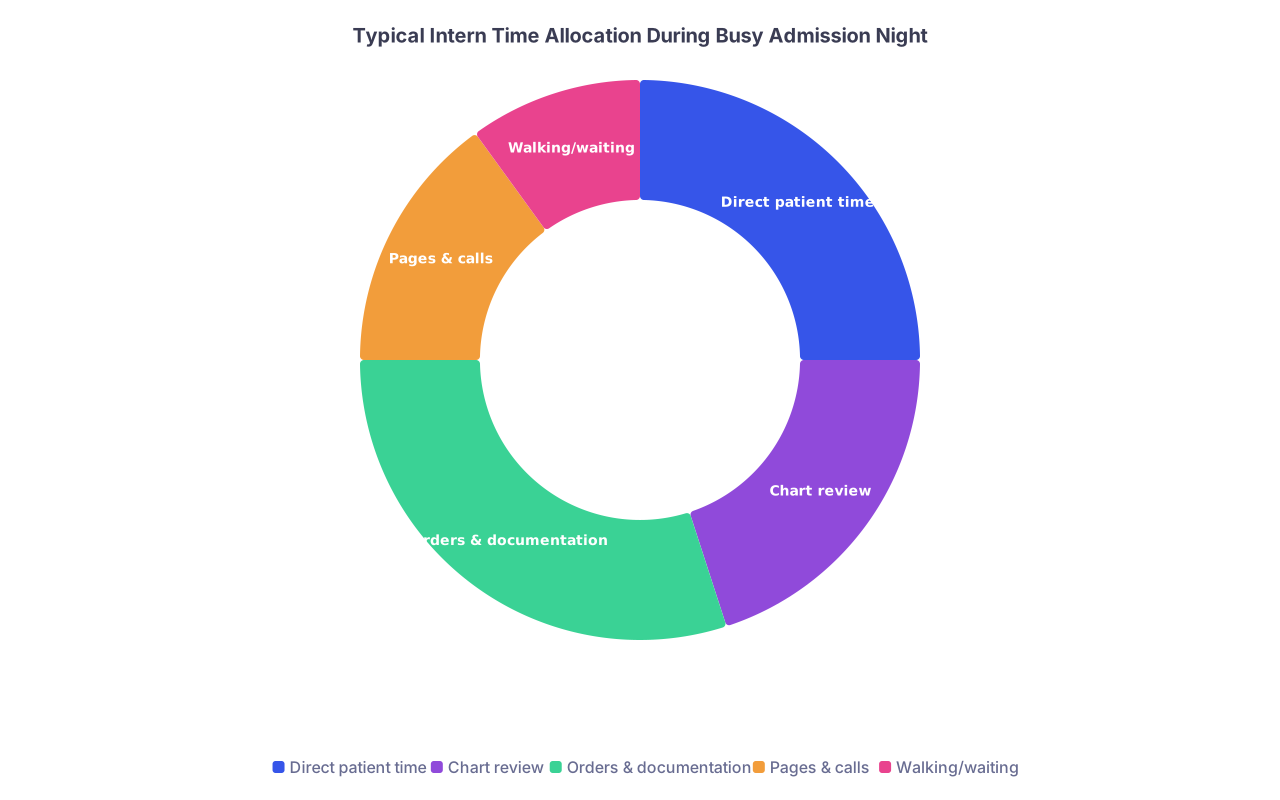
The worst nights are not “one very sick admission.” They are “four new admits, two cross-cover pages every 10 minutes, and an attending asking for updates.”
You cannot do those nights linearly. You must start thinking like an air-traffic controller.
| Category | Value |
|---|---|
| Direct patient time | 25 |
| Chart review | 20 |
| Orders & documentation | 30 |
| Pages & calls | 15 |
| Walking/waiting | 10 |
Step 1: Create an Admission Triage List
On a scrap paper, whiteboard, or in your EHR “to-do” area, list:
- Patient name / MRN (shortened)
- Location (ED room, floor bed)
- Acuity (A/B/C like earlier)
- Pending critical task (e.g., “start antibiotics,” “order CTA,” “place NPO/tele,” “verify code status”)
You want to see at a glance:
- Who is at risk if you delay 30–60 minutes.
- Who is safe to partially complete now and return later.
Step 2: Learn to “Partially Admit” Safely
There is a mental block many interns have: they think an admission must be completely finished (everything documented, reconciled, ordered) before moving to the next patient.
On a real service, that is fantasy.
You are allowed to:
- See a sick patient quickly.
- Do a focused H&P.
- Put in immediate life-saving or trajectory-changing orders: oxygen, antibiotics, fluids, hemodynamic monitoring, pain control, insulin.
- Write a short, bare-minimum note or even a brief “admission addendum” to document critical thinking.
- Then move to the next urgent case, planning to return for detailed documentation later.
The key is being explicit in your note:
“Brief initial note; full admission H&P to follow after stabilization. Current assessment and plan focused on sepsis management and hemodynamics.”
That is not sloppy. That is honest and transparent.
Step 3: Time-Box the Non-Critical Parts
If you are sitting in front of a stable admission chart at 1 a.m., obsessing over whether to list “chronic back pain” as a separate problem or bundle it under “chronic conditions,” you have already lost.
Give yourself limits:
- 15–20 minutes to fully complete a straightforward, stable admission including note and orders.
- 30–40 minutes for a complex ICU/step-down-level admission, recognizing that some documentation can be refined later.
If you hit your time limit and you are still writing a novel, that is your cue: shorten the note, move on.
High-Yield Communication Tricks That Save You Hours
Most admission bottlenecks are actually communication bottlenecks.
With the ED
Bad pattern: you get a disorganized, five-minute monologue from a busy ED doc. You forget half of it. You go upstairs anyway and discover three big issues never mentioned.
Better pattern: you actively control the call using a fixed structure.
“Can you give me:
- Age, key comorbidities, and why they came in;
- What you are worried about and why they cannot go home;
- How sick they are at this moment (pressors, oxygen, mental status);
- Any critical tests or consults that are pending?”
If they sound unsure about the disposition, you ask: “What’s making you admit instead of discharge? Specifics.”
You are not being difficult. You are reducing the “oh by the way they also have a 5.5 cm AAA” surprises.
With Nursing
Nurses are your allies. If they trust you, they will help you manage the flood. If they do not, every unclear order will come back to you as a page.
Three fast time-savers:
- When you first place orders, add a quick comment in the chart or call the nurse for complex patients: “Plan tonight is mainly monitoring, fluids, and starting antibiotics. I will be back after I see two other admissions.” That heads off a ton of “what is the plan” pages.
- Standardize your PRN orders: standing pain, nausea, bowel regimen, hypoglycemia protocol. Less 2 a.m. “can I get something for…?”
- Clarify parameters for vitals-related pages: “Please page if SBP <90, HR >130, RR >30, SpO2 <90 sustained despite nasal cannula 4L.”
With Your Own Team
You can also save future time by communicating cleanly to the people who inherit your patients.
Your goal for a handoff after a heavy admit night:
- Clear one-liner and main diagnosis.
- Top 3 issues and what you are actively following up (cultures, imaging, cardiology consult).
- Any unstable trends or “things that worry you.”
You do not need to recite the entire H&P. You are protecting them from having to reverse-engineer your thought process at midday with six other patients to see.
Avoiding Documentation Overkill (Without Getting Burned)
Let me be blunt: many interns over-document because they are afraid of attendings and auditors. So they write everything. That is not how experienced people chart.
Your admissions need to be:
- Legible
- Logical
- Defensible
They do not need to read like case reports.
Here is a simple mental check: if a sentence in your note does not help someone:
- Understand the diagnosis,
- Understand the severity, or
- Know what to do next,
it is probably fluff.
What Must Always Be Crystal Clear in an Admission Note
Regardless of specialty:
- Why the patient is being admitted today (and why they are not going home).
- Your top 1–3 working diagnoses (even if provisional).
- Your immediate management plan for the next 6–12 hours.
- Any major alternatives you considered and ruled out when high-risk (e.g., not ACS, not meningitis, etc.).
- Code status and goals of care discussion attempts.
If those pieces are sharp, you are safe. You can always add detail if an attending loves verbosity.
Intern-Level Risk Management: Cutting Corners vs Cutting Waste
You are going to feel this tension: “If I do everything perfectly, I will be here until 11 a.m.; if I try to be efficient, I am scared I will miss something huge.”
The way out is not “do everything” or “do less.” The way out is decide what can never be shortened, and what can always be shortened.
Non-negotiable:
- Seeing the patient yourself before signing off the admission (exceptions only in true codes/ICU-level chaos, and even then you go as soon as possible).
- Reviewing vital trends and basic labs before finalizing the plan.
- Documenting your core reasoning on unstable or potentially litigious cases (chest pain, neuro deficits, sepsis, OB issues, trauma).
Flexible / negotiable:
- Length of narrative HPI.
- Whether you document every single traded phone call.
- Whether you list 14 chronic conditions independently in your note.
- Whether your ROS is a full textbook review on a focused problem.
You are not being reckless if you shorten low-value documentation while keeping clinical care tight and explicit.
Tools and Micro-Habits That Quietly Add Up
None of these alone will save your night. Together, they can claw back 1–2 hours on a bad shift.
| Habit | Time Saved / Benefit |
|---|---|
| Fixed triage script for calls | Fewer repeated questions, clearer urgency |
| 1-page running list of admits | Prioritization, less mental load |
| 5–10 smart phrases | Faster, more consistent notes |
| Pre-trimmed order sets | Fewer unnecessary labs/pages |
| Standard PRN bundles | Fewer overnight pages |
A few more concrete ones:
- Keep a small notebook / digital note for “admission skeletons” and a running to-do list. The human brain is terrible at holding more than ~3–4 active tasks at once when stressed.
- When you open a chart, decide your next concrete action before you click anything else: “I will place initial vitals/tele/IVF orders first” or “I will write the A/P first.” This fights aimless clicking.
- Group similar tasks if possible: write two A/P sections for similar CHF admits back-to-back, or place multiple lab bundles together. Task switching kills your efficiency.
The Emotional Side: Not Letting Bottlenecks Break You
Every intern I have seen who is good at admissions has gone through at least a few nights where everything went sideways—codes, multiple ICU upgrades, angry families, and three pending ED admits at 4 a.m.
You will have nights where:
- Notes remain unfinished until post-call rounds.
- You forget a basic order and have to scramble.
- You get feedback that your documentation was “too thin” or “too long.”
This does not mean you are bad at this. It means you are exactly where you should be on the learning curve.
What you must do is post-mortem quickly:
- After a bad call night, take 10 minutes and ask: “Where did I actually lose time?”
- Was it note writing?
- Was it indecision?
- Was it finding data in the chart?
- Was it phone tag and unclear communication?
Pick one bottleneck and target it with a specific fix for the next call shift. Not five fixes. One.
That is how you go from “perpetually behind” in July to “secretly running the service” by March.
FAQs
1. How long should a typical admission take as an intern?
For a stable, straightforward medicine admission, a reasonable goal once you are past the first month is 20–30 minutes end-to-end: quick pre-chart, focused bedside evaluation, initial orders, and a concise note. Complex ICU-level or very unstable patients will legitimately take 40–60 minutes, sometimes more, especially when you are coordinating consults and procedures. The key is not the raw minutes, it is avoiding 60-minute notes on a simple cellulitis admit while other patients wait.
2. Is it safe to “do the note later” if the patient is sick?
Yes, with conditions. You must document at least a brief assessment and plan that clearly states what you think is happening and what you are doing in the immediate term—especially on septic, unstable, or high-risk patients. A one- or two-paragraph “initial stabilization note” is fine, as long as it is honest: “Brief note during active resuscitation; full H&P to follow.” Then you come back and complete the full documentation once the acute chaos settles. What is not acceptable is doing major interventions with zero contemporaneous documentation.
3. How do I handle attendings who want very detailed notes?
You adapt slightly without sacrificing your entire night. Ask directly: “For admissions, what are your priorities in the note—more detail in HPI, in A/P, or overall length?” Then shape your existing skeleton to that attending. Many who say they like “detailed notes” really mean they want a clear problem list and explicit reasoning on complex issues, not a bloated ROS. If someone truly insists on near-dictation-level detail for every admit, talk with your senior about how to balance that expectation with your actual workload.
4. What should I prioritize if I am behind on multiple admissions and cross-cover pages?
Use a strict hierarchy. First, any immediate safety issues: hypotension, hypoxia, new chest pain, altered mental status, critical labs that can harm the patient. Second, unstable or high-risk new admissions—get eyes on them, start lifesaving orders, and put in a brief note. Third, close the loop on time-sensitive tasks (antibiotics, anticoagulation, transfer orders). Only after that do you worry about fully polishing all your notes. If you are overwhelmed, call your senior early; it is not a failure, it is what a functional team does when the system is flooded.
With these shortcuts and structures wired into your workflow, you are not just “surviving admissions.” You are quietly becoming the intern everyone wants on nights, the one who can move patients safely through the bottleneck while still having something left in the tank for morning rounds. The next step is learning how to hand those patients off, round efficiently, and discharge them without creating a different set of bottlenecks—but that is a problem for another call month.