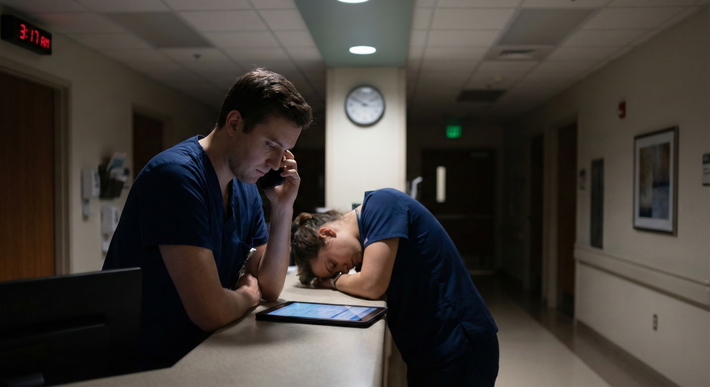
Most interns do cross-cover completely backwards. They react; they do not run the night.
Let me show you the opposite approach: a systematic, boringly reliable way to handle overnight calls that keeps patients safe and keeps you from melting down at 3:47 a.m.
You are not going to eliminate chaos. You are going to contain it.
1. The Real Job of Cross-Cover (That No One Explains)
Cross-cover is not primarily about “fixing problems.” It is about risk management on half-known patients with incomplete information and limited backup.
Your actual overnight job boils down to three priorities, in this order:
- Do not miss or delay recognition of a crashing patient.
- Do not let a potentially unstable situation drift without a plan.
- Do not create new problems for the day team through careless decisions.
Everything else—med recs, potassium repletion, even most pain calls—is secondary.
| Category | Value |
|---|---|
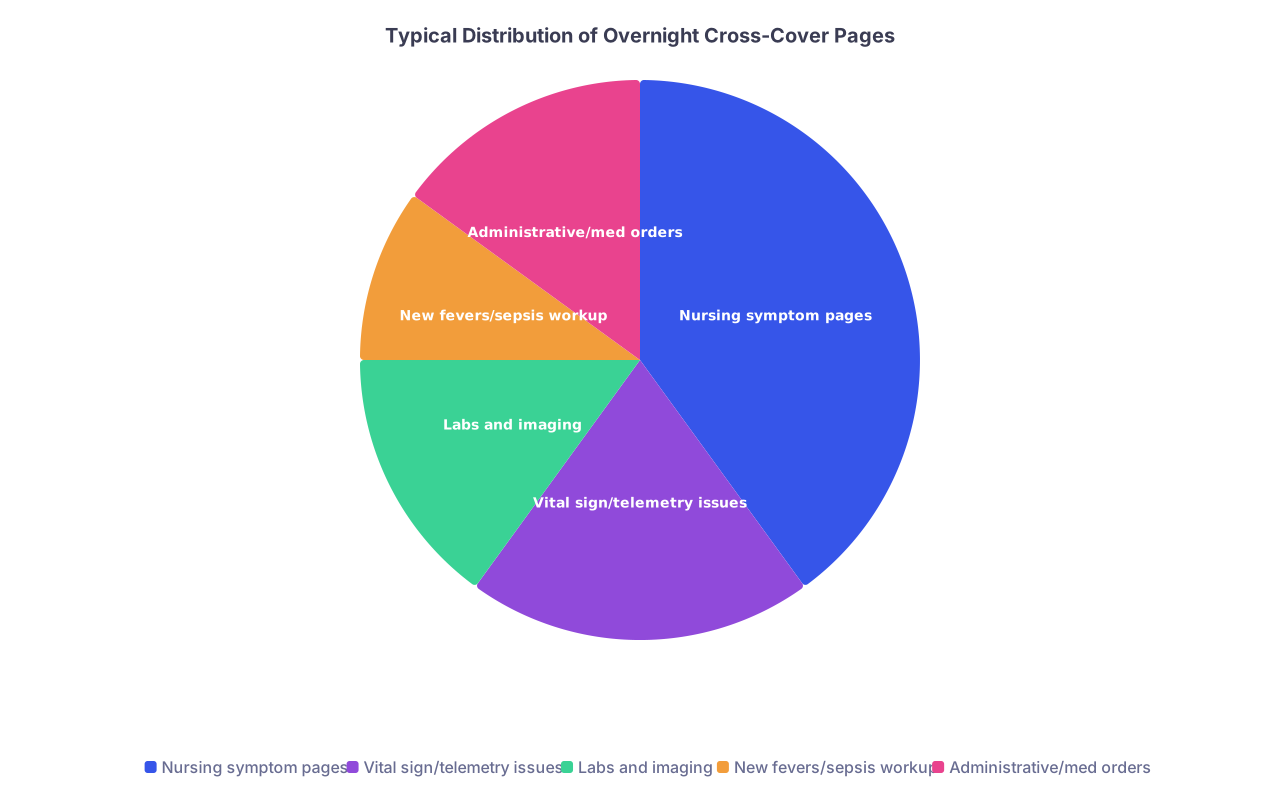
| Nursing symptom pages | 40 |
| Vital sign/telemetry issues | 20 |
| Labs and imaging | 15 |
| New fevers/sepsis workup | 10 |
| Administrative/med orders | 15 |
If you do cross-cover like a checklist-driven risk manager instead of a frantic short-order cook, your nights get dramatically safer and more predictable.
The mental model I want you to adopt:
Every call = structured assessment → classification of risk → standardized response.
2. Pre-Call Setup: How You Start Determines How You End
The worst way to start a night is to show up at 6:55 p.m., grab the sign-out stack, nod along, and page through chaos for 12 hours.
You can cut your overnight stress by half with a 20–30 minute pre-call system.
A. Aggressive, Structured Sign-Out
You are not a passive recipient of sign-out. You are interrogating it for failure points.
For each team you cross-cover, you want three buckets in your head (or on paper):
- Actively sick / could decompensate tonight
- “Watch this” / pending work-up / soft concerns
- Stable / basically housekeeping
Push for specifics. Cheap phrases like “kind of tenuous” are useless. You want:
- Last 24h trajectory: “Was better/worse in the last day?”
- Last vitals and O2 needs: “Any MAP <65? Any O2 changes today?”
- If they crash, what is the plan?
A good sign-out ask sounds like this:
“If this patient acutely desats or gets hypotensive, what is the first thing you want done? Fluids? Diuresis? NIV trial? Call you?”
Write those contingency plans down. They are gold at 2:30 a.m. when no one picks up the phone.

B. Your Own “At Risk” List
Do not trust that sign-out alone has captured everyone at risk.
Before the day team leaves, quickly scan:
- Patient list sorted by:
- Highest O2 requirement
- Recent rapid response / ICU downgrade
- DNR/DNI or comfort care
- Labs for today: K, Na, Cr trends, lactate, WBC if sick
Build a small “watch list” (5–15 patients max) you will think about proactively overnight. This might include:
- New GI bleed, still borderline
- COPD on 4L who is usually on room air
- New NSTEMI waiting for morning cath
- Decompensated cirrhosis with SBP yesterday
- Post-op day 0/1 with marginal pressures
C. Clear Escalation Rules With Your Senior
Ask these before they walk off to the call room:
- “Who do you want to know about no matter what?” (e.g., any hypotension, any new O2 >4L, any new A fib with RVR)
- “Who can I call you for even if I think I know what to do, just to double check?”
- “Any patients you personally worry will tank tonight?”
This is not weakness. This is how you prevent the 4 a.m. “Why did you not call me?” conversation.
3. The 30-Second Phone Pattern That Changes Everything
Most interns sound scattered on the phone. Nurses sense that and will (rightly) give less clinical detail and more defensive overpaging.
You need a single, repeatable verbal structure for every call.
The SBAR+V Framework (My Version)
SBAR is fine in theory. In real hospitals, it is usually mush. You can force structure like this:
- Situation – 1 sentence.
- Background – 1–2 key anchors.
- Assessment – what you think is going on (even if provisional).
- Recommendation – what you are going to do next.
- Vitals – most recent full set if not already included.
Example, when a nurse calls:
“This is Sarah on 7W, calling about Mr Jones in 712. His BP is 82/48, HR 112, MAP 57. He is on 3L nasal cannula, sat 95%. He is your 68-year-old with pneumonia on ceftriaxone/azithro, creatinine bumped from 1.0 to 1.5 today. He looks clammy and more confused than earlier. I am concerned he is septic and hypotensive. I think he needs a bolus and higher level of care. What would you like to do?”
When you call your senior:
“Hey, this is the intern on nights. I am calling about Mr Jones, 68-year-old with pneumonia, now hypotensive to 80s/40s, HR 110s, MAP ~55, on 3L satting mid-90s but more confused and cool. Exam with delayed cap refill, lungs wet-ish, JVP maybe elevated, urine output down over the last 4 hours. I am trying to decide if this is septic with relative hypovolemia or more cardiogenic. I have already ordered a liter of LR, labs including lactate, and I am about to get a stat CXR and EKG. I think he needs ICU evaluation. Can you come see him with me?”
Notice:
- Short.
- Decisive.
- Next steps already in motion.
Train yourself to always speak in that pattern. It forces you to think.
4. A Systematic Approach to Common Overnight Pages
Most cross-cover pages fall into predictable buckets. You do not need creativity. You need algorithms.
I am going to walk you through key categories and a stepwise way to handle them.
4.1 “Patient looks bad” / Vitals are off
These are the calls that kill people if mishandled.
Your internal reflex should be: “I need eyes on this patient now.”
Step 1: On the phone – 20-second triage
Ask immediately:
- Latest vitals (full set, not just the abnormal one)
- Mental status: “Is this their baseline?”
- O2: current requirement and what it was earlier
- Telemetry if on: new arrhythmia?
- Urine output over last 4–6 hours if sick
If any of the following:
- SBP <90 or MAP <65
- New O2 need ≥4L or rapidly rising
- HR >130 or RR >30
- Acute change in mental status
You say: “I am coming to see them now. Put them on the monitor and get a full set of vitals; I will be there in 3–5 minutes.”
You do not “place orders from the desk” in those scenarios.

| Step | Description |
|---|---|
| Step 1 | Abnormal vitals page |
| Step 2 | Go to bedside now |
| Step 3 | Review chart and vitals |
| Step 4 | Assess ABC and mental status |
| Step 5 | Call rapid response or senior |
| Step 6 | Bedside workup and targeted orders |
| Step 7 | Hypotension, hypoxia, AMS, RR high? |
| Step 8 | Unstable? |
Step 2: At bedside – an ABC-focused mini exam
You do not need a novel-length exam at 2 a.m. You need targeted information.
Airway/Breathing:
- Can they speak in full sentences?
- Work of breathing? Accessory use?
- Lung sounds: crackles, wheezes, absent on one side?
Circulation:
- Peripheral perfusion: skin temp, capillary refill
- JVP if you can see it at all
- Edema, new or worsening
- Heart rhythm regular vs irregular
Neuro:
- Oriented? Focal deficits? New confusion?
Anchor this with immediate data:
- Check monitor yourself: HR, BP, RR, O2 waveform
- Fingerstick glucose if altered
- Quick review of I/Os if relevant
Step 3: Classify and act
Rough mental buckets:
- Likely septic / distributive
- Likely hypovolemic
- Likely cardiogenic / fluid overloaded
- Likely respiratory primary (COPD, asthma, flash edema, PE)
- Other / unclear
You then have standard first-line actions for each category (with senior involvement as appropriate):
- Suspected sepsis: IV access, blood cultures if not yet done, lactate, bolus (if not volume overloaded), appropriate broad-spectrum antibiotics, early call for higher level of care.
- Suspected fluid overload: stop fluids, consider IV diuretics, non-invasive ventilation if indicated, stat CXR, EKG, call senior early.
- Primary respiratory: bronchodilators, steroids if COPD/asthma, trial of BiPAP for hypercarbic COPD, early involvement of senior/ICU.
You are not alone. But you must be the one to start the process.
4.2 Pain, Nausea, and “Symptom” Pages
These will fill your pager. You cannot treat them ad hoc without losing your mind.
Create simple internal “ladders” for each.
Pain calls
Before reflexively ordering IV dilaudid (do not), ask or check:
- Pattern: “New or baseline? Different from usual?”
- Last given pain meds: what, when, how much?
- Vitals and mental status: sedated? hypotensive?
- Etiology: post-op, chronic, sickle cell, cancer, unclear abdominal pain?
For stable, known chronic pain/post-op with no red flags:
- Use oral first if possible
- Re-dose within reasonable window
- If NPO, consider non-opioid adjuncts (IV Tylenol, ketorolac if kidney OK, regional blocks if available and appropriate)
Red flags where you must think beyond “more opioids”:
- New focal neuro deficits with headache
- Abdominal pain with guarding, hypotension, fever
- Chest pain radiating, associated with diaphoresis/ SOB
- Flank pain with fever and hypotension
Those demand bedside assessment, possible imaging, and senior involvement.
Nausea/vomiting
Again, laddered approach:
- Check last antiemetic: timing and dose
- Check QTc if patient is on multiple QT-prolonging meds
- Evaluate for obstruction, ileus, or ICP red flags if new
Simple moves:
- If last ondansetron was 6+ hours ago and QTc reasonable, you can repeat.
- For persistent post-op nausea, mix mechanisms (ondansetron + low-dose promethazine or compazine).
- For neuro patients, be cautious with sedating agents.
But if new bilious emesis, pain, distension, absent bowel sounds—this is not “just give Zofran.” You go see them.
4.3 Abnormal Labs
Lab pages are where interns either overreact or underreact. The trick is context.
| Lab/Issue | Typical Action Threshold at Night |
|---|---|
| Potassium | <3.0 or >5.5 (with EKG if >5.5) |
| Sodium | <125 or >150, or rapid change |
| Creatinine | >0.3–0.5 rise in 24h in a sick patient |
| Hemoglobin | <7 in most patients, <8 in cardiac/cancer |
| Platelets | <50k with bleeding / procedures |
Approach to any abnormal lab page
- Verify the value and specimen time.
- Compare to prior values (last 24–72 hours).
- Correlate with clinical status.
Examples:
K 2.9 in a stable patient with no arrhythmias, down from 3.4 earlier: oral or IV replacement depending on gut function, with a replacement protocol guideline.
K 6.2 up from 4.0 this morning in a patient with CKD and peaked T waves on telemetry: this is an emergency (calcium, insulin + dextrose, +/- albuterol, consider dialysis consult).
Hgb 6.8 from 7.2 this morning, no tachycardia, no signs of bleeding: transfuse if fits service protocol, discuss with your senior if unclear.
Hgb 5.4 from 10 this morning, hypotensive, melena: this is not just a type and cross. This is a resuscitation and GI consult situation.
You develop “muscle memory” here only by constantly pairing lab values with the clinical picture, not by treating numbers in isolation.
4.4 Fevers and “Possible Sepsis”
New fever overnight is a common, high-stakes scenario.
Stepwise
- Confirm: actual temp ≥38.0? When checked?
- Review: recent antibiotics, central lines, urinary catheters, prior cultures.
- Risk: Is patient neutropenic, post-op, immunocompromised?
At bedside:
- Check vitals trend: tachycardia? hypotension? tachypnea?
- Focused exam: lungs, lines, urine, surgical sites, skin.
Baseline fever workup (customize by hospital):
- Blood cultures x2
- Urine studies if urinary symptoms or catheter
- CXR if respiratory symptoms or no clear source
- Lactate if hemodynamically abnormal, high risk, or clinically septic
Antibiotics:
- Neutropenic fever: you do not wait. Broad coverage now (per institutional protocol) + immediate senior involvement.
- Clear source (e.g., new infiltrate on CXR in pneumonic patient not on antibiotics): start appropriate therapy.
- No clear source, clinically stable: often you can hold and discuss timing with senior, unless high risk.
Overnight intern error patterns I have seen:
- Ignoring fevers on neutropenic patients until morning. Unacceptable.
- Throwing vanc/zosyn at every 38.1 without exam or cultures. Lazy and harmful.
4.5 Telemetry, Arrhythmias, and “Funny Heart Rhythms”
You are not a cardiologist. You do not need to be. But you must be systematic.
For any tele call:
- Ask: “What exactly did the monitor show? HR range? Duration? Symptoms?”
- Check: blood pressure, O2 sat, mental status, chest pain, SOB.
Common scenarios:
- Sinus tachycardia 110–130 in a febrile, septic patient: treat the underlying cause, ensure adequate volume, check for pain/anxiety.
- New A fib with RVR: get EKG, vitals, consider beta-blocker or diltiazem if blood pressure tolerates, senior + possibly cardiology consult depending on time and protocol.
- Runs of NSVT in stable patient: check electrolytes (K, Mg), replete, check meds. Senior should know.
General rules:
- Always get and look at the EKG yourself. Do not rely solely on tele interpretation.
- If HR >150 and patient symptomatic or hypotensive, you need higher-level help now.
5. Time and Task Management: Running the Night, Not Letting It Run You
The pager will not respect your bandwidth. You need your own internal triage.
The “3 Buckets” List
At any given time, your to-do list should be mentally or physically split into:
- Now (unsafe to delay)
- Soon (within 30–60 minutes)
- Later / bundle (non-urgent, can group)
Examples:
- Now: hypotension, hypoxia, chest pain, new neuro deficit, acute mental status change.
- Soon: new fever in high-risk patient, lab abnormalities above thresholds, new pain complaint in post-op patient.
- Later/bundle: sleep med orders, bowel regimens, routine home med reconciliation, “can you sign the PT order”.
| Category | Value |
|---|---|
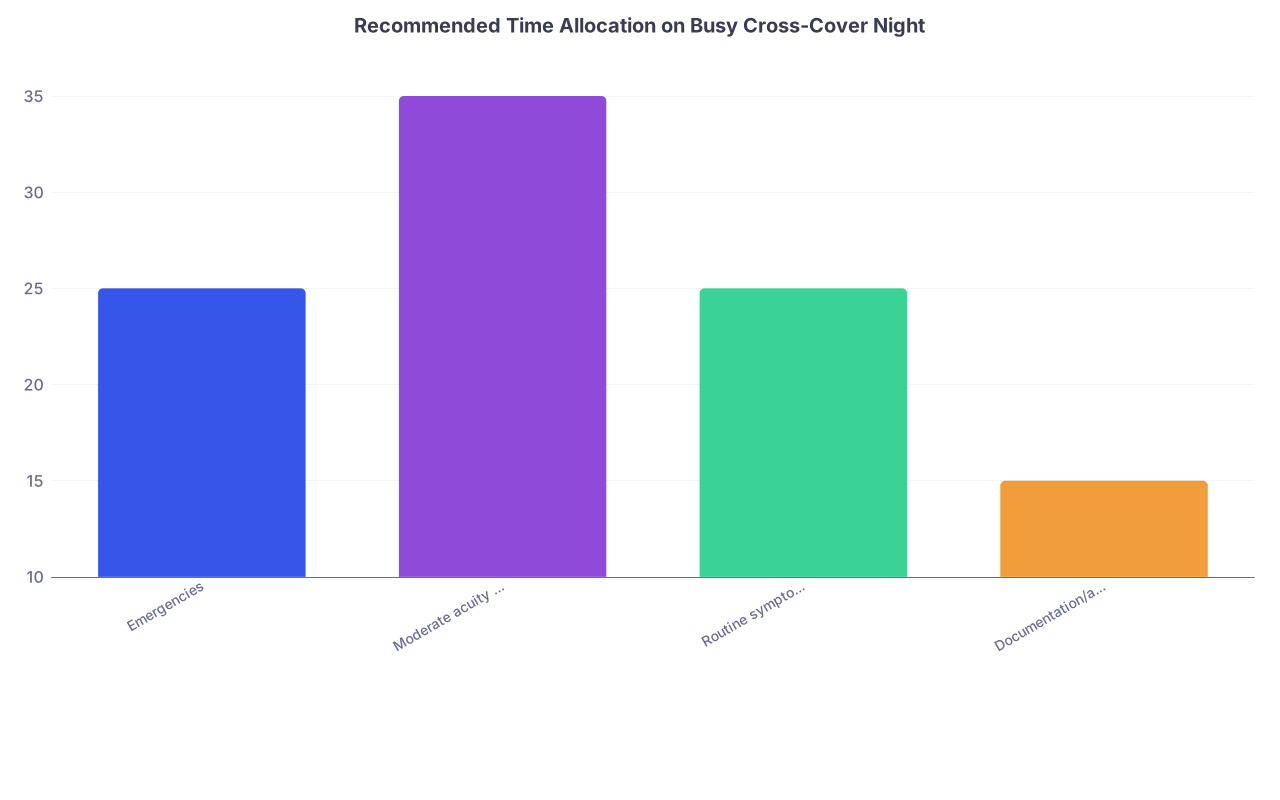
| Emergencies | 25 |
| Moderate acuity issues | 35 |
| Routine symptom management | 25 |
| Documentation/admin | 15 |
You are allowed to say to a nurse for a non-urgent issue:
“I am currently at a bedside with a hypotensive patient. I will call you back in about 20–30 minutes as soon as I stabilize things. Is it safe to wait that long?”
They will usually say yes. If they say no, you re-triage.
Documenting Smartly
Night notes should be:
- Brief
- Focused on what changed, what you did, and what the day team needs to know
Template I like:
- “Overnight cross-cover note: Called about [issue]. On exam: [key findings]. Labs/imaging: [specifics]. Assessment: [your working dx]. Plan: [what you did and what needs following in the morning].”
This becomes crucial for continuity and protects you when questions arise later.
6. Knowing When You Are Over Your Head (And Making the Right Call Fast)
The only unforgivable cross-cover mistake is being too proud or too scared to escalate.
Situations where you should have almost zero threshold to call your senior:
- Any patient you think might need ICU level care
- Repeat calls on the same patient for worsening vitals
- You are about to start a drip you have never managed before
- Suspected stroke, STEMI, massive PE, or acute surgical abdomen
- Neutropenic sepsis, especially if hypotensive

| Step | Description |
|---|---|
| Step 1 | Recognize high risk issue |
| Step 2 | Call rapid response |
| Step 3 | Start initial management |
| Step 4 | Call senior resident |
| Step 5 | Call ICU team |
| Step 6 | Continue on floor with close monitoring |
| Step 7 | Can you stabilize with basics? |
| Step 8 | Senior concerned for ICU? |
When you call, be honest about your uncertainty:
“I am not sure what the primary driver is here. I have done X, Y, and Z. I am worried about missing something. Can you come take a look with me?”
Nobody sane will fault you for that.
7. Protecting Yourself: Sleep, Sanity, and Learning on Nights
Nights can either be pure survival or serious growth. The difference is how you structure them.
Micro-rests
You are not going to get 6 hours straight. You might get 20–30 minute windows.
Between clusters of pages:
- Close your eyes in the call room. Phone volume up. Pager on vibrate on your chest.
- Do not doom-scroll your phone. Your brain will not reset.
- Hydrate and eat something small; hypoglycemic, dehydrated interns think worse.
Deliberate learning
After an event—rapid response, new sepsis, bad arrhythmia—take 2–3 minutes when things calm to review:
- What labs were ordered and why
- What your senior or ICU team did that you had not thought of
- One guideline or protocol relevant to what just happened
That is how you build internal algorithms, not by passively existing through nights.

8. Specialty-Specific Nuances on Cross-Cover
Cross-cover is not identical across services. A few examples so you are not caught off guard.
Medicine services
- Bread and butter: sepsis, electrolyte abnormalities, COPD/CHF, GI bleeds.
- Culture: earlier ICU involvement, more tolerance for empiric antibiotics if justified.
- Watch for: neutropenic fever, cirrhosis complications (HE, SBP, variceal bleed).
Surgical services
- Bread and butter: post-op pain, ileus, hypotension, bleeding, wound issues.
- Culture: fluid responsiveness, early recognition of “this abdomen is not right.”
- Watch for: unexplained tachycardia and soft pressures = bleeding or anastomotic leak until proven otherwise.
Neurology/neurosurgery
- Bread and butter: neuro exam changes, ICP concerns, seizures.
- Culture: CT head early and often, strict BP parameters.
- Watch for: subtle neuro changes that nurses notice—take them seriously.
You do not have to know everything, but you must know when the situation has left “general intern-level” territory and entered “I need the specialty senior now” territory.
9. Putting It All Together: A Mental Model for Every Call
If you remember nothing else, use this 5-step mental script for every page:
- Is this potentially life-threatening in the next 5–15 minutes?
- If yes → go to bedside now, call for help en route.
- What is the minimum information I need from the caller before I move?
- Vitals, symptoms, relevant background.
- What is my first bedside action?
- ABC check, focused exam, monitor, basic labs if indicated.
- What working diagnosis bucket does this fit?
- Sepsis, volume status issue, respiratory, arrhythmia, pain/symptom, lab abnormality.
- What is my algorithmic first step for that bucket?
- Fluids vs diuresis vs O2/NIV vs antibiotics vs imaging vs simple PRN.
You will not be perfect. No one is. But if you apply this same structure on night 1 and on night 100, you will be safe, efficient, and noticeably calmer than your peers.

FAQs
1. How do I handle multiple urgent pages at once without panicking?
Sort them by immediate threat. Anything involving hypotension, hypoxia, chest pain, acute mental status change, or new neuro deficits goes to the top. Call back each nurse and say explicitly what you are doing: “I am going first to the hypotensive patient in 612; I will come to see your patient in 20–30 minutes unless they change.” Get your senior involved early if you have more than one truly unstable patient. You cannot physically be in two rooms at once; your job is to triage transparently and activate more help when needed.
2. What if I feel silly calling my senior for something that might be minor?
You will feel sillier explaining a delayed escalation after a bad outcome. A simple heuristic: if you are thinking “Should I call?” the answer is almost always yes, especially in your first 6 months. Frame it as: “I think this is X and I have done A, B, C; I want to make sure I am not missing anything.” Seniors remember being interns. The only thing that irritates them long-term is being left out of serious situations.
3. How much can I rely on nursing judgment overnight?
Quite a lot—but you must calibrate to individual nurses. Experienced nurses will often know something is wrong before vitals catch up. When a trusted nurse says, “They just do not look right,” go see the patient. At the same time, do not abdicate your responsibility. Use their assessment as an early warning system, then apply your own structured exam and decision-making. Over time, you will learn whom you can lean on more heavily.
4. Should I pre-write orders (PRNs, labs) to reduce pages?
Yes, within reason. Good day teams will already set up PRN pain meds, bowel regimens, sliding scales, and night-time SLP or PT parameters. When you notice patterns—“this CHF patient keeps needing potassium repletion” or “this COPD patient has repeated wheeze overnight”—you can suggest to the day team to build standing orders. As cross-cover, you should not be radically altering long-term regimens at night, but small anticipatory orders are appropriate if you understand the patient’s course.
5. How do I avoid missing subtle but important changes, like slow sepsis?
Two habits: deliberate watch lists and trend watching. Keep a short list of “patients I am worried about tonight” based on sign-out and your own review. For those patients, skim their vitals, I/Os, and any new labs every few hours, even without a page. Look for trends, not single values: rising heart rate, creeping O2 requirements, slowly dropping urine output. That pattern-recognition step is what separates a merely responsive intern from a clinician who catches deterioration early.
6. What’s the single most important mindset shift for surviving cross-cover?
Stop seeing yourself as a victim of random pages and start seeing yourself as the on-call risk manager for a small population of patients. That means: you impose structure, you set priorities, you ask for clear information, and you escalate intentionally. You are not there to please everyone or to instantly respond to every minor request. You are there to keep people from crashing, keep evolving problems from drifting, and hand the service back in the morning without new disasters. Focus on that, and the noise becomes manageable.
Key points to walk away with:
- Treat every page as a structured process: clarify, classify, then act from simple internal algorithms.
- Aggressive pre-call preparation and explicit escalation plans with your senior make nights far safer and less chaotic.
- Your primary overnight job is not fixing everything; it is recognizing and controlling risk on incomplete information—do that consistently, and you will master cross-cover.