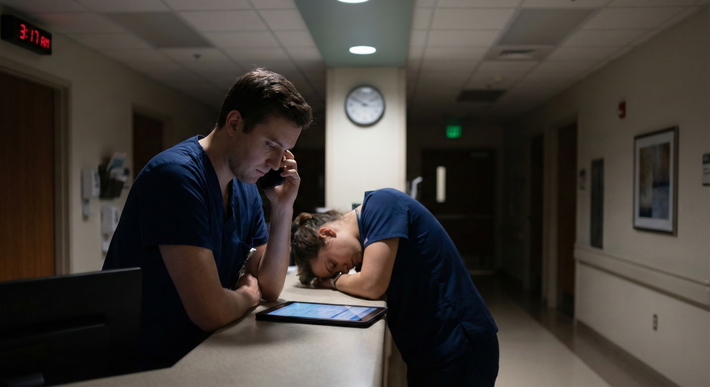
Pre-rounding is not “a quick glance at the chart.” Pre-rounding is a high-speed, high-stakes data acquisition operation—and most interns do it badly.
Let me show you how to do it like someone who has already survived a couple of July 1s.
You are not just “checking labs and vitals.” You are building a compressed, structured mental model of 12–20 active patients, under time pressure, with incomplete data, on a moving target (nurses giving meds, consultants writing notes, patients crashing). If you do not use structure, you will drown in random details and show up to rounds sounding vague and unsafe.
We are going to fix that.
The Real Problem: Cognitive Overload, Not Time
Everyone complains about “not having enough time” to pre-round. That is only half true. I have watched interns with the same census and the same time window—one walks into rounds cool and composed, the other is sweating and flipping through sticky notes.
The difference is not effort. It is structure.
What you are up against on a typical busy ward day:
- Census 12–18 patients
- Pre-rounding window 60–90 minutes (and that includes walking, waiting for elevators, random pages)
- EMR lag, missing labs, nurses in the room, transport taking patients
- Senior who expects a focused 30–60 second update per patient, not a rambling chart biopsy
If you try to pre-round in “EMR-tourism” mode—clicking aimlessly through every tab—you will lose. You need a protocol.
Step 0: Know Your Output Before You Start
You do not pre-round to “know what happened.” You pre-round to deliver a specific, crisp output on rounds.
What your attending actually needs, per patient, in ~30–60 seconds:
- Overnight events: any instability, pain, vomiting, delirium, rapid responses, new imaging, key pages
- Current clinical status: “better / same / worse” with 1–2 specific metrics
- Today’s objective data: vitals trend, I/Os, labs, new imaging, pertinent exam
- Plan: 3–5 prioritized items with clear actions
So your pre-rounding process must be designed backwards from that output. You are not collecting all data. You are collecting the minimum necessary structured data that lets you answer:
- Safe? (Airway, breathing, circulation, mentation, lines/tubes, high-risk meds)
- Trending in right direction?
- Anything on fire requiring early intervention or senior involvement?
- What 3–5 concrete things will we do today?
That dictates how you pre-round.
Step 1: Build a Ruthlessly Simple Template
You cannot keep 12+ patients straight in your head. Stop trying.
You need a standardized “micro-template” for every patient. Whether you use printed lists, index cards, or a neatly formatted OneNote page, it must be fast to fill and easy to scan.
Here is a tight, purpose-built data structure that works on medicine, surgery, step-down—basically anywhere on the wards:
| Field | Content Example |
|---|---|
| ID | 508 Jones, M/67 – CHF exacerbation |
| Overnight | ↑O2 to 4L; 2x 10/10 CP – trops/imaging |
| Vitals trend | T, HR, BP, RR, O2 (last 24h + now) |
| I/O | 24h net, UOP, drains, stool, emesis |
| Key labs | Na/K/Cr, Hgb/WBC, key disease markers |
| Med issues | Pressors, insulin, anticoag, rate control |
| Exam focus | Mental status, lungs, heart, edema, abd |
| Today priorities | 3 bullets: diagnostics, therapeutics, dispo |
That fits in 6–8 short lines per patient. If you are typing paragraphs, you are doing it wrong.
You train your brain that each patient is a “packet” of information in this fixed order. That way when your attending asks, “What are her vitals?” you do not mentally rummage—you know exactly where to look.
Step 2: A Time-Boxed Macro Workflow
You have 60–90 minutes. Spend it deliberately. Do not wander.
Here is a concrete breakdown I teach new interns:
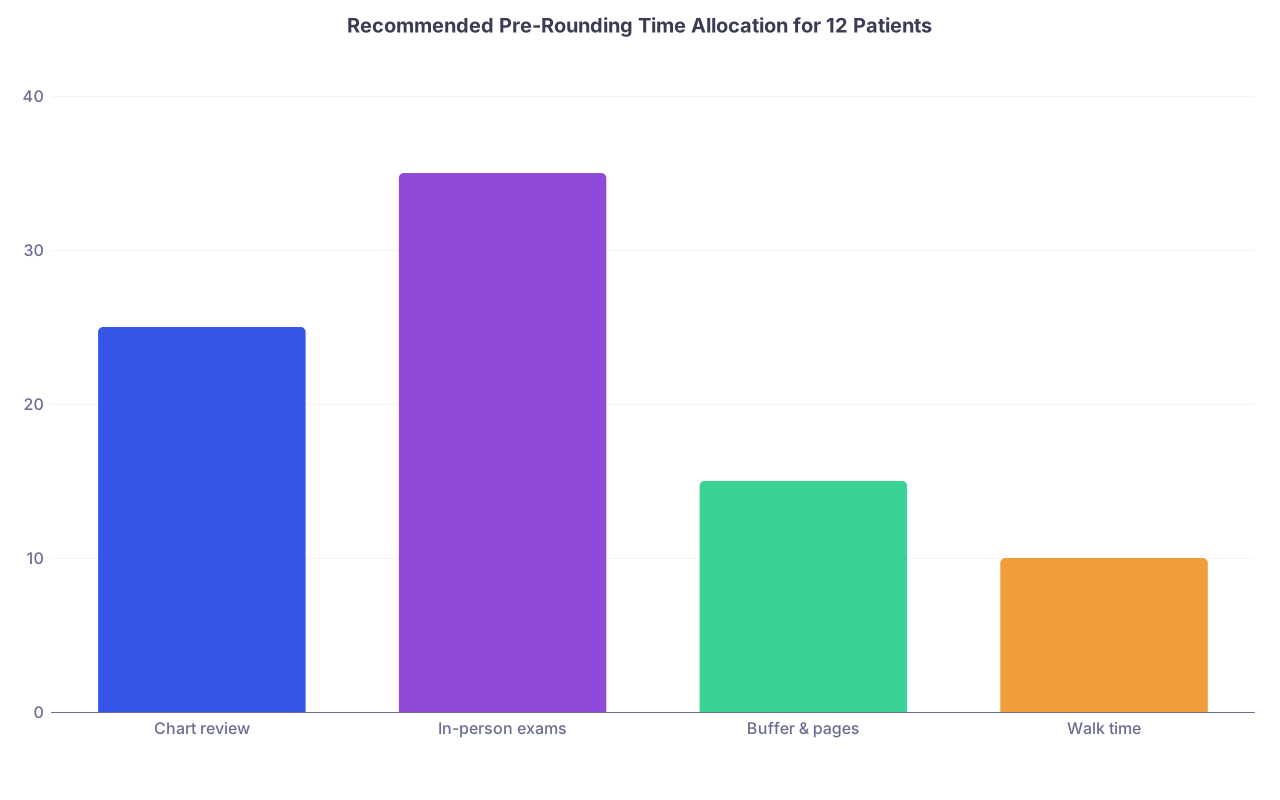
| Category | Value |
|---|---|
| Chart review | 25 |
| In-person exams | 35 |
| Buffer & pages | 15 |
| Walk time | 10 |
For 12 patients and 75 minutes:
- 20–25 minutes: EMR chart data sweep for all patients
- 35–40 minutes: Rapid walk-through exams and bedside updates
- 10–15 minutes: Buffer (pages, finding nurses, unpredictable delays)
The order matters.
Global chart sweep first
You identify the trainwrecks early. You flag the missing labs. You sort “urgent” vs “stable” before you physically walk around.Then bedside exams, in priority order
Start with sickest/least stable. End with “doing fine, dispo pending” types.Buffer last
You will get interrupted. Assume it. Plan around it.
If you are doing full chart + full exam for each patient before moving on, you will not finish on time.
Step 3: The 90-Second EMR Pass Per Patient
Let me be specific. On your first pass, your job is not “deep understanding.” It is creating a structured, up-to-date thumbnail.
Per patient, in the EMR, your click-path should be almost reflexive and in the same order every time.
Here is a practical sequence that usually works across systems:
Overview / Summary tab (10–15 sec)
- Confirm ID and chief problem: “67M, CHF exacerbation, HD#3.”
- Glance at current location: floor/stepdown/tele.
- Scan problem list just enough to recall comorbidities: CKD, DM, AFib on apixaban.
Events / Nursing flowsheet / Overnight notes (15–20 sec)
You are looking for:- Rapid response or code calls, escalating O2 requirements
- High pain scores, agitation, restraints, sitter
- New PRNs given: IV morphine, IV labetalol, IV zofran, haldol
Jot a 1-liner in “Overnight”: - “No events”
- or “N/V 3x, zofran; no RRT”
- or “RRT 03:20, hypotension – bolus, now stable”
Vitals (15–20 sec)
You do not recite every value. You identify patterns:- Temp: afebrile? febrile spike overnight?
- HR: tachy, brady, new AF with RVR?
- BP: hypotensive episodes, wide swings, MAPs?
- RR: persistent tachypnea?
- O2: baseline vs now, FiO2 changes, mode changes
Mentally answer: “Better / same / worse than 24 hours ago?”
I/O (10–15 sec)
- Net 24h (and sometimes 48h if diuresing or in AKI)
- UOP: ml/kg/hr roughly; “borderline” vs “good” vs “anuric”
- Drains: chest tube output, JP, NGT, ostomy
Summarize in 1 line: - “Net -1.2L, UOP 0.7 ml/kg/hr”
- or “Net +600, CT 150 serosang, NGT 400 bilious”
Labs (20–30 sec)
This is where interns drown. You are not reading every lab in detail. You are scanning what moved and what matters.For almost every adult inpatient, your core set:
- BMP: Na, K, BUN/Cr, CO2, glucose
- CBC: Hgb, WBC, platelets
- Disease-specific markers (as applicable):
- CHF: BNP, troponin trends if relevant
- Liver: LFTs, INR
- Infection: lactate, cultures, procalcitonin if used
- Anticoag: INR, anti-Xa
Ask:
- “Up, down, same?”
- “Safe for current meds/plan?” (e.g., K for diuretics, Cr for contrast or ACEi)
New imaging / consultant notes (15–20 sec)
- See if any result is back that you did not see yesterday: CT, MR, echo, duplex.
- Check last 1–2 consultant notes only (Cards, GI, ID).
You are not summarizing the whole note. You pull 1–2 key lines: - “Cards: cont metop, ↑lasix 80 IV bid, f/u echo result”
- “GI: plan EGD today NPO after midnight, hold apixaban”
Quick meds scan (10–15 sec)
Only to catch:- New high-risk meds: heparin drip, insulin gtt, amio, pressors
- Anticoagulation status for procedures
- Obvious errors (still on IV cefepime though cultures are negative and ID yesterday said de-escalate)
This whole EMR sweep should be 60–90 seconds per patient once you are practiced. For 12 patients, ~20 minutes is realistic. Early on, you will be slower. That is fine; you will speed up as you standardize your clicks.
Step 4: Structured Bedside Pass – 3–4 Minutes per Patient
Chart review alone is not pre-rounding. You must see the patient.
Your bedside mini-visit is not a full admission H&P. It is a focused, high-yield check that tells you:
- Are they safer, sicker, or unchanged since yesterday?
- Is there any new complaint?
- Does your exam match the story in the chart?
Standardize this too. A fast, reliable pattern:
Doorway check (5–10 sec)
- Monitor: HR, rhythm, O2 sat, BP if displayed
- Lines/tubes: on vent? HFNC? chest tube? drains? Foley?
- General appearance: sleeping, distressed, delirious, in restraints?
Open with a micro-intro (10–15 sec)
“Hi Mr. Smith, it is Dr. ___, one of the interns with the medicine team. Just checking on you before we start rounds.”You are setting expectations. This will not be a 20-minute talk.
Targeted symptom screen (30–45 sec)
Take 3–5 core questions depending on the case:- All patients: “How are you feeling this morning? Better, worse, or about the same as yesterday?”
- Cardiac: “Any chest pain, palpitations, shortness of breath?”
- Pulm: “Breathing more comfortable? Cough better or worse? Any more sputum?”
- GI: “Any nausea, vomiting, belly pain, able to eat? Last bowel movement?”
- Neuro: “Any new weakness, numbness, vision changes, confusion?”
You are listening for change and red flags, not a novel.
Focused exam (1–2 minutes)
Again, pattern. For most med/surg patients:- General: awake, alert, oriented? Distress?
- Lungs: are they moving enough air, wheezing/rales improving or not, still needing accessory muscles?
- Heart: rate and rhythm (irregularly irregular?), extra sounds if you are good enough to trust yourself quickly.
- Abdomen: soft vs tender vs peritonitic, distention, bowel sounds if relevant.
- Extremities: edema (better / worse), pulses as indicated, check any wounds or surgical sites.
- Lines/tubes: dressings clean/dry, obvious issues.
You do not need a neurologic exam for the stable post-lap chole. You need a neurologic exam in the delirious sepsis patient. Use judgment but keep it short.
Micro-closure (15–20 sec)
- “We will discuss you on rounds in the next couple of hours.”
- “Is there anything in particular you want me to bring up with the team?”
That last question is gold. Patients will often surface the real issue: uncontrolled pain, wanting to go home, fear about a procedure, family needing a call.
Jot 1–2 words: “wants better pain control,” “anxious about surgery,” “family update.”
Step 5: Triage and Prioritization Across 12+ Patients
You are not just gathering data linearly. You are continuously triaging.
After your EMR sweep and first 2–3 bedside checks, pause for 30–60 seconds with your list and sort your patients.
A practical way: mark each patient A/B/C.
A – Unstable / concerning / time-sensitive
- New O2 requirement
- Hypotension, tachycardia, sepsis
- Rapidly rising creatinine, dropping Hgb, active chest pain
These go first on bedside exam. If something smells bad, call your senior before formal rounds.
B – Active management, not crashing
- Titrating diuresis, treating pneumonia, complex endocrine issues
- Needs careful plan for the day, but not an emergency
Middle of your bedside run.
C – Stable / dispo planning
- “Medically ready waiting for placement,” post-op day 3 doing well, controlled chronic conditions
Last. If you run short on time, these are safest to have a brief or even bedside-free morning (if you saw them thoroughly yesterday and there were truly no overnight issues—but still glance at vitals/labs).
- “Medically ready waiting for placement,” post-op day 3 doing well, controlled chronic conditions
On many services, your distribution will look roughly like this:
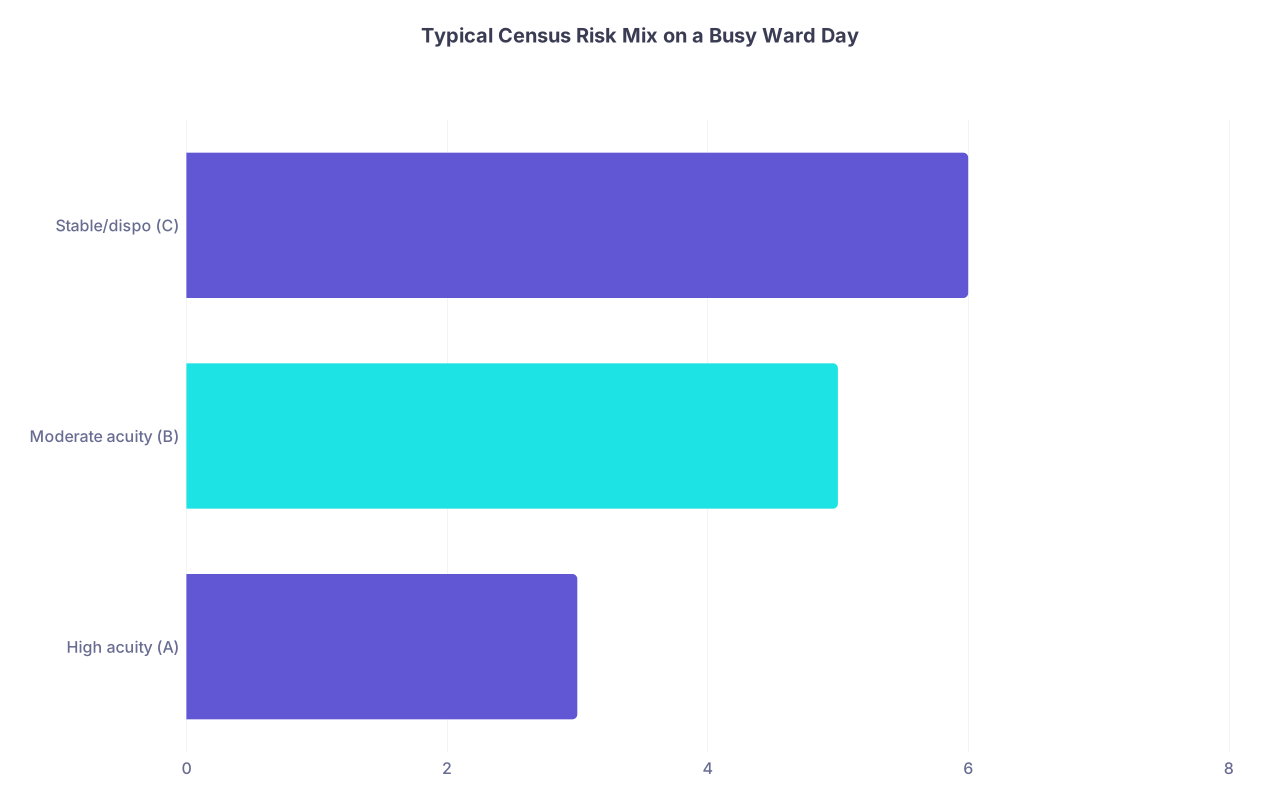
| Category | Value |
|---|---|
| High acuity (A) | 3 |
| Moderate acuity (B) | 5 |
| Stable/dispo (C) | 6 |
If you cannot see everyone perfectly before rounds, at least you have strategically focused on the ones who could crash.
Step 6: How to Take Notes Fast Without Losing the Thread
You do not have time to write essays.
For each patient, you want 6–8 short, structured lines. Example for “508 Jones”:
- 508 Jones M67 – CHF, HD3
- ON: ↑O2 2→4L, 1x CP 4/10, trop neg, no RRT
- Vitals: afebrile; HR 90–110; BP 110–130/60–70; RR 18–24; O2 94% on 4L
- I/O: net -1.1L, UOP OK
- Labs: Na 134; K 4.0; Cr 1.6→1.7; Hgb 10.4; WBC 9.8; BNP down
- Exam: less SOB, bibasilar crackles but improved, 1+ edema
- Today: cont IV lasix; goal net -1L; TTE read; consider wean O2; dispo in 1–2d
That is enough to run a clean, focused presentation and to update your senior if things change.
One trick: use consistent shorthand and symbols for trends:
- ↑ / ↓ for up/down
- “→” for “to” or “trend toward”
- “~” for “about / roughly”
- Circle critically abnormal values (if on paper) or star them (if electronic)
What you avoid: full sentences, narrative descriptions, and rewriting lab values that do not change decisions.
Step 7: Common Failure Modes and How to Fix Them
I have watched interns repeatedly get burned by the same mistakes. Avoid these.
Failure 1: Deep-diving one complex patient and short-changing the rest
You have the new, interesting DKA + sepsis patient with 4 consultants. You spend 25 minutes reading every note. Result: you barely glance at 8 other patients and walk into rounds unprepared.
Fix:
- Put a hard cap: 3–5 minutes max on first pass for any one patient.
- Mark them for “deep dive after rounds” or “need longer review at noon.”
- For pre-rounds, you only need: safe, trending, key labs, today priorities.
Failure 2: Skipping bedside exams on “stable” patients for days
Then one day your “stable” patient is suddenly delirious, hypoxic, or has a giant sacral ulcer you never saw because you have not been in the room all week.
Fix:
- At least lay eyes on every patient daily. Even the “C” group.
- A 30–60 second in-room check is better than nothing.
- Use the doorway + one question + brief scan model if extremely tight on time.
Failure 3: Random, unstructured chart clicking
You look at 8 lab tabs and miss that the BP has been 80s for 3 hours. I have seen this happen.
Fix:
- Always follow the same pattern: overview → overnight events → vitals → I/O → labs → imaging/consults → meds.
- Muscle memory beats anxiety.
Failure 4: No early escalation
You see worrisome trends during pre-rounding, but tell yourself, “I will just bring it up during rounds.” Then the patient codes at 08:15.
Fix:
- If you find: new O2 > 4L, SBP < 90 for repeated readings, HR > 130 with symptoms, new chest pain, acute confusion, rapidly dropping Hgb, or any major “bad feeling” – stop. Call your senior.
- Your goal is early detection, not pretty presentations.
Failure 5: Carrying everything in your head
You think you will remember that K was 2.9, the CT is at 10:00, and the patient wants to go home early for a funeral. You will not.
Fix:
- Write it down in the same place every time.
- One patient per block, same fields, same order.
- During rounds, you can actually listen instead of scrambling for details.
Step 8: Integrate Pre-Rounding with the Rest of Your Day
Pre-rounding is not a standalone activity. It feeds:
- Morning rounds presentations
- Order entry for the day
- Family updates
- Notes (progress notes, event notes)
- Discharge planning
So structure your notes to serve multiple purposes. The “Today” bullet line for each patient often becomes:
- Your assessment and plan skeleton
- Your personal task list
- A quick pocket reference for family calls
A simple pattern for the “Today” line:
- 1–2 diagnostics (e.g., “repeat BMP at 15:00,” “f/u CT results”)
- 1–2 therapeutics (e.g., “increase lasix,” “wean O2 as tolerated,” “start insulin regimen”)
- 1 dispo element (e.g., “PT/OT today,” “SNF paperwork,” “home w/ HH tomorrow”)
By mid-morning, you should be able to glance down and see your entire team’s day.
Step 9: Special Considerations by Service
The core structure stands, but yes, different rotations weight different data.
On medicine wards:
- Heavier focus on vitals trends, I/O, labs
- Plans revolve around titrating meds, adjusting volume status, managing comorbidities
- You will carry more “B” category patients
On surgical services:
- Extra weight on:
- Pain control
- Return of bowel function (flatus/BM)
- Wound and drain output details
- Ambulation: walked? how far?
- I/O and drains are central
- Exam: incision sites, peritoneal signs, compartment checks
On step-down / high-acuity floors:
- Tighter vitals: look at individual episodes, not just 24h summary
- More device-related (HFNC settings, BiPAP, telemetry rhythms)
- More need for early escalation during pre-rounds
Do not reinvent your whole method every rotation. Keep your skeleton and add a few service-specific fields.
Step 10: Use Tools, But Do Not Depend on Them
Residents love custom EMR printouts and “perfect” patient list templates. They help—but they do not replace thinking.
If your system allows, build:
- A column view with: room, name, age, primary dx, code status, last vitals summary, diet, DVT prophylaxis
- Smart phrases in your notes that mirror your pre-round template
- Quick actions for “sign out” fields like “overnight events,” “pending tests,” “to-do today”
But remember: no tool will make decisions for you. The value is in your interpretation and prioritization, not in a prettier list.
A Visual Snapshot: What Your Morning Should Look Like
To pull it together, here is the actual sequence I would expect a competent intern to follow on a 7:00 start, 12-patient day:

| Step | Description |
|---|---|
| Step 1 | Arrive 6 -15 |
| Step 2 | Print/refresh list |
| Step 3 | Global EMR sweep all 12 |
| Step 4 | Mark A/B/C acuity |
| Step 5 | Bedside exams A patients |
| Step 6 | Bedside exams B patients |
| Step 7 | Quick bedside or chart-only check on C |
| Step 8 | Refine Today bullets |
| Step 9 | Call senior about any unstable |
| Step 10 | Be ready for rounds by 7 -45 |
This is realistic. Not theoretical. I have seen interns move from chaos to control by following essentially this sequence.
Final Thoughts
Pre-rounding is not about being a martyr who skips breakfast to see every patient twice. It is about designing a repeatable, efficient system that scales from 4 patients to 20 without your brain melting.
Remember these core points:
- Structure beats speed. A consistent, lean template and fixed click-path will do more for you than “working harder.”
- Pre-rounding’s job is triage and clarity, not full documentation. Identify who is sick, what changed, and what you will do today.
- If something feels wrong, stop and escalate. Better to annoy your senior at 06:45 than explain an avoidable crash at 10:00.