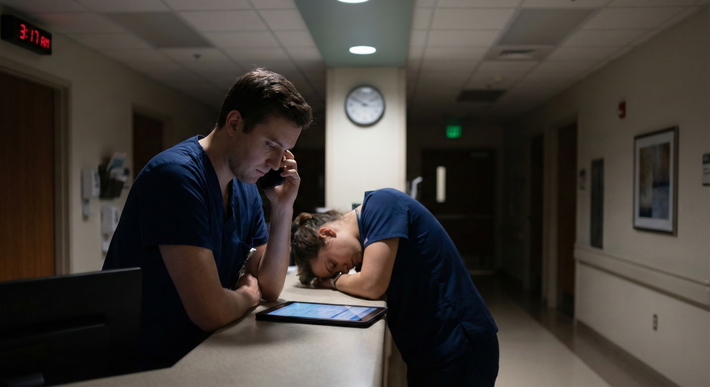
The worst clinical decisions you will ever make are the ones you are too tired to recognize as bad.
You are not “pushing through.” You are cognitively impaired. Post‑call, your brain is a liability unless you manage it deliberately. Let me break this down specifically, because this is where good interns quietly get themselves – and patients – in trouble.
What Post‑Call Really Does To Your Brain
I am not talking about vague “fatigue.” I am talking about measurable neurologic impairment that looks a lot like being mildly drunk.
After a typical 24–28 hour call:
- Your reaction time is slower.
- Your working memory is shot.
- Your risk assessment is distorted.
- Your confidence stays the same or goes up. That is the dangerous part.
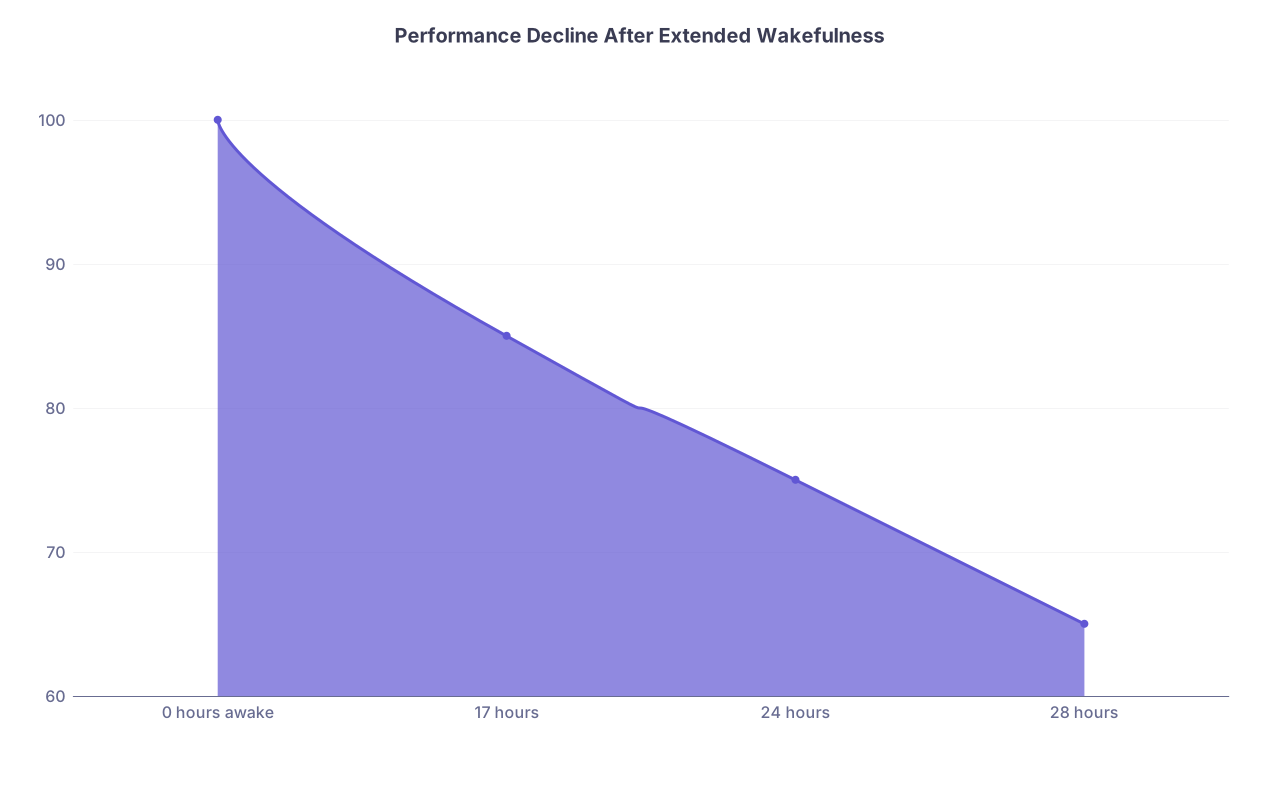
| Category | Value |
|---|---|
| 0 hours awake | 100 |
| 17 hours | 85 |
| 24 hours | 75 |
| 28 hours | 65 |
That curve is why “I’ll just quickly place this order before I crash” is a terrible sentence.
A few specific cognitive failures I see over and over in interns post‑call:
Anchoring and inertia
You stick to your night‑shift impression even when new labs, new imaging, or new exam findings are screaming that the story changed. You anchored at 3 a.m. and now your brain is too sluggish to reframe.Premature closure
You accept the first “good enough” explanation and stop thinking. Chest pain in a 65‑year‑old? “Probably GERD; he looks fine” sounds reasonable when your frontal lobe is undercaffeinated and overused.Task blindness
You forget one major step in an otherwise familiar process. For example: you write the discharge order and the narrative, but forget to reconcile meds or arrange follow‑up. You remember only when the nurse calls at 3 p.m. – or nobody catches it at all.Risk underestimation
You minimize how bad “mildly hypotensive but asymptomatic” can become. You underestimate how quickly “borderline okay” deteriorates, especially in the frail or septic.
I want you to assume this: post‑call, you are functioning at maybe 60–70% of your best. And that is on a good day. So the entire game becomes: how do you make good decisions with a bad brain?
The Critical Distinction: Pre‑Call vs Post‑Call Decisions
Strong interns learn to separate two kinds of decisions:
- Decisions you make when fresh and thinking clearly.
- Decisions you allow your post‑call self to handle.
You need a hard line between those.
Pre‑commitment: Decide While You Still Trust Yourself
On days before call, and early in the call day before things get chaotic, you should deliberately pre‑decide:
- Which kinds of decisions future‑you is not allowed to make post‑call.
- Which conditions in your patients automatically trigger calling for help.
- What “good enough” looks like for sign‑outs, discharges, and cross‑cover plans.
Here is a rough structure I have interns use.
| Decision Type | Post-Call Allowed? | Require Senior/Attending? |
|---|---|---|
| New high-risk diagnosis | No | Yes |
| Major code status change | No | Yes |
| High-risk discharge | Rarely | Yes |
| Procedural consent | No | Yes |
| Escalation to ICU | Yes, with call | Yes |
You adjust the specifics for your specialty and institution, but the principle stands: you restrict what your post‑call self is allowed to decide alone.
Think of it as designing a safety system for a drunk version of yourself.
High‑Risk Decision Types You Should Lock Down
Let us go case by case. These are the decision classes where tired interns wreck themselves.
1. Discharges Post‑Call
Discharging a patient seems administratively annoying, not risky. That is naive. The riskiest part of a hospitalization is often the 48–72 hours after discharge, especially from medicine, surgery, cardiology, psych.
High‑risk discharges where your tired brain should not be the final authority:
- New anticoagulation (AFib, VTE, mechanical valve).
- Recent acute coronary syndrome.
- Recent suicide attempt or severe depression.
- Advanced COPD/CHF with frequent exacerbations.
- New insulin regimen or complex med changes in elderly.
The post‑call rule I push:
- Complex or high‑risk discharges should be decided and largely built pre‑call by you and your senior / attending.
- Post‑call you are allowed to execute a pre‑agreed plan and update small details. You are not allowed to reinvent the plan.
Put it bluntly: if you are tidying details on a discharge at 9 a.m. post‑call, fine. If you are creating the plan from scratch at 9 a.m. post‑call, you are asking to miss something serious.
2. Code Status and Goals of Care
Post‑call is not when you should be having your first meaningful goals‑of‑care conversation with a family.
Why?
Because a good conversation:
- Requires empathy and emotional bandwidth.
- Requires clear thinking about prognosis, treatment options, and burdens.
- Requires time and willingness to sit with discomfort.
You do not have those at hour 26.
If someone is crashing at 5 a.m. and nobody has addressed code status yet, obviously you do what is needed to preserve life and stabilize. But the pattern I see is different: a tired intern, at 10 a.m. post‑call, trying to explain DNR/DNI alone to a family they barely know because “no one has gotten to it yet.”
Your rule should be:
- Planned, non‑emergent code status changes should not be led solo by a post‑call intern.
- Loop in your senior or attending. Or explicitly schedule the conversation with the day team.
3. Major Diagnostic Reframes
You started the night thinking: “This is probably community‑acquired pneumonia.” You wrote the note with that framing. Then new data comes in:
- Negative procalcitonin.
- CT shows no focal consolidation, but an effusion and a mass.
- Hyponatremia and SIADH picture.
- Weight loss you did not fully register at 2 a.m.
By 8 a.m. your tired brain will want to protect the original story. “Still pneumonia, maybe atypical…”
This is where you must be strict. Any time new data significantly conflicts with your working diagnosis, you must:
- Say the quiet part out loud: “This might not be pneumonia.”
- Force a re‑check with your senior or attending on rounds.
- Document the uncertainty clearly instead of papering it over.
Post‑call you are prone to cognitive inertia. So you design a rule: “If new data contradicts my night diagnosis, I flag it for re‑discussion and do not finalize the new narrative alone.”
4. Procedural Decisions
Here is where bad things happen quietly:
- Placing a central line when you are shaky and rushing.
- Attempting an LP on a borderline patient with unclear imaging status.
- Doing a bedside thoracentesis because “IR might not get to it until tomorrow.”
Post‑call—a simple rule: you do not initiate elective or semi‑elective invasive procedures without a real‑time discussion with your senior or attending. Full stop.
If it is an emergency and you are the only one there, you do what you must. But that is rare. The much more common hazard is the tired intern volunteering for a procedure they could easily safely defer until they or someone else is rested.
A Practical Framework: The Post‑Call Decision Ladder
You need structure. Otherwise “be careful post‑call” turns into empty advice.
Here is the explicit ladder I teach:
Level 0 – Automatic Pass:
Decisions you automatically defer or escalate post‑call. You simply do not make these alone.Examples:
- New DNR/DNI in a complex ICU patient.
- High‑risk discharge plan.
- Major diagnostic pivot (e.g., sepsis to malignancy; stable angina to NSTEMI).
- Procedural consents and elective invasive procedures.
Level 1 – “Call Before You Click”:
You can think about it, but you must call someone (senior, fellow, attending, pharmacist, etc.) before executing.Examples:
- Starting or changing high‑risk meds (anticoagulants, antiarrhythmics, insulin drips, chemo, clozapine).
- Downgrading level of care (ICU → step‑down; step‑down → floor).
- Stopping 1:1 sitter or suicide precautions.
Level 2 – “Two‑Step Check”:
You can decide, but you impose a pause and review step.Process:
- Draft the order/plan.
- Step away for 2–3 minutes (bathroom, sip of water, stand up).
- Come back and re‑read once before signing.
Examples:
- Discharge med reconciliation for a low‑risk patient.
- Writing a cross‑cover note or handoff note.
- Ordering a modest med change (increasing the beta‑blocker dose, adjusting diuretics) in a stable, known patient.
Level 3 – “Green Light”:
You can handle this post‑call without extra steps, because the risk is low, the reversal is easy, and your system has catch‑points.Examples:
- Ordering PRN bowel regimen.
- Reordering home vitamin D.
- Writing a simple note update.
Design your own ladder with your senior residents. But have one. Vague “trust your judgment” post‑call is a trap.
Concrete Tools To Protect You From Your Own Brain
1. The Post‑Call Checklist (Yes, a Literal Checklist)
You are too tired to rely on memory. Use a written checklist for the last 60–90 minutes of your call shift.
Core elements:
Patients with overnight instability:
- Did I clearly document events?
- Did I notify the primary team in sign‑out?
- Are there any time‑sensitive follow‑ups (cultures, repeat labs, imaging)?
Discharges I touched overnight:
- Are follow‑up appointments arranged and documented?
- Is med reconciliation complete and plausible?
- Are key teaching points documented (red flags, when to come back)?
High‑risk meds started/changed overnight:
- Did I discuss these with someone?
- Are necessary labs ordered (INR, drug levels, BMP, LFTs)?
- Does nursing know what to watch for?
Write your own version on paper and keep it in your white coat. Electronic notes do not help if your tired brain never opens them.
2. Structured Handoff That Exposes Your Weak Thinking
The usual lazy sign‑out is: “Stable, nothing going on, call if issues.” That hides your cognitive errors nicely.
Change the format:
For each significant patient, you state explicitly:
- What I think is going on.
- What I am worried I might be missing.
- What could hurt them in the next 12–24 hours.
- What I need you to double‑check when you are fresh.
This forces your post‑call brain to name the uncertainty, which naturally makes the day team more vigilant.

| Step | Description |
|---|---|
| Step 1 | Review overnight events |
| Step 2 | Identify high risk patients |
| Step 3 | Clarify working diagnosis |
| Step 4 | State what might be missing |
| Step 5 | Define next 12-24h risks |
| Step 6 | Ask day team to recheck key points |
The act of saying “I might be missing X” is not weakness. It is exactly what compentent seniors listen for.
3. Use Other People’s Brains On Purpose
Your world at 9 a.m. post‑call should not be you alone vs the chart.
Leverage:
- Nurses – They know who looks bad. If the night nurse tells you “Mr. Jones worries me,” take that seriously, no matter how benign his numbers look to your tired eyes.
- Pharmacists – High‑risk med changes, especially dosing in renal dysfunction, are exactly where you want a pharmacist’s sober brain.
- Respiratory therapists – Borderline respiratory status, NIV settings, oxygen weaning. Get their read.
- Your co‑interns – “Gut check this discharge plan with me in 60 seconds?” is a perfectly valid ask.
Post‑call, you are not trying to prove independence. You are trying to survive without hurting patients.
The Emotional Trap: Guilt, Heroics, and Overcompensation
A lot of bad post‑call decisions are emotional, not cognitive.
You feel:
- Guilty that the night was busy and you “did not do enough” for certain patients.
- Embarrassed that you are behind on notes, discharges, or orders.
- Competitive because another intern seems to “handle it all” without complaining.
- Afraid to be the intern who calls the senior again.
So you quietly take on more than your tired brain can safely manage. That is how you end up:
- “Just finishing” three discharges alone at 11 a.m.
- Agreeing to consent someone for a procedure you barely understand because the team is backed up.
- Drastically adjusting insulin or cardiac meds because you want the numbers to look good by rounds.
You need to recognize that pattern early. I listen for phrases like:
- “I did not want to bother you but…”
- “I felt bad leaving this for the day team so I…”
- “I know I should be able to handle this by now, so I just went ahead and…”
Those are red flags. When you hear yourself think that way, stop. Call. You are about to trade pride for safety.
Building a Personal Post‑Call Rulebook
Hospitals and programs talk a lot about “fatigue mitigation.” They hand you a module about duty hours and naps. Fine. But very few actually help you build personal operating procedures for post‑call.
You can do this yourself in a simple one‑page document saved on your phone.
Sections I suggest:
“I Do Not Decide This Post‑Call”
- New DNR/DNI on complex patients.
- Elective procedures or consents.
- Major discharge plans for high‑risk conditions.
“I Must Call Someone Before Doing This Post‑Call”
- Changing pressors, antiarrhythmics, or anticoagulation.
- Downgrading level of care.
- Stopping sitter/suicide precautions.
“My Non‑Negotiable Checklist Before Leaving”
- Did I hand off every patient I touched overnight with clear concerns?
- Did I close the loop on any stat imaging/labs I ordered?
- Did I document any significant overnight events?
“Danger Phrases In My Own Head”
When I think:- “This is probably fine.”
- “I am too tired to call someone.”
- “I just want to get this done and go home.”
→ That is my trigger to pause and call.
Revisit this rulebook after each call month. Update it based on what almost went wrong. Or what actually did.
A Few Realistic Scenarios (And How To Handle Them)
Let me walk through common intern situations. This is exactly the level of granularity you should practice mentally.
Scenario 1: The “Simple” Discharge
You admitted a 54‑year‑old with mild CHF exacerbation. Diuresed well, breathing comfortably. It is now 8:30 a.m. post‑call, and the attending wants him home “early if possible.”
Your tired brain says: “He looks fine. Let me just discharge him quickly.”
Better approach:
- Check your pre‑call plan. Did you and the day team outline discharge criteria yesterday?
- If yes and he meets them: build the discharge, but use a two‑step check. Write it, walk away for 2 minutes, re‑read.
- If no plan exists: do not invent one alone post‑call. Tell your senior/attending: “He may be ready, but I would like you to review and finalize the plan; I worry I will miss something post‑call.”
You will feel slower and less “efficient” this way. You will also have far fewer bounce‑backs.
Scenario 2: Borderline Vital Signs
At 6 a.m. a nurse pages: “Your 79‑year‑old with pneumonia is 93/58, HR 110, but she looks okay.”
You are fried. Your impulse: give a fluid bolus, order a repeat BP in 30 minutes, move on.
Better:
- Go see her. Yes, physically. Even if you are exhausted.
- Ask yourself three direct questions:
- Is this new or a continuation?
- Does this fit our current story (sepsis, dehydration, bleeding, meds)?
- Could this get catastrophically worse in the next 2–3 hours?
If your answers are unclear, escalate. Call your senior and say exactly this:
“I am post‑call and tired, so my read might be off. This is what I see… I am worried I am underestimating this.”
That single sentence is powerful. It buys you supervision without drama.
Scenario 3: Lab Result You Did Not Expect
You ordered a troponin at 3 a.m. for vague chest discomfort. At 7 a.m., while you are typing sign‑out, it pops up mildly elevated.
You want very badly to ignore it because the shift is almost over.
Bad habit.
Post‑call policy should be: unexpected critical or near‑critical labs must be actively addressed before you leave, even if you feel fine clinically. Not always fully worked up, but at least:
- Acknowledge in the chart.
- Arrange for repeat labs if appropriate.
- Hand off clearly to the day team: “I was surprised by this; I have not fully worked it up yet; please reassess.”
The alternative is waking up at 3 p.m. to twenty messages asking why you discharged someone with an elevated troponin and no documentation.
The Data Reality: Why You Are Not Special
Every intern thinks, “Yes, people make mistakes when tired, but I do pretty well.” That is the cognitive bias talking.
The literature is not ambiguous:
- Extended shifts increase serious medical errors, needle sticks, and near‑misses for residents.
- Sleep deprivation impairs psychomotor performance similarly to blood alcohol levels hovering in the 0.05–0.1% range.
- Subjective perception of impairment lags far behind measured decline. You feel “okay” long after your performance has dropped.
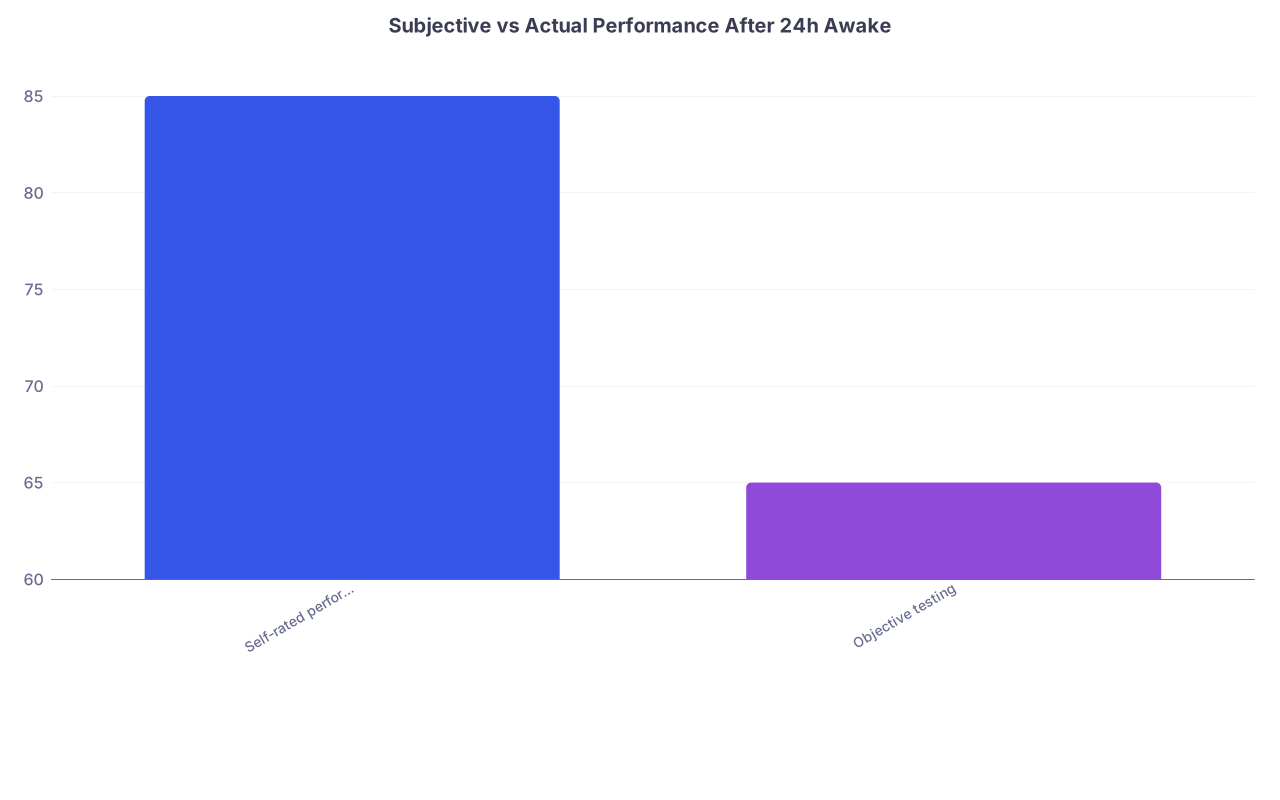
| Category | Value |
|---|---|
| Self-rated performance | 85 |
| Objective testing | 65 |
So no, you are not the exception. You are human. Your only advantage is whether you design your work to account for that instead of pretending you are immune.
Protecting Your Own Future Brain
Last point, because it matters: this is not just about your current call month. Chronic fatigue and repeated decision‑making in a cognitively impaired state changes how you practice long term.
Bad habits form:
- Relying on vibes instead of data.
- Normalizing sloppy sign‑outs because “nothing bad happened last time.”
- Treating escalation as optional instead of expected.
On the flip side, interns who develop strong post‑call rules end up:
- Faster at identifying which patients genuinely need them.
- Better at using the team’s brainpower.
- More trusted by seniors, because their “I am worried” actually means something.
So you are not just getting through the year. You are deciding what kind of physician you will become.
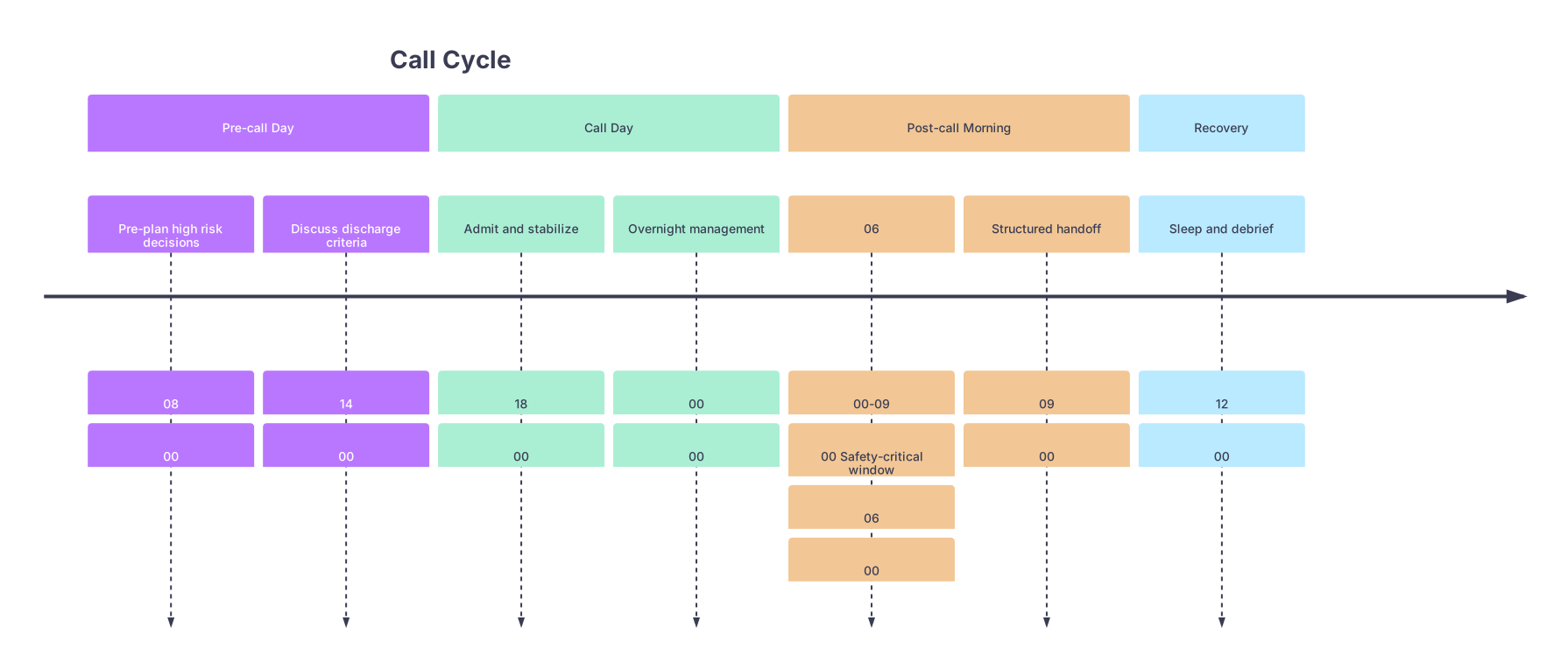
| Period | Event |
|---|---|
| Pre-call Day - Pre-plan high risk decisions | 08 |
| Pre-call Day - Discuss discharge criteria | 14 |
| Call Day - Admit and stabilize | 18 |
| Call Day - Overnight management | 00 |
| Post-call Morning - 06 | 00-09 |
| Post-call Morning - Structured handoff | 09 |
| Recovery - Sleep and debrief | 12 |

The Three Things To Remember
- Post‑call, your brain is not fine. Assume 30–40% performance drop and design your decisions around that reality.
- Explicit rules beat vibes: decide in advance which decisions you will not make alone when tired, and use checklists and ladders to enforce that.
- Use other brains: seniors, nurses, pharmacists, and the day team exist so you do not have to trust your impaired judgment in isolation. Use them aggressively.