
The cult of “always say yes” is quietly wrecking a lot of first-year interns. Not making them stronger. Not making them team players. Just pushing them toward burnout, errors, and resentment while everyone publicly applauds their “work ethic.”
Let’s tear that apart.
The unspoken myth in many residencies goes like this:
If you’re a good intern, you say yes. To every page. Every extra task. Every swap. Every committee. Every “quick favor.” You stay late. You pick up the slack. You never push back.
That’s not professionalism. That’s boundary failure.
And the data we have on resident burnout, errors, and wellness absolutely does not support the “always say yes” culture.
The Hidden Cost of “Yes” Culture in Internship
I’ve watched brand-new interns come in on July 1 trying to impress everyone. They nod, agree, volunteer. A senior says, “Can you just call all the families before rounds too?” They say yes. Attending: “Let’s also have you work up a talk for tomorrow.” Yes. Co-resident: “Can you cover my weekend?” Yes.
By October, they’re the ones secretly crying in the call room, fighting with their partner at home, and googling “How to leave residency.”
The “say yes to everything” script ignores three brutal facts:
Residency is already operating at the edge of safe workload.
ACGME duty-hour limits (80 hours/week average, 24+4 hour calls) weren’t created because residents were underworked. They came in response to fatigue-related errors, high-profile patient harm (look up the Libby Zion case), and years of data on what happens when you push doctors past their cognitive limits.Fatigue isn’t a character flaw. It’s biology.
Studies have repeatedly shown that residents after 24 hours of continuous work function at the cognitive level of someone with a blood alcohol level around 0.10. If someone showed up to work that drunk, we’d send them home. But an intern on hour 27 who says “yes, I can stay to help admit two more” is often praised as dedicated.Burnout rates are already through the roof.
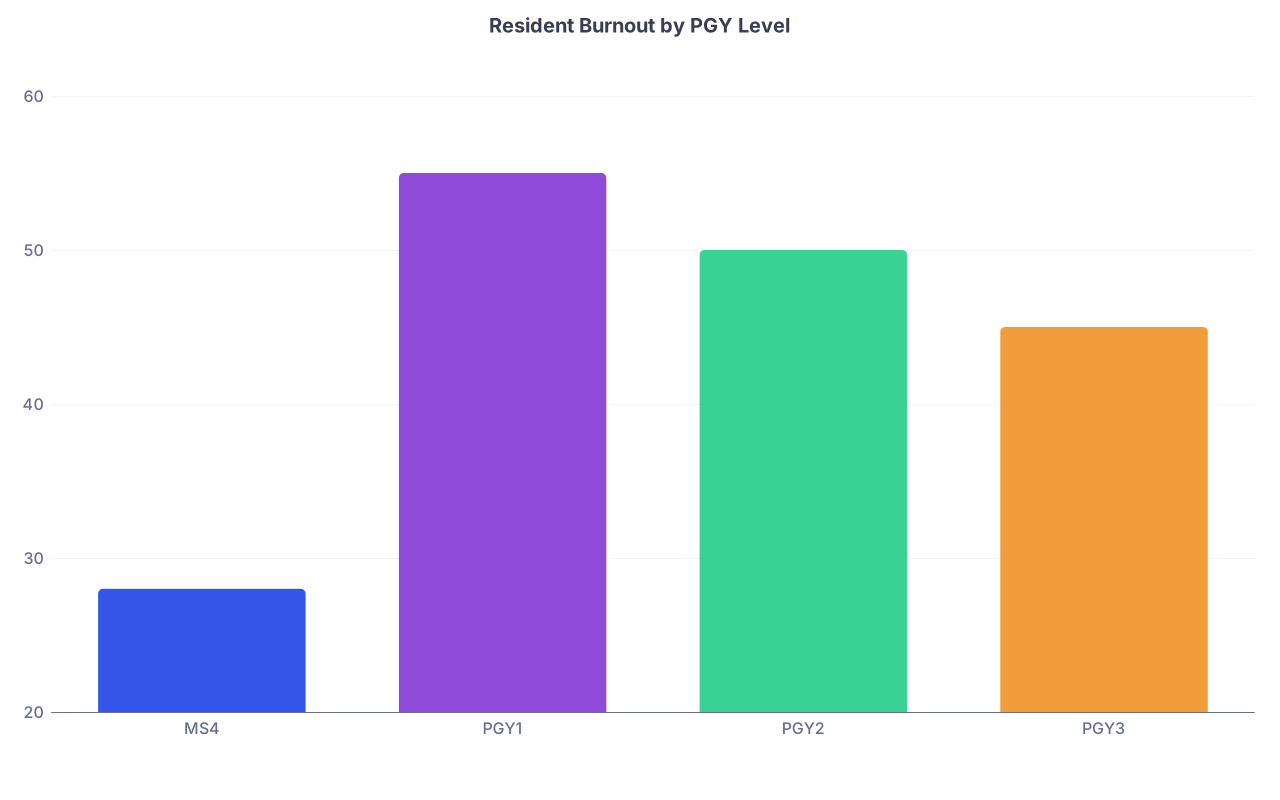
Large surveys (e.g., Medscape, AMA, and multiple JAMA papers) consistently show resident burnout hovering around 40–60%, depending on specialty. That’s with the current “do more, say yes more” culture baked in. More yes is not the solution. It’s part of the problem.
So when people tell you to always say yes, they’re telling you to ignore the safety rails that barely keep this system functional.
What the Evidence Actually Shows About Overwork and Errors
Let’s ground this in data, not macho storytelling.
One landmark NEJM trial on interns and extended shifts showed that limiting interns to shorter shifts significantly reduced serious medical errors—especially diagnostic errors and medication mistakes. The same intern, same training, same knowledge. Fewer hours, fewer errors.
That’s not “weak.” That’s physiology.
| Category | Value |
|---|---|
| MS4 | 28 |
| PGY1 | 55 |
| PGY2 | 50 |
| PGY3 | 45 |
PGY1s are consistently at or near the peak burnout rate. You start at a disadvantage: new role, steep learning curve, worst schedule.
So what happens if you layer “say yes to everything” on top of that?
You get:
- More work compression (same time, more tasks).
- More interruptions, more cognitive load.
- More documentation catch-up late at night.
- More after-hours “invisible” work at home (finishing notes, reading, presentations).
And with that, you get:
- Higher risk of attention slips (missing allergies, missing trending creatinine).
- Worse clinical reasoning (fatigue wrecks working memory).
- Shorter fuse with patients, nurses, consultants, and your own team.
There is no study—none—that suggests interns who always say yes have better patient outcomes or become better doctors. What we do see is that:
- Chronic sleep deprivation is linked to higher rates of needle sticks and motor vehicle crashes after night shifts.
- Burned-out residents are more likely to report suboptimal patient care and medical errors.
- Programs with better scheduling, clear limits, and support are associated with lower burnout and higher satisfaction.
So the “say yes” hero is not a hero. They’re a risk.
How “Always Say Yes” Gets You Exploited (Often by Accident)
This part nobody likes to say out loud: healthcare runs on unpaid or under-acknowledged labor. When you consistently say yes, the system quietly rearranges itself around your willingness.
I’ve seen this play out the same way in different hospitals:
- The intern who “doesn’t mind staying late” magically becomes the default person who stays late.
- The intern who “doesn’t mind taking extra calls” suddenly finds themselves covering more weekends “because they’re reliable.”
- The intern who “is so good with families” is unofficially assigned to update every anxious relative on the floor.
None of this goes in your evaluation as “extra 12 hours of unpaid work every week.” It shows up as a vague “hardworking” comment. The same word someone else gets for… doing their actual job and going home.
Meanwhile, your learning time shrinks. Your sleep shrinks. Your margin for error evaporates.
And yes, people will take advantage. Some knowingly. Many unconsciously. A hospital is a machine—if one gear spins faster, the system uses it.
Saying No Is Not Unprofessional. It’s Risk Management.
Let me be very clear: I’m not telling you to be lazy, difficult, or unavailable.
I’m saying professionalism includes knowing your limits, protecting your learning, and not endangering patients because you’re afraid to look “weak.”
Saying no (or “not now”) in internship can actually be the most responsible move in several situations:
- When an extra task would push you past duty hours or safe fatigue levels.
- When taking on something new would mean you cannot safely complete what’s already on your plate.
- When you’re being asked to do something outside your competency without proper supervision.
- When a request is clearly about convenience for others, not patient care or your education.
But you do need to say it well. Because “no” in medicine is a loaded word.
How to Say “No” Without Burning Bridges
Here’s the difference between foolish no and professional no:
Bad:
“I’m not doing that. That’s not my problem.”
You’ll get labeled difficult. Rightfully.
Professional:
“I can do X or Y safely, but not both in the next hour. Which is higher priority?”
Now you’ve turned it into a triage conversation, not refusal.
Another:
Instead of:
“Stop paging me for this.”
Try:
“I’m getting frequent pages about routine lab values. Can we agree that unless there’s an acute change or critical value, we’ll address them on rounds? It’ll help me avoid missing urgent issues.”
You’re not dodging responsibility. You’re structuring it.
One more common one: when you’re clearly over your head.
Instead of pretending you’re fine:
“I’m not comfortable doing this central line without supervision. I need a senior at the bedside.”
That’s not weakness. That’s how you avoid turning a simple procedure into a catastrophe.
What You Actually Should Say Yes To
The contrarian position isn’t “always say no.” That’s just the mirror-image stupid version.
You want to say yes to the right things at the right time.
Good yes:
High-yield clinical reps that build skills:
Extra lumbar puncture? Yes. Airway opportunity with supervision? Yes. Running part of rounds while an attending shadows? Yes.Mentorship and feedback:
Attending offers to review your notes, walk through a tough case, or debrief a bad outcome? Yes. That’s gold. Make time.Opportunities aligned with your goals:
You’re interested in cardiology and someone offers to loop you into an echo reading session or clinic afternoon? That’s the kind of yes that actually affects your future.Reasonable team support:
Swapping a call once in a while, helping a co-intern with a crashing patient, staying a bit late when a true disaster hits at sign-out. Real emergencies, not chronic system dysfunction.
The key is this: each yes costs something. Time, energy, focus, or sleep. You need a return on that investment.
Intern Reality: You’re Not Just Busy, You’re Constantly Interruptible
A big reason “always say yes” is so toxic is that intern life is already a nonstop interruption factory.
Pages, calls, texts, bedside questions, EMR alerts, attendings wanting updates, families wanting explanations. You’re switching context every few minutes.

| Step | Description |
|---|---|
| Step 1 | Start shift |
| Step 2 | Pre round |
| Step 3 | Page from nurse |
| Step 4 | See patient |
| Step 5 | Try to write note |
| Step 6 | Lab result calls |
| Step 7 | Update attending |
| Step 8 | Admission from ED |
| Step 9 | Write orders |
| Step 10 | Family questions |
| Step 11 | Try to finish notes |
| Step 12 | Sign out |
Now imagine layering “yes to everything” on top of that chaos:
- “Can you also do the discharge summaries for the other team?”
- “Can you help cover cross-cover for neurology tonight?”
- “Can you take on being wellness chief/board liaison/education rep this year?”
You can’t fix a structurally overloaded role by adding more to it.
If you’re constantly in reactive yes-mode, you never get to the deeper parts of training—developing clinical reasoning, pattern recognition, and the ability to anticipate problems instead of simply chasing them.
A Simple Framework: When to Say Yes, When to Push Back
You do not need a 10-step productivity system. You need a filter.
Here’s a blunt, practical one:
Ask yourself four questions about any new request:
Does this directly improve patient care right now?
- If yes, strong bias toward yes.
- If no, go to #2.
Does this significantly help my learning or long-term goals?
- If yes, consider saying yes if you can drop or delay something lower-yield.
- If no, go to #3.
Can I realistically do this without compromising safety, duty hours, or basic rest?
- If no, you need to modify or decline.
- If yes, go to #4.
Is this something that’s become “intern work” just because interns don’t refuse it?
- Examples: repeated scavenger hunts for fax forms, non-urgent paperwork others could do, endless data re-entry.
- These are prime candidates for pushing back or renegotiating.
You can combine this with clear communication to seniors:
- “I can stay an extra 30 minutes to stabilize this new admission, but after that I’m at 80 hours for the week. How do you want to handle the rest of the admissions?”
- “I want to give that talk, but this week I’m already on nights with heavy admits. Could we schedule it for next month or shorten the scope?”
You’re not a martyr. You’re a physician in training inside a barely-contained system. Act like it.
The Biggest Myth: Saying Yes = Being Liked
A lot of interns are afraid that if they don’t always say yes, seniors and attendings will dislike them, tank their evals, and ruin their careers.
Here’s the uncomfortable truth: the people whose opinions matter long-term usually respect clarity, boundaries, and insight more than blind compliance.
The attendings I’ve seen rave about interns aren’t saying, “They always stayed late no matter what.” They say things like:
- “They knew when to ask for help.”
- “They prioritized well on busy days.”
- “They were reliable with follow-through.”
- “They protected their learning time and used it well.”
That last one matters. Your residency is your one shot at becoming a competent, independent physician before the safety net disappears. If you spend it as unpaid administrative glue, you’ll pay for it later when you’re out on your own and realize your clinical foundation is thinner than it should be.
| Scenario | Good or Bad "Yes"? |
|---|---|
| Extra procedure with supervision | Good |
| Covering a crashing patient at sign-out | Good |
| Taking on chronic extra notes for another team | Bad |
| Repeatedly staying post-24 hours for admits | Bad |
| Joining research aligned with your goals | Good |
How This Plays Out Over a Full Year
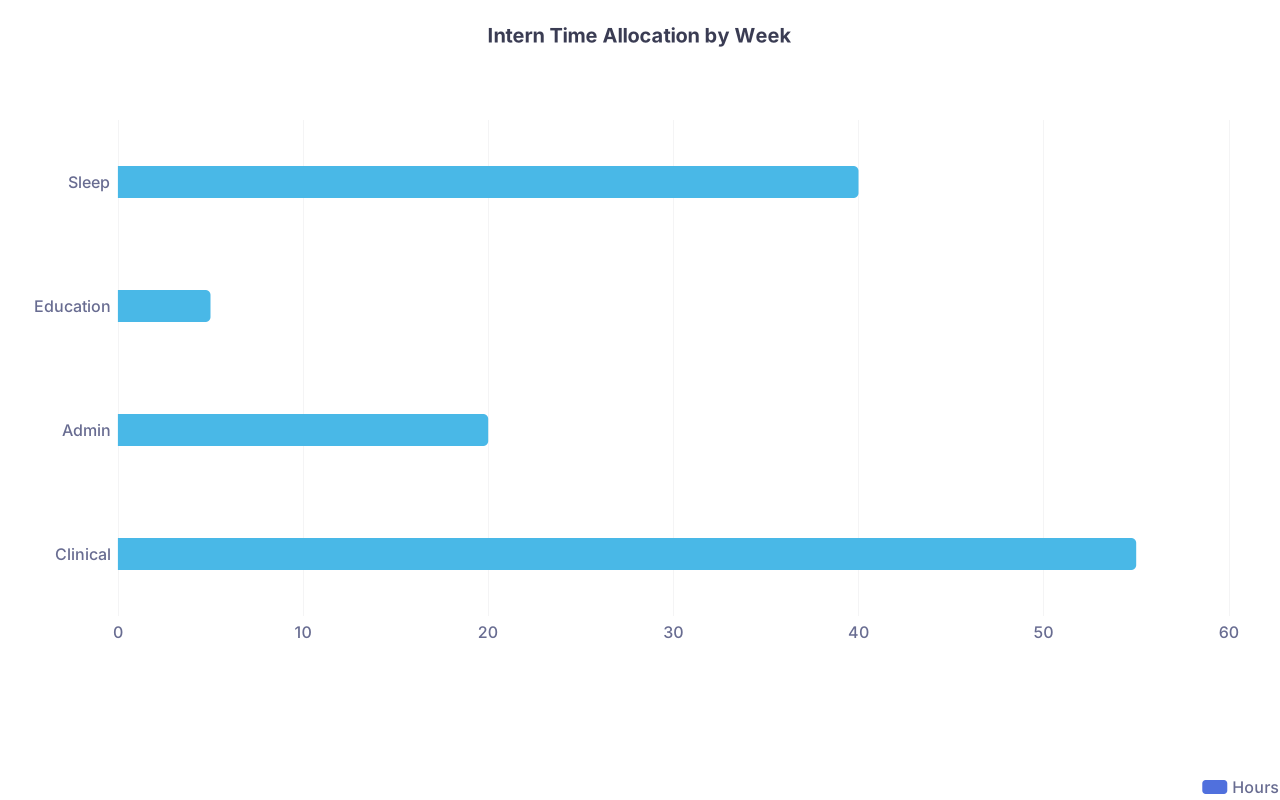
Zoom out. Look at a full PGY1 year.
| Category | Hours |
|---|---|
| Clinical | 55 |
| Admin | 20 |
| Education | 5 |
| Sleep | 40 |
You don’t have infinite slack:
- Clinical work will expand to fill any space you give it.
- Administrative nonsense will do the same.
- Education and sleep are the first to get squeezed when you say yes too much.
The interns who survive and grow are the ones who gradually shift that balance:
- They get faster at documentation and say no to doing everyone else’s charting.
- They protect key educational activities instead of trading them away for more scut.
- They follow duty hours even when it’s “inconvenient” to their hero fantasy.
You don’t win this game by being the most self-sacrificing cog. You win it by emerging from residency competent, not broken.

The Bottom Line: Smart Boundaries Beat Blind Obedience
Let’s strip it down.
“Always say yes” is terrible advice for first-year interns because:
It ignores reality. You’re already at the edge in terms of hours, fatigue, and cognitive load. More yes usually means more errors, not better training.
It gets you exploited, not rewarded. Systems quickly adapt to the most compliant person. You’ll accumulate invisible work and visible exhaustion.
It undermines what residency is for. Your goal is to become a competent, thinking physician. That requires protecting time and energy for actual learning, not just endless task-checking.
Say yes strategically. Say no professionally. And stop treating self-neglect as evidence that you care about patients more than the intern who goes home on time and comes back sharp.