
Only 46% of residents report actually working within the 80‑hour limit “most of the time” when surveyed anonymously.
So let’s stop pretending the 80‑hour rule is some kind of protective shield. It is a political compromise, not a guarantee of safety, learning, or sanity.
You’re starting intern year, and everyone keeps saying, “At least there’s the 80‑hour rule now.” As if that single sentence means you won’t be crushed, exhausted, or put in ethically questionable situations. The reality is messier. And less comforting.
This is the myth: “The 80‑hour rule protects interns from overwork and abuse.”
Here’s what the data – and real hospital life – actually show.
What the 80‑Hour Rule Really Says (That Nobody Bothered to Explain)
First, the boring legalese that gets misquoted on every orientation slide.
The ACGME duty hour standards (for most U.S. residencies) say roughly:
- Maximum average 80 hours per week, averaged over 4 weeks
- Minimum 1 day off in 7, averaged over 4 weeks
- In‑house call no more than every 3rd night, averaged over 4 weeks
- At least 8 hours off between shifts (with “exceptions”)
- No more than 24 hours of continuous in‑house duty, plus up to 4 more for “transitions and education”
So even on paper, it is not: “You will never work more than 80 hours in a week.”
It is: “Over a month, your averaged hours shouldn’t exceed 80.” You can absolutely have a 95‑hour week followed by a 65‑hour week and be “compliant.”
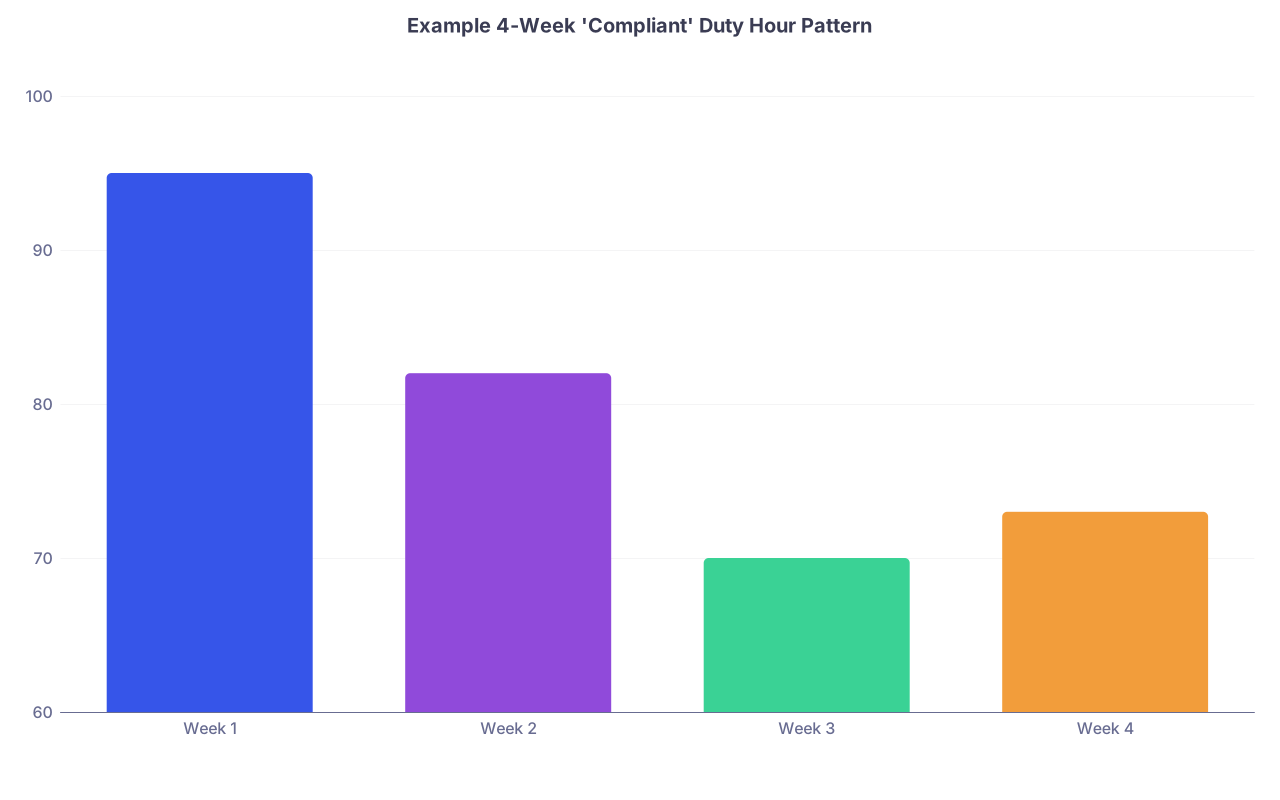
| Category | Value |
|---|---|
| Week 1 | 95 |
| Week 2 | 82 |
| Week 3 | 70 |
| Week 4 | 73 |
Average: 80.0 hours/week. Fully compliant. Still miserable.
Same for days off. You can legally work 19 days in a row as an intern if the rest of that 4‑week block is structured the right way. I have seen this. Residents are told, “You’re still compliant.”
The rule is about program compliance, not your lived experience on any given week.
The Compliance Game: How Hours Get “Fixed” On Paper
Here’s the part no one puts in the brochure: duty hour tracking is a game, and you are the game piece.
Two things are true at once:
- ACGME can and does cite programs for violations.
- Programs have every incentive to make the numbers look pretty.
So what happens?
I’ve watched all of the following in real time:
- Intern charts say 84 hours/week, but the chief quietly suggests, “Maybe you’re overestimating. Did you really need to count that time you stayed after sign‑out?”
- People stop logging pre‑rounding or “arriving early to review labs” because everyone else isn’t logging it.
- Residents put 79.5 hours for “bad weeks,” every single time. Magically. Like they all hit that number to the decimal.
- Faculty nudge: “If we keep reporting violations, the ACGME will take away your program. That hurts everyone.”
So data on “compliance” is hopelessly biased. Residents under‑report. Programs “educate” people on how to click boxes. And ACGME mostly sees sanitized spreadsheets.
| Topic | On Paper (ACGME) | Common Reality for Interns |
|---|---|---|
| 80‑hour cap | 80 hrs/week over 4 weeks | 90+ hr weeks with later “makeups” |
| Day off | 1 in 7 over 4 weeks | 10–19 days straight on tough blocks |
| Max shift | 24 + 4 hours | Post‑call “just finish notes” past 28 |
| Reporting | “No retaliation” policy | Social pressure not to report |
The myth is that “If there’s a violation, it’ll be fixed.”
The reality: it usually gets re‑labeled.
The Science: Did The 80‑Hour Rule Actually Help?
This is where it gets uncomfortable. Because everybody wants the story to be simple: fewer hours = safer care, happier residents. The literature does not fully back that up.
On patient safety
Large, serious studies after duty hour reforms found:
- No consistent, major improvement in mortality after the 80‑hour rule. Some specialties saw tiny improvements. Others saw nothing.
- Error rates are heavily influenced by handoffs, system design, and supervision, not just hours.
- One classic finding: when hours went down but handoffs went up, errors from poor communication replaced errors from fatigue.
The brain loves simple stories: “less fatigue = safer.” The hospital does not care about simple stories. It’s a complex machine. You can cut hours and still harm patients if you simultaneously increase fragmentation and chaos.
On resident learning
People assumed more rest would mean better learning. Again, not so clean:
- Multiple studies show board scores and test performance didn’t magically improve post‑reform.
- Some senior residents felt less prepared for attending life because their exposure to complex, longitudinal cases got chopped up.
- Shorter shifts can mean more time doing fast, shallow, check‑box medicine, less time actually following a patient through a full ICU course or a rocky post‑op week.
On resident well‑being
This one hurts most: you’d expect a dramatic drop in burnout. We didn’t get it.
- Burnout remains staggeringly high: 40–70% in many surveys, even after duty hour limits.
- Depression, suicidal ideation, and anxiety rates in residents remain far above age‑matched controls.
- Why? Because hours are one dimension. Toxic culture, lack of psychological safety, feeling useless or morally distressed – those are still fully intact.
So no, the 80‑hour rule did not “fix” residency. It changed its shape. That’s it.
The Loopholes That Make Your Life Miserable
Let’s be very literal. What does “80 hours averaged over 4 weeks” allow programs to do to your schedule?
Here’s a typical “compliant but brutal” month on a busy medicine service:
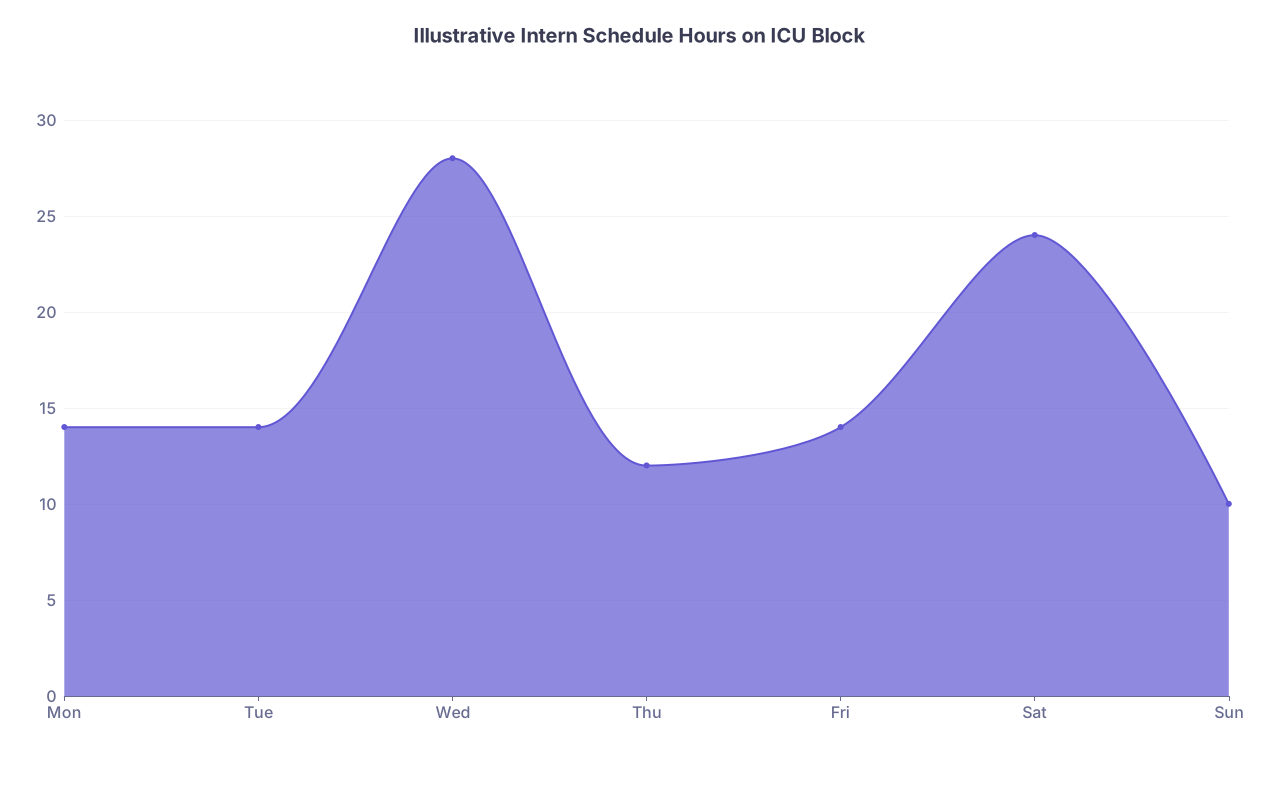
| Category | Value |
|---|---|
| Mon | 14 |
| Tue | 14 |
| Wed | 28 |
| Thu | 12 |
| Fri | 14 |
| Sat | 24 |
| Sun | 10 |
One post‑call day at 28 hours. One “light” day at 10. That week still can slide under 80 if the second week is lighter.
Here are some of the greatest hits of the loophole world:
“Just finish up” post‑call
You signed out at 11 a.m. Like you were supposed to. But there are 12 notes unfinished, 3 families waiting, and a consultant demanding a call back. You leave at 3 p.m.
Officially? You probably still log “24 + 4” because “documentation isn’t direct patient care.”The pre‑round phantom hours
You’re scheduled 6 a.m. to 6 p.m.
You show up at 5:15 to check labs and imaging, because if you don’t, rounds are a slaughter. Most interns do not count that 45 minutes. Multiply by 6 days/week for a year.“Voluntary” educational events
M&M, journal club, board review sessions after your shift. You’re told attendance is “strongly encouraged.” You know what that means.Q4 call disguised as “night float + long days”
Program says “we eliminated 24‑hour call.”
Reality: 6 p.m. – 7 a.m. night float plus multiple 14–16 hour “long call” days on wards. Your circadian rhythm is wrecked, but hey, no 30‑hour shifts, so this is “better,” right?
This is how you end up technically compliant and still eating graham crackers from the call room vending machine at 3 a.m. while trying not to cry.
The Culture Problem: Why Interns Don’t Say “No”
Everyone likes blaming “the system,” but there’s a softer, uglier force at work: culture.
On your first tough rotation, you’ll hear variations of:
- “Back when I was an intern, we worked 120 hours and we were fine.”
- “You’re going home? Must be nice, 80‑hour generation.”
- “We can’t staff the service if you report every little overage. Be a team player.”
So you internalize three poisonous ideas:
- Needing rest is weakness.
- Protecting yourself is selfish.
- Speaking up threatens the program.
This is how 27‑year‑olds with chest pain keep rounding. I’m not exaggerating. I watched a PGY‑2 finish prerounds with crushing substernal pain because he “didn’t want to dump” the team. He ended up with a cath later that day.
The 80‑hour rule cannot protect you from a culture that pathologizes self‑care and worships martyrdom.
What Duty Hours Actually Mean For You (If You’re Starting Intern Year)
Let me translate the policy into practical reality.
1. Expect some weeks to be awful – and still “legal”
You will have:
- A run of 5–6 days where you’re at the hospital 14–16 hours per day.
- Some post‑call days where you’re technically “off” but stay well into the afternoon.
- Blocks (ICU, NICU, trauma, certain surgical rotations) where you feel like you live in the stairwell.
Knowing that this is system‑designed – not a personal failure – helps you stop the “I must be weak” narrative.
2. You are allowed to count all the hours you are working
You are doing actual work when you:
- Arrive early to review labs and imaging
- Pre‑chart at home because the EMR is trash
- Stay late finishing notes, following up critical labs, talking to families
Count those hours. They are work. If your program has a problem with that, the problem is not you.
3. Under‑reporting hurts you and the people behind you
Here’s the harsh truth: programs only change when the pain shows up on paper.
If every intern works 90 hours but logs 78 to “avoid trouble,” leadership sees this:
- “No violations.”
- “Residents report manageable duty hours.”
- “No need to adjust staffing.”
So the suffering stays invisible. The people after you get the same raw deal. You do not get moral credit for silently absorbing structural failure.
How To Survive Inside A Flawed System (Without Being A Martyr)
No, you can’t fix ACGME as an intern. But you’re not powerless. There’s a middle ground between “saintly silence” and “burn it all down.”
Know your actual numbers
Track your hours yourself for a month. Use your phone notes, a dumb Excel sheet, whatever.
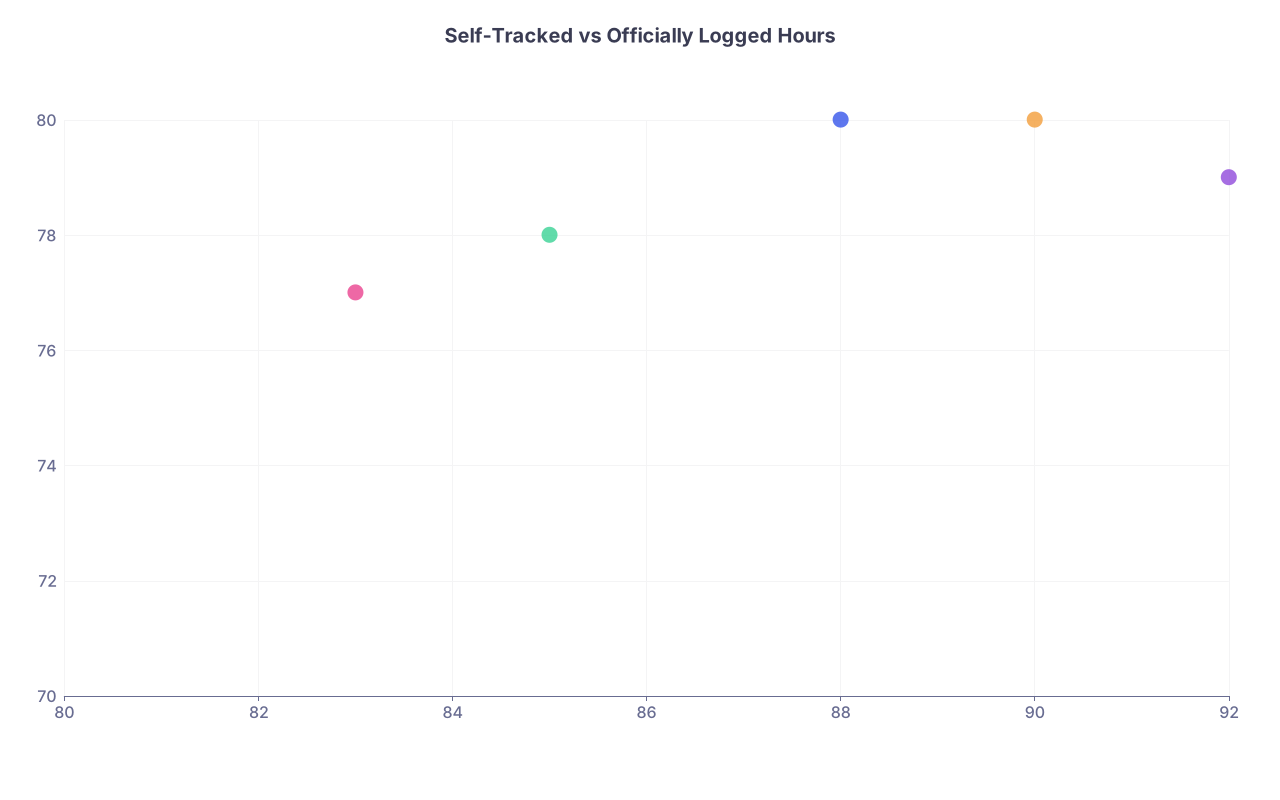
| Category | Value |
|---|---|
| Intern A | 88,80 |
| Intern B | 92,79 |
| Intern C | 85,78 |
| Intern D | 90,80 |
| Intern E | 83,77 |
First number: self‑tracked. Second: what they logged. The gap is real.
Knowing your true numbers gives you:
- A sanity check (“No, I’m not exaggerating how tired I am.”)
- Concrete data if you later need to talk to chiefs or GME
- The ability to see patterns (which rotations or attendings are worse)
Learn to say one specific, powerful sentence
You’re dead on your feet. The consult resident wants you to go see one more borderline‑nonsense case at 6:45 p.m. You have been there since 5:30 a.m.
You say:
“I’ve hit my duty hour limit for today. I need to hand this off.”
Not a debate. Not an apology. A boundary.
Some people will push back. Fine. Repeat:
“I’ve hit my duty hour limit for today. I need to hand this off.”
If they escalate, that becomes data for your chief or program director: “I tried to follow duty hours and was pressured not to.”
Use your chief residents (the ones who actually care)
There are always at least a few chiefs or upper levels who remember how bad it was and are quietly trying to make it better.
Find them. Tell them specifically:
- “On nights we are covering 3 services and getting 18 admissions. We are leaving 3–4 hours late regularly.”
- “On X rotation, our ‘post‑call’ is usually 26–28 hours. That’s not sustainable.”
Specifics give them something to work with. They can:
- Adjust admission caps
- Change cross‑coverage assignments
- Push for additional APPs or a float resident
You complaining in the call room changes nothing. You plus data, talking to the right person, sometimes does.
The Next Myth You’ll Hear: “This Is Just How Medicine Is”
No, it isn’t. It’s how we’ve chosen to structure training.
Other countries have residents:
- With 48–56 hour weekly caps (not just averaged)
- Stronger enforcement and actual penalties for violations
- More built‑in staffing to protect off days
Are those systems perfect? Absolutely not. But the idea that “training must be brutal to be legitimate” is a cultural belief, not a law of physics.
We could:
- Use more night hospitalists and nocturnists
- Add APPs or extra residents on chronic overflow rotations
- Rationalize consult expectations instead of “page for everything"
- Build handoff systems that don’t fall apart when a human being goes home
Those are choices. Not impossibilities.

| Step | Description |
|---|---|
| Step 1 | Understaffed Service |
| Step 2 | Residents Work Longer |
| Step 3 | Underreport Hours |
| Step 4 | No Documented Violations |
| Step 5 | Leadership Sees No Problem |
Break that loop at any point, the system starts to change. Usually it starts with residents refusing to collude in hiding the problem.
What You Should Actually Take From The 80‑Hour Rule
Not comfort. Not the illusion that you are safe because someone made a PowerPoint about wellness.
Three things:
It’s a floor, not a ceiling.
It defines the outer edge of what is allowed, not what is healthy or ideal. A “70‑hour compliant week” can still break you if the work is chaotic and unsupported.Your data matters more than the policy text.
What you really work, what you really feel, and what you really report – that’s the only lever that has ever changed residency. Not slogans.You’re not weak for needing rest. You’re human.
Fatigue impairs judgment. Chronic sleep loss wrecks mood, cognition, and physical health. None of that makes you less dedicated. It makes you not a robot.
The 80‑hour rule myth says: “You’re protected now.”
The reality: you’re still going to be pushed to your limits. The difference is whether you learn to recognize when the system crosses the line – and whether you’re willing to stop helping it hide that fact.